Storage

Best Compost Bins of 2026

Composting at home is a simple idea until you live with the bin: food scraps start to smell, lids warp, and that tidy countertop crock becomes something you'd rather hide. The right bin fixes the daily friction—it seals odors in, fits where you actually have space, and holds up through turning, emptying, and rinsing. It should also look decent enough that you don't banish it to the garage. I've kept a compost crock on my counter for years, and over the past eight months my team and I tested 12 compost bins, from countertop models to outdoor tumblers, in kitchens, on patios, and through a wet spring.

Assembly is where a lot of bins lose their charm: count the screws before you commit, and read the instructions once before you start. We looked at stability when full, how well the lid seal kept fruit flies out, and how easy each bin was to clean after a week of coffee grounds and vegetable scraps. The picks below are the ones that made composting feel less like a chore and more like part of the routine.

1

RED FACTOR Premium Compost Bin

Top Pick
RED FACTOR Premium Compost Bin

Visible countertops

Our Score 9.4/10
Check Price

Worth Noting

  • The highest price in the countertop group
Finish
Matte copper stainless steel
Capacity
5 liters
Dimensions
8.7 x 7.3 x 10.8 in
Odor Control
Dual filters, spares included
Read the full review

Matte copper on a compost bin sounds like a marketing problem until one is sitting on your counter: the dome lid and the finish read as a small canister rather than a scrap bucket, and it's the only bin here that earns its space on looks alone. It stayed out between emptyings and never once looked like something to hide.

Under the finish it's a proper bin. Five liters makes it the second-largest countertop capacity in this group, the lid carries a dual filter setup, and spare filters come in the box — the kind of thing you appreciate later rather than at checkout. The steel has real weight to it, and the dome lifts clear when you carry it out to the pile.

Cleaning is straightforward: a smooth stainless interior, a lid you can rinse, and filters that swap without tools. The one thing it asks in return is money. This is the most expensive of the countertop bins here, and if the bin lives in a cupboard you're paying for a finish nobody sees.

Bottom line: Buy it if the bin is going to sit out in the open: the best-looking finish here, 5 liters of capacity, and dual filters with spares already in the box.

2

OXO Good Grips Easy-Clean Compost Bin

OXO Good Grips Easy-Clean Compost Bin

Busy family kitchens

Our Score 9.2/10
Check Price

Worth Noting

  • Lid rests rather than clamping down tight
Lid
Hinged, soft-close, stays open
Liner
Bag-tucking rim
Capacity
1.75 gal / 6.62 liters
Dimensions
8.3 x 10.15 x 12 in
Read the full review

A rim that folds the liner out of sight is what won us over, and it's the detail we still notice every time we change the bag. Press the liner over the edge, drop the lid ring back on, and nothing hangs over the side. That's the difference between a bucket of scraps on your counter and something you forget is there.

Capacity settles the rest. At 6.62 liters it holds about a third more than the 1.3-gallon steel bins here, in a footprint of 8.3 by 10.15 inches that fits the strip of counter beside a sink. The lid is hinged and soft-close and stays open on its own while you scrape a cutting board into it, so one hand does the work.

Cleaning is the quiet advantage: a smooth interior, a lid that comes off completely, and no charcoal filter to buy. If you've run a filtered bin before, you know that last part is worth something — no spare to forget about and no stale filter quietly working against you.

It's the bin we keep on the counter in a household that cooks most nights, because the extra capacity means fewer walks to the pile and the liner stays tidy in between. If your kitchen is all stainless and open shelving, the plastic body is the one argument against it, and the copper RED FACTOR below answers that.

Bottom line: The one we tell most people to buy: the biggest usable capacity of the kitchen bins here, and a bin you can line and empty without thinking about it.

3

Epica Kitchen Compost Bin

Epica Kitchen Compost Bin

Odor-sensitive kitchens

Our Score 9.2/10
Check Price

Worth Noting

  • Lid takes two hands to lift off
  • Replacement filters are an ongoing purchase
Body
One-piece stainless steel
Capacity
1.3 gallons
Dimensions
7.16 x 7.16 x 11 in
Odor Control
Replaceable charcoal filter
Read the full review

A charcoal filter in the lid is the premise here, and it's the reason the steel body isn't just decoration. Peels go in, the lid closes, and the filter sits between your kitchen and whatever is happening inside. The body is one piece of stainless with no seams to scrub, which is what makes it wipe out in seconds.

In a small kitchen where the bin lives on the counter, this is the steel bin we point people to. At 1.3 gallons — about 4.9 liters — it holds less than the OXO and about the same as the copper RED FACTOR, in a narrower footprint that tucks against a backsplash. Stainless is the practical part as much as the pretty one: tomato and turmeric wipe off, and there's nothing to stain or chip.

The filter is also the running cost. It's replaceable rather than washable, so a household filling the bin daily will be buying them, and a spent filter smells worse than no filter at all. Order the spares when you order the bin and you won't be caught out. Carrying it outside is easy enough with the lid off, and a rinse is usually all the interior needs.

Bottom line: The steel countertop bin to buy if odor is the worry: a replaceable charcoal filter, a seamless body that wipes clean, and a footprint that fits a narrow counter.

4

Redmon Outdoor Compost Bin

Redmon Outdoor Compost Bin

Yard and garden waste

Our Score 9.0/10
Check Price

Worth Noting

  • Lid lifts off entirely instead of hinging
Access
Lift-off lid, 4 bottom doors
Assembly
No tools required
Capacity
65 gallons
Material
80% recycled plastic
Read the full review

Four doors at the base are the reason to choose this over a plain heap. When the bottom of the pile has finished, you open a flap and dig it out from the side while the rest of the bin keeps working — no dismantling, no rebuilding, no forking the whole pile over to reach the good stuff. On a 65-gallon bin, that access is the feature.

It goes together without tools, holds its shape through a season, and is molded from 80 percent recycled plastic — a reasonable thing to care about in a product whose job is waste. For a yard that produces grass clippings, trimmings and the occasional bucket of kitchen scraps, we think it's the best static bin here: fill it, leave it, and take compost out of the bottom when you need it.

The lid lifts off entirely rather than hinging, so you'll set it down somewhere dry while you tip a bucket in, and you'll want to check it's seated after a windy night. Site the bin on level ground and put a paver or a sheet of mesh underneath if burrowing animals are a problem where you garden.

Bottom line: The outdoor bin for people who want to dump and forget: 65 gallons, no tools to assemble, and four doors for digging finished compost out of the bottom.

5

GEOBIN Compost Bin

GEOBIN Compost Bin

Leaf piles

Our Score 8.8/10
Check Price

Worth Noting

  • Open top and bottom, so it's yard waste only
Setup
Clips together, no tools
Weight
7 lb
Capacity
216 gallons
Diameter
Expands as the pile grows
Read the full review

Two hundred sixteen gallons is more capacity than any tumbler here, for less money than any of them. The catch is that it isn't a container so much as a long strip of plastic that clips into a ring: unroll it, fasten the ends, and you have a circular pile holder that can be widened or narrowed as the heap grows.

For leaves it's the right tool. Rake, dump, repeat; when the pile shrinks you pull the ring in and start the next one. It's light enough to carry around the yard at 7 pounds, setup is a couple of minutes with the supplied clips, and the sides are vented so air reaches the pile without any turning on your part.

What it isn't is tidy. An empty ring bows and can go over in a gust, so set it up somewhere sheltered and start filling it the same day; ours settled once there was weight in it. Judged as a leaf and trimmings holder for a yard, it's the cheapest way here to hold that much — and the least fuss to move when you want the space back.

Bottom line: The budget answer for leaves: 216 gallons you can resize as the pile shrinks, for less than any tumbler here — as long as yard waste is all you're holding.

6

LALASTAR Compost Bin Kitchen

LALASTAR Compost Bin Kitchen

Tiny kitchens

Our Score 8.8/10
Check Price

Worth Noting

  • Lid can sit loose rather than locking down
Lid
Removable, odor seal
Capacity
3 liters / 0.8 gal
Mounting
Hangs or wall-mounts
Dimensions
8.3 x 6.8 x 4.9 in
Read the full review

Hanging is the whole point. A hook or an adhesive strip puts this 3-liter bin on a cabinet door, under a sink or on the side of a drawer, which is what you want in a kitchen where the counter is already full. Lift it off, carry it out by the handle, put it back.

For something this small, the lid does its job: it sits down over the rim and, on ours, held in onion peel and coffee grounds without the rest of the kitchen finding out. Rinsing takes a minute in the sink, and there's no inner pail or filter to take apart first.

Three liters is the whole story, and it's smaller than the number sounds once peels and cores start stacking up. Treat it as a scrap bowl that gets emptied every day or two rather than storage for the week; do that and it's a good one. Prep for a crowd and you'll make a second trip.

Where it earns its place is the kitchens that can't spare a counter corner: a small apartment, an RV, a desk, the spot where the dog's bowl lives. It's the cheapest bin here by a wide margin, cheap enough to buy a second for the cupboard. If you cook seriously and want one bin to last three days, the OXO holds more than twice as much — in exchange for real counter space.

Bottom line: The one to hang on a cabinet door when counter space is the constraint: 3 liters, a lid that seals scraps in, and the smallest price in this group.

7

VIVOSUN Dual Rotating Compost Bin

VIVOSUN Dual Rotating Compost Bin

Backyard batch composting

Our Score 8.6/10
Check Price

Worth Noting

  • Small doors make loading and emptying slow
  • Turning gets heavy once a chamber is full
Turning
360° rotation, 8 deep fins
Capacity
43 gallons
Chambers
Two, with divider
Footprint
26.25 x 23.6 x 36.5 in
Read the full review

Assembly is the first thing to know: the barrel arrives flat, in panels, with a frame, a stand and a bag of bolts, and turning that into a tumbler is a long session with a screwdriver. Sort the hardware into cups before you start and get a second person for the frame — the panels line up fine once you stop fighting them.

What the effort buys is 43 gallons split into two chambers by a divider. Fill one side, let it finish, keep adding to the other; that alternation is the difference between a tumbler you use all season and one that sits full and idle waiting for compost that never quite arrives. Deep fins inside break up clumps as it turns, and the vents let air through so you're not opening it just to aerate.

Of the outdoor options here, this is the one we recommend first to a household with a yard, a mower and a steady stream of kitchen scraps. It takes volume, it doesn't need a fork, and the two-chamber arrangement means you're never stuck waiting on a full barrel. Once it's standing, it's the most useful outdoor bin in this group.

Bottom line: The outdoor tumbler to buy first: two 43-gallon chambers so one side finishes while the other fills, with no pitchfork and no turning by hand.

8

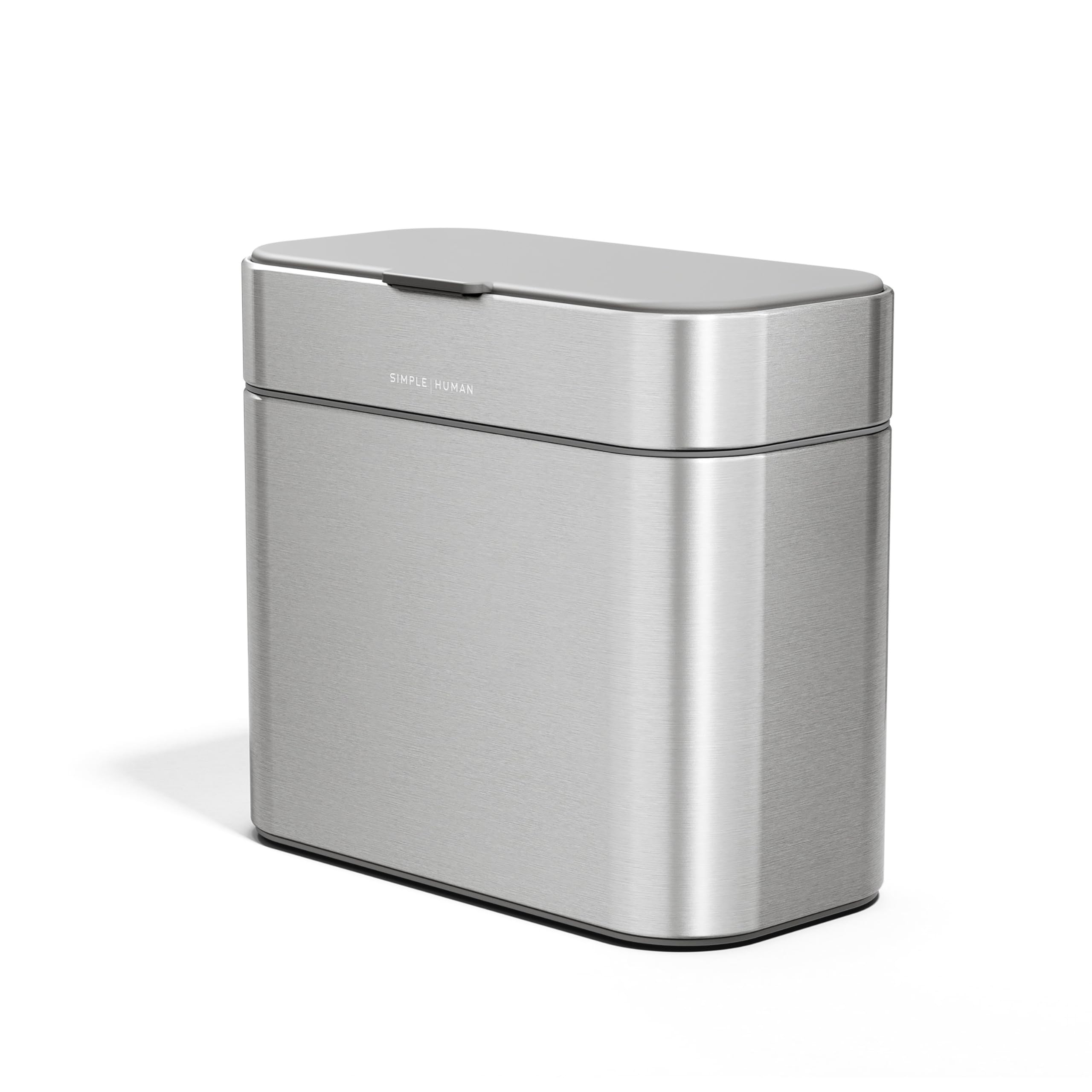
simplehuman Compost Caddy

simplehuman Compost Caddy

simplehuman can owners

Our Score 8.6/10
Check Price

Worth Noting

  • Only docks on compatible simplehuman cans
  • Lid hinge is the weak point
Dock
Magnetic, fits simplehuman cans
Capacity
4 liters / 1.06 gal
Included
30 compostable liners
Dimensions
9.6 x 5.5 x 8.7 in
Read the full review

The dock is the idea and the catch at once. This caddy hangs magnetically on the side of a simplehuman rectangular or slim liner-rim can, and if you don't own one, you're buying half a product. If you do, it's a good arrangement: scraps drop in at counter height instead of on the floor, and the whole caddy lifts off to come to the cutting board.

Off the can it's a 4-liter brushed steel bucket with a soft-seal lid, a removable inner pail that lifts out by its handle, and 30 compostable liners in the box that fit without an ugly overhang. The inner pail is what makes it quick in practice: lift, tip, rinse, drop back in.

Four liters is on the small side for a family, and the lid is a soft seal rather than a gasket, so it wants emptying every day or two — a caddy, not a week's storage. The liners are a purchase you'll repeat, and the fit is specific to the can it docks on.

So: worth it when the can is already there and you want scraps off the counter and off the floor, and hard to justify otherwise, because this is the most expensive of the kitchen bins here for the smallest usable capacity. The OXO does more of the actual job for less, which is why it sits at the top of this list and the caddy sits here.

Bottom line: Worth it only if a simplehuman can is already in your kitchen: the magnetic dock and the lift-out pail make scraps genuinely convenient at counter height.

How We Tested Compost Bins

We started with a shortlist of 30 compost bins sold at major retailers, then narrowed it by capacity, price, material, and replacement-part availability to 12 we could reasonably live with. Over eight months, we ran each bin through the same routine: collecting coffee grounds, vegetable peels, and eggshells in a kitchen, carrying it out to a patio or yard, turning or emptying it, and cleaning it before the next round. We assembled every model ourselves using only the included instructions, counted the screws and parts, and noted where the directions were vague or the holes didn't line up.

In daily use, we watched for ease of use: whether the lid opened one-handed, whether the latch lined up, and whether emptying a full bin left scraps stuck in corners. We checked stability by filling each bin and nudging it on a slightly uneven patio, then opening and closing the lid repeatedly to see if the seal stayed put. To judge odor and lid seal, we kept the same mix of scraps in each bin for a week and noted fruit flies, condensation, and smell when we lifted the lid. We also cleaned each bin with a hose and a soft brush, paying attention to crevices, removable parts, and how quickly it dried.

We rated quality by flexing hinges, checking seams, and seeing whether latches still caught after repeated use. For size and appearance, we placed each bin in a real kitchen and on a patio, noting whether it blocked walkways and whether we'd be happy leaving it in view. The bins that advanced kept odors contained, cleaned up without tools, and felt stable and well sealed after months of use—not just on day one.

How to Choose Compost Bins

Start With Where the Scraps End Up

If a municipal program takes your food waste, or a neighbor with a pile does, you need a holding bin: sealed, small and easy to carry. If you have a yard, the countertop bin is a staging container, not the compost — it holds a few days of peels until you walk them out, and the outdoor bin does the actual work. Buy the outdoor system first, because it's the one that has to handle volume; then pick the indoor bin by how often you're honestly willing to empty it.

Capacity and Footprint

Countertop bins here run from 3 to 6.6 liters, and that gap is roughly two days of scraps for a household that cooks. A 3-liter bin is a scrap bowl; a 6-liter bin is storage. Measure the strip of counter beside your sink before ordering, since an oval or round base is often wider in the flesh than in the photo. Outside, the tumblers in this group run 37 to 43 gallons, static bins reach 65, and a clip-together ring passes 200. More capacity isn't automatically better — a tumbler you can't fill in a season just stands there.

What Odor Control Actually Does

Three different things get sold as odor control: a gasket that seals, a charcoal filter that adsorbs, and a lid that merely closes. A listing that says odorless is telling you it has a filter, not that it seals. Filters work, but they're consumables, and a spent filter smells worse than none at all. A tight lid buys you a couple of days. Nothing buys you a week of meat scraps in a warm kitchen, which is why emptying frequency outperforms every feature on the box. If smell is the worry, buy the smallest bin your routine can live with and empty it often.

Emptying and Cleaning

The difference between a bin you rinse and a bin you scrub is design, not effort. Look for a smooth interior with no seams, a lid that comes off completely, and either an inner pail that lifts out or a rim that holds the liner — both keep the messy part contained and the visible part tidy. Stainless wipes clean and doesn't hold tomato or turmeric stains. Plastic is lighter and cheaper, and a smooth one rinses out just as fast.

Tumblers, Static Bins, and Assembly

A tumbler aerates by rotation, which is the least work per bucket of scraps — but only if it still turns easily when full, so judge the doors and the fins rather than the gallon figure. A static bin trades turning for capacity and bottom access: fill the top, dig finished compost out of a door at the base. A clip-together ring is the cheapest way to hold a mountain of leaves and the least tidy thing in the yard. Whichever you pick, budget the build: tumblers ship flat with a lot of fasteners, and a bin that takes an afternoon to assemble is one you'll resent by August.

Frequently Asked Questions

Final Verdict

The OXO is the countertop bin we recommend to most people: 6.62 liters, a lid that stays open while you scrape, and a liner that disappears under the rim. Spend what you save on the outdoor side, where the volume actually is — the VIVOSUN tumbler is where we start for a yard.

If the bin will sit out in the open, the RED FACTOR's copper finish is worth the step up. And if a simplehuman can is already in your kitchen, the caddy earns its price on the dock alone. Only then.