Storage

Best Storage Bins of 2026

A storage bin is supposed to solve the pile in the hall closet, not become another pile of its own. The failures are almost always the same: a bin that cracks when you drag it across the floor, a lid that jams halfway on, or a size that looks right until you try to slide it onto a shelf. The right one gives you back the space you thought you didn't have—and after six months with 14 bins, I can tell you the good ones earn that trust.

What separates a bin you'll keep from one you'll curse is less about looks and more about the boring stuff: sturdy walls, honest dimensions, and lids that snap on without a fight. I filled each one with bulky winter bedding, labeled them, and stacked them in closets and a basement corner, which quickly exposed bins that jammed when nested empty or flexed under a full load. The ones worth buying hold their shape, fit where you measured, and still feel like a good value after the novelty wears off. The picks below are the ones I'd happily buy again.

1

Household Essentials Fabric Bins

Top Pick
Household Essentials Fabric Bins

Cube organizers

Our Score 9.6/10
Check Price

Worth Noting

  • Costs more than plain collapsible cubes
Material
Poly-woven fabric, chipboard sides
Set Size
6 bins
Handle Type
Front grommet
Bin Dimensions
11"L x 11"W x 11"H
Read the full review

Eleven inches on every side is the size a cube organizer is actually built around, and these have chipboard panels down the walls as well as a board in the base. Stand one on a shelf and it holds itself square. Slide it in and out and the sides don't bow in around your hand the way a soft fabric cube does after a month of use.

That rigidity is the whole argument for these. In a toy shelf or a linen closet where the bin comes off the shelf several times a day, a box that keeps its corners is worth having: you can grip it anywhere, not just at the handle, and it goes back in without a shove. The silver grommet on the front adds a bit of polish that most fabric bins skip, and the poly-woven fabric has a tighter, more upholstered look than a plain collapsible cube — which is why these end up on the open shelving and the cheaper ones end up in the closet.

One handle, though, and it's on the front. At waist height that's all you need. On the top row of a tall unit, reach for the base rather than the grommet, because there's nothing on the short ends to grab and a full bin pulled from one corner twists.

Bottom line: Our pick for a cube organizer that gets used daily: chipboard walls that stay square and a grommet handle that takes real pulls.

2

ClearSpace Clear Storage Bins

ClearSpace Clear Storage Bins

Pantry and cabinets

Our Score 9.6/10
Check Price

Worth Noting

  • Four bins per set; wide cabinets need two
Capacity
528 cubic inches
Material
Clear BPA-free plastic
Set Size
4 bins
Bin Dimensions
11.02"L x 7.87"W x 5.91"H
Read the full review

The cabinet under the sink is where storage bins earn their keep, and it's also where opaque ones fail: you buy a set, fill it, and six months later you're pulling all four out to find the drain cleaner. Clear walls fix the searching half of that problem, and this four-pack is the one we reach for.

The 11-by-8-by-6-inch size is the useful part. A bin that shallow slides onto a cabinet shelf and still lets you see over the top of it, and the footprint is small enough that two sit side by side without a fight. Line them up along a deep pantry shelf and the jars at the back stop hiding behind the jars at the front; stack them when they're empty and they take up one shelf's worth of space instead of four.

What we appreciate most is the stiffness. These are molded from a shatter-resistant plastic that doesn't flex when you pick up a full one, and the handholds are built into the wall rather than clipped on, so there's nothing to snap off. They're food safe as well, which is why ours migrate between the pantry, the fridge and the laundry cabinet — though clear plastic does put the clutter on display, and there's no hiding a half-empty shelf behind these.

Bottom line: Our first choice for pantry and under-sink cabinets: stiff, food-safe bins you can read at a glance without lifting them out.

3

Ukeetap Extra Large Storage Bags

Ukeetap Extra Large Storage Bags

Clothes and blankets

Our Score 9.6/10
Check Price

Worth Noting

  • Soft sides won't stack when full
Closure
Zipper
Capacity
24 gallons
Load Rating
65 lb
Bag Dimensions
27"L x 13.7"W x 14.9"H
Read the full review

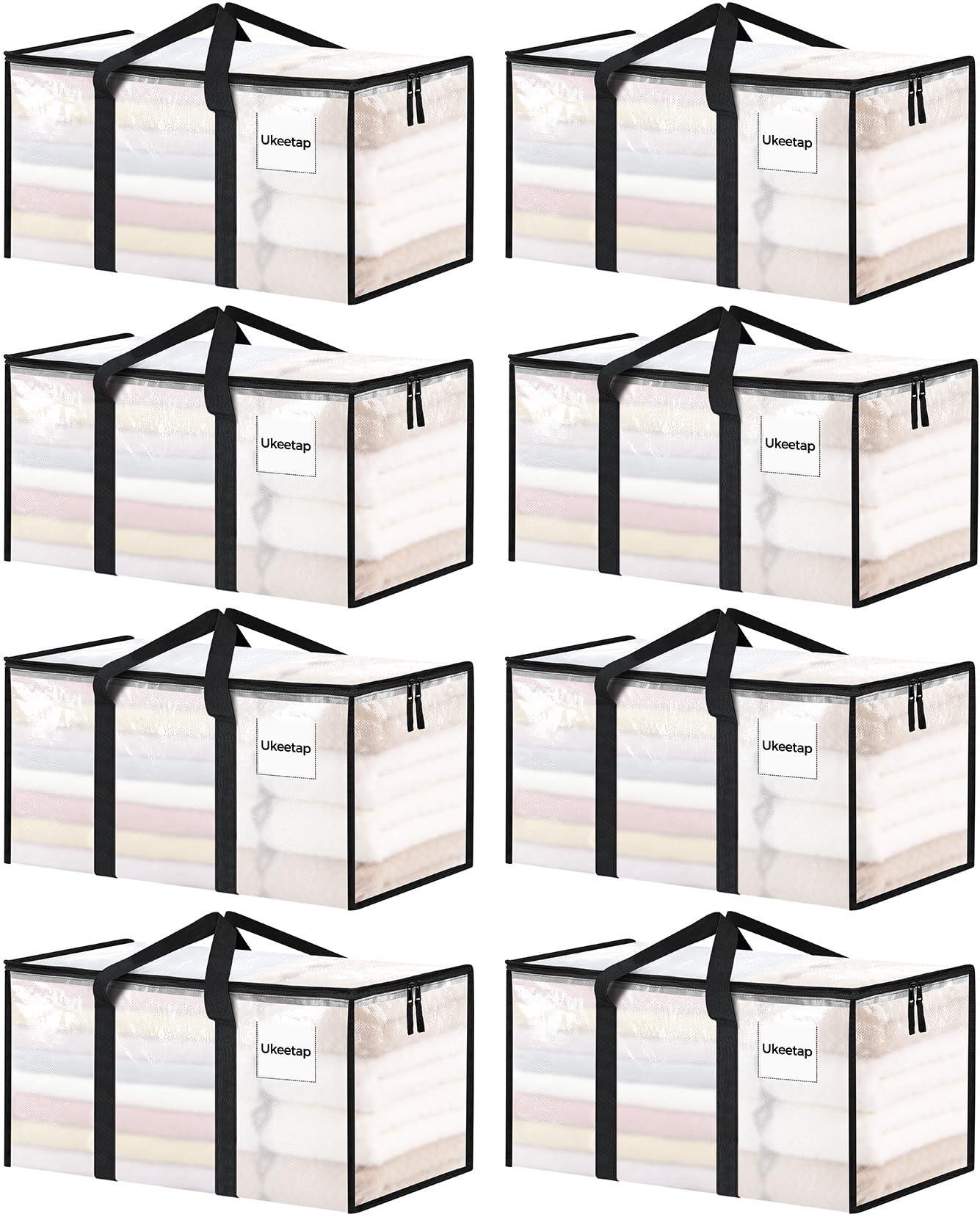
Eight zippered bags made from a woven plastic sheet, with webbing handles wrapped around the sides. These are closer to a moving bag than to a tote, and for soft goods that's an advantage rather than a compromise.

Twenty-four gallons and a 65-pound rating is enough for a queen comforter plus a couple of blankets, or a whole season of clothes, and the soft sides squeeze into gaps a rigid tote can't enter: the space above a wardrobe, the wedge beside a water heater, the back of a hatchback on moving day. They fold down flat in seconds when they're empty, which is more than any plastic bin here manages.

The details are what make a stack of eight workable. There's a clear front so you can see the shape of what's inside, a label pocket on the end, and handles that meet over your shoulder instead of cutting into your fingers when a bag is heavy. They're water resistant rather than waterproof, which is enough for a dry basement and not enough for a shed roof that leaks.

Placement decides whether these work. On a closet floor, in an attic where they can stand upright, or in the back of a car, they're the easiest thing here to live with, and for a move they beat cardboard by a mile — no tape, no collapsing bottoms, and you can see what's in them through the side. A garage rack where you want them three high is the one job that calls for a lidded tote instead.

Bottom line: Our pick for off-season clothes and blankets: 24-gallon bags that carry over a shoulder and fold flat when the season turns.

4

Amazon Basics Fabric Cubes

Amazon Basics Fabric Cubes

Closets and shelves

Our Score 9.4/10
Check Price

Worth Noting

  • 10.5-inch cube leaves a gap in 11-inch openings
Material
Fabric
Set Size
6 cubes
Cube Dimensions
10.5"L x 10.5"W x 11"H
Capacity Per Cube
8.5 liters
Read the full review

Six cubes, each one 10.5 inches square and 11 inches tall, holding about 8.5 liters apiece: that's a folded stack of sweaters, a shelf of toys, or the cable nest behind a desk. This is the set we point people to first, and the reason is simple. It's the least expensive way in this group to make a whole shelving unit look deliberate, and the cubes fold flat when they're empty instead of sitting there occupying the space you bought them to save.

The bottom panel is reinforced, which matters more than it sounds. A fabric cube with a floppy base slumps the moment you put a hardback in it, and once a cube has lost its corners it never sits square again. Ours held their shape with a shelf's worth of books inside, and the fabric hasn't stretched at the top edge where hands go in. The sewn-in handle is a small thing that turns out not to be: you pull a loaded cube off a shelf by it every day, and a handle that's stitched rather than glued doesn't peel away.

Fabric breathes, which is lovely for clothes and wrong for a garage, where dust settles into the weave and nothing can stack on an open cube. In a closet, a kid's room or on open shelving in a living room, neither of those costs you anything.

Bottom line: The set we hand people first — six cubes that keep their shape under a shelf's worth of weight and fold flat out of the way when they're empty.

5

YIHONG Clear Storage Bins

YIHONG Clear Storage Bins

Pantry and fridge

Our Score 9.4/10
Check Price

Worth Noting

  • All six bins are one size, with no smaller option
Capacity
504 cubic inches
Material
BPA-free plastic
Set Size
6 bins
Bin Dimensions
11.2"L x 7.5"W x 6"H
Read the full review

The first ten minutes with these bins are the worst ten minutes. They arrive nested inside one another under real pressure, and the walls grip hard enough that separating all six takes patience. Work around the rim with your thumbs rather than levering at one spot, because force it and the plastic at the lip can crack before the two bins let go.

Past that, you have six clear bins measuring 11.2 by 7.5 by 6 inches and holding a little over 500 cubic inches each. That's wider and taller than the four-bin set above, which is the difference between a row of bottles standing upright and a row of bottles lying down, and you get six of them rather than four.

They earn their place in a fridge, a freezer or a deep pantry shelf. The plastic is BPA free, the walls are clear enough to read a label through, and the molded side handles let you pull a loaded bin forward without hooking a finger under the rim. Stack two when they're full and they hold steady instead of wobbling off each other.

Set against the ClearSpace bins, these are the better value per bin and the more forgiving size for tall items, and the unpacking is a one-time annoyance rather than something you live with afterwards. Just don't plan on dealing with them in a hurry on moving day, when the last thing you want is six bins welded together in a hallway.

Bottom line: Six clear bins with more room per bin than our pantry pick and a lower cost each — the set to buy when four isn't enough.

6

Sterilite 64-Quart Latching Boxes

Sterilite 64-Quart Latching Boxes

Garage and bedding

Our Score 9.2/10
Check Price

Worth Noting

  • 13.5-inch height rules out under-bed use
Closure
Latching lid
Capacity
64 quarts
Set Size
4 boxes
Exterior Dimensions
23.75"L x 16"W x 13.5"H
Read the full review

A latch is the difference between a tote you can carry and a tote that dumps a winter's bedding on the garage floor. This one hooks over the lid and opens with one hand, and the lid is recessed so the next box settles down inside the rim instead of skating around on top of it.

Sixty-four quarts is the size we find most useful in a garage. It takes a folded duvet, a set of sheets and a couple of pillows with the lid down, and it's still light enough that one person can carry a full one out to the car — provided nobody has filled it with tools. The interior is deep and squared off rather than tapered to nothing, so a stack of board games or a row of binders stands up instead of slumping into the middle.

Clear plastic is the other half of the appeal: you can see the duvet through the side without unclipping anything. The weak point is the corners. A tote this size takes knocks in transit, and a cracked rim is easy to miss inside the cardboard and impossible to repair later, so check all four corners the day the box lands rather than the following spring.

Bottom line: The lidded tote we pick for bedding and garage overflow: a latch that stays shut, a lid that stacks, and a size one person can still carry.

7

Rubbermaid Roughneck 31-Gallon Tote

Rubbermaid Roughneck 31-Gallon Tote

Attic and garage

Our Score 9.2/10
Check Price

Worth Noting

  • Costliest per bin in this group
Capacity
31 gallons
Load Rating
124 lb
Temperature Range
0 to 115°F
Exterior Dimensions
32.3"L x 20.4"W x 16.7"H
Read the full review

Zero to 115°F is the number that sells these. An attic in July and a garage in January are the two places plastic totes fail, and the Roughneck is built for both: the resin stays flexible instead of going brittle, which is the difference between a tote that survives two winters and one that cracks the first time you set it down on a cold floor.

Thirty-one gallons is a serious amount of volume. A duvet, two pillows and a blanket go in with room for a bag of out-of-season shoes on top. The load rating is 124 pounds, the highest in this group, and it's the only tote here we trust with books and tools rather than soft goods.

They're opaque, and that cuts both ways. The dark indigo hides what's in the garage from anyone walking past, and it hides it from you too, so write on the short end before the lid goes on. The snap-down lid is rated waterproof, which is what you want under a basement window that seeps and over anything a mouse might find interesting.

Where they stop making sense is indoors. On a closet shelf a 31-gallon tote is more box than you need, and hauling one down from a high shelf is a two-hand job. It earns its keep in a garage, an attic or a basement, where the temperature swings and the load is heavy and a cheaper tote is a gamble.

Bottom line: Our pick for garages, attics and basements: 31 gallons of heavy-duty tote rated for temperature swings and a 124-pound load.

8

Sterilite 6-Quart Storage Boxes

Sterilite 6-Quart Storage Boxes

Shoes and crafts

Our Score 9.2/10
Check Price

Worth Noting

  • Shallow size only suits small items
Closure
Snap-on lid
Capacity
6 quarts
Set Size
12 boxes
Stacking
Recessed lid
Read the full review

Six quarts doesn't sound like much until you're standing in front of a closet that has become a pile. One of these takes a pair of flats, a folded sweater, or the tangle of chargers that has no other home, and because the lid snaps on you can put it on a shelf without dust finding its way in.

Twelve at once is the appeal. It's enough to do a whole shelf, a full run under a bed, or one category of clutter in every room in the same size, which is what makes a shelf look organized rather than merely tidier. They stack when full and nest when empty, so the spares don't become clutter themselves while you wait to fill them.

For shoes and small clutter this is the format we reach for: the lowest per-box cost in this group, clear enough to see what's in them, shallow enough that nothing gets lost at the bottom. The lids are the part to check. They're a snap cover rather than a latch, and on a box this shallow a lid that doesn't seat properly is obvious immediately, so press each one down as you unpack and set aside any that ride up for light items only.

Bottom line: Twelve small lidded boxes that turn a cluttered closet shelf into rows — our pick for shoes, crafts and drawer-sized odds and ends.

How We Tested 14 Storage Bins Over Six Months

To build the shortlist, I started with the bins I already trusted and then read through customer reviews for patterns—cracked corners, lids that wouldn't seat, sets that arrived with mismatched sizes. I narrowed by dimensions, material, and price, then ordered 14 bins that represented the range of what shoppers actually consider: lidded totes, stackable bins, and a few clear options for shelves. Testing ran for six months, from the first cool week of fall through a full holiday season of swapping decorations and storing gifts.

In my own closets, I filled each bin with the same loads—winter blankets, out-of-season clothes, holiday decor, and a heavy stack of books—to compare capacity and how the walls held up. I measured each bin inside and out, then checked whether it actually fit on a standard shelf or under a bed. To test durability, I dragged loaded bins across a wood floor, dropped a few empty ones from waist height, and stacked them three high for a month to see which lids bowed or cracked. I nested empty bins to see whether they pulled apart cleanly or jammed together, and I snapped and unsnapped every lid a dozen times, watching for latches that stuck or needed two hands.

At the end, I compared price against the wear I saw: a cheap bin that survived felt like a win, while an expensive one had to earn it with easier stacking and a lid that sealed. The bins that scored highest were not the flashiest—they were the ones I stopped thinking about, because they opened, filled, and stacked without a fight.

How to Choose Storage Bins

Match the bin to the room, not the label

The first fork is the room, not the material. A bedroom closet or a living-room shelf is dry, stable and visible, so fabric bins make sense: they sit quietly in a color scheme and never scratch a shelf. A garage, attic or basement is none of those things. Temperature swings make ordinary plastic brittle, damp finds its way into anything breathable, and dust works into woven fabric and stays there.

If the bin is going somewhere unconditioned, buy rigid plastic with a lid that latches, and look for a stated temperature range before you trust a tote to an attic. The Rubbermaid Roughneck is the one here that names its range, and that rating is the reason it costs more than a plain tote.

Measure the opening, not the bin

Cube organizers are built around an 11-inch opening, so check that number before anything else. An 11-inch bin slides in flush; a 10.5-inch cube drops in with a visible gap above it. Under a bed, measure from the floor to the frame rather than to the mattress, because a box that clears by half an inch will not clear once it is full and bulging.

Measure the inside too. Tapered walls mean the base of a bin is smaller than its rim, so something rigid that just fits at the top will jam before it reaches the bottom. Measure the tallest thing you plan to store and add an inch of slack.

Clear, fabric or opaque

Clear bins are a working tool. In a pantry, a fridge or under a sink, reading the contents without lifting anything out is the entire point, and that is why our pantry picks are all open-topped and see-through. Fabric and opaque plastic are a decorating decision: they hide the mess, which is what lets a wall of cube bins read as furniture rather than storage.

The trade-off is honest. Clear shows you what you have, and it also shows you what you have. If the shelf is in sight from the sofa, buy fabric or a dark tote; if it sits behind a door, buy clear and stop guessing.

Fill heavy things small and light things big

A 64-quart tote full of books weighs more than most people want to carry down a flight of stairs, lid or no lid. Load ratings help — 124 pounds on the Roughneck, 65 on the soft bags here — but the practical limit is your own arms, so we prefer two small bins to one enormous one on a stair.

Keep dense items in small boxes and bulky, light items in the big ones. Lift by the handles rather than the rim, and stack only bins whose lids are recessed to accept the base of the one above. Soft-sided bags don't stack at all; they slump into whatever shape the contents allow.

Frequently Asked Questions

Final Verdict

Start with the Amazon Basics cubes if the job is a closet, a shelf or a kid's room. Six of them, they hold their shape, and they fold away when the shelf is bare. Move to the ClearSpace bins the moment you need to see what you own, and to the Rubbermaid Roughneck the moment a bin is headed somewhere the temperature swings.

Between those three you can put away most of what a house accumulates. Everything else here is a size decision: the Household Essentials set if your cube openings are exactly 11 inches, the Sterilite 6-quart boxes if the clutter is small, the Ukeetap bags if it is soft.