Storage

Best Underbed Storage of 2026

Underbed storage looks like free square footage until you actually try to use it. The gap under a standard bed is only a few inches deep, and the wrong bin turns that space into a dust trap that won't slide, won't shut, or splits a seam the first time you haul it out. What a good option fixes isn't just clutter — it makes the space usable on an ordinary Tuesday, when you want the winter blankets and don't feel like wrestling a zipper for ten minutes.

Here's what nobody tells you: the measurements printed on a listing are exterior, and your bed's real clearance is measured to the lowest point of the frame, not the mattress. Get those two numbers wrong and even a beautifully made bin won't fit. My team and I have spent the past six months with 14 underbed storage pieces, filling them with off-season clothes and spare linens and dragging them in and out weekly, and the gaps in capacity, sturdiness, and appearance showed up fast. The ones genuinely worth your money are below.

1

Vailando Side-Supported Underbed Bins

Top Pick
Vailando Side-Supported Underbed Bins

Most beds

Our Score 9.4/10
Check Price

Worth Noting

  • Not for frames under six inches
  • No wheels, so a full bin must be lifted
Height
6 in
Capacity
60 L
Footprint
33.7 x 17.1 in
Structure
PP side and bottom boards
Read the full review

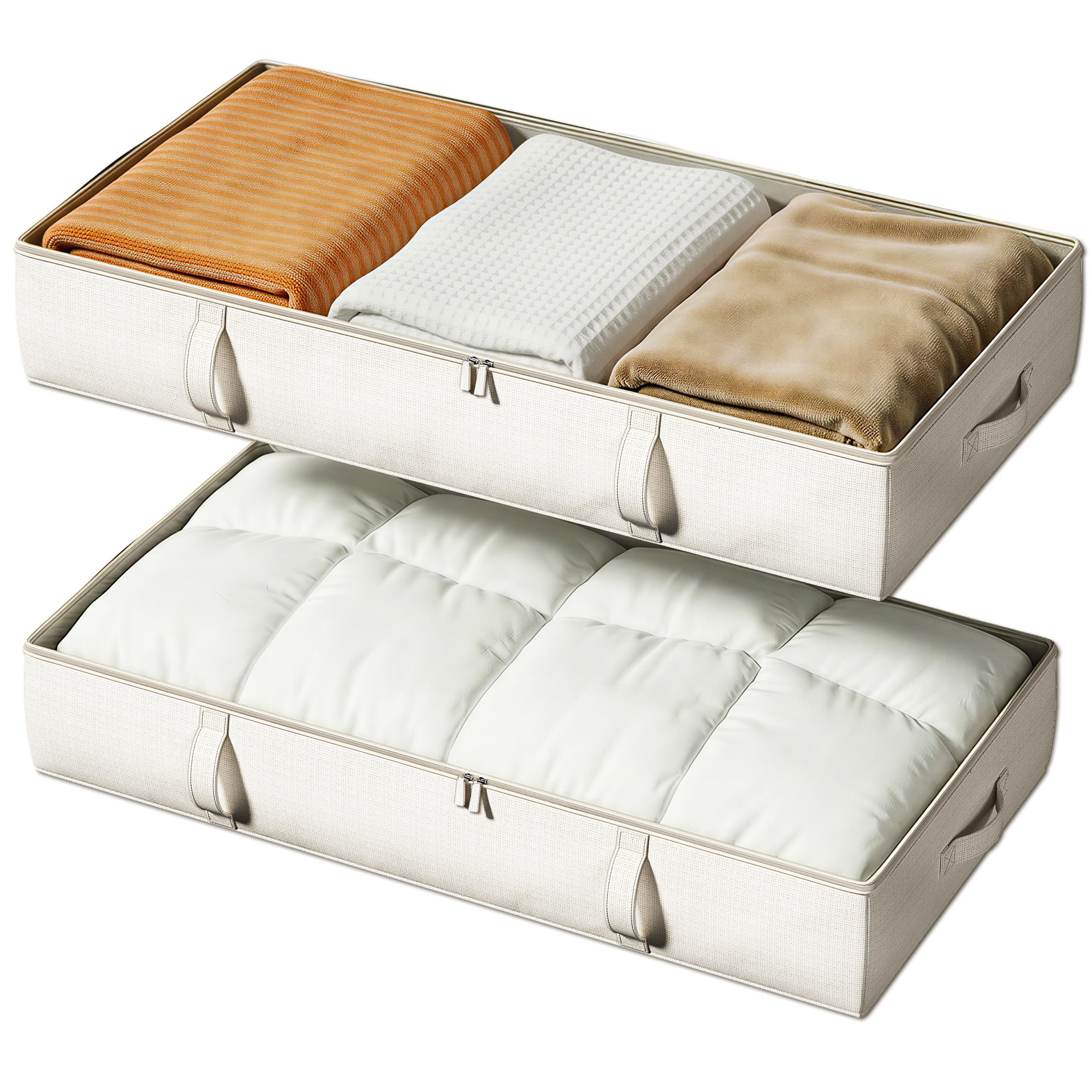
The rigid sidewalls and bottom board are what sold us on the Vailando bins. They arrive flat, then the PP panels pop into place and hold the sides square while you fill the bin. With sweaters, duvets, or winter coats, that changes the job: the bin stays open, so you are not holding it up with one hand and stuffing with the other. The 60-liter capacity is generous without turning the bin into a trunk that swallows everything.

At 33.7 by 17.1 inches, each bin covers a useful footprint under a queen or king frame, and two of them make a sensible seasonal swap. The linen fabric has a soft look, but the reinforcement is what we trust when the bin is full. Three handles are the practical extras: they give you something solid to pull, and the zip runs cleanly around the lid.

We compared it with the softer bags here and kept coming back to the structured shape. It stacks more predictably, and the lid does not collapse into the contents. Six inches is still a low profile for most standard frames, and the bin slides on smooth flooring without drama. This is the one we recommend first for clothes and bedding because it balances capacity, support, and a footprint that does not waste the space under a bed.

Bottom line: We recommend the Vailando for most beds: a rigid, 60-liter bin that holds bulky clothes without collapsing and still keeps a low six-inch profile.

2

TidyCorner Low-Profile Underbed Containers

TidyCorner Low-Profile Underbed Containers

Low clearance

Our Score 9.4/10
Check Price

Worth Noting

  • 30-pound load limit per bin
Top
Clear plastic, dual zipper
Height
4.5 in
Capacity
45 L
Footprint
33.6 x 17 in
Read the full review

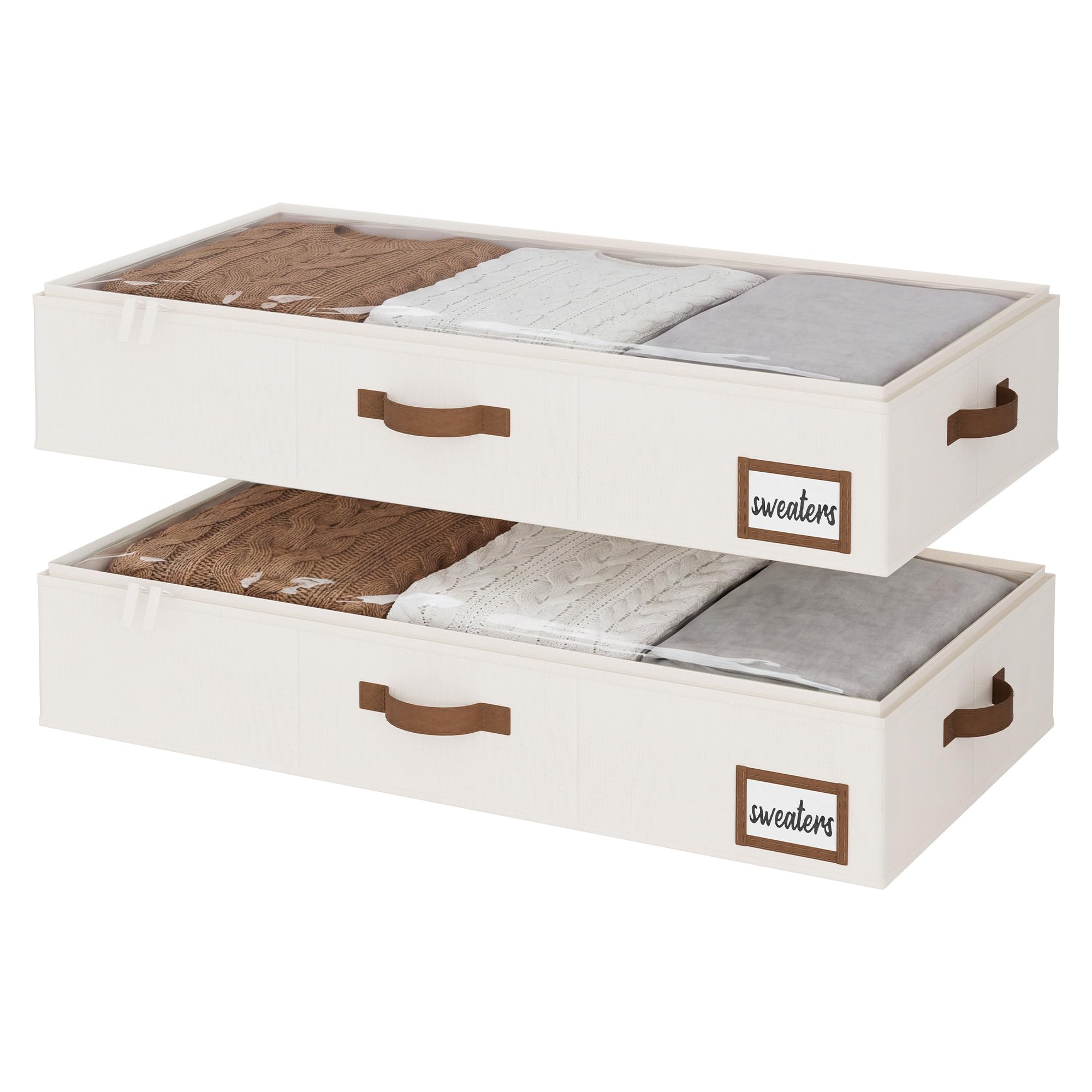
At 4.5 inches tall, the TidyCorner bins are the lowest-profile structured option in this group. That difference from the six-inch bins is the difference between sliding under a platform bed and leaving the bin at the foot of it. The 45-liter capacity is still enough for a folded duvet, a stack of sweaters, or several pairs of boots.

We do not treat it as the default for a roomy frame. It earns its place when the gap is the constraint: 4.5 inches clears low platform beds and frames with a shallow drawer above the floor. The clear plastic top and double zipper make it easy to check contents without pulling the whole bin out, and the narrow height keeps the bin from scraping the frame.

The composite linen has enough body to hold its shape on the floor, and the three reinforced handles give you a firm pull. We liked the way the bin slid on smooth flooring and the way the clear top made a seasonal swap less of a guessing game. For clothes, linens, and shoes, the 45-liter size is easy to live with; two bins fit under a queen frame with room to spare.

Bottom line: We reach for the TidyCorner when clearance is tight: its 4.5-inch bins slide into gaps that leave taller containers stranded.

3

StorageWorks Clear-Lid Underbed Box

StorageWorks Clear-Lid Underbed Box

Visible storage

Our Score 9.4/10
Check Price

Worth Noting

  • No wheels for moving a full box
Lid
Clear plastic
Height
6 in
Footprint
33 x 17 in
Structure
Cardboard-reinforced sides and base
Read the full review

A clear lid is only useful if it stays rigid and leaves the contents visible, and the StorageWorks lid does both. It sits over the bin rather than stretching across a soft frame, so you can see the folded quilt or the stack of sweaters without unzipping. The ivory polycotton and reinforced sides give it a finished look that is rare among the bins here.

At six inches tall, it slots into the same clearance band as the Vailando, and the 33-by-17-inch footprint is easy to arrange under a queen or full frame. The box held its shape when we packed it with folded bedding; the cardboard reinforcement in the sides and base is doing real work, not just dressing up a soft bag. The label holder is a small thing, but it saves a season of guessing.

The metal zippers run smoothly around the lid, and the PU handles give you a firm pull when the box is loaded. This is the most polished-looking bin here, and the one we leave out when the underbed area is visible. It is also the priciest of the structured picks, so the value depends on how much you care about the look and the lid.

Bottom line: We choose the StorageWorks when the bin may stay visible: the clear lid and finished fabric look intentional, not like utility storage.

4

Yecaye Underbed Storage with Wheels

Yecaye Underbed Storage with Wheels

Heavy loads

Our Score 9.0/10
Check Price

Worth Noting

  • Assembly required before first use
Height
6.69 in
Wheels
Four 360-degree casters
Clearance
Over 7 in
Load Rating
66 lb
Read the full review

The four casters are the reason to consider the Yecaye. A loaded underbed bin is awkward to lift, especially when it is full of books, boots, or winter bedding, and the wheels turn that chore into a pull. The metal frame gives the bin a rigidity that fabric-only boxes lack, and the 66-pound load rating is the highest in this group.

The trade-off is clearance: Yecaye lists the bins for underbed spaces over seven inches, and the 6.69-inch height leaves little margin. Check the gap at the lowest point of the frame, not just the middle. We paid attention to that because a bin that rolls is only useful if it rolls out without scraping the bed.

Smooth zippers, a clear window, and a label pocket make it easy to identify what is inside, and the PU fabric wipes clean. The casters roll well on carpet and hard floors, and the front handle gives you a way to steer a loaded bin. This is the pick for a guest room or kid's room where storage gets pulled out weekly, not for a low platform bed.

Bottom line: We recommend the Yecaye for heavy underbed loads that need to move: the metal frame and casters take the lifting out of seasonal swaps.

5

punemi Three-Sided Underbed Bin

punemi Three-Sided Underbed Bin

Bulky bedding

Our Score 9.0/10
Check Price

Worth Noting

  • Zipper durability is the weak point
Height
6.7 in
Opening
Three-sided zipper
Capacity
49 L
Footprint
30 x 15 in
Read the full review

The three-sided zipper is the feature that makes the punemi feel different. Instead of a single top opening, the lid peels back on three sides, so you can drop in a folded duvet or pull out the pair of boots that sank to the bottom without unloading everything on top. At 49 liters, each bin has enough room for a bulky comforter or a full set of bedding, and the structured fabric keeps the sides upright while you pack.

The 6.7-inch height is the catch: it is the tallest structured bin here, and it needs a frame with more room than the six-inch Vailando or StorageWorks. We liked the reinforced bottom and the way the bin held its shape on the floor, but we kept it for beds with generous clearance rather than low platform frames.

For bulky bedding, the opening is worth the extra height. We used it as the big-items bin and appreciated not having to drag everything out to reach the bottom layer. It is not the one for a shallow frame or for rolling a loaded bin across carpet; that is Yecaye's job. But when the contents are soft, bulky, and awkward, the three-sided access saves more effort than another inch of capacity.

Bottom line: We like the punemi for bulky bedding and quick access: the three-sided opening lets you load and dig through a full bin without unzipping the whole top.

6

Onlyeasy Underbed Shoe Organizer

Onlyeasy Underbed Shoe Organizer

Shoes

Our Score 9.0/10
Check Price

Worth Noting

  • Large men's shoes and high-tops will not fit
  • Dividers lose shape when empty
Height
5.9 in
Footprint
29.3 x 23.6 in
Compartments
12 per organizer
Shoe Capacity
24 pairs flat or 12 pairs sneakers
Read the full review

Twelve compartments in each organizer, a clear window across the top, and a footprint that slides under the bed: the Onlyeasy is built around one job. We sorted flats and low-profile sneakers pair by pair, and the clear top made it obvious which slot held the black loafers without unzipping the whole thing. The 5.9-inch height is low enough for most frames, and the two handles make the loaded organizer easy to pull out.

The set holds up to 24 pairs of flats or 12 pairs of sneakers in total, which is a useful amount for a shared closet or a seasonal switch. We liked the clear window more than we expected: shoes are the one thing you usually identify by looking, not labeling. The fabric wipes clean and the organizer folds flat when empty, so it does not take up much shelf space in summer.

The compartments suit flats, sandals, and smaller sneakers, and the clear window makes a pair easy to spot. It is not a general-purpose bin, so we keep bedding and bulky clothes in the structured bins. For the pile of shoes by the door, though, the compartments keep pairs together and stop one shoe from disappearing under the bed. That narrow job is done well.

Bottom line: We keep the Onlyeasy for shoe clutter: twelve compartments per organizer keep flats and smaller sneakers paired and visible.

7

Zober 90L Underbed Bags

Zober 90L Underbed Bags

Bulk storage

Our Score 8.6/10
Check Price

Worth Noting

  • Handles can tear under a heavy load
Height
7 in
Capacity
90 L per bag
Footprint
39 x 20 in
Pack Count
4
Read the full review

The four-bag pack is the appeal: each bag is listed at 90 liters and measures 39 by 20 by 7 inches, so a king-size comforter or a winter coat stack disappears into one. We packed a bag with bedding and were surprised by how much it took before the sides bulged. If you are swapping a closet over for the season, having four bags at once is more useful than one perfect bin.

Soft-sided bags earn their place in odd gaps. The Zober has no rigid frame, so it can be squashed under a low frame or into the space beside a bed leg where a structured bin will not go. The trade-off is that it does not slide as cleanly on carpet, especially when full, and it will not stack like a box. We treat it as bulk storage, not everyday access.

The see-through panel makes it easy to find the right bag without opening all four. We liked that the empty bags fold flat enough to tuck into a drawer, and the reinforced handles give you a place to pull when the load is light. The zipper runs cleanly enough for seasonal access, though this is not a bag you will want to open every day.

We still recommend the Zober for duvets, out-of-season clothes, and stuffed animals, provided the contents are soft and you are not asking it to carry the heaviest gear. It is the budget four-pack in this group, and it leaves room to buy a sturdier bin for the things you pull out weekly. Just do not expect it to behave like the structured picks.

Bottom line: We keep the Zober bags for light, bulky bedding and tight budgets: four 90-liter bags swallow duvets, but they need gentle handling.

How We Tested the Best Underbed Storage

We built the shortlist by rounding up the styles people actually buy — flexible fabric bags, rigid plastic totes, zippered canvas boxes, and a couple of folding crates — then filtered by published interior dimensions, material, and price relative to capacity. Fourteen made the cut.

Each one went into a real home for six months. I measured every option inside and out, then checked it against the actual clearance under three bed frames — a tall platform, a standard box spring, and a low metal frame — since the height on a listing rarely matches the gap you're working with. Then I packed each one the same way, a queen comforter or twelve sweaters depending on size, so capacity comparisons meant something.

After that it was weekly use: sliding loaded bins across hardwood and low-pile carpet to see whether handles or wheels helped or snagged, zipping and unzipping the fabric ones until corners started to catch, and lifting full bins by their handles to watch for seams pulling. Anything that lived under a bed stayed there a month before I pulled it out and checked the lid for dust and the fabric for sagging.

Sturdiness got the least glamorous test — two full bins stacked on each other for a week to see which sides bowed. Appearance was judged in place, tucked under a frame, watching for lint and crooked zip lines. Value came down to usable cubic feet for the money rather than the sticker price, and the ones that scored well are still in rotation.

How to Choose the Right Underbed Storage

Measure the Gap Before You Shop

We start with the clear gap between the floor and the lowest part of the bed frame, then subtract an inch for carpet or a thick rug. Underbed bins in this group run from 4.5 to 7 inches tall, and that difference decides whether the bin disappears or becomes clutter at the foot of the bed. A 4.5-inch bin such as the TidyCorner is the safer choice for low platform beds; a six-inch bin like the Vailando fits many standard frames. Wheeled bins need still more room: the Yecaye asks for over seven inches.

Choose Structure for the Load

Rigid sidewalls and a reinforced bottom keep a full bin square, which makes loading and sliding easier. That is why we lean toward the Vailando and StorageWorks for clothes and bedding. Soft bags such as the Zober squeeze into awkward gaps and swallow bulky duvets, but they collapse when empty and are harder to push across carpet. Match the structure to how often you need access: a bin you open weekly benefits from rigid sides, while a once-a-season duvet bag can be softer. For heavy books or tools, prioritize a stated load rating and a metal frame.

Look at Access, Not Just Capacity

A clear window or lid saves you from unzipping every bin to find one sweater, and a wide opening matters when the contents are bulky. The punemi's three-sided zip is the easiest loading design here; the StorageWorks clear lid is the easiest to inspect. Handles are not decoration: reinforced side handles let you pull a loaded bin out from the foot of the bed. Wheels are the better answer for heavy loads, but they raise the clearance requirement. We do not pay extra for wheels unless the bin will be heavy or pulled out often.

Match the Bin to What You Store

Shoes need compartments, not a deep open box. The Onlyeasy's twelve slots per organizer keep flats and smaller sneakers paired, while bulky high-tops need a larger open bin. Bedding and winter coats reward volume and a wide opening, so the Vailando's 60 liters or the punemi's 49 liters make more sense than a shallow shoe organizer. For clothes you rotate weekly, a low-profile bin with a clear top is easier to live with. Measure the longest item you plan to store, then check the listed footprint against the usable rectangle under the frame, allowing for legs and skirts.

Frequently Asked Questions

Final Verdict

Vailando is the default we recommend: six inches tall, rigid enough to stay open while you pack it, and roomy enough for bulky clothes. If your frame sits low, choose the TidyCorner's 4.5-inch bins instead; if you are moving heavy loads across carpet, Yecaye's wheels are the better tool. Most shoppers can stop at the Vailando, but measure the gap first.