Storage

Best Shoe Racks of 2026

A shoe rack is one of those purchases you make after the pile by the door has become a trip hazard. I have lived with the leaning tower of sneakers, and all I wanted was a spot where shoes land without turning the entryway into a mudroom. What a good rack fixes is not just clutter but the small daily friction of hunting for a matching pair while someone waits at the door.

The tricky part is that capacity claims are optimistic: a rack that says it holds 24 pairs may not fit chunky sneakers, tall boots, or a household where everyone owns three pairs of gym shoes. Over the past six months, my team and I assembled and lived with 12 shoe racks, judging quality, sturdiness, appearance, size, value, and how well the hardware held up. Assembly is where cheap racks reveal themselves—missing pilot holes, vague diagrams, a wobble that never quite disappears—and durability shows up months later, when joints loosen or shelves sag. The right pick should earn its footprint and still look intentional by the front door.

1

VASAGLE 6-Tier Shoe Rack

Top Pick
VASAGLE 6-Tier Shoe Rack

Entryway and closet

Our Score 9.6/10
Check Price

Worth Noting

  • Needs 39 inches of uninterrupted wall
Frame
Steel and particleboard
Shelves
5 mesh shelves plus wood top
Capacity
24 to 30 pairs
Dimensions
11.8"D x 39.4"W x 43.3"H
Read the full review

A shoe rack that can stand in the open is a different product from one that hides in a closet, and this VASAGLE is the one we point to when the entryway is the destination. The rustic brown top gives you a surface at 43.3 inches for keys and mail without looking like utility shelving, and five mesh shelves below hold 24 to 30 pairs. Plenty of racks store shoes; this one can be the thing you decorate around.

Mesh does more work than it gets credit for. Shoes do not drop through the gaps, grit falls out instead of settling in a film under every pair, and you can see what is on the middle tier without crouching. The steel frame and adjustable feet keep it level on a hallway floor that is not, which is the difference between a rack you forget about and one that clicks every time someone walks past. An anti-tip kit comes in the box.

Width is the constraint. At 39.4 inches across and 11.8 inches deep it wants a clear run of wall and will not turn a closet corner the way a narrow tower can. Check the longest shoe in the house against that depth before you commit: 11.8 inches is generous for sneakers and tighter for a big men's boot, which will sit proud of the front rail.

Assembly is the usual labeled-parts process, and the payoff is a rack that looks deliberate in a hallway rather than improvised. If the household genuinely runs past 30 pairs, the SONGMICS 8-tier trades the console top for height and a frame that splits; if the wall you have is 17 inches, go narrow. For a hallway or bedroom wall with room to breathe, this is the one we recommend first.

Bottom line: Our pick for most homes: a wood-topped rack that looks like furniture, holds 24 to 30 pairs, and stays steady in a busy hallway.

2

SONGMICS 8-Tier Shoe Rack

SONGMICS 8-Tier Shoe Rack

Big households

Our Score 9.4/10
Check Price

Worth Noting

  • Shelf edges can arrive scratched or dented
Setup
Two 4-tier racks, stackable or split
Capacity
32 to 40 pairs
Dimensions
12.1"D x 36.4"W x 64.4"H
Shelf Spacing
8.1 inches
Read the full review

Thirty-two pairs of men's shoes or forty of women's is the claim on this eight-tier SONGMICS, and the build is what makes the number believable: two four-tier racks bolted into one 64.4-inch frame. Run it as a single tower in a garage or a closet, or leave the two halves apart and put four tiers in two different rooms.

The split is our favorite thing about it, and the reason it suits a closet with a hanging rod better than a taller single-frame rack does. The shelves are the other clever part: they set flat for boots or angled for easier access, and 8.1 inches of spacing takes high heels and high-tops without laying them down. Each shelf carries up to 22 pounds, and the feet adjust for a floor that slopes.

Sixty-four inches is a lot of rack, and the top two tiers sit above eye level for most of us, which is exactly where the angled setting earns its keep: tilt a shelf and you can see what is on it from the floor. A stack this tall belongs against a wall and fixed to it, not standing free. As pure storage per inch of floor, it gives you more than anything else here.

Bottom line: Buy this one when the shoe pile belongs to the whole household: 32 to 40 pairs, and a frame that splits into two racks when you move.

3

KEETDY 3-Tier Long Shoe Rack

KEETDY 3-Tier Long Shoe Rack

Boots and high-tops

Our Score 9.4/10
Check Price

Worth Noting

  • 43 inches of wall for only three tiers
Dimensions
11.4 x 43 x 24.4 inches
Configuration
Stacks into 6 tiers
Load Capacity
50 lb
Shelf Spacing
8 inches
Read the full review

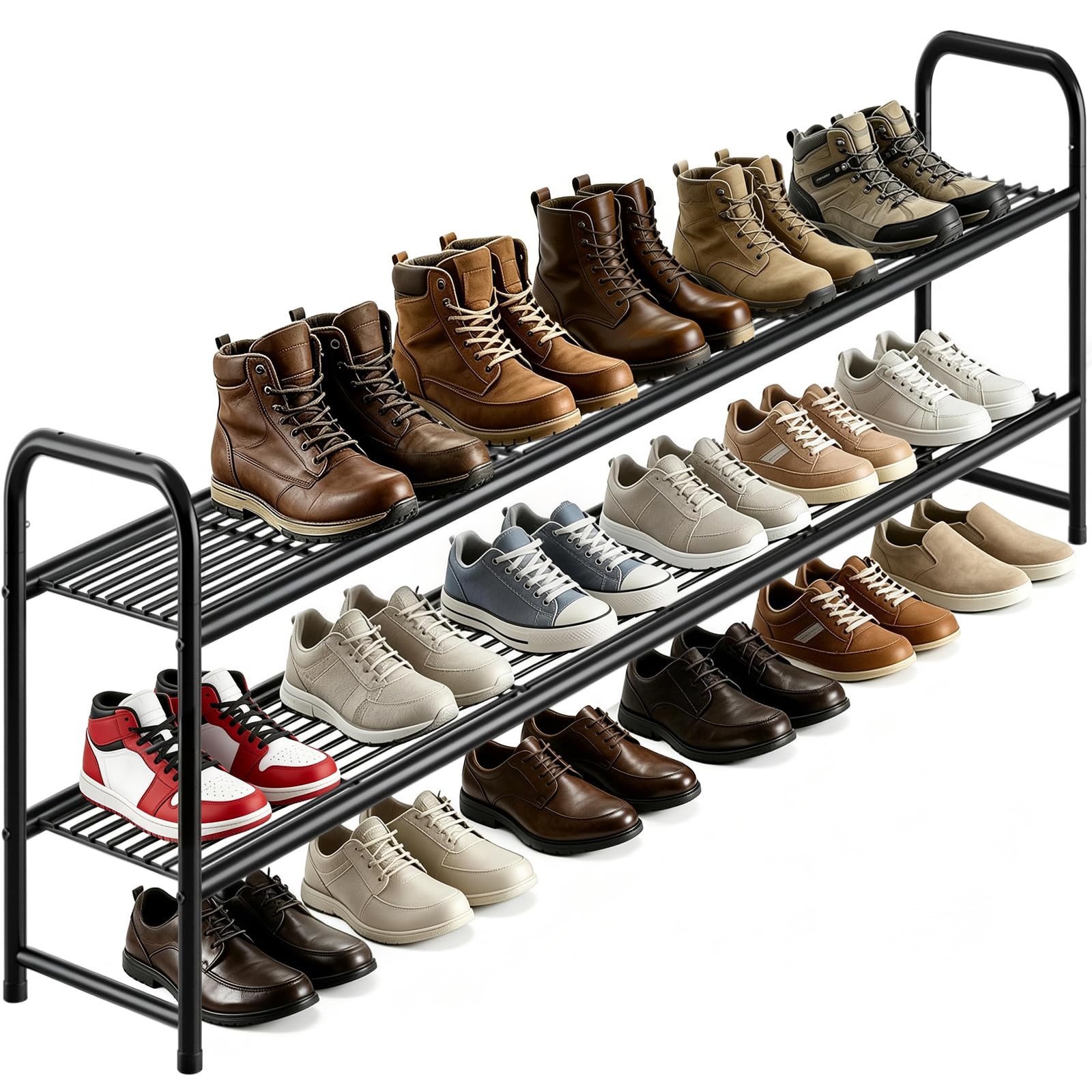
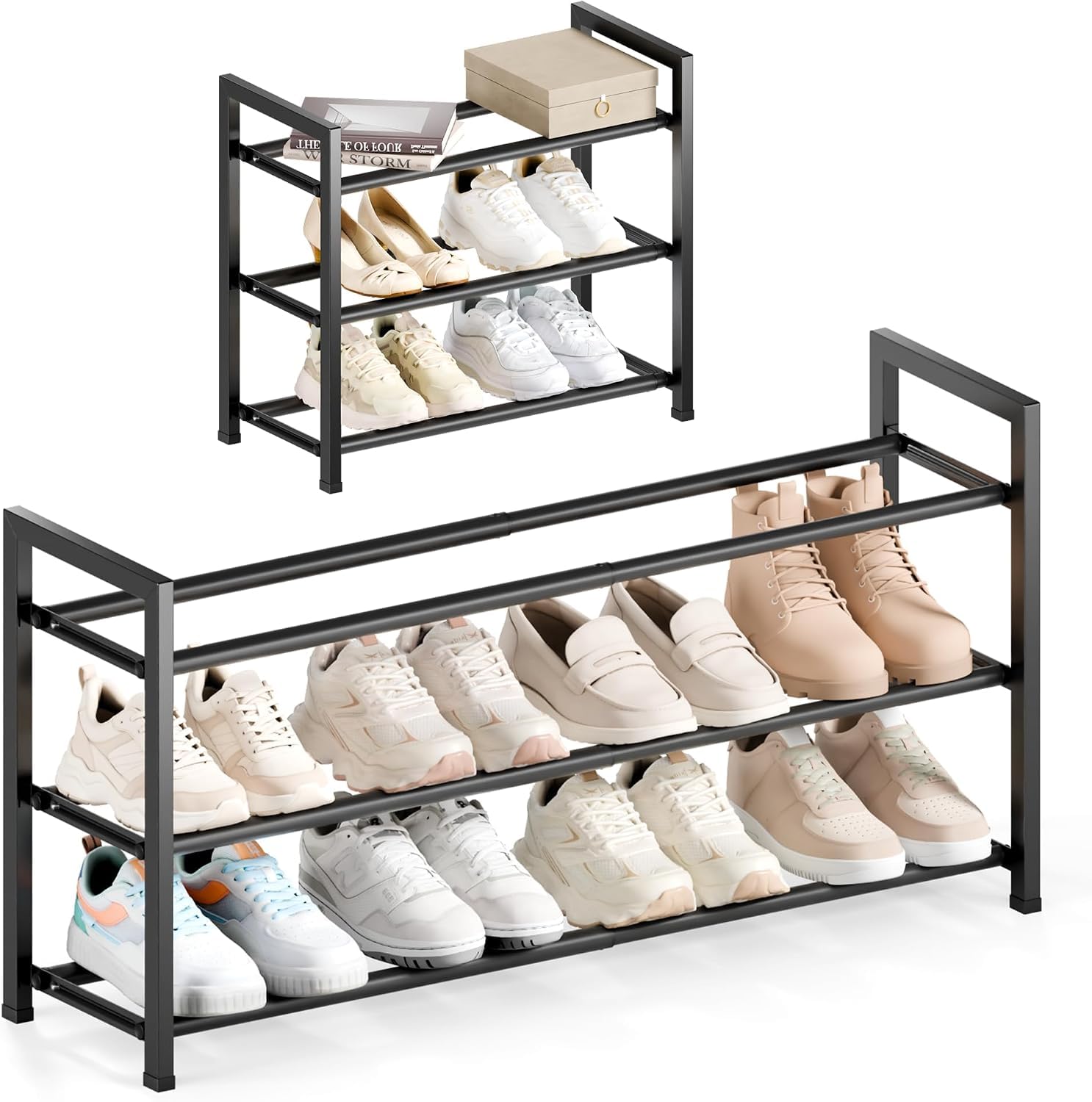
Eight inches between shelves is the number to look for if boots live in your house, and this KEETDY has it on all three tiers. Knee-highs, high-tops, and rain boots stand upright instead of lying on their sides in a pile, and the shelf distance is stated plainly rather than left to a photo to imply.

A shelf also lifts out. Take one out and you have room for the tallest pair in the house; leave all three in and the rack carries up to 50 pounds. Screws, a screwdriver, and numbered parts come in the box, and a second unit stacks on top to make six tiers when three stops being enough.

Forty-three inches wide and 24.4 inches tall is a shape that works along a mudroom wall or under a window, and it is our pick for the family whose shoes collect by the back door. You see every pair at a glance, because nothing is stacked above the others. Where height is available and width is not, this is the wrong rack; where the floor line is long, it is the easiest one here to live with.

Bottom line: We recommend it to anyone whose boots currently live on the floor: eight-inch shelf gaps and a removable tier make room for the tall stuff.

4

AOODA 2-Tier Long Rack

AOODA 2-Tier Long Rack

Mudrooms and garages

Our Score 9.4/10
Check Price

Worth Noting

  • Each tier carries only 11 to 15 pounds
Capacity
18 pairs
Dimensions
11.4"D x 42.7"W x 18.7"H
Shelf Spacing
8 inches
Per-shelf Load
11 to 15 pounds
Read the full review

Two tiers sounds like a compromise until you read the width: 42.7 inches, eighteen pairs, and nothing stacked higher than 18.7 inches off the floor. It is a shelf run rather than a tower, and for a mudroom wall that is the more useful shape.

The eight-inch tier height is the other half of the story. Knee boots and rain boots stand upright, the coated grid does not mind a wet sole, and the whole thing wipes clean, which is what you want where shoes come in wet and get kicked off.

Buy two and they stack into a four-tier rack, so the same design can grow if the household does. Numbered parts and illustrated instructions keep assembly short, and the open grid means you can see the pair you want from the doorway without crouching.

Where it beats the taller picks is at floor level: nothing is above a child's eyeline, nothing gets buried at the back of a deep shelf, and you can sweep under it without moving a tower. We think it is the best of these for a garage or utility wall. In a hallway where you want furniture, it is the wrong look; set it where shoes come in wet and it earns its floor space all winter.

Bottom line: A long, low run for mudrooms and garages, where boots need to stand up and nobody wants to reach above their head.

5

Simple Houseware 3-Tier Rack

Simple Houseware 3-Tier Rack

Starter and stacking

Our Score 9.2/10
Check Price

Worth Noting

  • Nine-pair capacity per unit
Weight
4.4 lb
Capacity
9 pairs
Dimensions
10.6"D x 26.5"W x 19"H
Shelf Load
30 lb
Read the full review

This is the rack we hand to someone furnishing a first apartment. It weighs 4.4 pounds, snaps together without tools, and holds nine pairs across three tiers. The same connectors let you seat a second unit on top, so it grows with a collection instead of being replaced by it, and the space under the bottom shelf takes slippers and flip-flops.

The wire grid suits sneakers, trainers, and sandals, and because the whole thing is light you can carry it from closet to entryway and back without unloading it. Each shelf is rated to 30 pounds, which is more than a tier of shoes will ever ask for.

What catches people out is scale. At 26.5 inches wide and 19 inches tall it is smaller on the floor than it photographs, so measure the gap you are filling before ordering and buy two if the number is close. Stacked, the pair makes a tower twice as tall and handles eighteen pairs between them.

Bottom line: An easy first rack: snaps together without tools, stacks as the collection grows, and moves from closet to entryway in one hand.

6

Bumusty Expandable 3-Tier

Bumusty Expandable 3-Tier

Tight odd spaces

Our Score 9.2/10
Check Price

Worth Noting

  • 15-pound load rules out a boot collection
Capacity
Up to 12 pairs
Dimensions
8.86"D x 33.27"W x 17.1"H
Load Capacity
15 lb
Expandable Width
18 to 33 inches
Read the full review

The gap between a door frame and the nearest wall is a space no fixed-width rack fits, and it is exactly where this one goes. The frame telescopes from 18 to 33 inches, so you set the width to the room instead of measuring and hoping.

We like that the adjustment is not a one-time decision. Because it assembles without tools, you can pull it wider when you move, narrow it again for a hallway, and nothing about the frame complains. Of the racks here that adapt, it is the simplest to change after the fact, which matters more than it sounds in a rental.

At 8.86 inches deep it is the shallowest rack in this group, and that is what lets it sit behind a door or beside a coat rack without eating the walkway. It is also why a large boot will hang off the front edge. Put it where the space is tight and the footwear is sneakers, sandals, and kids' shoes, and it never asks for attention.

Bottom line: Its telescoping frame fits gaps that fixed racks cannot, which makes it the right answer for a narrow entryway with light shoes.

7

VASAGLE 4-Tier Shoe Rack

VASAGLE 4-Tier Shoe Rack

Small hallways

Our Score 9.2/10
Check Price

Worth Noting

  • Fabric shelves take a set under heavy pairs
Shelves
3 fabric shelves
Capacity
9 to 12 pairs
Top Load
66 lb
Dimensions
11.8"D x 29.5"W x 28"H
Read the full review

A narrow hall asks three things of a shoe rack: a surface for keys, a top that looks like furniture rather than shelving, and a footprint that leaves the door swing alone. This VASAGLE answers all three at 29.5 inches wide and 28 inches tall, which is small enough to disappear into a hallway that has no room for a proper console.

The top wears the same rustic brown finish as our top pick and is rated to 66 pounds, more than a bowl, a leash, and the day's mail will ever weigh. Three fabric shelves below hold 9 to 12 pairs, which is a couple's worth of everyday shoes rather than a household's whole collection.

Twenty-eight inches is low for a console, and that is the point: it sits under a light switch or a window without blocking either. The adjustable feet and the included anti-tip kit keep it where you put it, and the price lands below most entryway furniture that does half as much.

The honest comparison is with our top pick: same frame, same feet, roughly a third of the storage and a much smaller claim on the hallway. We keep coming back to it for an apartment entry or the end of a bedroom where a 39-inch console would be the only thing in the room. For four people's shoes it is too small; for the two or three pairs you actually wear, it is exactly the right size.

Bottom line: A small hallway console that happens to hold shoes: same finish as our top pick, at a third of the footprint and the capacity.

8

OYREL 10-Tier Shoe Rack

OYREL 10-Tier Shoe Rack

Narrow closet corners

Our Score 9.0/10
Check Price

Worth Noting

  • Plastic connectors let the frame flex
Frame
Metal tubes and PP connectors
Tiers
10
Dimensions
11.8"D x 17.1"W x 78.7"H
Configuration
Splits into shorter racks
Read the full review

Half the width of our top pick and nearly twice its height, this OYREL puts ten tiers into 17.1 inches of wall. That is the shape a closet corner wants: 11.8 inches deep, 78.7 inches tall, shoes stacked vertically instead of spreading along the floor.

Ten tiers is more than most closets need in one place, and it splits into shorter units, so three tiers can stand by the front door while the rest go inside the closet. Tall and light is a combination to respect: this belongs against a wall or wedged into a corner rather than standing free in the middle of a room.

Where it beats the bigger racks is in rooms that have height and no width: a wardrobe end, the strip beside a door, the dead corner behind a dresser. It will not feel as solid as a steel-and-wood console, and it is not trying to. What it does is turn 17 inches into room for a serious sneaker collection, and for a dorm, a rental closet, or a garage wall that is a trade worth making.

Bottom line: Ten tiers in seventeen inches of wall, for the closet corner that has height and nothing else.

How We Tested 12 Shoe Racks Over Six Months

We started with a shortlist of racks sold at major retailers and home stores, then filtered by capacity claims, footprint dimensions, materials, assembly requirements, and price relative to what you get. From that pool, we brought in 12 racks and tested them for six months in the places shoes actually collect: front entryways, closet floors, a mudroom, and one narrow apartment hallway. Each rack was loaded with the shoes people really wear—sneakers, boots, heels, kids' shoes—and we counted how many pairs actually fit rather than trusting the box.

We timed solo assembly with only the included tools and noted every confusing step, misaligned hole, and missing piece. Once built, we shook each rack, nudged it while loaded, and moved it across the floor to see whether it stayed square or flexed. We measured the footprint before and after setup, checked whether tall boots cleared the shelves, and watched how the finish held up against daily scuffs and wiping.

We judged sturdiness and overall build quality over weeks, not minutes: we noted shelf sag, loosening screws, bent bars, and whether the rack still sat flat after being reloaded. For appearance, we considered how each looked in a real entryway, not just in product photos. At the end, we compared what each rack cost against its actual usable capacity and the condition it was in after six months—the best values were the ones that still felt solid and looked tidy without fuss.

How to Choose Shoe Racks

Start With the Wall, Not the Shoe Count

Width eliminates more racks than budget does. The picks here run from 17.1 inches across to 43 inches, and those are different pieces of furniture: a 43-inch run needs a long stretch of wall, while a 17-inch tower will stand in the strip beside a door. Height matters in the other direction. A 78.7-inch rack uses the full height of a closet; an 18.7-inch rack slides under a window or a bench. Measure the wall, then the door swing, then the baseboard.

Shelf Spacing Decides What Fits Upright

Eight inches between tiers is the threshold for boots, high-tops, and anything with a shaft. Below that, tall pairs have to lie down and eat two slots apiece. Two designs buy you room without giving up the whole rack: a removable tier, which you pull out for the tallest pair in the house, and angled shelves, which trade a little capacity for being able to see what's on a tier above eye level. If your collection is mostly flats and sneakers, spacing barely matters and you should buy for capacity instead.

Depth Is the Spec Buyers Overlook

Depth in this group runs from 8.86 inches to 12.1 inches, and the shallowest option is what lets a rack sit behind a door in a narrow hall. The catch is overhang: a big men's boot on an 8.86-inch shelf hangs over the front edge, where it collects dust and gets kicked. Measure one shoe from heel to toe rather than trusting a size, and add an inch for the shelf's front rail. Twelve inches clears almost anything; nine inches is for sneakers and sandals.

Stack, Split, or Expand

Three growth mechanisms, three kinds of room. Stackable units double in height when you add a second, which suits a closet with unused vertical space. Splittable towers come apart into two or three shorter racks, so one purchase can serve a closet and a front door. Expandable frames change width to fit the gap you have. Buy the mechanism that matches how you'll live in the next year or two, because the biggest single unit is not the flexible answer.

Frames, Feet, and the Wobble Question

A steel frame with dense mesh or welded grid shelves is the most rigid thing in this category. Slim tubes joined by plastic connectors flex, which is fine for a light rack wedged into a corner and less fine in a hallway people brush past. Adjustable feet matter more than they sound: they are what keeps a rack from rocking on an old, uneven floor. And a tall freestanding rack should be fixed to the wall, especially where children or dogs are in the house.

Frequently Asked Questions

Final Verdict

Most homes should start with the VASAGLE 6-tier. It is the only rack here that earns a place in a hallway you actually look at, and 24 to 30 pairs is enough for a couple or a small family without turning the entry into a warehouse.

Move up to the SONGMICS 8-tier if the shoe pile belongs to four people and the closet has height to spare. Move sideways to the OYREL tower if 17 inches is all the wall you have. Everything else here is a shape decision: low and long for boots, wide and short for awkward gaps.