Outdoor

Best Pizza Ovens of 2026

A pizza oven only earns its patio space if it can hit serious heat and hold it. The promise is a blistered crust and a molten center in about 90 seconds, not a pale pie that needs rescuing indoors. I've had weeknights where the dough was ready, the toppings were prepped, and the oven was still crawling toward temperature. What a good one fixes is simple: it turns pizza night into an event instead of a project.

Over nine months, my team and I fired up seven pizza ovens—wood, gas, pellet, and electric—and cooked the same dough and toppings in each. Differences show up fast: some blast out heat but scorch the crust before the center sets, while others are easy to launch into but slow to recover between pies. Ease of use matters as much as raw temperature; if the door, stone, and turning peel fight you, the pizza suffers. The picks below are the ovens that made good pizza repeatably, held up over months of use, and didn't just perform on the first try.

1

Ninja Artisan Pizza Oven

Top Pick
Ninja Artisan Pizza Oven

Most home kitchens

Our Score 9.4/10
Check Price

Worth Noting

  • 12-inch maximum pizza size
Dimensions
20.78 x 16.22 x 12.4 in
Pizza Size
12 in
Max Temperature
700 °F
Cooking Functions
Pizza, bake, broil, warm, proof
Read the full review

Three minutes is the number on the box, and eighteen is the number that actually shapes your evening. The three-minute bake assumes a fully preheated oven, and that preheat runs about 18 minutes, so pizza night is a slow warm-up followed by a fast, loud, wonderful stretch of pies going in and out. What you get for the wait is 700°F from a wall socket, with no flame to feed and no pie to turn.

That combination is why this is our pick for most households. Everything else here asks something of you: a bag of pellets, a propane tank, a peel worked over live fire. The Artisan asks for an outlet. The 90–700°F range means it earns its space beyond pizza, too — we have proofed dough and broiled in it between pizza nights — and it costs less than the fuel-burning ovens on this list, which makes the case easy to argue.

Placement is the thing to solve before you order. It is sold as an outdoor oven, so you need a covered spot with power, and the 16.22-inch width and 20.78-inch depth are worth measuring against whatever counter that turns out to be. The five settings do real work rather than decorating the panel: Neapolitan gives you the spotted rim, thin crust is faster and crisper, and custom is where you go when your dough is wetter than the recipe assumed.

Bottom line: Our pick for most households: 700°F heat, three-minute pies, and no flame, fuel canister, or turning peel to think about.

2

Presto Pizzaz Plus

Presto Pizzaz Plus

Frozen pizza nights

Our Score 9.4/10
Check Price

Worth Noting

  • Rotating tray only stops when unplugged
  • Suited to frozen and take-and-bake pies
Weight
6 lb
Dimensions
18 x 13.25 x 9.25 in
Pizza Size
12 in
Rotating Tray
Continuous rotation
Read the full review

Twelve minutes for a frozen pizza, on a pan that keeps turning so it browns evenly — that is the Presto's whole proposition, and a persuasive one for the money. It is not a Neapolitan oven and does not pretend to be: there is no temperature dial, just switches for the top and bottom elements and a timer.

As a cheap pizza appliance, it is the one we hand to a first apartment or a dorm room. Running the bottom element alone is the trick that earns it a place — it finishes a soggy take-and-bake crust without cremating the cheese, and the same switch does right by leftovers, wings, and quesadillas. Anything that would go leathery in a microwave comes out of this with an actual crust.

It also stores better than anything else here: six pounds, a footprint smaller than a sheet pan, and a body that stands on its side in a cupboard. For a kitchen where turning on the oven is a last resort on a hot night, that is most of the appeal.

Bottom line: We keep recommending it because it costs little and does the frozen-pizza job better than a full-size oven.

3

Wisco 421

Wisco 421

One-box counter oven

Our Score 9.2/10
Check Price

Worth Noting

  • 500°F ceiling rules out fast, high-heat bakes
Weight
19 lb
Wattage
1500 W
Dimensions
18 x 15 x 7.75 in
Temperature Range
150-500 °F
Read the full review

A thermostat that runs from 150°F to 500°F in 25-degree steps tells you most of what the Wisco is: a small countertop oven that happens to be very good at pizza, rather than a pizza furnace. That is a feature when the same box is going to do frozen pies, wings, and a Tuesday sub.

The practical details are well judged. At 7.75 inches tall it slides under a wall cabinet, the handle flips up for storage, and the clean-out tray pulls out for a wipe rather than a scrub. It heats in about five minutes, and the one-touch 450°F setting for ten minutes is the one to use for a standard frozen pizza.

The element runs hotter down the middle than at the edges, so we rotate the pie halfway through — a small habit that makes results consistent. We also learned not to trust the timer's chime to carry across a room.

This is the one for a household that reheats more than it stretches dough. It is stainless, it is simple, and nothing about it feels like a gadget built to fail. Just do not expect blistered leopard spots from a 500°F ceiling.

Bottom line: Our pick for a household that reheats more than it stretches dough: a 500°F box for wings, subs, and frozen pies.

4

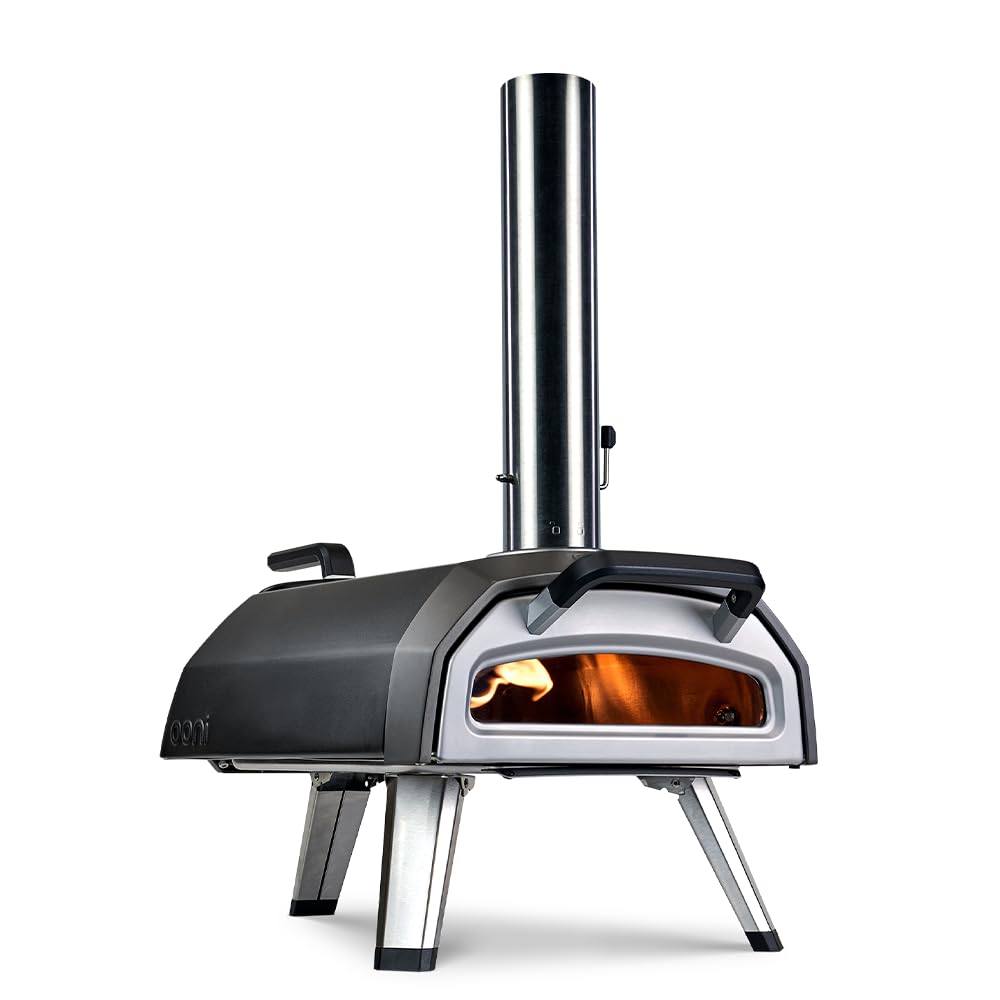
Ooni Karu 2

Ooni Karu 2

Wood-fired flavor

Our Score 9.0/10
Check Price

Worth Noting

  • Propane burner is a separate purchase
  • Bakes need turning and watching
Fuel
Wood/charcoal, gas optional
Weight
33.7 lb
Pizza Size
12 in
Max Temperature
950 °F
Read the full review

The Karu 2 is the one we pick when the fire is the point. It runs on wood or charcoal, reaches 950°F, and bakes a 12-inch pie in about 60 seconds — the fastest bake here, and the only one with smoke in the crust.

Read the multi-fuel claim closely. Wood and charcoal work out of the box; propane needs the separately sold gas burner, so if what you picture is turning a knob and walking away, price that in before comparing it to a gas oven. As a wood oven it is lovely: about 15 minutes to temperature, a glass door you can watch the pie through, and an integrated thermometer instead of guesswork.

At 15.3 kg it is the lightest serious outdoor oven in this group, and it comes apart for the car — more than the 43.5-pound HALO can claim. What it is not is hands-off. A 60-second bake means turning the pie as it cooks and learning to read the flame, and the first few sessions will teach you more than any instruction sheet. We think the crust is worth the practice, but buy it because you want to cook with fire, not because you want dinner to be easier.

Bottom line: We choose the Karu 2 when the fire is the point: 950°F, sixty-second pies, and a learning curve worth climbing.

5

Chefman Indoor Pizza Oven

Chefman Indoor Pizza Oven

Indoor winter pizza

Our Score 8.8/10
Check Price

Worth Noting

  • Deep 18.7-inch countertop footprint
Dimensions
18.7 x 17 x 10.94 in
Pizza Size
12 in
Max Temperature
800 °F
Temperature Range
300-800 °F
Read the full review

Before anything else, the Chefman asks for counter. It measures 18.7 inches deep and 17 wide, which eats most of the usable depth of a standard run, and at 23.3 pounds it is not the sort of thing you put away after every use. That is the deal you make for an 800°F ceiling in the kitchen and real Neapolitan-style edges in February.

Five presets cover Neapolitan, New York, thin crust, pan, and frozen, with a manual mode that lets you push the top and bottom elements independently. We spent most of our time in manual. The presets land close, and a small nudge on the top element is usually what turns a pale crust into a properly blistered one. It also pays to distrust the ready indicator: the panel hits temperature well before the stone has soaked up enough heat, and ten extra minutes makes a visible difference to the first pie of the night.

For a 12-inch household that wants to keep cooking when the patio is out of commission, this is the indoor oven we point people to. It costs less than the 14-inch alternative on this list and takes up roughly the same counter, so the only real thing you give up is size. If pizza night means four people and one big pie, spend the difference on the Big Horn instead.

Bottom line: For a kitchen that has to work in January, we recommend this one: 800°F, twelve-inch pies, and a stone in the box.

6

HALO Versa 16

HALO Versa 16

Big backyard pies

Our Score 8.8/10
Check Price

Worth Noting

  • 43.5 lb, so it stays where you set it
  • No peel in the box
Fuel
Propane
Weight
43.5 lb
Pizza Size
16 in
Heat-up Time
12 min to 750 °F
Read the full review

A 16-inch stone that turns itself is the whole argument for the Versa 16. Load a pie, close the lid, and five minutes later it comes out evenly baked with nobody standing over it holding a turning peel. If four people are making their own pizzas in the yard, that is the difference between a party and a production line.

The rest of the hardware holds up. The stone reaches 750°F in about 12 minutes, the cooking surface is the largest here, and it runs from a standard 20-pound propane tank or a one-pound canister. At 43.5 pounds it is not the tailgate oven the pitch suggests — the housing gets very hot, so plan a permanent spot on a heatproof table with nothing above it. The side-swinging lid opens the whole deck for cleaning, which we appreciated after a run of six pies.

Watch the stone rather than the lid thermometer, and give it a full 15 minutes with the lid shut; if you own an infrared thermometer, this is the oven where it earns its keep. The burner does the work and the stone does the cooking, and a stone that has not fully soaked will give you a pale base no matter what the gauge reads.

Bottom line: We like it for a crowd: the 16-inch stone turns itself, so you load a pie, chat, and pull it five minutes later.

7

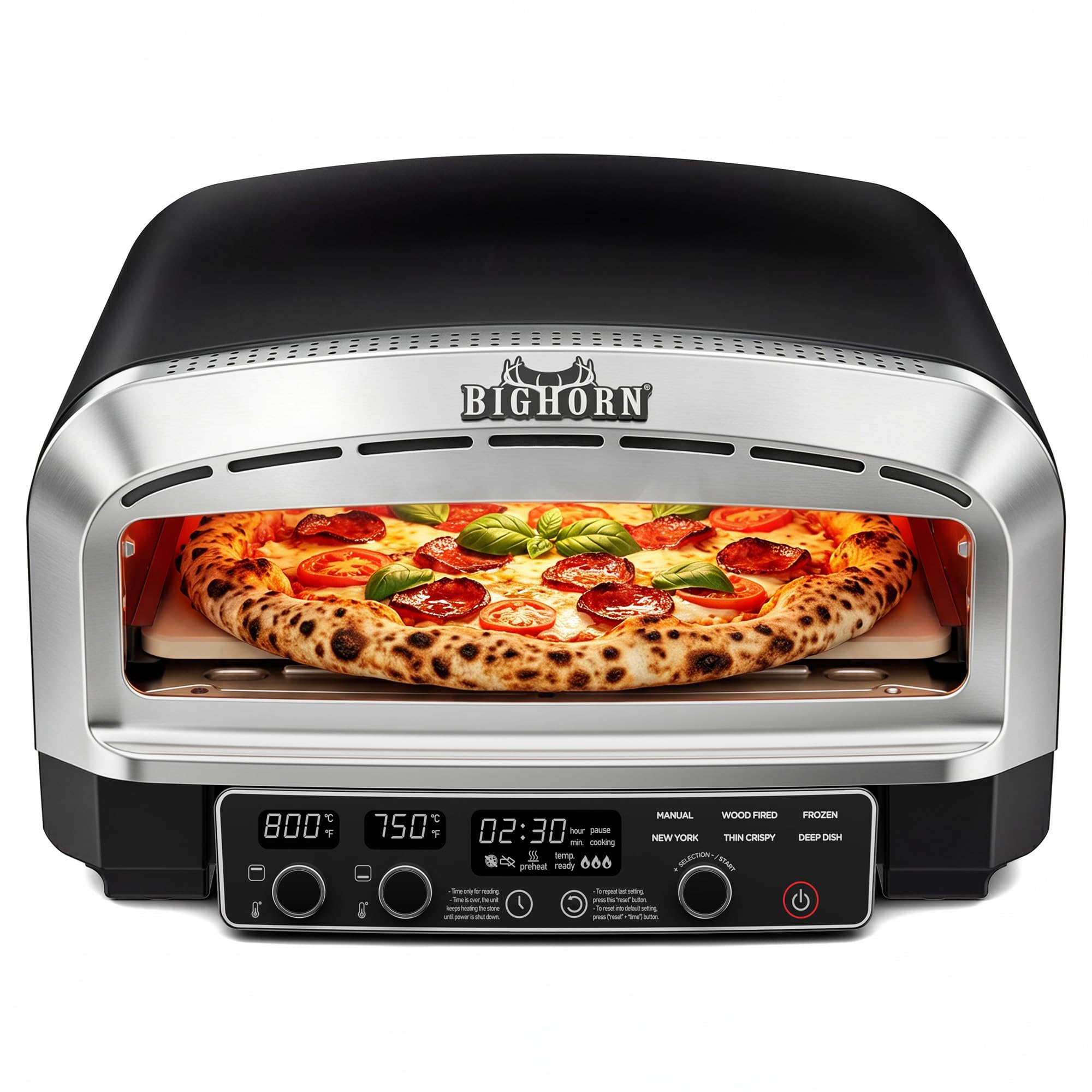
BIG HORN 14-Inch Indoor

BIG HORN 14-Inch Indoor

Feeding a family

Our Score 8.8/10
Check Price

Worth Noting

  • Controls take a session to learn
Dimensions
20.31 x 18.86 x 10.44 in
Pizza Size
14 in
Cooking Presets
6
Max Temperature
850 °F
Read the full review

Fourteen inches does not sound like much next to twelve until you are feeding four people and the difference is a third pizza. This is the only indoor oven here that fits a 14-inch pie, and with 850°F and PID temperature control it bakes one in about three minutes.

The package is unusually complete: stone, peel, six presets that include a wood-fired setting and a deep-dish one, and a body that flips up between uses to halve its footprint. Preheat runs about 15 minutes, the stone lifts out for cleaning, and the coated finish wipes down without drama.

The controls are where it asks for patience. The knob-and-preset arrangement is not the friendliest we used, and the first session goes on working out which control does what. Once you are past that, the PID holds temperature steadily across back-to-back pies, which is the thing that actually matters when you are baking for a family rather than photographing one pizza. Twelve-inch households can save money with the Chefman; anyone who regularly bakes for four should start here.

Bottom line: The one we reach for when four people want pizza at once: a 14-inch indoor bake with heat control that holds steady.

8

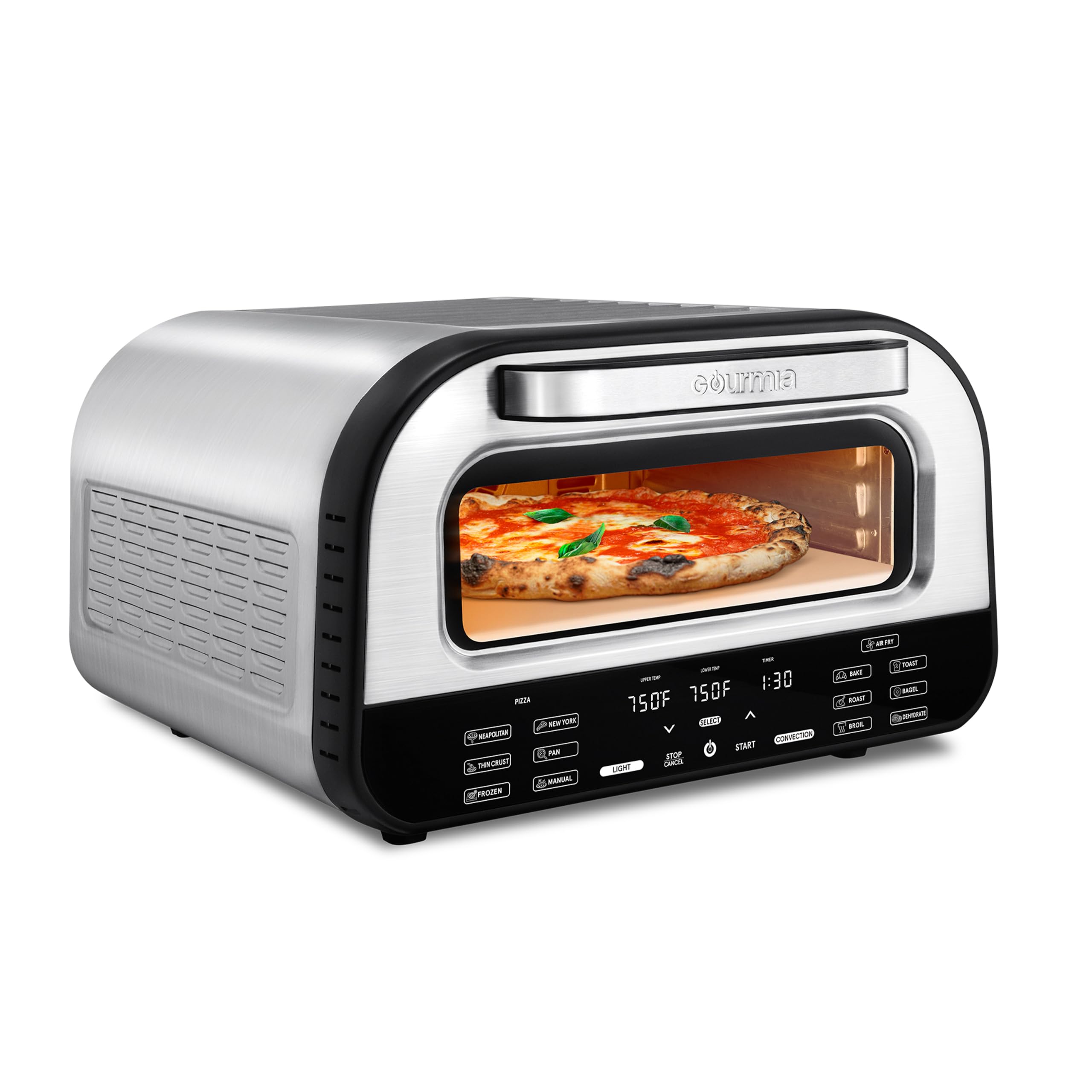
Gourmia Indoor Pizza Oven

Gourmia Indoor Pizza Oven

Small kitchens

Our Score 8.2/10
Check Price

Worth Noting

  • Most functions cap at 500°F
  • Heat runs hotter than the set temperature
Capacity
18 liters
Pizza Size
12 in
Pizza Mode Max
800 °F
Cooking Functions
Pizza, air fry, bake, roast, broil, toast
Read the full review

Seven functions, an air-fry basket, a drip tray, and a pizza stone that reaches 800°F: the Gourmia is trying to be the only thing on your counter. Judged as a multi-cooker that also does pizza, it makes a decent case for itself.

The pizza side is better than the price suggests. A 12-inch pie comes out with a crisp base and properly melted cheese, and the glass door and interior light let you watch the crust set without opening the door and dumping the heat. The stone preheat is what makes that work, and it is the mode worth learning first.

Consistency is where it wobbles. Preheat times swing from session to session, and the oven runs hotter than the number you set, so the first bake is a calibration exercise — start lower than you think and adjust. The dishwasher-safe basket and drip tray are genuinely welcome, because cleanup is the part multi-cookers usually get wrong.

We recommend it to a small kitchen that wants air frying and respectable pizza without spending much. If pizza is the main event rather than a bonus, one of the ovens above bakes better and behaves more predictably.

Bottom line: We recommend it for a small kitchen that wants air frying and real 12-inch pizza from one box, provided you will babysit the dial.

How We Tested Pizza Ovens

We started with a shortlist of ovens that could fit a standard outdoor patio or a sturdy countertop, then narrowed it by fuel type, footprint, claimed maximum temperature, and the kind of pizza each was designed to bake. Every oven on the list had to reach usable heat without a professional installation or a dedicated trailer. We ended up with seven models—wood, gas, pellet, and electric—and used them for nine months, rotating them through the same weekly pizza nights and a few larger backyard gatherings.

Each test started from a cold oven. We timed how long it took to reach its stated operating temperature, then launched the same room-temperature dough with the same simple topping load into every oven. We watched the first pie closely for bottom char, top browning, and whether the center cooked before the crust turned bitter. Then we baked two, three, and sometimes five pies back-to-back to see how quickly the stone or deck recovered and whether heat output stayed steady or faded.

Ease of use got its own set of checks: how much fiddling the door or baffle required, whether the peel slid under a raw pie cleanly, how easy the oven was to turn and rotate a pizza mid-bake, and how much ash or soot we had to manage afterward. We also noted heating performance on cool, breezy evenings, because an oven that only works on a still summer night is a fair-weather tool. After nine months, we checked stones for cracks, doors and hinges for wobble, burners and thermometers for drift, and exteriors for rust or warping. The ovens that made the final list produced consistently good pizza without constant babysitting, and they still felt solid after repeated use.

How to Choose Pizza Ovens

Indoor electric or outdoor fire

An electric countertop oven plugs in, needs no fuel and no clearance from a flame, and works in February. Its limits are a 12- to 14-inch footprint on your counter and a cord. A wood, charcoal, or propane oven gets hotter and tastes of smoke; it also needs an outdoor spot away from siding, a low roof, and anything that can scorch, plus a heatproof table underneath.

The trap is the phrase multi-fuel. On the Ooni Karu 2, wood and charcoal work out of the box and propane means buying the burner separately, so price the fuel you actually intend to use before comparing ovens. If most of your pizza nights happen indoors, buy the indoor oven first and the fire later.

Peak heat is the headline; balance is the bake

Chasing the largest number on the box is the common mistake. A 900°F oven with a cold stone bakes a pale, flabby base, and a 500°F oven with a properly soaked stone turns out a crisp one. What you want is separate control of top and bottom heat — the Chefman's manual mode, the Big Horn's PID control, the Presto's element switches.

The bottom element sets the base; the top sets the cheese and the spotting on the rim. If a pie browns on top before the base sets, take the top element down rather than the whole oven, and give the stone longer next time.

How big a pie, and how much counter

Twelve inches covers one hungry person or two moderate ones. If four people are eating, fourteen or sixteen inches saves a whole round of baking. Then check the footprint rather than the stone: the 16-inch HALO is 22.5 inches wide and 43.5 pounds, and a dropdown door needs clear space in front of it so you can slide a peel in.

In a tight kitchen, the Big Horn's flip-up body and the Presto's six pounds matter more than an extra inch of stone. Measure the depth of the counter you plan to give up, not the width of the box on the listing.

Turning, cleaning, and the parts that wear

A pie in a 60-second oven needs turning halfway; over a season, that is the difference between a hobby and a chore. A motorized stone or a wide open deck removes the job entirely. Cleanup is the other long-term tax, so look for a stone that lifts out and a crumb tray you can pull — the Wisco's slide-out tray and the HALO's hinged lid both save real scrubbing.

The parts that fail are predictable: stones crack, doors and handles take the heat. Favouring an oven with a replaceable stone and a simple door over one with an extra preset is money well spent.

Frequently Asked Questions

Final Verdict

The Ninja Artisan is the oven we recommend to most people. It delivers 700°F from a wall socket, bakes a 12-inch pie in about three minutes without turning, and costs less than the fire-burning options here. Buy it once you have found a covered outdoor spot with power.

Change the requirement and the answer changes with it. If the oven has to live indoors, take the Chefman for 12-inch pies or the Big Horn 14-inch for a family. If the fire is the reason you are doing this, the Ooni is worth the learning curve — and if you mainly want supermarket pizza done properly and cheaply, the Presto is the one to grab.