Outdoor

Best Outdoor Benches of 2026

An outdoor bench can look perfect in a product photo and feel like a mistake by July. The bolts strip, the seat collects water, the powder coat bubbles at the welds, and what seemed like a reasonable price turns into a wobbly prop you never sit on. What you want is simple: a bench that goes together without a fight, looks settled on the porch or under the tree, and still feels solid after a few seasons of weather.

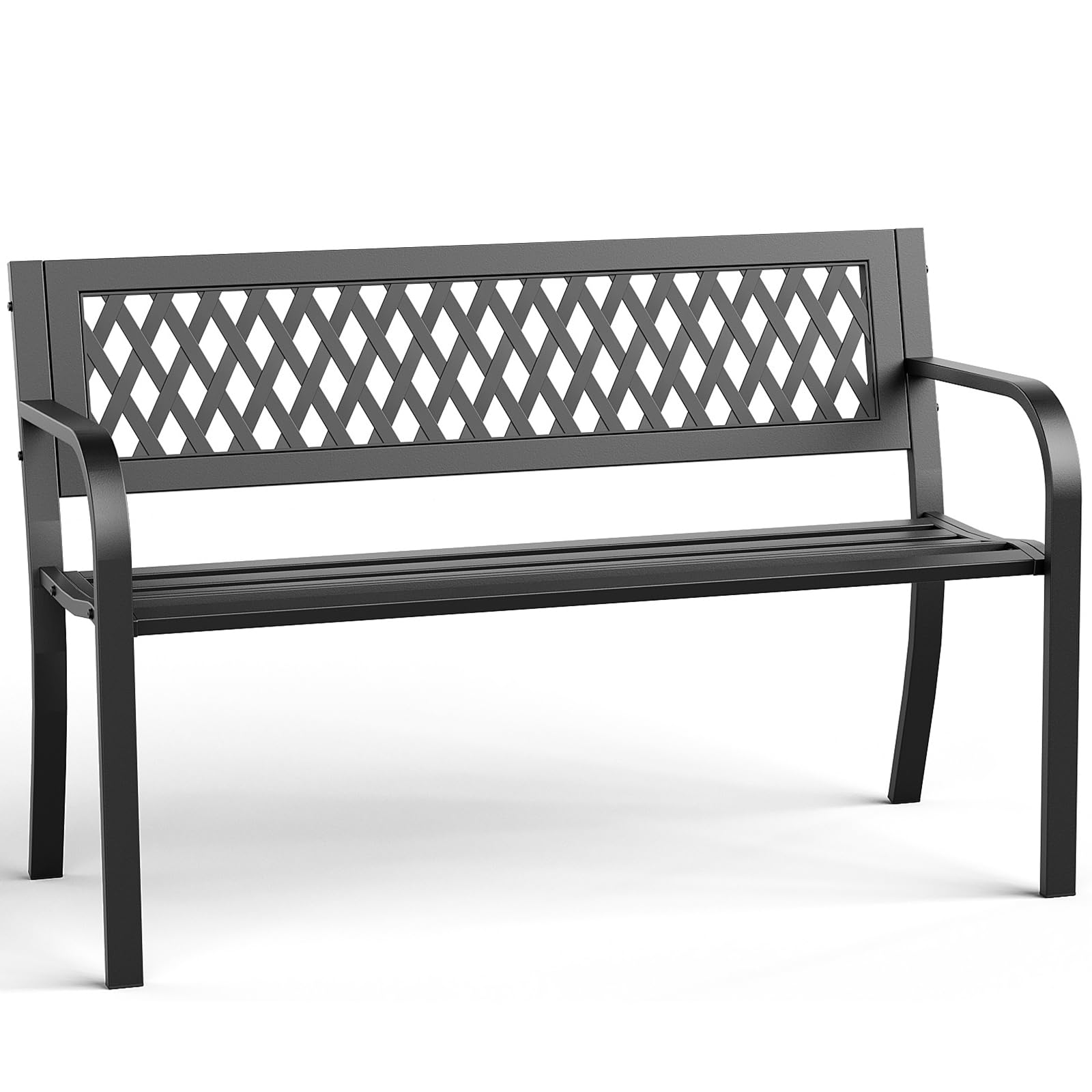
We put twelve benches through eight months of real use—on a sunny deck, a damp garden corner, and a covered porch—assembling each one solo, sitting long enough to judge comfort, and watching joints for rust and wood for splintering. Appearance is easy to fake online; sturdiness, durability, and value are not. A useful rule I learned: the material sets the maintenance—wood needs oiling, metal needs coated hardware, and composite hides a lot but can feel plasticky and flex when you shift. The picks below earned their place by holding up, not just showing up.

1

Psilvam Poly Lumber Bench

Top Pick
Psilvam Poly Lumber Bench

Year-round gardens

Our Score 9.6/10
Check Price

Worth Noting

  • Hard plank seat needs a cushion
  • Costs well above the budget steel benches
Frame
Recycled polystyrene (poly lumber)
Bench Weight
65 lb
Assembled Size
47"W x 23.6"D x 36"H
Weight Capacity
700 lb
Read the full review

Poly lumber is the reason this bench is our top pick. It is recycled polystyrene, molded and colored to read as painted wood, and it takes the single most common failure in this category off the table: steel that rusts from the joints outward. There is nothing to repaint, nothing to seal, nothing to oil — a hose and a stiff brush handle a season of pollen and tree sap.

At 65 pounds it is the heaviest two-seater in this set, and the mass does useful work. The 700-pound rating is well beyond what two adults need, the frame does not flex when someone drops into it, and the bench stays where you set it instead of skating across a deck in a gust. The trade shows up on moving day: you want a second person to carry it around the house.

Setup is nine screws into pre-drilled holes with the parts numbered, and the pieces are light enough to pass through a gate one at a time. Do plan on a cushion. The seat is a flat, hard plank — the same as every bench of this shape — and at 15.35 inches it sits lower than most here, which is comfortable for shorter legs and less so if you are tall.

What you pay for is the material and the weight, and that is the honest summary. It costs well above the budget steel benches, and it reads as painted wood rather than joinery, so if you want a bench that looks like cast iron, look further down this list. If you want the one you can leave out from April to November without thinking about it, this is it.

Bottom line: We point anyone who plans to leave a bench out all year here: poly lumber means no rust to chase, and a 700-pound frame takes two adults without a wobble.

2

ACUEL 50-Inch HDPE Bench

ACUEL 50-Inch HDPE Bench

Large households

Our Score 9.6/10
Check Price

Worth Noting

  • One finish only
Frame
HDPE with stainless steel hardware
Bench Weight
52.9 lb
Assembled Size
49.8"W x 24.8"D x 36.8"H
Weight Capacity
800 lb
Read the full review

Both poly benches here solve the same problem, and the ACUEL solves it slightly differently: 50 inches wide instead of 47, wide flat armrests instead of a slim frame, and HDPE rather than polystyrene. What we noticed first is the hardware. Stainless bolts on a bench built to sit in the rain are the detail most makers skip, and they are the one that decides whether a weatherproof bench is still weatherproof in year four.

At 52.9 pounds it is lighter than our top pick while carrying a higher 800-pound rating, and the armrests change how it feels to use: there is somewhere to put a mug, a book, or a hand while you push yourself up. The seat back is squared off in a farmhouse profile, which suits a porch railing or a shingled wall better than a formal border.

Assembly is designed rather than endured. The parts are numbered, the holes are pre-drilled and aligned, and because the bolts are stainless you are not spending the first season watching for rust blooms around the heads. The three-year warranty is the longest in this set.

The limit is the finish list: mocha brown is the only color. If that reads as a warm weathered wood to you, it is a better-looking bench than the price suggests, and the width makes it the one we point larger households toward. If you want a painted-wood look in a garden border, the Psilvam does that job more convincingly.

Bottom line: The other no-rust bench worth buying: wider than our top pick, with flat armrests, an 800-pound rating, and stainless hardware that will not stain the slats.

3

FDW 46-Inch Garden Bench

FDW 46-Inch Garden Bench

Tight budgets

Our Score 9.4/10
Check Price

Worth Noting

  • Plastic grid backrest, not cast metal
Frame
Powder-coated steel, plastic backrest
Seat Height
18 in
Assembled Size
45.7"W x 20.5"D x 29.9"H
Weight Capacity
480 lb
Read the full review

Four pieces and a small bag of bolts — that is the entire bench. Assembly is where cheap outdoor furniture usually gives itself away, with holes that do not line up and hardware that strips, and this one sidesteps it: the parts are labeled, the bolts go in cleanly, and two people can have it standing in one short session.

What we like is how much of a real bench you get for the money. The 45.7-inch seat is honest two-person width rather than a squeeze, the 480-pound rating is generous for a 23-pound frame, and the 18-inch seat height is taller than most here — closer to a dining chair than a lounger, which is easier on knees and harder on slouching.

Two things to know. The backrest is a molded plastic grid rather than cast metal, so it will not feel like wrought iron up close, and the screw heads and joints are where the powder coat is thinnest — exactly where water sits. A quick pass with matching spray paint over the bolts before you assemble it is the cheapest insurance on this page. For a porch or an entryway out of the worst weather, that is a trade worth taking.

Bottom line: Our budget pick: two people fit on a genuinely sturdy frame, and the only real cost is keeping paint on the joints where water sits.

4

Maemttes 50-Inch Metal Bench

Maemttes 50-Inch Metal Bench

Three-across seating

Our Score 9.2/10
Check Price

Worth Noting

  • Light enough to shift in open wind
Frame
Powder-coated alloy steel
Bench Weight
29 lb
Assembled Size
50.4"W x 21.3"D x 32.7"H
Weight Capacity
880 lb
Read the full review

880 pounds is the highest rating in this set, and it comes on a bench that is 50 inches wide and 29 pounds. That combination looks odd until you see it: the frame is alloy steel dressed up as cast iron, and the rating is there for three adults piling on, not two.

The 50-inch width and 16.54-inch seat height land where most people want them, and 29 pounds is light enough to haul out of the way when the mower comes through. The backrest is metal in a decorative pattern, which is more than the budget benches here can claim, and the finish reads as bronze rather than flat black.

Here is the honest reason it is not our top pick: painted steel outdoors is a maintenance item and poly is not. The finish is the wear part, and the bolts are where it wears first — touch up chips while they are small and this bench looks after itself otherwise. Buy it if you need three-across seating from a metal bench, and if the wind on your property is serious, site it against something solid.

Bottom line: The metal bench we recommend when three adults need somewhere to sit: 880 pounds of capacity on a 50-inch frame that one person can still drag.

5

VINGLI 38.5-Inch Rose Bench

VINGLI 38.5-Inch Rose Bench

Narrow porches

Our Score 9.2/10
Check Price

Worth Noting

  • 13.5-inch seat depth is a perch
  • Narrow
Frame
Cast aluminium and cast iron
Bench Weight
20.7 lb
Assembled Size
38.5"W x 13.5"D x 31"H
Weight Capacity
500 lb
Read the full review

The rose scrollwork is the whole reason to look at this bench. Three round flower motifs make up the seat panel, the backrest is a cast-aluminium rose pattern in a bronze finish, and the legs are cast iron with a curl at the foot. Against a plain porch wall or at the edge of a border, it does decorative work that a slatted bench simply cannot.

The dimensions are where it gets specific: 38.5 inches wide, 13.5 inches deep, 31 inches tall, and 20.7 pounds. That 13.5-inch seat depth is the number we keep coming back to. A typical dining chair is around 17 inches deep, so this is a perch — fine for a coffee and a phone call, not for an afternoon with a book.

Assembly is genuinely simple: the frame arrives in a few castings, the hardware includes screw caps to cover the bolt heads, and one person can manage it. The 500-pound rating is generous for the size, though the usable seat is narrow enough that two adults fit only if they like each other.

So it is a decorator's bench with a 500-pound frame, which is a fair description. Buy it for a narrow porch, a courtyard, or a spot beside a path where the look is doing the work. Do not buy it as the household's main outdoor seat — the shallow seat and the narrow width will send everyone back to the chairs.

Bottom line: Buy it as porch jewelry you can sit on briefly: the rose scrollwork is the point, and the 38.5-inch width fits where nothing else will.

6

Make Changes 47-Inch Bench

Make Changes 47-Inch Bench

Sheltered porches

Our Score 9.2/10
Check Price

Worth Noting

  • Too light for an exposed, windy spot
Frame
Powder-coated steel, plastic backrest
Bench Weight
20 lb
Assembled Size
47"W x 20"D x 30"H
Weight Capacity
500 lb
Read the full review

20 pounds is the whole story here. That is the lightest bench in this set by a wide margin — light enough for one person to carry out of the garage and set down without help, and light enough that you think about where it stands before a storm rolls in.

The rest is a familiar package done well: a 47-inch powder-coated steel frame, a 500-pound rating, a plastic grid backrest with a decorative pattern, and a slatted seat at 16 inches. Assembly is a handful of bolts, and we were pleasantly surprised by how smooth the powder coat is — it does not read as a cheap bench until you are standing right next to it.

Where it belongs is a covered porch, a balcony with a wall behind it, or a patio corner out of the prevailing wind. In the open, a 20-pound bench is a bench that relocates. Set against a railing with a planter at each end, it is a good inexpensive seat that one person can reposition for the season, which is more than most of the benches here can say.

Bottom line: A light, inexpensive two-seater for a sheltered porch: at 20 pounds it is the easiest bench here to move, and the one most likely to move itself.

7

Christopher Knight Esme Bench

Christopher Knight Esme Bench

Entryways

Our Score 9.2/10
Check Price

Worth Noting

  • No backrest
Style
Backless slat bench
Material
Acacia wood, teak finish
Assembled Size
63"W x 16.5"D x 17.75"H
Weight Capacity
400 lb
Read the full review

This is not a lounge bench, and it is worth saying so first. Sixty-three inches wide, 16.5 inches deep, 17.75 inches tall, no back — it is a plank on two angled legs, in acacia with a teak finish, and it is happiest doing something other than holding two people for an afternoon.

That is not a knock on how it is made. The legs attach with four long screws, it arrives nearly built, and the 400-pound rating covers three people sitting down to pull boots on. Of everything here, it is the one that takes the least time to get out of the box and into position.

Acacia is a real outdoor wood, and the teak color is a finish on it rather than a treatment through it. An annual coat of teak oil keeps it from silvering, and a bench this low and this light is easy to cover or carry into a garage for the worst of the winter. Four screws also mean it is only as steady as the surface under it — check them after the first month, especially on a deck that flexes.

We recommend it for the jobs a bench does when nobody is sitting: the foot of a bed, an entryway that needs a landing spot, a long wall that wants something under a row of plants. Bought as evening seating for two it will disappoint. Bought as the best-looking 63-inch surface in this list, it earns its place.

Bottom line: Not a lounge bench: a 63-inch backless acacia plank that earns its place in an entryway, at the foot of a bed, or under a row of plants.

8

Lifetime Convertible Bench

Lifetime Convertible Bench

Small decks

Our Score 9.0/10
Check Price

Worth Noting

  • Slat screws can work loose over time
  • Two people make assembly easier
Frame
Powder-coated steel, faux wood slats
Conversion
Bench to picnic table
Assembled Size
55.5"W x 33.9"D x 29.1"H
Seating Capacity
3
Read the full review

A small deck asks a bench to do more than one job. This one answers by not being only a bench: pull the backrest up and it locks into a 55-inch picnic table; drop it and you are sitting on a three-person bench again. It is the only piece here that earns its floor space twice.

We like it most for that reason, and because the mechanism is genuinely one-person work — a spring-loaded latch, not a puzzle. The frame is powder-coated steel under faux-wood slats, the 500-pound rating covers three adults, and the conversion is smooth enough that you will actually use the table instead of leaving it in bench position forever.

Two practical notes. Assembly wants a second person for the frame, and the tool list does not mention needle-nose pliers, which you need for the two springs — have a pair within reach before you start. In table mode the footprint is 33.9 inches deep, so measure the deck before you commit; it needs room behind it.

Where it does not fit is a formal garden or a front path. This looks like sturdy outdoor furniture rather than decoration, and it belongs where people eat. For the patio that has to be a bench on Tuesday and a dinner table on Saturday, nothing else here does the job.

Bottom line: For a deck that has to seat a crowd and serve dinner, this is the pick: one person can flip it from three-person bench to picnic table in seconds.

How We Tested a Dozen Outdoor Benches

To build the shortlist, I read through hundreds of customer reviews and spec sheets, then filtered for material, seat height, depth, weight capacity, and price. We ruled out benches with vague hardware descriptions or finishes that seemed to rely on a fresh coat of paint, and we deliberately mixed wood, metal, and composite so the comparison wasn't rigged. The final twelve went through eight months of testing, spread across a backyard, a front porch, and a garden corner that stays damp after rain.

Each bench arrived as a box of parts; I assembled every one alone with the included tools and a timer, noting where the instructions stalled, how many bolts needed a second pair of hands, and whether the finished frame sat level without shims. After assembly, I sat in the center and at each end, rocked side to side, and leaned back to see if the joints shifted or the legs lifted. Any bench that wobbled on day one got flagged—sturdiness is one thing you can't add later.

Comfort came down to time, not first impressions: I spent at least twenty minutes on each bench with a book, judging seat depth, back angle, and whether the edges dug into my legs. For appearance, I checked the finish from a few feet away and up close, looking for uneven color, rough sanding, and gaps at the joints. Durability was a season-long watch—rain, sun, and temperature swings left their marks, and I checked bolt heads for rust, wood for splinters and fading, composite for sagging, and cushions for waterlogged foam. Value got the final say: I compared price against materials, hardware, and how much upkeep each bench would demand.

How to Choose Outdoor Benches

The frame decides how long it lasts

Three materials cover almost everything here: painted steel and cast iron, poly lumber, and outdoor wood. Steel is the stiffest and the cheapest per inch of seat, but its finish is a wear part — the coating is thinnest at the bolt heads and at the joints where water collects, and that is where rust starts. Poly lumber cannot rust or rot and never needs repainting, which is why the benches we recommend most confidently for uncovered spots are poly.

Wood sits in between. Acacia and similar outdoor hardwoods are genuinely weather-ready, but a factory finish is not a permanent one, and an annual oil or a winter cover is the price of keeping the color. Our rule: if rain lands on it all year with no roof overhead, pay for poly. Under a porch roof, painted steel is fine — keep matching touch-up paint on the shelf and hit chips while they are small.

Seat depth and height beat the photograph

The number that separates a bench you sit on from a bench you look at is depth. Twenty inches and up takes a cushion and a whole evening. The shallow decorative benches here run closer to 13 to 16 inches, which makes them perches — fine for a coffee, not for a book. Add roughly two inches for a cushion when you are working out clearance.

Seat height is the other half. Sixteen to seventeen inches suits most adults and lets shorter legs reach the ground; an 18-inch seat is easier to stand up from and harder to settle into. Measure depth and height before you fall for the scrollwork.

Two people or three — width versus rating

Allow about 20 inches of seat per adult. A 45- to 50-inch bench seats two comfortably and three only if they are close; a 63-inch backless bench seats three with room to spare. Armrests eat into that usable width, so a wide bench with heavy arms can seat fewer people than its tape measure suggests.

The weight rating is not a seating capacity. An 880-pound bench is built for two or three heavy adults, not six, and a 500-pound rating on a 20-pound frame tells you about the steel rather than about how many friends fit.

Weight is a wind decision

Bench weights in this group run from 20 to 65 pounds, and the difference cuts both ways. A light bench is one you drag out of the way to mow and carry through a gate alone; it is also the one that shifts in a gust, so give it a wall, a railing, or a sheltered corner. A heavy bench stays where you put it and takes two people to reposition.

Neither is better. Decide which problem you would rather have: moving the bench, or chasing it.

Assembly, hardware, and the yearly ten minutes

Look for pre-drilled holes, numbered parts, and stainless hardware. A zinc bolt in an otherwise weatherproof bench is the one component that still rusts, and it will stain the slats below it. Assembly is usually a single session's work and much easier with a second person holding the frame square while the first drives bolts.

Upkeep depends entirely on what you bought: soap and water on poly, a rinse and a touch-up on steel, an oil coat on wood. None of it takes long, and all of it is easier done before the season starts than after.

Frequently Asked Questions

Final Verdict

Poly lumber is where we start, and the Psilvam is the bench we recommend: nothing on it can rust, 65 pounds keeps it where you set it, and the maintenance is a hose. If your bench lives under a roof and the poly premium is hard to justify, the Maemttes holds three adults on an 880-pound frame for a fraction of the money — just keep an eye on the paint.

And if the deck has to serve dinner as well as shade, the Lifetime convertible does two jobs in one footprint. Those three cover almost every backyard; the rest of this list exists to fit the odd gap, the narrow porch, and the entryway.