Outdoor

Best Outdoor Grills of 2026

Every grill looks promising in the showroom. The real test comes in the second summer — whether the firebox has started to flake, whether the burners still light on the first click, whether the lid thermometer tells the truth. I've spent enough Saturdays assembling these on a driveway to know the wrench session is part of the deal. What a good grill actually buys you is smaller and better: dinner outside on a Tuesday, no flare-up panic, no scraping rust off the grates in June.

Over eight months, my team and I cooked on seven grills — gas, charcoal, and one pellet model — starting in late spring and carrying on through a stretch of cold-weather cooks. The number quoted most, BTU count, tells you least; heat delivered per square inch of actual grate space, and the thickness of the steel holding it in, matters far more. What follows are the grills that held their temperature, went together without a fight, and still looked worth owning after a summer of rain.

1

Weber Jumbo Joe 18

Top Pick
Weber Jumbo Joe 18

Camping and tailgating

Our Score 9.6/10
Check Price

Worth Noting

  • Legs rust if it's stored wet
Lid
Tuck-N-Carry lock
Fuel
Charcoal
Weight
18 lb
Cooking Area
240 square inches
Read the full review

The lid locks down with a twist and the whole kettle carries by a single handle, ash and all. That's what makes the Jumbo Joe a travel grill rather than just a small one. Eighteen pounds and about twenty inches across means it rides in the trunk beside the cooler, and the porcelain bowl doesn't care whether it lands on a tailgate or a picnic table.

We take it because it cooks like a kettle, not like a camping gadget. The dampers work the same way as the big Weber's, the grate is 18.5 inches, and a chimney of coals gives you a hot side and a cool side for a few steaks or six burgers. Cleanup is the aluminum ash catcher, which lifts straight out.

The catch is scale. Two hundred and forty square inches feeds four comfortably and gets tight at eight, so a crowd means cooking in batches. The legs are the part that ages, with rust at the joints after a few seasons outdoors, so store it dry and it keeps going. Nothing else here cooks this well this far from home.

Bottom line: Our pick when the grill has to leave the yard: it cooks like a kettle, locks shut for the car, and weighs less than most coolers.

2

Weber Kettle Premium 22

Weber Kettle Premium 22

All-round backyard grilling

Our Score 9.4/10
Check Price

Worth Noting

  • Dented or bent parts on arrival
  • Plated steel grate, not cast iron
Fuel
Charcoal
Weight
32.3 lb
Cleanup
One-Touch ash system
Kettle Size
22 inches
Read the full review

Two dampers and a hooked lid are the entire control system, and that turns out to be enough. The bowl and lid are porcelain-enameled steel, the grate is plated steel, and the grill weighs a little over thirty pounds, light enough to drag into the shade and heavy enough to stay where you park it. After a few cooks you steer temperature by how the coals look and sound, not just by the lid thermometer.

That control is why this is our top pick. Nothing else here is as forgiving for someone moving from gas to live fire: close both dampers and the fire settles, open them and it climbs, and a two-zone setup with coals banked to one side is a job for a pair of tongs. Ash is the chore people dread, and the One-Touch vanes sweep it into a catcher underneath, so cleanup takes half a minute the next morning.

Capacity is honest at 22 inches: about a dozen burgers, a spatchcocked chicken, or two racks of ribs with a little rearranging. The limitation is the fuel itself. There's a lighting window before dinner, and a windy evening eats into the coal bed. A chimney starter handles the first part, a sheltered corner the second.

What we kept coming back to is how little fuel it takes. One chimney of briquettes runs a two-zone dinner for four, and the bag outlasts what we expected. That's the quiet argument for a kettle over a big cart: you're not heating a party-sized grate to cook six burgers.

Bottom line: For one grill on one patio, this is the one we point to: charcoal flavor, heat you can steer, and the longest warranty in this group.

3

Cuisinart CGG-306

Cuisinart CGG-306

Balcony and tailgate

Our Score 8.8/10
Check Price

Worth Noting

  • Internal parts rust when stored uncovered outdoors
Weight
22 lb
Burners
2 stainless steel
Cooking Area
275 square inches
Total Output
20,000 BTU
Read the full review

Two burners, 275 square inches, and 22 pounds: this is the grill for a balcony, a tailgate, or the corner of a patio where a full cart won't fit. The legs fold, the lid locks, and it carries by a handle like a suitcase, which is why it's the one we grab for a day out.

We like it for that job and not much past it. It heats fast and sears properly, and the stainless grates put a crust on a burger without complaint, but holding a genuinely low temperature is the hard part. The workaround is running one burner and parking the food on the cold side, which works fine once you've done it twice.

Size is the other honest limit. Two hundred and seventy-five square inches is about a dozen burgers, enough for four people with a little juggling and tight at eight. Where it earns its keep is storage and travel: it takes less shelf space than a cooler, and the folding legs let it live in a closet between weekends.

Bottom line: For a balcony, a tailgate, or two people cooking, it's the portable gas grill we reach for, provided it gets stored dry.

4

Monument Mesa II 410FBZ

Monument Mesa II 410FBZ

Everyday gas cooking

Our Score 8.6/10
Check Price

Worth Noting

  • Two-year overall warranty
Burners
4 main with Broil Zone
Warranty
2 years; 8 on burners
Cooking Area
525 square inches
Side Shelves
Foldable
Read the full review

Four main burners, 525 square inches, and side shelves that fold flat: on paper the Mesa II reads like a gas grill that should cost noticeably more than it does. What settled it for us is how little it asks in return. It lights on the first click, the heat spreads evenly enough that a full grate of chicken thighs browns at the same rate, and the folded shelves leave a narrow patio walkable.

Gas earns its keep on a weeknight. No chimney, no ash, no waiting: turn two burners on, close the lid, and you're cooking. The 525 square inches is more room than the kettle or either tabletop grill here, enough for a family of four with a little left over, and the warming rack keeps finished food out of the way while the rest catches up.

The compromises are materials and coverage. The cart and firebox use thinner steel than the premium gas grills in this group, so a cover is part of the purchase rather than an accessory, and the warranty runs two years, with eight on the burners. At this price that's a reasonable set of trade-offs, and the parts most likely to need replacing are the ones covered longest.

Bottom line: The gas grill we suggest to most people, because four burners, even heat, and folding shelves cover a normal backyard better than anything else here.

5

Royal Gourmet GA6402S

Royal Gourmet GA6402S

Large backyard parties

Our Score 8.6/10
Check Price

Worth Noting

  • Very heavy at 116.6 pounds
Weight
116.6 lb
Burners
5 main, sear, side burner
Cooking Area
835 square inches
Total Output
74,000 BTU
Read the full review

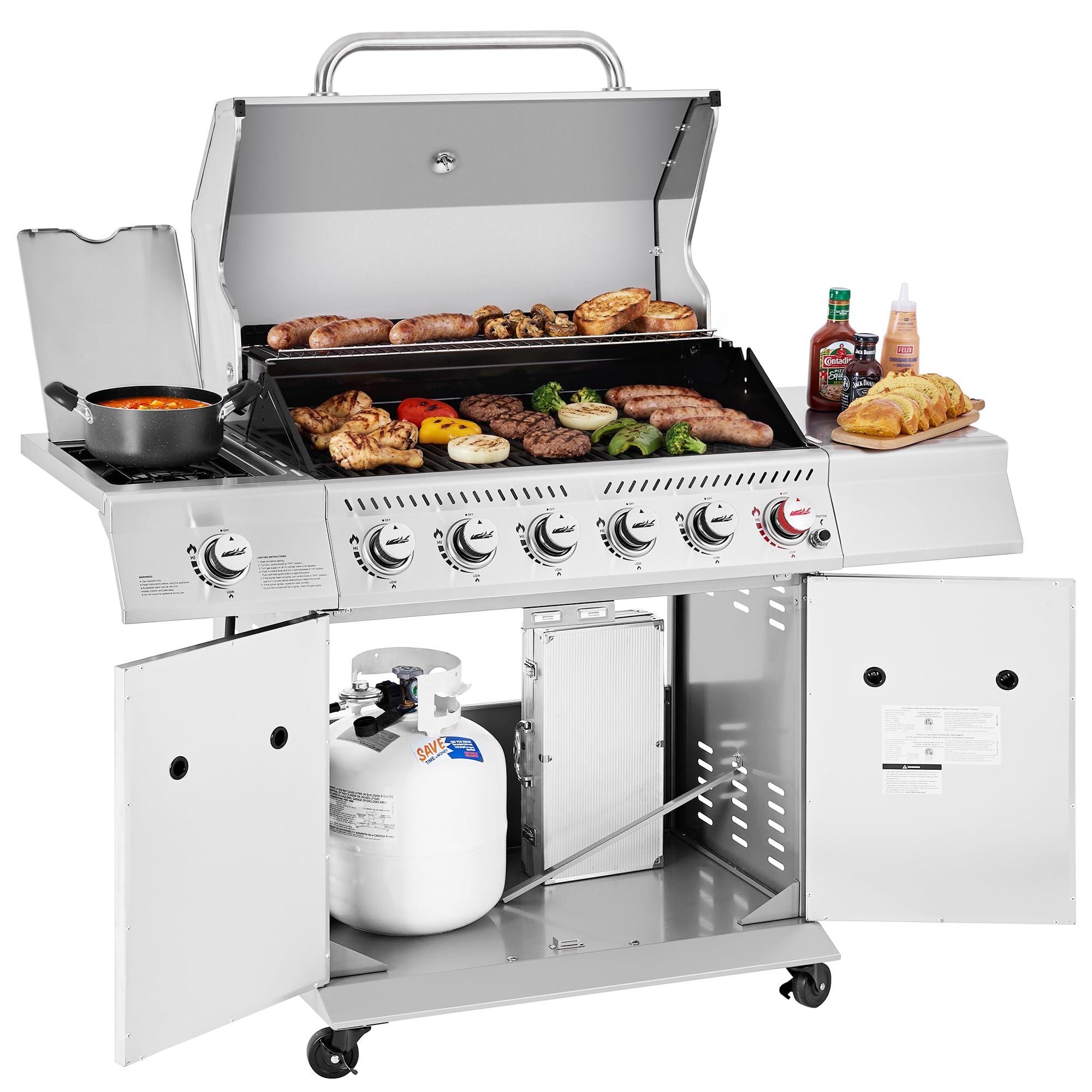
Eight hundred and thirty-five square inches isn't a number most backyards need. It's more than three times the grate on a tabletop grill, and it's rated for thirty-nine burgers at once. What that buys is a party where everything comes off the fire together instead of in waves.

The hardware is there for it: five main burners, a 14,000 BTU sear burner, and a 10,000 BTU side burner, each with its own igniter, so you can run two burners for a Tuesday dinner and all of them for a crowd. The cabinet underneath swallows trays and foil, and the locking casters keep it from wandering across the patio.

We rate it as the capacity pick, not the everything pick. The painted cabinet is the part that ages outdoors, so it wants a cover and a sheltered spot, and the whole cart is happiest when it stays put for the season. Host twice a month and that's a fair trade. Grill for two and you're heating a lot of steel for six burgers.

Bottom line: We keep this one for hosts: 835 square inches, a sear burner, and a side burner mean one cook can feed a whole yard without a second round.

6

Electactic 3-Burner

Electactic 3-Burner

Mid-size gas cooking

Our Score 8.6/10
Check Price

Worth Noting

  • One-year warranty is short for a cart
Burners
3 main plus side burner
Warranty
1 year
Cooking Area
489.17 square inches
Total Output
34,000 BTU
Read the full review

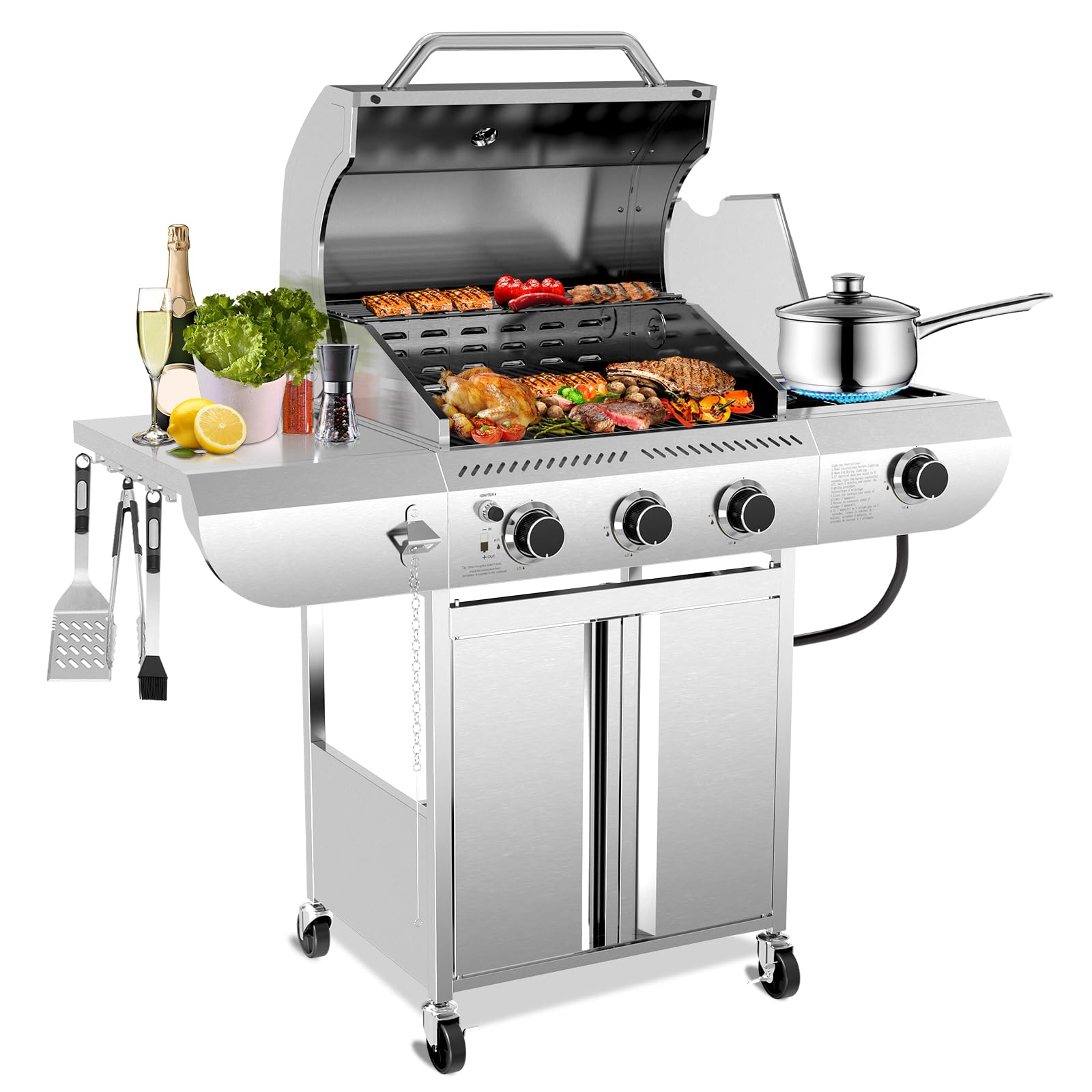
The 10,000 BTU side burner is what separates this cart from the other mid-priced gas grills here. It gives you somewhere to boil corn or finish a sauce while the main grate works, and the whole grill comes in well under the big Royal Gourmet.

The main grate measures 358.95 square inches, with a warming rack that brings the total to 489.17, enough for four people with room to shuffle things and not enough for a block party. Three 8,000 BTU burners plus the side burner total 34,000 BTU, the lid and body are stainless, and the grates are cast iron. Cast iron at this price is more than we expected.

Heat is the open question. The grill can run hotter toward the front of the box and cooler at the back, so rotate food rather than trusting the knobs, and treat the first cook as a test: burgers and a thermometer rather than a ribeye you care about. Assembly is quick, the locking casters roll well, and the whole thing looks more expensive than it is.

Bottom line: If a side burner matters and flagship money doesn't, we rate this cart the value play, with the caveat that heat runs uneven front to back.

7

Grills House ZH3005Y-SC

Grills House ZH3005Y-SC

Gas plus charcoal

Our Score 8.4/10
Check Price

Worth Noting

  • Thin steel; finish shows wear outdoors
  • Assembly is fiddly, with diagram-only instructions
Fuel
Gas, charcoal, offset smoker
Weight
87 lb
Cooking Area
1,020 square inches
Total Output
34,000 BTU
Read the full review

Gas on one side, charcoal in the middle, an offset smoker hanging off the end: one cart, three ways to cook, and 1,020 square inches to do it on. Nothing else here covers gas and live fire together, which is the whole reason to look at it.

The flexibility is real. Two 12,000 BTU gas burners plus a 10,000 BTU side burner handle quick weeknight cooking, the charcoal pan adjusts through three heights so you can sear or slow-cook over the coals, and the smoker box takes wood chunks for a long Sunday brisket while the gas side does the sides.

The catch is upkeep. Three fuels mean three kinds of maintenance: propane to refill, charcoal and wood to keep dry, and an ash pan to empty. It's more to manage than a single-fuel grill, and the payoff only shows up if you actually use the smoker. A household that never lights the offset is paying for hardware it won't use.

We treat it as a second grill or a way to try smoking without buying a dedicated smoker. It does three jobs competently and none of them to the standard of the single-purpose picks above; what it offers is options on one cart, in one footprint, for less than a premium gas grill alone.

Bottom line: For a household that can't pick between gas, charcoal, and smoke, this is the cart we suggest, as long as thin steel and a fiddly build are acceptable.

How We Tested the Best Outdoor Grills

We started with a list of about 40 grills and cut it down by cooking area, burner configuration, grate and firebox material, price, and whether replacement parts were actually available a few years out. Reviews mentioning rust at the welds or a hardware bag that didn't match the manual sent several models off the list before we ever lit them. That left seven: four gas, two charcoal, and one pellet.

Assembly came first, on a driveway, with a stopwatch and only the tools in the box. I timed how long each build took solo, noted which steps genuinely needed a second person for the lid or side shelves, and checked the hardware count against the manual. Then I taped each footprint on a 10-by-10 deck, opened the lid to see how far it swung back, and rolled every grill across grass, over a patio step, and up a ramp to see which casters locked and which dug in.

For cooking, I preheated each one with an ambient thermometer at grate level and logged the climb to 500 degrees, then set four probes across the surface to map where the hot and cool zones fell. We cooked 80/20 burgers, chicken thighs, and a full batch of vegetables with the lid down, watching for flare-ups and how quickly the grease tray filled. Grills stayed outside through rain, so I checked fasteners, hinge slop, and paint at the firebox seams, compared each lid thermometer against an instant-read, and counted what came in the box versus what was sold separately.

How to Choose Outdoor Grills

Pick the fuel that fits your evenings

Charcoal gives you smoke, a harder sear, and a lighting window before dinner. Gas gets you cooking almost immediately and asks only for a tank. If you cook on weeknights, gas earns its keep, and a cart like the Monument Mesa II hides that convenience under a lid. If grilling is a weekend ritual, a kettle returns more flavor for the money. Electric is the route where open flame isn't allowed, but none of them produce a real crust, so treat one as a different appliance rather than a smaller grill.

Match the grate to your actual crowd

Capacity is the specification people overbuy. The 18-inch Jumbo Joe's 240 square inches feeds four; 275 square inches on a tabletop does about a dozen burgers; 525 handles a family plus leftovers; and 835 is party territory, rated for 39 burgers at once. Buy for your usual Saturday, not your biggest one. A huge grate takes longer to heat, burns more fuel, and eats patio you may want for chairs.

Heat control beats headline BTU

Any grill gets hot; the question is whether it can sit at a low temperature for a pork shoulder and then climb for a sear. On charcoal that's dampers and a two-zone coal bed. On gas it's burner count, a sear zone, and a lid thermometer you trust. Treat a big BTU number as fuel consumption as much as power: a grill with modest burners and good air control beats a hot box you can't dial down.

Weigh it before you fall for it

Weight decides whether a grill gets used. Eighteen pounds goes in a car, 87 pounds gets wheeled across a patio, and 116.6 pounds stays where it landed. Think through the run from the door to the patio, and whether the side shelves fold; the Mesa II's do, which is the difference between a walkway and an obstacle. Then plan storage, because a cover and a dry corner add seasons to any of these grills.

Frequently Asked Questions

Final Verdict

The Weber Kettle Premium is where we start almost every conversation about outdoor grills: it holds a temperature you can steer, cleans up with a few sweeps of a lever, and carries the longest warranty in this group. Choose the Jumbo Joe if the grill has to travel, the Monument Mesa II if gas convenience matters more than charcoal flavor, or the Royal Gourmet GA6402S if you regularly cook for a crowd.

Fuel and headcount decide the rest. Everything else here is a variation on those two answers.