Outdoor

Best Patio Heaters of 2026

The first genuinely cold evening of fall has a way of ending a backyard dinner early. A patio heater is meant to buy you another hour or two outside, and the right one does exactly that — without turning your deck into a construction project. Heat output is the headline, but assembly and installation can be maddening, value gets murky once you factor in fuel, and a heater that looks great can still wobble in a breeze or be a hassle to light and adjust. The right one extends the season, keeps guests comfortable, and earns its footprint.

I've spent the past eight months living with 10 patio heaters on a backyard patio, shuffling them between a dining table and a seating area, assembling them solo, and running them through cool evenings, breezy nights, and damp weather. Appearance and lighting turned out to matter more than I expected — a heater is furniture, and one that glows nicely makes the patio feel intentional. But the picks that rose to the top all shared strong heat output, steady footing, and simple controls. The list below is organized around how you'll actually use one, not lab specs.

1

NUUK Wood Pellet Patio Heater

Top Pick
NUUK Wood Pellet Patio Heater

No propane tank

Our Score 9.2/10
Check Price

Worth Noting

  • Ash cleanup and dry fuel storage add chores
  • Priciest heater in this group
Fuel
Wood pellets
Weight
48.9 lb
Heat Output
70,000 BTU
Hopper Feed
Gravity-fed
Read the full review

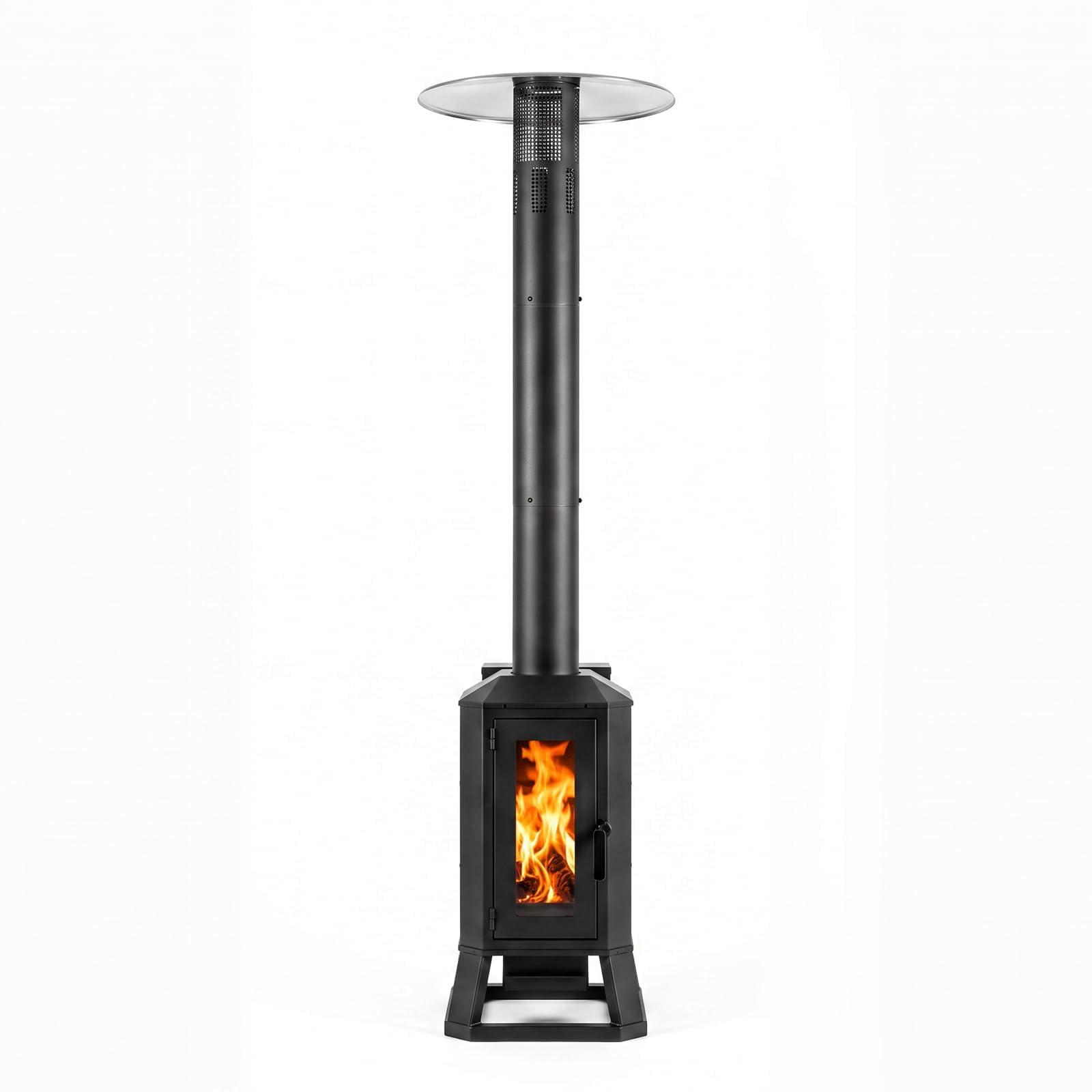
The NUUK is the odd one out and the most interesting heater in this group: 70,000 BTU from wood pellets rather than propane, with the fire visible through a glass window in the front. It stands 77.6 inches tall, weighs 48.9 pounds, feeds by gravity from a hopper, and rolls on built-in wheels. Nothing else here produces that much heat or that particular kind of light.

Burning pellets changes the whole ritual. There's no cylinder to swap and no refill run, and no propane smell — you fill a hopper and the flame feeds itself. The fuel is easy to buy and easy to store as long as you store it dry, and a bag of pellets is a good deal less intimidating than a 20-pound tank on a Saturday afternoon.

What you take on is upkeep. Pellet burners produce ash that has to be emptied, the firebox wants regular cleaning, and the first light of a session can smoke briefly while the fire establishes itself. You also need somewhere dry for the fuel, because damp pellets are a wasted bag. None of that is difficult. It's just work a propane tower never asks of you.

It's also the priciest heater here by a wide margin, and the premium buys flame and fuel independence rather than convenience. For a household already heating with pellets, or one that wants a fire on the patio without a gas cylinder anywhere near it, it's a genuinely different proposition from everything else on this page.

Bottom line: For the reader who prefers a bag of pellets to a propane tank, this is the one: the most heat here, a real fire, and the most upkeep.
2

EAST OAK 50,000 BTU Patio Heater

EAST OAK 50,000 BTU Patio Heater

Most patios

Our Score 9.0/10
Check Price

Worth Noting

  • Lower-post welds and the finish coating are the weak points
Burner
Double-layer 304 stainless
Height
87 inches
Warranty
3 years
Heat Output
50,000 BTU
Read the full review

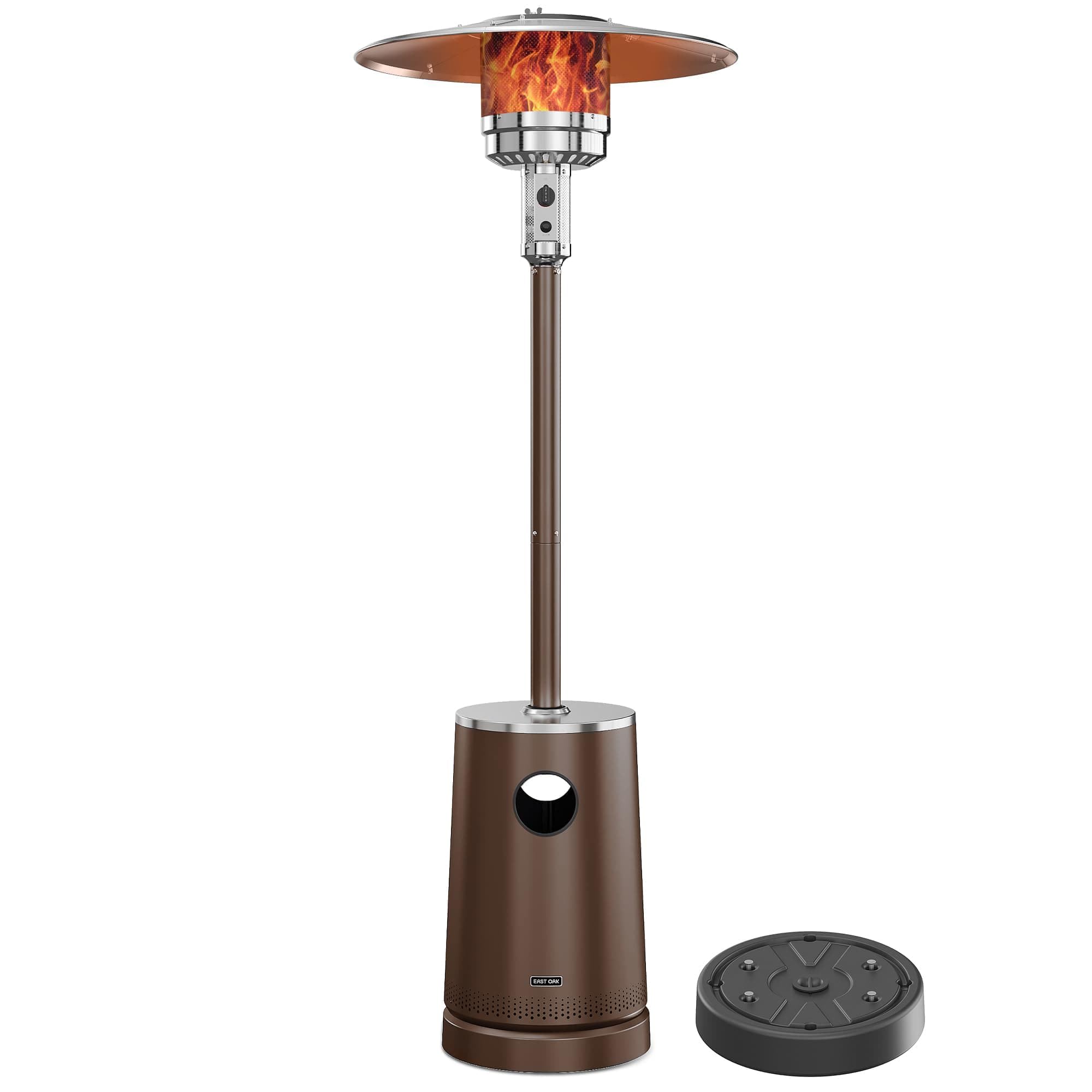
The most useful thing about the EAST OAK is a small one: a stainless ring that caps the tank housing and turns the middle of the heater into a table. On a patio where every square foot is spoken for, that's somewhere to set a glass down while you're standing around talking — we found we used it constantly — and it hides the propane cylinder completely, which is why the thing reads as furniture rather than equipment.

Underneath the looks it's the strongest heater of the propane group: 50,000 BTU through a double-layer 304 stainless burner, the most output of any gas tower here. The burner sits in a conical barrel instead of a straight cylinder, which is a stability fix as much as a styling one, and the base takes sand ballast for the windy weeks. One-touch ignition lights in a second, the knob gives a real range between low and high, and the wheels mean one person can roll it out of the breeze. The listing claims a 20-foot radius; plan on a good circle around the table and a smaller one once there's any wind at all.

Assembly is a screwdriver-and-two-wrenches job — burner, reflector panels, posts — and it goes faster with a second pair of hands. The three-year warranty is the longest stated on any pick in this group, and it's much of the reason this sits at the top: towers in this band are usually the thing you replace in two seasons. Fill the sand before the first windy forecast rather than after.

Bottom line: For most patios, this is the propane tower we point people to: 50,000 BTU, a table ring for drinks, and a three-year warranty no other pick matches.

3

Hykolity 48,000 BTU Pyramid Heater

Hykolity 48,000 BTU Pyramid Heater

Style-first decks

Our Score 9.0/10
Check Price

Worth Noting

  • ⚠️ Needs roughly eight feet of clear height above it
Height
90 inches
Safety
45-degree tip shutoff
Included
Fitted cover
Heat Output
48,000 BTU
Read the full review

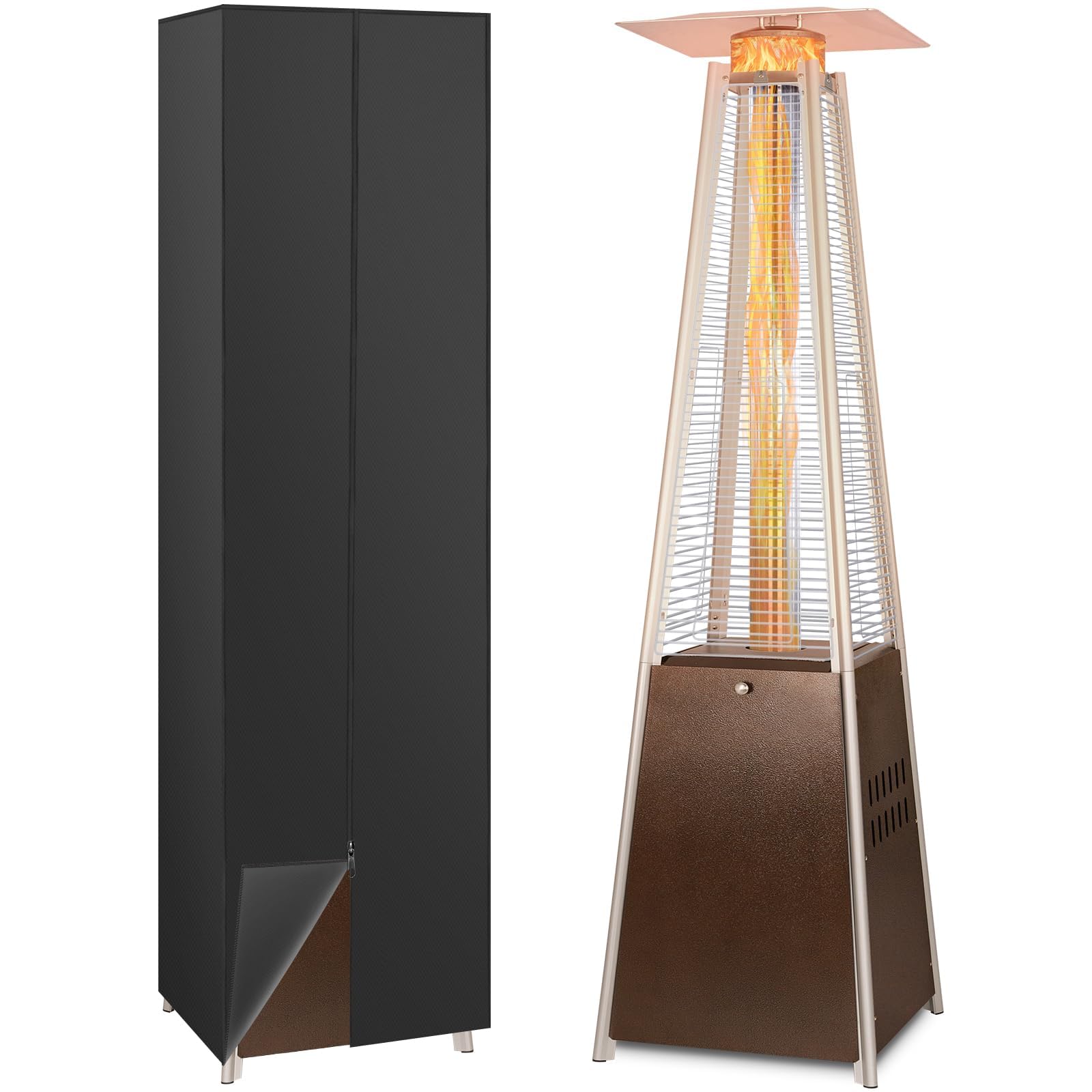
The Hykolity is the other pyramid in this group, and it's the one with more muscle: 48,000 BTU against the Pamapic's 42,000, from the same 20-pound tank, in the same 90-inch glass-tube shape. Bronze finish, two detachable wheels, a tip-over valve that cuts the flame past 45 degrees, and a fitted cover included rather than sold separately.

Where it pulls ahead practically is heat. More output from a similar footprint means the circle around the table is a little wider and the far end stays inside it. The included cover matters more than it sounds: these towers live outdoors year-round, and the ones that survive are the ones somebody bothered to cover.

What we can't yet judge is how the bronze holds up after two winters, and that's the fair question with any pyramid — the tube, the paint, and the joints are what age first. What we can judge, we like: the same spectacle the Pamapic sells, with more warmth behind it. And at 90 inches it needs clear height overhead wherever it lands, which rules out a low pergola.

Bottom line: Our pick of the two pyramids when output matters more than price: 48,000 BTU, a cover in the box, and the same flame.

4

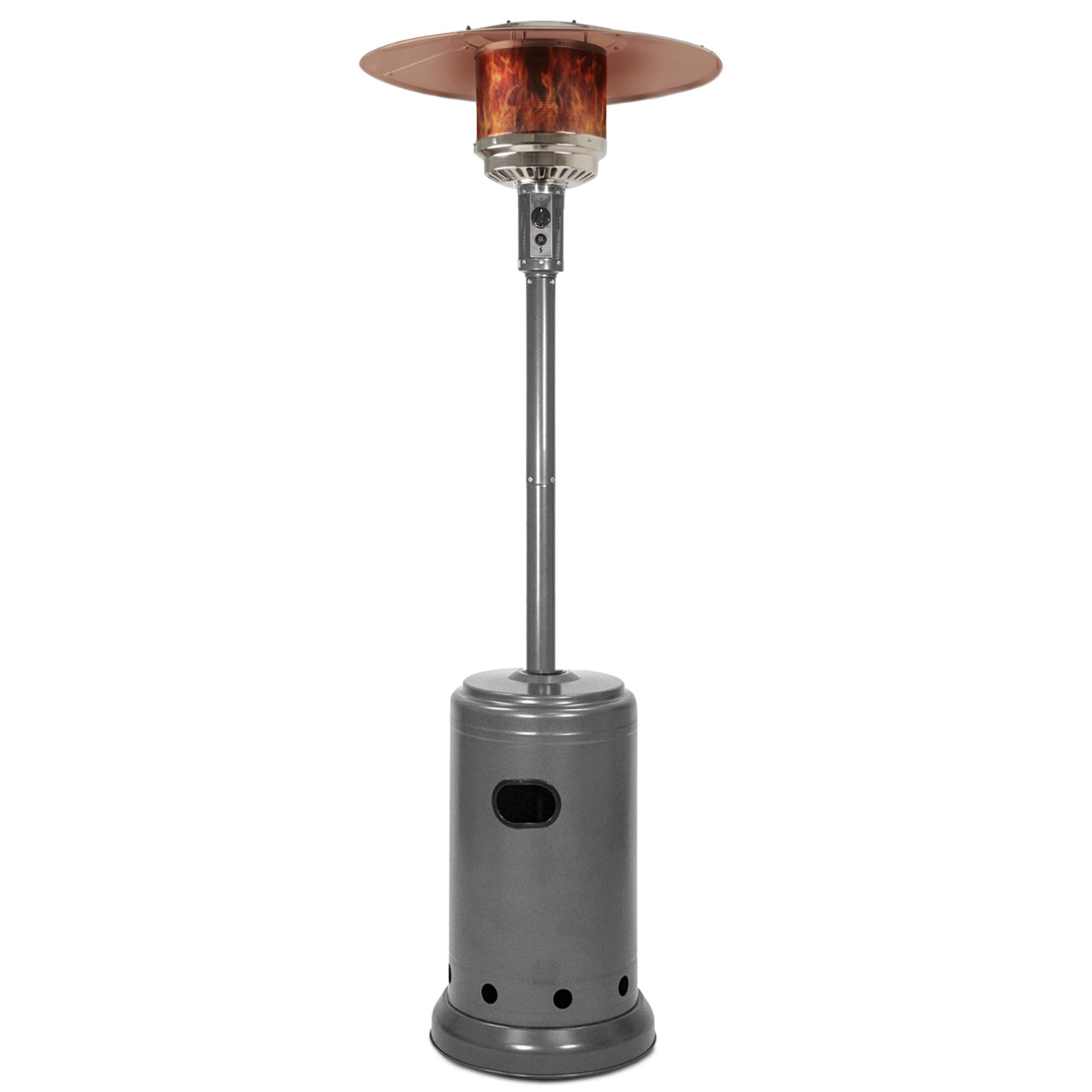
Amazon Basics 46,000 BTU Patio Heater

Amazon Basics 46,000 BTU Patio Heater

Tight budgets

Our Score 8.8/10
Check Price

Worth Noting

  • Rust and igniter failures are the known weak spot
Base
Water-fillable
Weight
37 lb
Coverage
9-foot radius
Heat Output
46,000 BTU
Read the full review

The Amazon Basics tower is the least expensive full-size propane heater in this group, and it doesn't feel like a compromise when you're standing next to it. Slate gray powder coat, a 46,000 BTU burner, a nine-foot heat radius, and a water-fillable base that gives it enough weight to stay put on a deck. Assembly is genuinely easy — the supplied tool does the whole job — which is more than we can say for the pyramids.

Where it earns its place is as the heater you buy this weekend without overthinking it. The heat is real and it arrives instantly, the tilt shutoff works, and there's a chain to stop the tank wandering under the housing. What we can't ignore is the finish: rust and dead igniters are what go wrong with this one, and a heater left uncovered on a deck in February is exactly where that starts.

Treat it as a seasonal tool and the arithmetic works. Cover it, bring the head indoors over winter, empty the water box before a freeze, and it hands you a warm October and November for less than anything else on this page. We don't expect the paint to look new in year three. We do expect it to still light.

Bottom line: We call this the value pick: the least expensive full-size tower here, and it heats a circle just fine, as long as you cover it between seasons.

5

VAGKRI 42-Inch Electric Patio Heater

VAGKRI 42-Inch Electric Patio Heater

No-fuel heating

Our Score 8.8/10
Check Price

Worth Noting

  • Draws 12.5 amps, most of a 15-amp circuit
  • Heats what it faces, not the surrounding air
Timer
24 hours
Heat Levels
9
Heat Output
1,500 W
Weather Rating
IPX5
Read the full review

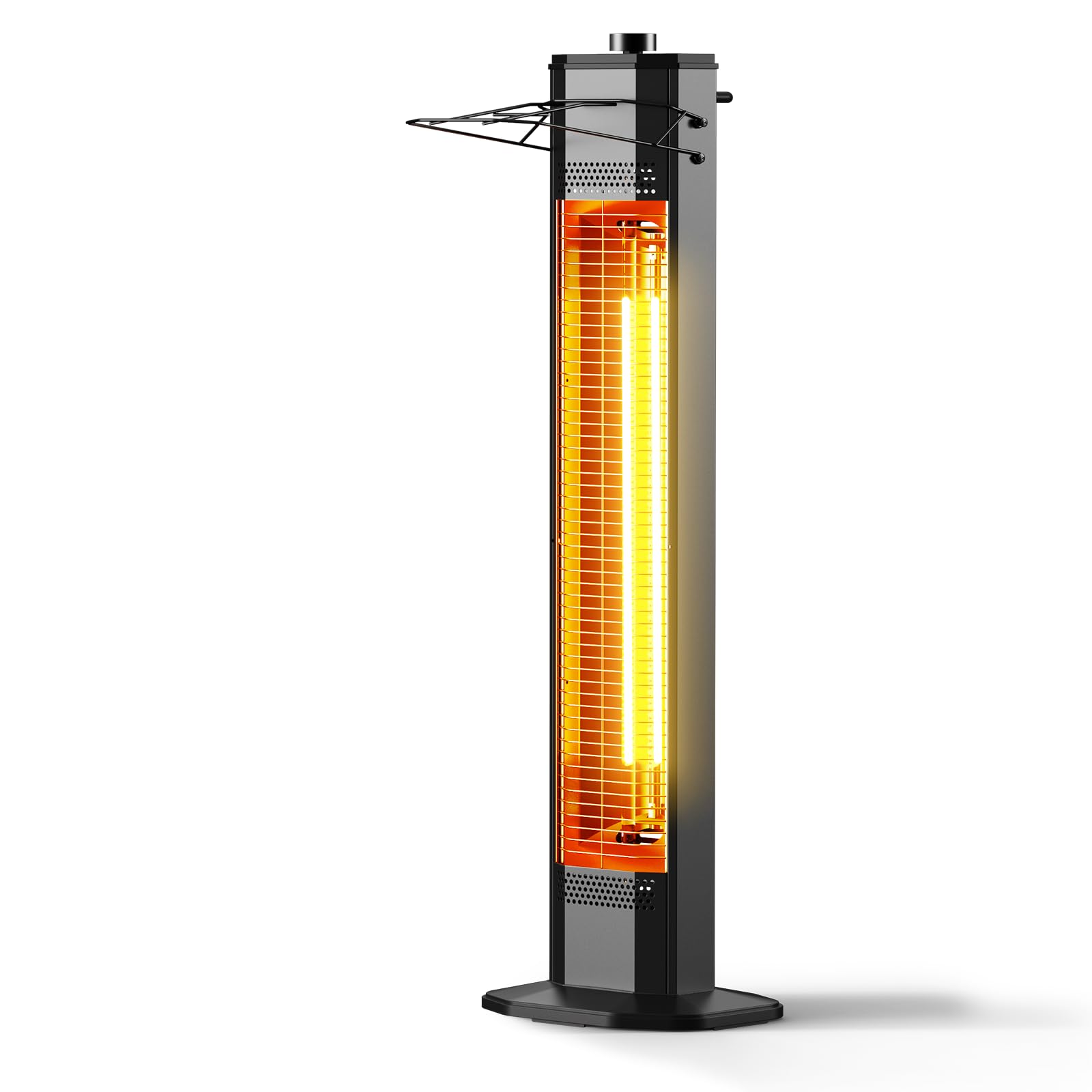
Not everyone wants a propane cylinder parked on the deck, and the VAGKRI is the answer for those evenings: a 42-inch tower that runs on a cord, draws 1,500 watts at full tilt, and starts throwing heat in about a second. Nine levels between 620 and 1,500 watts, a 24-hour timer, a remote, and a 100-degree arc that covers a sofa rather than a yard. The footprint is barely six inches deep, so it disappears against a wall.

We like it most for the timer and the silence — no fuel smell, no ignition dance, no refill run on a Friday afternoon. What we don't like is the draw: 12.5 amps is most of a standard 15-amp circuit, so it wants an outlet that isn't already feeding a grill or a string of lights. And like every electric here, it warms the people in front of it rather than the air around them. On a screened porch that's exactly right; on an open lawn in a breeze it's a candle.

Bottom line: We keep one of these for nights when a propane tank feels like too much trouble: instant, silent heat, as long as guests sit inside its arc.

6

Nfccra 34-Inch Electric Patio Heater

Nfccra 34-Inch Electric Patio Heater

Small patios

Our Score 8.8/10
Check Price

Worth Noting

  • Six-and-a-half-foot cord dictates placement
Height
34 inches
Heat Levels
3
Heat Output
1,500 W
Weather Rating
IPX5
Read the full review

At 34 inches tall and 7.5 pounds, the Nfccra fits where the towers can't: between two Adirondack chairs, on a balcony, at the end of a narrow porch. The base is roughly the size of a dinner plate, there's a handle on the back, and carrying it from the patio to the garage is a one-hand job. For a small outdoor space, that's the whole argument.

It's a 1,500-watt carbon infrared heater with three levels — 600, 900 and 1,500 watts — plus a mesh guard over the elements, tip-over and overheat shutoffs, an IPX5 rating, and UL certification. Heat arrives immediately and stays dry and silent. Two or three chairs in front of it stay comfortable; anyone standing at the edge of the circle won't feel much.

The cord is our one real reservation: 6.6 feet is short enough that outlet placement decides where this can live, so measure before you fall for a particular corner of the deck. Otherwise this is the little heater we keep coming back to, and it costs less than the tower models without feeling like a downgrade.

Bottom line: The electric heater we reach for on a balcony or a small deck: 7.5 pounds, three settings, and heat that arrives before you sit down.

7

Pamapic 89-Inch Pyramid Patio Heater

Pamapic 89-Inch Pyramid Patio Heater

Flame ambiance

Our Score 8.6/10
Check Price

Worth Noting

  • 42,000 BTU is the lowest of the propane towers here
  • Glass tube is the fragile part if it tips
Height
89.4 inches
Weight
61.7 lb
Included
Fitted cover
Heat Output
42,000 BTU
Read the full review

A pyramid heater is patio furniture that happens to make heat, and the Pamapic is the best-looking version of that idea in this group. The quartz tube runs the flame up the middle of an 89-inch hammered bronze tower, and after dark it does more for a deck than a string of lights. We think that's worth paying for — just go in clear-eyed that you're buying atmosphere first and BTUs second.

The numbers are honest rather than heroic: 42,000 BTU, the lowest of the propane towers here, drawn from a standard 20-pound tank that hides behind a side-access door. Around a dinner table on a still night in the high fifties it's comfortable; spread across six chairs on an open deck and the people at the ends will feel the difference. Assembly runs about an hour, the wheels let you tuck it against the house, and a fitted cover comes in the box.

Two things to know before you commit. At 61.7 pounds it's the heaviest heater we tested, so moving it is a two-hands-and-a-plan job rather than something you do mid-party. And light it the day it arrives — a unit that won't hold a flame out of the box is a return, not a repair.

Bottom line: We choose this pyramid for the firelight rather than the raw output: 42,000 BTU is the least among the propane towers here, and the flame earns it.

8

DR. Infrared 1500W Patio Heater

DR. Infrared 1500W Patio Heater

Covered porches

Our Score 8.6/10
Check Price

Worth Noting

  • Bracket takes fiddling to get square
  • Heating element is the part that tends to fail
Weight
8 lb
Mounting
Wall or ceiling bracket
Heat Output
1,500 W
Weather Rating
IP55
Read the full review

The DR. Infrared doesn't stand on your patio at all. It's a 35-inch bar, eight pounds, that hangs from a wall or ceiling bracket — both included — and throws heat down at whatever sits beneath it. Three settings between 900 and 1,500 watts, a remote, and an IP55 rating that covers a covered porch but not direct rain. Of every pick here, it's the one that disappears once it's up.

On a porch with a wall to mount it on, that's a real advantage: no floor space used, nothing to tip, nothing to refill, and heat the second you press the button. It's also the least expensive way into radiant warmth in this group. Hang it over the seating, angled down, and treat the rest of the patio as out of scope.

Because this is a spot heater, and that word does a lot of work. Radiant heat travels in a line; sit directly beneath the bar and it's excellent, sit six feet to the side and it's decoration. Add any breeze and the warmth leaves with it. That's not a defect so much as the nature of a wall-mounted radiant bar, and it's why the mounting position matters more than the wattage.

Where it makes sense is a covered porch with a soffit or a wall, seating arranged under it, and no expectations beyond that circle. Where it doesn't is an open deck, a windy corner, or anyone hoping to take the chill off a whole yard. On those terms we're happy to recommend it — it's a specific tool that does one job neatly.

Bottom line: We recommend this for a covered porch with a wall to hang it from, and only when you want a warm seat rather than a warm patio.

How We Tested the Best Patio Heaters

We started by scanning the market for freestanding, tabletop, and mounted patio heaters, then narrowed the field by comparing claimed heat output, footprint, fuel type, price, and availability of replacement parts. That left 10 units, which we tested over eight months on a backyard patio.

Assembly and installation were timed from unboxing to first start, working solo and using only the tools that came in the box. We noted missing hardware, confusing instructions, and whether a unit required drilling or anchoring; for mounted models we checked what the bracket attached to and whether it felt secure once installed. Ease of use came down to small actions — lighting the heater after dark, adjusting the flame or thermostat with one hand, and moving it out of the way before mowing. Models with built-in lights were judged on whether they lit the table or just cast a glow at the base. Durability was tracked by leaving each heater out through rain and wind, then checking for rust, loose fittings, and cracked parts.

Heat output was measured at three and six feet from the unit, at table and standing height, on evenings between 45 and 55 degrees. We watched whether the warmth felt even across a table or only in one spot. For sturdiness, we nudged each heater during normal use and watched for rocking on pavers and grass; a weighted base mattered more than a wide tripod. Functionality got a practical read — did the controls make sense without reading the manual, and did the safety features work without being annoying? We judged value against the price of the unit plus fuel or electricity, and appearance by a simple test: would we leave it on the patio when it wasn't in use? Overall performance was the sum of those parts, not a single score.

How to Choose Patio Heaters

Radiant heat, not warm air

Both propane towers and infrared electrics throw heat at objects in a line of sight. Step behind a chair or around a corner and the warmth stops, which is why a 50,000 BTU tower and a 1,500-watt electric can feel reasonable on the same evening: they're heating people, not cubic feet of air. Arrange seating in an arc facing the heater rather than a wide ring around a fire pit.

Coverage claims assume still air. A breeze strips radiant heat faster than cold does, so a windbreak — a wall, a screen, a hedge — buys more comfort than another 10,000 BTU ever will.

Propane or electric?

Propane delivers the most heat per unit and needs no cord, at the cost of a 20-pound tank, a refill run, and a footprint wide enough to hide the cylinder. Electric delivers instant, odorless, silent warmth and a heater you can carry with one hand, but at 1,500 watts it's a spot heater.

The electrical draw is the part people miss. Both electrics here pull 12.5 amps, which is most of a standard 15-amp circuit — put one on an outlet that isn't already feeding a grill rotisserie or a string of lights, and skip the long extension cord.

Height, placement, and wind

The towers here run 87 to 91 inches, and the pyramids need clear space above the reflector. Under a pergola or an awning, measure before you order: a 90-inch heater does not fit beneath a seven-foot beam with any margin, and a hot reflector close to a wooden roof is a bad arrangement.

Weight the base. Sand in a conical base or water in a tank housing is what keeps a tower upright in a gust, and a heater on its side is the failure that actually matters. Wall and ceiling units sidestep the problem entirely on a porch with a soffit.

The off-season is what ends them

The failures that finish a patio heater are usually finish and ignition, not the burner. Rust starts where water sits — around the base, the tank housing, the burner cap — and igniters are the first component to quit. A cover, a dry spot for the head in the worst months, and emptying a water-filled base before a hard freeze will buy you seasons.

Buy the cover with the heater rather than after the first rust spot. The picks here that include one are worth a small premium for exactly that reason.

Does it have to look good?

On a decorated patio, yes. A heater is seven and a half feet of metal standing where everyone can see it, and the gap between hammered bronze with a flame inside and a plain gray cylinder is the gap between decor and equipment. Decide first whether you want it to disappear — a wall unit, a slim tower — or to be the focal point.

We put real weight on this, because the heater you don't mind looking at is the one you leave out all season, and the one you leave out is the one you actually use.

Frequently Asked Questions

Final Verdict

For a typical patio, the EAST OAK is the one we send people to. Fifty thousand BTUs, a stainless ring over the tank that works as a drink table, and a three-year warranty no other pick here matches make it the safest money in the group.

If the flame is the point, the Pamapic buys a better-looking evening with less heat behind it. If hauling a propane tank sounds like more trouble than the whole idea is worth, hang the DR. Infrared on a porch wall, or roll the Nfccra out to the balcony, and stop there.