Outdoor

Best Patio Umbrellas of 2026

A patio umbrella has one job: keep the sun off the table. The catch is that the bigger the canopy, the more shade it throws — and the more it acts like a sail the first time the wind picks up. I've watched an inexpensive one cartwheel across a lawn and take a glass of iced tea down with it. So the real question isn't which color looks best on the deck, though that matters more than people admit; it's which canopy stays planted, holds its color, and is simple enough for one person to crank open before lunch.

We've kept twelve of them standing outside since late April, opened and closed twice a day, and five months later the differences are not subtle. One thing worth knowing before you shop: the base, not the pole, is what keeps an umbrella upright — most tip-overs blamed on flimsy frames were really an unweighted base. What follows are the ones that held their color, stayed put, and were still easy to crank by August.

1

Best Choice 7.5ft Patio Umbrella

Top Pick
Best Choice 7.5ft Patio Umbrella

Four-chair tables

Our Score 9.2/10
Check Price

Worth Noting

  • 7.5-foot canopy only shades four chairs
Frame
6-rib steel, 38mm pole
Fabric
180g polyester with PA coating
Weight
9 lb
Canopy Diameter
7.5 ft (90 in)
Read the full review

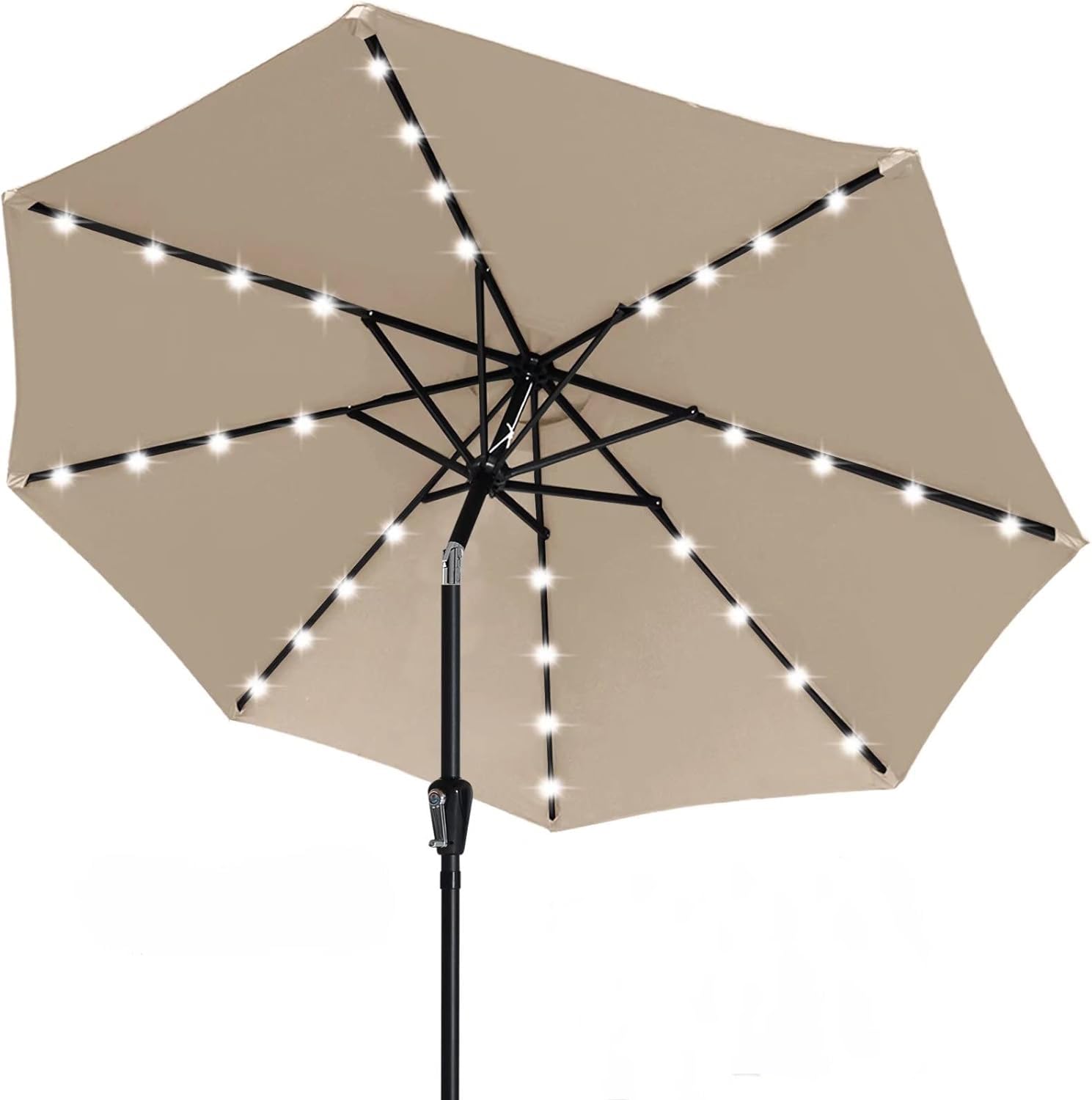
Six steel ribs, a 38mm pole with a 0.7mm wall, 9 pounds on the scale. This is the umbrella here that shrinks the canopy without shrinking the hardware, and that is exactly the trade we want over a four-chair table: the stiffness of a full-size frame with a fraction of the canvas to catch the wind. Fewer ribs also means fewer joints, and joints are where cheap umbrellas come apart.

The canopy is 180g polyester with a PA coating — mid-weight, not the yarn-dyed cloth that holds color for years, but enough to shed a shower and stay presentable through a summer. The crank raises it in a few turns and the push-button tilt holds the angle you set rather than drifting halfway through an afternoon. We were also glad to find a real vent at the top instead of a decorative seam: air passes through it instead of lifting the whole canopy.

The honest limits are about size, not quality. Seven and a half feet shades a four-chair table, and if your table seats six the outer seats sit in sun — the 10-foot version below is the fix, not a heavier base. The frame takes a gust better than the wider, cheaper canopies here, but a storm that catches it open still does damage, so close it. The base is separate; the maker lists a matching one, and buying it beats trusting the hole in the table.

Bottom line: Our overall pick for a four-chair table: a full-size steel frame under a small canopy, light enough to move alone and steady in a gust.

2

Abba Patio Lyon 9FT Umbrella

Abba Patio Lyon 9FT Umbrella

Sheltered patios

Our Score 9.2/10
Check Price

Worth Noting

  • Heaviest pick here at 13.2 pounds
Frame
8 aluminum ribs, steel frame
Fabric
UPF 50+ polyester
Weight
13.2 lb
Canopy Diameter
9 ft (108 in)
Read the full review

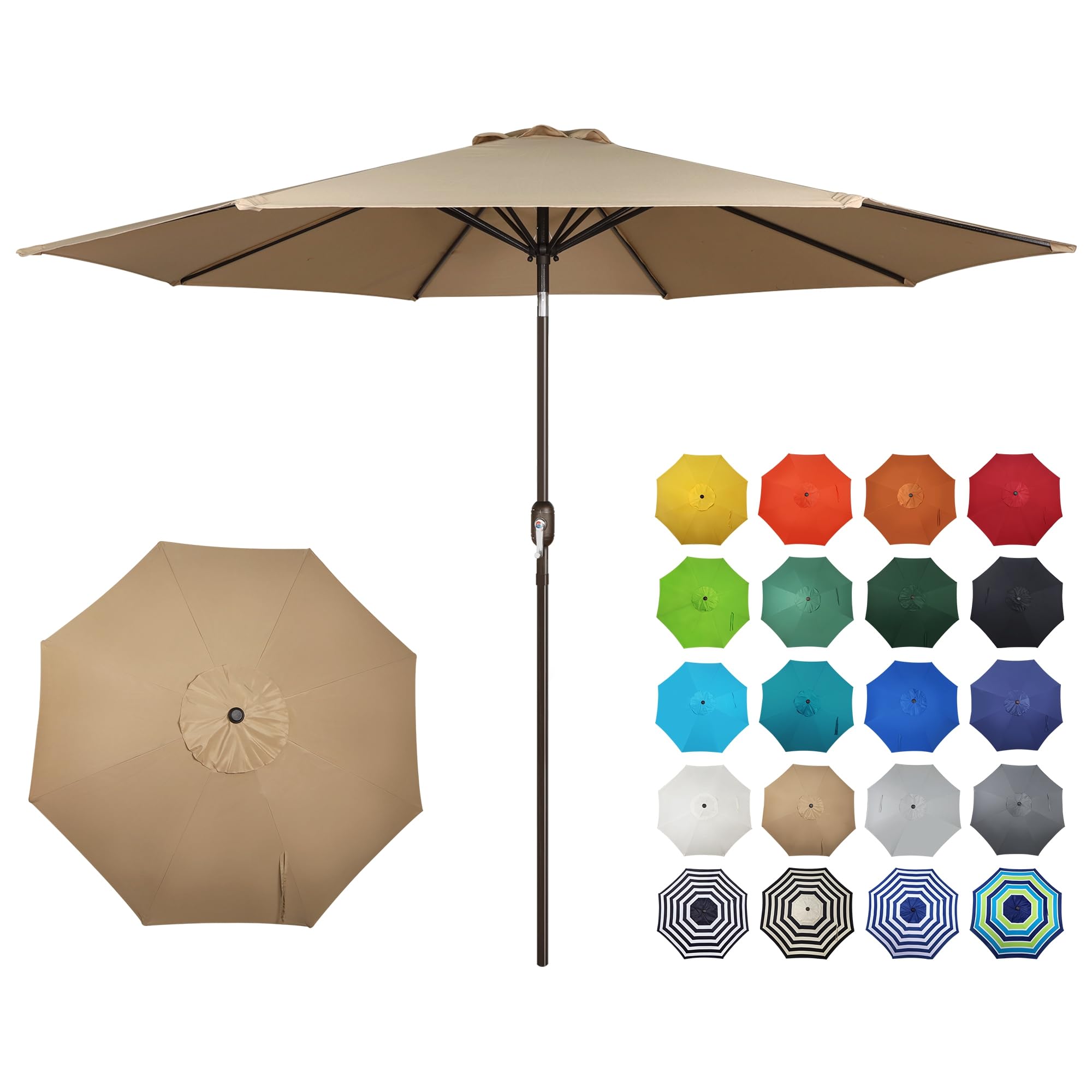
Setup is four pole sections that screw together by hand, with the canopy already attached and no tools involved — a couple of minutes and you are done. That sounds like a small thing until you have taken an umbrella down and put it back up for a third season. It is the reason this one sits ahead of the other budget nine-footers here.

Eight aluminum ribs do the structural work, and the canopy sits taut between them with no sagging pockets to collect water after a shower. The fabric is rated UPF 50+, a specific claim rather than the vague UV-resistant line on most of this list, and the closure is a clip instead of a Velcro strap that fills with grass and stops sticking by August. Those are the details of a more expensive umbrella, at a not-more-expensive price.

Thirteen pounds is the most you will lift in this group, and that is the price of the steel frame and the extra ribs. On a patio where the umbrella goes up in May and comes down in September, it is the right trade; if you move it every weekend, it is not. The weak point is the tilt joint, which can lose its grip and leave the canopy leaning, so use it to set an angle for the season rather than to chase the sun across the afternoon. On a sheltered patio, it is the best-looking and best-detailed pick in the budget half of this list.

Bottom line: The best-finished umbrella in the budget half of this list: eight ribs, UPF 50+ fabric and a tool-free pole, with a tilt joint to treat gently.

3

Blissun 10FT Patio Umbrella

Blissun 10FT Patio Umbrella

Off-season storage

Our Score 9.0/10
Check Price

Worth Noting

  • Fades noticeably within a season or two of sun
Frame
8 iron ribs, powder-coated pole
Fabric
180g polyester
Assembly
Detachable ribs, tool-free
Canopy Diameter
10 ft
Read the full review

The ribs unclip, and that is the best idea on any umbrella in this group. The canopy arms detach from the pole, so a 10-footer breaks down into a bundle you can stand in the corner of a garage rather than leaving it up all winter because there is nowhere to put it. Setup is tool-free and takes a couple of minutes, which also means the person taking it down in October does not need help.

Everything else is competent rather than clever. The 10-foot canopy is sized for 42- to 54-inch tables with four to six chairs, eight reinforced iron ribs brace it more evenly than the six-rib 10-footer above, and the crank and push-button tilt behave the way they should. The pole is powder-coated and carries the canopy with less flex at the top than the price suggests.

The fabric is where the money did not go. It is 180g polyester, it sheds rain, and in strong afternoon sun it fades — the tan especially goes pale after a season or two, and care does not stop it. That is the trade for the storage trick. If the umbrella will stand in full sun year-round instead of coming down each fall, the yarn-dyed ABCCANOPY below is the smarter buy even at its premium.

Bottom line: The pick when storage decides the purchase: a full 10-foot canopy that breaks down tool-free, as long as you can live with the fade.

4

Tempera Market Patio Umbrella

Tempera Market Patio Umbrella

Small decks

Our Score 9.0/10
Check Price

Worth Noting

  • Thin canopy shows wear after a hard season
Tilt
Push button
Canopy
Fade-resistant polyester
Opening
Crank lift
Read the full review

The Tempera is the plain one here: a crank, a push-button tilt, a fade-resistant polyester canopy, no lights and nothing detachable. It is also the least fussy to set up — the pole slides together, the canopy is already attached, and you are done before you have found a screwdriver you do not need. Confirm the canopy diameter on the color you order before checkout; sizing is the one thing about a table umbrella worth double-checking.

Color is what it does better than most at this end of the range. The choices run from a deep green through grey to a near-black that holds its shade instead of going lilac, and the fabric is rated fade resistant and water resistant enough for a summer shower. The tilt mechanism is simple and holds its angle, which is a small mercy given how often tilt joints are the thing that fails on an inexpensive umbrella.

Our read: this is the umbrella for a first patio, a rental, or a deck where shade is a convenience rather than an heirloom. It shades the table, it looks tidy, it goes up without a fight, and it leaves budget for the base you will actually need. That is a smaller ambition than the picks above — honestly stated, and enough for a lot of yards.

Bottom line: A tidy, inexpensive umbrella for a first patio or a rental: quick to set up, honest about its thin canopy, and easy to live with.

5

Best Choice 10ft Patio Umbrella

Best Choice 10ft Patio Umbrella

Six-chair tables

Our Score 8.8/10
Check Price

Worth Noting

  • Six ribs under a 10-foot canopy flex in wind
  • Awkward to handle overhead at 12 pounds
Frame
6-rib steel
Fabric
180g polyester
Weight
12 lb
Canopy Diameter
10 ft
Read the full review

Think of this as the top pick with a longer table in mind. Same six-rib steel frame, same 180g polyester, same crank and push-button tilt — but a 10-foot hexagonal canopy instead of 7.5 feet, and 12 pounds instead of 9. If your table seats six, that gap is the difference between everyone in shade and the end seats squinting into the afternoon sun.

Two and a half extra feet of canvas is a lot to hang on six ribs, and that is the trade we accept here. A wider canopy catches more wind and puts more leverage on the same joints, so this is the umbrella for a sheltered patio or a table tucked close to the house. On an exposed deck, the Abba Lyon's eight ribs over nine feet is the better-shaped choice; on a covered patio, the extra coverage wins.

In daily use it is undemanding. The crank takes the extra fabric without much effort, the tilt stays where you leave it, and the weight is manageable as long as you are lifting it out of a table rather than over your head on tiptoe. Colors run bright — the orange is properly orange — which is either the whole point or the reason to choose the navy. Set it once toward the low sun and it asks nothing else of you.

Bottom line: For a six-chair table on a sheltered patio: all the top pick's frame and simplicity, with a 10-foot canopy that actually covers the end seats.

6

JEAREY 9FT Patio Umbrella

JEAREY 9FT Patio Umbrella

Neutral color schemes

Our Score 8.8/10
Check Price

Worth Noting

  • Seam stitching is the weak point in the canopy
Frame
Iron pole and frame
Fabric
Polyester, fade resistant
Weight
11.5 lb
Canopy Diameter
9 ft (108 in)
Read the full review

The beige is a soft, flat neutral that reads as fabric rather than plastic, and against a wood deck it recedes the way good outdoor furniture does. Nine feet across, an iron frame, 11.5 pounds. It is the least showy umbrella here, and for a lot of patios that is precisely right.

The tilt is the part to understand before you buy. A push-button tilt is a convenience until the joint stops holding, and this is the umbrella in this group where that joint is likeliest to go slack and leave the canopy leaning to one side. Set an angle for the season and it never comes up; swing the canopy around every afternoon and it will. That is a use pattern, not a lottery.

The crank does its job without complaint, and the iron pole has a reassuring weight when you stand it up through the table. The canopy is water-resistant and rated fade resistant, but the stitching at the seams is where the budget shows — the cloth holds, the thread is what to keep an eye on. Maintenance is a wipe-down and a dry winter storage, nothing more.

So: a good-looking, decently built nine-footer for a patio that is not taking the brunt of the weather, at a price that makes replacing it down the road painless. Buy it for the color and the coverage, decide on a tilt angle and leave it alone, and it does everything a table umbrella is asked to do.

Bottom line: A quietly good-looking nine-footer for a sheltered patio; set the tilt once where you want it and skip it if you adjust the angle daily.

7

ABCCANOPY 9FT Solar LED Umbrella

ABCCANOPY 9FT Solar LED Umbrella

Evening entertaining

Our Score 8.6/10
Check Price

Worth Noting

  • Lights depend on a panel that dirt and shade can defeat
  • Ambience-level light, not task lighting
Frame
8-rib powder-coated steel
Fabric
Yarn-dyed polyester, UPF 50+
Lighting
32 solar LEDs, 4 per rib
Canopy Diameter
9 ft
Read the full review

Thirty-two LEDs sit in the ribs, four to a rib, wired to a small solar panel at the top of the pole. No cord, no outlet, no separate string lights to untangle in June. The output is ambience rather than illumination — you can see your plate and your glass, you cannot read a book — and that is what a patio actually needs once the sun drops.

We think it earns its premium, because a lit umbrella changes how long you stay outside. It also does the daytime job properly: 9 feet of yarn-dyed, UPF 50+ canopy, eight ribs on a powder-coated steel frame, and a 45-degree tilt that swings both ways so the shade follows the sun instead of you dragging your chair around the table. Nothing in the frame feels like a compromise made to pay for the lights.

The caveat is the panel. A solar cell on top of a pole sits exactly where pollen, bird mess and the shadow of a nearby tree collect, and when it stops charging the lights go and you are left with an ordinary umbrella and a battery you cannot reach. Wipe it down now and then and keep the canopy out in the open rather than under a pergola. The cloth itself is happiest on a porch or a sheltered patio rather than an open, windy deck.

Bottom line: Buy it for the evenings: solar light in the ribs, a proper yarn-dyed canopy, and a 9-foot frame that handles the daytime job just as well.

How We Chose and Tested These Patio Umbrellas

We built a shortlist of roughly 40 umbrellas sold at major retailers and narrowed it by fabric type, vent construction, frame material, whether a base was included, and whether a replacement canopy could be bought on its own. From that group we bought twelve, spanning plain market umbrellas through cantilever styles with crank and tilt.

Testing ran from late April through September. Each umbrella lived where it would in real life — over a dining table on a brick patio, on a sun-baked deck, and beside a pool — and one person opened and closed it at least twice a day. At 1 p.m. and again at 4 p.m. we measured the actual shaded footprint on the ground and checked whether the canopy cleared seated heads at the table. Listed diameters and real coverage did not always match.

For sturdiness, we noted pole sway during ordinary afternoon gusts and through one memorably windy week, nudged each base to see if it slid, and inspected hub connections and joints after repeated opening. Ease of use got timed: how many crank turns to full open, whether the tilt collar moved without pinching a hand, and whether the locking pin lined up on the first try.

On the solar-lit models we sat underneath at dusk and again around 10 p.m. to see whether the glow was even or fell in one bright spot, and counted evenings before output dimmed. At the end, we compared photos of each canopy taken from the same spot at the same time of day against day-one shots to catch fading, and looked for rust at the hub and mildew along the seams. Value came down to whether a base was in the box and whether a worn canopy could be replaced without buying a whole new umbrella.

How to Choose Patio Umbrellas

Match the canopy to the table, not the yard

The nine-foot umbrellas here are sold for 42- to 54-inch tables with four to six chairs; 10 feet gives you margin on a six-chair set, and 7.5 feet is a four-chair canopy. The trap is buying the biggest canopy the patio can hold rather than the one the table needs. Every extra foot of diameter catches more wind, needs more base weight, and shades a neighbor who never asked.

Measure the table across the top, not the length, and count chairs. If the end seats sit outside the canopy line in the afternoon, you need the next size up — a bigger base will not fix that.

Budget for the base from the start

Almost none of these umbrellas ship with a base, and a hole in the middle of a table is a hole, not an anchor. Buy the base the maker lists for the model, or a freestanding one you can weight until it will not shift under a firm push. A light base under a big canopy is the setup that ends with the umbrella across the lawn and someone's table glass on the ground.

This is the part of the purchase people skip when they compare prices, and it is why a budget umbrella plus a proper base often costs more than the midrange umbrella alone.

Ribs, vents and the wind question

Six steel ribs is the budget standard; eight aluminum or iron ribs brace a canopy more evenly and keep it taut across a wider span. The vent at the top matters too — it lets air through instead of letting the canopy behave like a sail. If your patio is exposed, prioritize the frame and drop a canopy size rather than keeping the size and accepting a flimsier structure.

No umbrella in this group is meant to stay open in a gust. Closing it is the single habit that decides whether you get three seasons or eight.

The crank and tilt are what break first

Every moving part on an umbrella lives in the crank housing and the tilt joint, and that is where these fail. A push-button tilt is the simpler, more reliable arrangement; a friction joint that you swing around twice a day is the one that goes slack and leaves the canopy permanently leaning. Set the angle for the season and leave it, and the mechanism lasts.

Two practical checks before you buy: see how high up the pole the tilt button sits if you are shorter than about six feet, and raise the canopy fully until it locks before you tilt it.

Fabric, fade and what the extra money buys

Two things separate a canopy that looks good in year three from one that does not: fabric weight and how the color was set. The budget canopies here are around 180g polyester — water-resistant and perfectly serviceable, but it fades. Yarn-dyed fabric with a UPF 50+ rating holds color and blocks more UV, and it is where the premium picks put their money.

In full afternoon sun a light color stays presentable longer than a saturated red or orange. If you want the umbrella to look new for several seasons, that is what you are paying for.

Frequently Asked Questions

Final Verdict

Our pick is the Best Choice Products 7.5-footer for a four-chair table. It has the best-supported frame in this group — six steel ribs on a full 38mm pole — it weighs 9 pounds so one person can put it up and take it down, and it leaves room in the budget for a base that actually holds.

With six chairs, move to the 10-foot Best Choice: same frame, more canopy, more weight. And if you want a 9-footer with better details than the budget norm, the Abba Lyon's eight ribs, UPF 50+ fabric and tool-free pole are the step up worth taking.