Outdoor

Best Deck Boxes of 2026

A deck box looks like the simplest thing you'll buy for your yard: a big box with a lid. Then the first fall storm rolls through, and you find out whether yours actually keeps water out or whether your cushions come out smelling like a wet dog. A good one handles two jobs at once, swallowing seat cushions, pool toys, and grill tools while still being light enough to drag across the deck when you want the space back, and it has to look like it belongs there, because it's the one piece of outdoor furniture nobody gets to hide.

I've lived with a resin box that quietly filled with rainwater and a cedar chest that ate an entire Saturday and two people to assemble. Over the past eight months, my team and I have loaded, hosed down, sat on, and hauled 10 deck boxes to figure out which ones deserve the square footage. The pattern is consistent: the boxes that hold up are rarely the cheapest or the fanciest, and how the lid works matters more than the spec sheet lets on. Below, the picks are sorted by what each one does best.

1

Lifetime 60012 130 Gal

Top Pick
Lifetime 60012 130 Gal

Seating and storage

Our Score 9.0/10
Check Price

Worth Noting

  • 52 pounds empty and awkward to shift alone
Capacity
130 gallons
Warranty
10-year limited
Seat Rating
900 lb
Exterior Dimensions
60"L x 24"W x 27.2"H
Read the full review

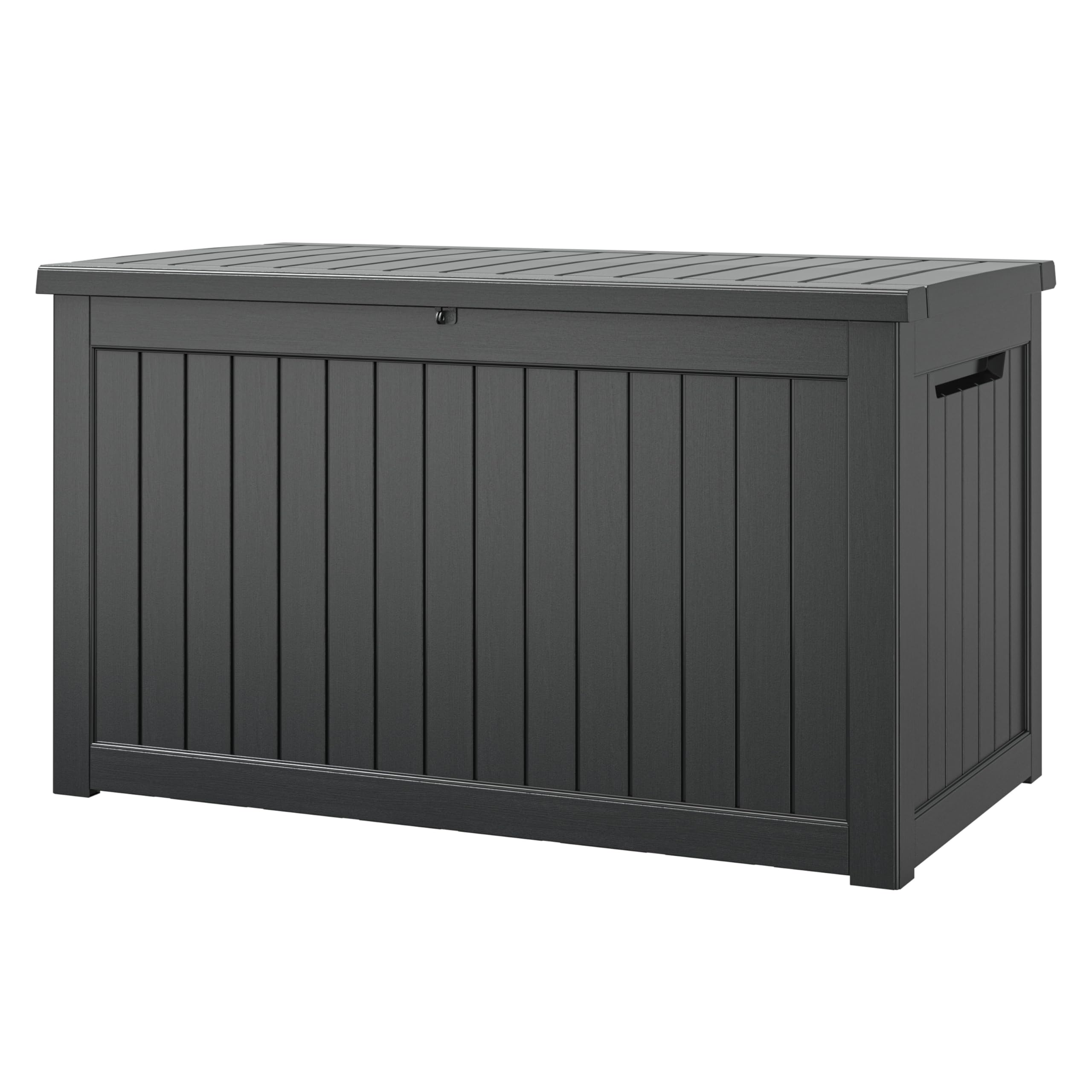
What the lid pivots on is the first thing we check on a resin box, and it is why this Lifetime ends up at the top of the group. The hinges are powder-coated steel instead of the molded plastic tabs nearly everything else here uses, and the spring inside them closes a 130-gallon lid gently rather than dropping it on your fingers. Add a 900-pound seat rating — the highest in this set — and a 10-year limited warranty, and you have a box built to be sat on, not just filled.

The 130 gallons are shaped usefully, too: 57 inches long, nearly 21 wide and almost 24 deep inside. A deep-seat cushion set lies flat and stacks without being folded in half, which is more than we can say for shorter boxes carrying a similar gallon count. It weighs 52 pounds empty, so pick the spot before you build it — you will not want to shift it again after a season of rain.

Weather is where cheap boxes come apart, and this one holds. High-density polyethylene will not rot, go brittle in the cold or need refinishing, the lid overlaps the rim instead of sitting flush, and contents stay dry through storms. It is rated water resistant rather than sealed, so if the box sits fully exposed, run a bead of silicone along the seams — ten minutes and very little money for a lot of peace of mind.

Assembly is the honest caveat. It arrives as panels, screws and a printed sheet; the panels are heavy, and the molding can leave a little flashing around the screw holes that wants trimming before everything seats. Line up a drill driver and a second pair of hands and it is an unremarkable hour. The warranty is what stays with us: two years is standard in this set, and Lifetime puts ten on this one.

Bottom line: We think it is the one to buy if the box will double as seating: steel hinges, a 900-pound rating and a 10-year warranty beat everything else here.

2

Keter Westwood 150 Gal

Keter Westwood 150 Gal

Full cushion sets

Our Score 9.0/10
Check Price

Worth Noting

  • 28-inch depth needs a generous deck
  • Weatherproof rather than a sealed dry box
Lid
Hydraulic piston
Capacity
150 gallons
Seat Rating
660 lb
Exterior Dimensions
61"L x 28.3"W x 25.2"H
Read the full review

A four-cushion deep-seat set plus the throw pillows is the load that defeats most deck boxes, and this Keter swallows it with room to spare. At 61 inches long, 28 inches deep and 25 tall, it is the second-biggest box here, and the extra depth is what lets you drop cushions in sideways instead of wrestling them flat.

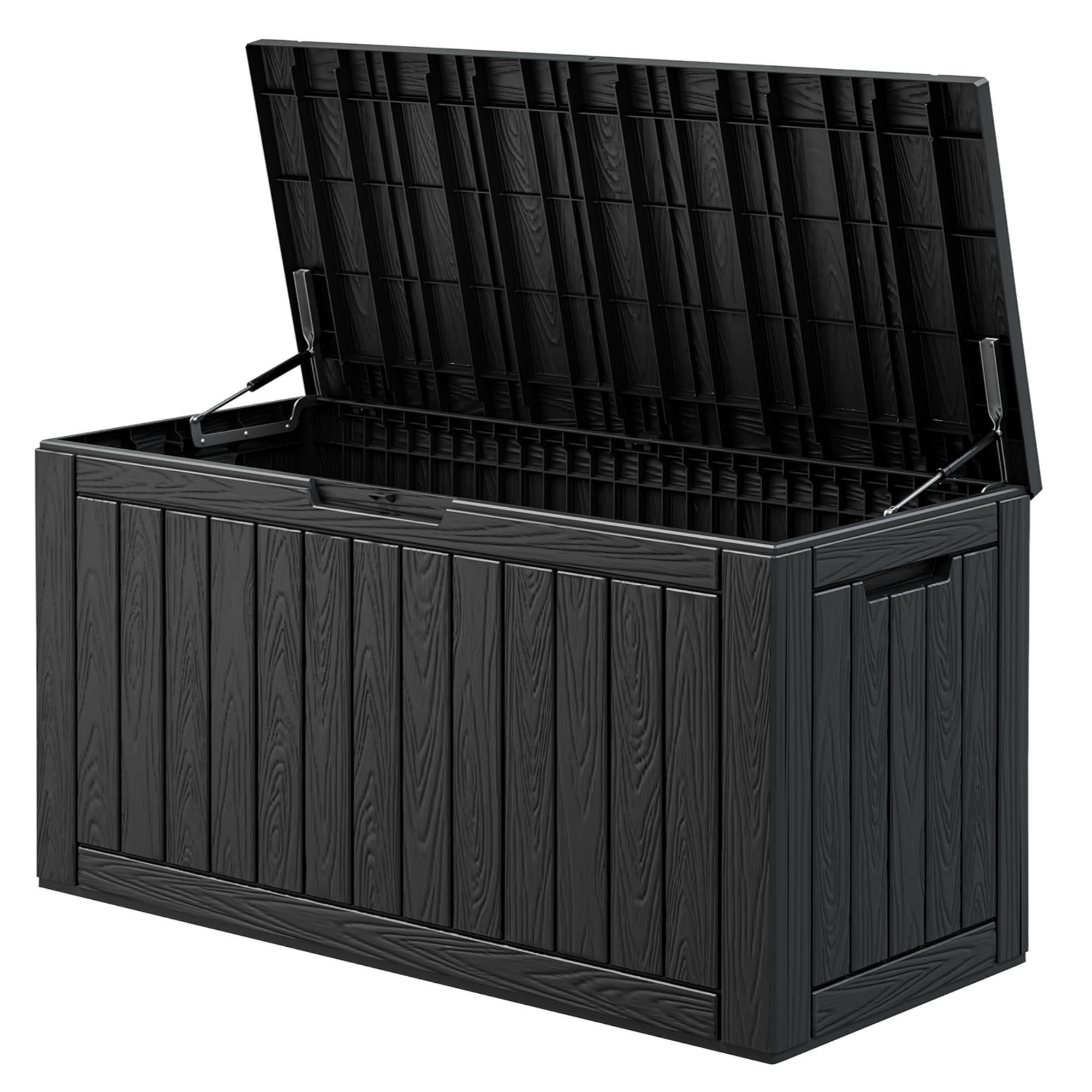
The hydraulic piston is the part we appreciate most: the lid rises and stays where you leave it, so you load with both hands instead of propping the lid on your head. It also takes 660 pounds of seating, and the wood-plank resin reads as furniture rather than a plastic tub — the kind of thing you notice every time you look out the window, which is the whole point of a box that lives on a deck.

One thing to know before you commit: it wants some shade. Lid corners can lift where the box sits in unbroken sun all day, so an eave or a few hours of afternoon cover makes a difference over a few seasons. Do that, and it is the most satisfying big box here to live with — the lid alone saves you a season of small annoyances.

Bottom line: For a whole deep-seat cushion set, this is the box we point to: 150 gallons, a hydraulic lid that stays up, and a bench that seats two.

3

Devoko 80 Gal Storage Bench

Devoko 80 Gal Storage Bench

Table-side seating

Our Score 8.8/10
Check Price

Worth Noting

  • Seat frame costs interior height
  • Rain gets in if the lid is not fully latched
Capacity
80 gallons
Seat Height
16.9 inches
Seat Rating
400 lb
Exterior Dimensions
52.8"L x 22.6"W x 32.3"H
Read the full review

Just under 17 inches is the number that matters here, because that is seat height — where a patio chair sits — so this is the one box in the group you can pull up to a table and use as a bench rather than a perch. Three steel bars run through the case, it is rated for 400 pounds, and two or three people can sit on it without the top sagging. If your deck needs seating as much as storage, this is the one we point to.

The storage is honest about its limits. The seat frame sits over the box, so what fits is what lies flat: a five-gallon bucket stands upright, a cushion set goes in without folding, and a tall stack has to be split between this and somewhere else. Eighty gallons is still a serious amount of gear, and the whole thing is a two-person lift rather than a one-person drag.

Assembly is a snap-together job one person can finish, and the black finish blends in beside most patio furniture. Check the seat panel for cracks as soon as it is out of the carton, before you load it and before the packaging goes out — that panel is the part to inspect closely, and after that it is simply a matter of using it.

Bottom line: If you want to sit at a table rather than perch on a lid, this is the one: real bench height, a 400-pound rating and storage underneath.

4

MAIUSCOLI 45 Gal

MAIUSCOLI 45 Gal

Small porches

Our Score 8.8/10
Check Price

Worth Noting

  • Printed assembly illustrations are hard to follow
  • Thin panels flex until the box is loaded
Lid
Lockable
Assembly
Tool-free snap assembly
Material
Resin
Exterior Dimensions
22.09"L x 17.09"W x 20.87"H
Read the full review

Not every deck needs a bench. If your outdoor kit is one chair cushion, a pair of gloves and a bag of birdseed, this is the least expensive box in the group, and it does the job without asking for space you do not have.

At roughly 22 by 17 by 21 inches it has the footprint of a side table, which is how it earns its place: beside a door for deliveries, between two chairs with a drink on the lid, or on a balcony where a full-size box would block the walkway. The lid locks, the panels snap together without tools, and contents have stayed dry through rain. For a small setup, we think it is the sensible buy.

What it is not is a cushion box for a full set — 22 inches of length takes one chair cushion, not four — so be honest about the pile before you order. Set your expectations at weatherproof side table with a lockable lid and it overdelivers; expect it to replace a real deck box and you will be disappointed.

Bottom line: The least expensive way to stop hauling cushions through the house, and for a porch or balcony it is all most people need.

5

NUNU LAB 300 Gal Deck Box

NUNU LAB 300 Gal Deck Box

Oversized gear

Our Score 8.6/10
Check Price

Worth Noting

  • 68 pounds empty
Weight
68.2 lb
Locking
Lockable latches
Opening
Gas lift
Exterior Dimensions
58"L x 32.2"W x 34"H
Read the full review

Thirty-four inches tall and 32 wide, this is the biggest box in the group by a clear margin, and the difference hits you the moment you drop something in. Pool floats, a folded umbrella, a stack of chair covers, a bag of charcoal — all of it disappears with room left over. If your outdoor kit has outgrown a normal deck box, this is the one that ends the overflow.

Two details make it easy to live with. The gas lift holds the lid open at whatever height you leave it, so loading is a two-handed job rather than a juggling act, and the panels snap together without tools in about the time it takes to break down the carton. The latches are padlock-ready, which counts for something if the box sits near a path or a driveway.

The catch is that a big resin box is a wobbly one until it is full. The panels flex, and there is no seat rating on this model, so we treat it as storage rather than furniture — nobody sits on it, and no planter goes on the lid. What we like is how honest the trade is: the most space here, the least furniture. If you need both, buy the Lifetime.

Bottom line: When the gear is the problem, this is the biggest box here, and the gas lift makes loading it a two-handed job in the good sense.

6

NBYSGO 50 Gal

NBYSGO 50 Gal

Front-door deliveries

Our Score 8.6/10
Check Price

Worth Noting

  • Lift-off lid needs two hands and a free surface
  • Padlock sold separately
Locking
Padlock ready
Opening
Lift-off lid
Seat Rating
500 lb
Exterior Dimensions
31"L x 17"W x 22"H
Read the full review

The best thing about a 31-inch box is where it fits: beside a front door, under a window, at the end of a narrow balcony. This one has spent most of its time catching deliveries, which is the job its shape suits — long enough for a parcel, short enough to tuck against a wall.

It is also a seat. The 500-pound rating is more than two people need, the lid is padlock-ready, and the panels clip together without tools in a few minutes. Rain runs off and the contents stay dry, which is the whole point for a box on an open porch.

Where it shows its price is the lid plastic, which is the part that goes first: lift it squarely rather than yanking a corner, and keep the box out of a wind tunnel, because an empty one will skate. Treated as porch furniture rather than a toy chest, it has held up well, and the seating rating is generous for a box this light.

Bottom line: A front-door box that happens to be a bench: 31 inches long, rated for 500 pounds, and cheap enough to buy a second one.

7

Keter Everwood 50 Gal

Keter Everwood 50 Gal

Small-space style

Our Score 8.6/10
Check Price

Worth Noting

  • Small for the price
  • Plastic hinges are the weak point
Color
Walnut
Assembly
No tools required
Capacity
50 gallons
Exterior Dimensions
32.4"L x 18"W x 22.7"H
Read the full review

Walnut-look resin, a long low shape and side panels that read as furniture — this is the Keter you buy when the box is going to be looked at every day. On a balcony or a small city patio, that counts for more than another twenty gallons.

Size is the compromise. Fifty gallons takes a stack of chair pillows, a hose and a pair of gloves, and then it is full; there is no room for a lounger cushion as well. What it does have is a footprint that slips under a window ledge or along a wall, which is the trade most small patios need to make.

Assembly is tool-free and takes minutes, the lid is lock-ready (you supply the lock), and there is no stated seat rating, so treat it as a table rather than a bench. Resin means no rust streaks on the paving and nothing to repaint, which is most of what you want from a box this size.

The honest summary is that you are buying the look and the low profile, not the volume. If the box stands where you will see it every day and your kit fits in one armload, that is a fair trade; if four chairs' worth of cushions need a home, put the money into something bigger.

Bottom line: The deck box to buy when it will be looked at: a walnut-look 50-gallon box that reads as furniture on a small patio.

8

KAMABOKO 150 Gal

KAMABOKO 150 Gal

Value large storage

Our Score 8.4/10
Check Price

Worth Noting

  • Panels flex against a lean
Weight
22.4 lb
Opening
Dual hydraulic struts
Seat Rating
680 lb
Exterior Dimensions
46.89"L x 20.87"W x 23.82"H
Read the full review

Same job as the Westwood, smaller footprint and a much smaller outlay. Both are long, deep, wood-grain boxes with a lid that lifts on struts; this one is 14 inches shorter and 7 inches narrower, which changes where it can go.

What it does well is the big-box stuff. The 680-pound seat rating is higher than the Westwood's, the dual struts lift a wide lid smoothly and let it down soft, and the wood-grain top sheds water — ours has kept towels and cushions dry. At 22 pounds empty, one person can drag it across a deck without asking for help.

The trade is the sun. The lid is the part that ages first when a box stands in unbroken light, so a covered porch or an eave is where this one belongs; under a roof, filled and left alone, it has been fine.

For that setting it is the value pick of the big boxes: you give up some rigidity and a little life expectancy up top, and you get a long, lockable, genuinely usable box for far less money. If it is going to stand in the open and take a daily sitting, spend more.

Bottom line: A long, lockable box with dual struts and a 680-pound rating for a lot less than the Westwood — as long as it lives under cover.

How We Chose and Tested the Best Deck Boxes

We started with more than 40 deck boxes sold at major retailers and narrowed them by listed capacity, footprint, material, and price, then read through customer reviews looking for complaints that repeated: cracked lids, water getting in, hardware missing from the box. That left us with 10, from small resin benches to a cedar chest, and we've been living with them on decks and patios for eight months.

Assembly came first. We built each box solo with whatever tools the manufacturer included, timing how long it took and noting where the instructions lost us, whether the pre-drilled holes lined up, and whether screws bit into solid material or stripped out. Then we loaded them the way people actually do: two sets of seat cushions, a stack of pool towels, grill tools, and whatever else was cluttering the deck, checking how much room was left over and whether the lid still closed flush against a full load.

Weather and wear got their own rounds. We hosed each box down for five minutes with paper towels inside, left them out through sun and rain for weeks, and watched seams, hinges, and lids for warping, water intrusion, and fading. We opened and closed every lid one-handed, from a crouch, with an armful of cushions, noting which ones slammed, which stayed open in a breeze, and which needed two hands and a knee. Each box was weighed empty and dragged across wood decking and concrete to see how it handled being moved by one person.

Sturdiness got a blunt test: we sat on the lids, leaned hard on the corners, and stacked a full storage bin on top. Appearance we judged over months rather than minutes, watching how finishes held up and whether the plastic chalked or the wood grayed unevenly.

How to Choose Deck Boxes

Measure the pile, not the gallon figure

Gallons tell you volume; cushions are a shape problem. A deep-seat cushion is roughly two feet square and does not bend, so interior length decides whether you stack flat or wedge. For a full set, look for an interior around 50 inches or more — the Lifetime's 57 inches takes ours flat — and check depth too, because a 20-inch-deep box swallows a folded umbrella that a 17-inch one will not.

If your cushions spend the summer in a spare-room pile, measure the pile and take those numbers to the listing. A short box with a big gallon count is still a box you have to fold everything into.

Match the box to where it stands

Resin will not rot, rust or need repainting, but it does care about sun and wind. Unbroken sun softens lids over a season and the corners lift first, so an eave or a few hours of afternoon shade is often worth more than another twenty gallons. Wind is the other one: an empty box is light enough to blow open or skate across a deck, so latch it, lock it, or weight the bottom with what you store.

If the box sits fully exposed, expect weatherproof rather than waterproof. A tube of silicone along the seams is cheap insurance and takes ten minutes.

Decide whether it is seating or storage

Ratings in this set run from 400 to 900 pounds, but height matters as much as the number. A box with a seat around 17 inches is bench height and works at a table; the Lifetime's 900-pound top sits at 27 inches, which makes it a perch for pulling boots on rather than a chair. The Devoko bench pairs its 400-pound rating with a 16.9-inch seat, and that combination is why it exists.

If nobody is going to sit on it, skip the rating entirely and put the money into volume instead.

Look at the hardware before the finish

What fails on these boxes is rarely the panel. It is the hinge tab, the latch and the lid corner. Powder-coated steel hinges, like the Lifetime's, take that strain off a plastic edge that will otherwise crack in year two.

Assembly separates the field just as cleanly. Snap-together panels go up in ten minutes with no tools; screwed panels want a driver, a free hour and often a second pair of hands. Build it where it will live, because moving a loaded box is nobody's idea of a good afternoon.

Frequently Asked Questions

Final Verdict

Buy the Lifetime 60012. Steel hinges, the highest seat rating here, and a 10-year warranty are the three things that separate a box you keep from a box you replace, and it swallows a full cushion set while it does it.

The exception is a deep-seat pile that needs every inch: the Keter Westwood is 20 gallons bigger with a lid that holds itself up. And for a balcony or a front door, the small MAIUSCOLI covers the same ground for very little.