Kitchen

Best Toasters of 2026

A toaster has one job, and yet the wrong one can leave you scraping charcoal into the sink at 7 a.m. — one side blonde, the other black, or a bagel wedged so tight you need a knife to free it. The right model fixes all of that quietly: even browning across the whole slice, a lever that doesn't need two hands, and a footprint that doesn't eat the only clear stretch of counter you have. It's a small appliance that earns its keep twice a day, which is why the differences between models matter more than the prices suggest.

I've cycled through a lot of toasters in a lot of kitchens. Over the past six months, my team and I ran 12 through their paces, from two-slot bargains to wide-slot four-slicers, and the pattern held: appearance and color get a machine onto your counter, but toastability keeps it there. Slot width, not wattage, is the spec first-time buyers overlook — a narrow slot rules out bagels and good sourdough. Below, our picks, sorted by what they're actually good at.

1

Savorfuze Touch Screen 2-Slice

Top Pick
Savorfuze Touch Screen 2-Slice

Gadget lovers

Our Score 9.2/10
Check Price

Worth Noting

  • Newest design here, with least history
Slices
2
Footprint
10.5"D x 6.5"W x 7.5"H
Slot Width
1.5"
Bread Programs
6
Read the full review

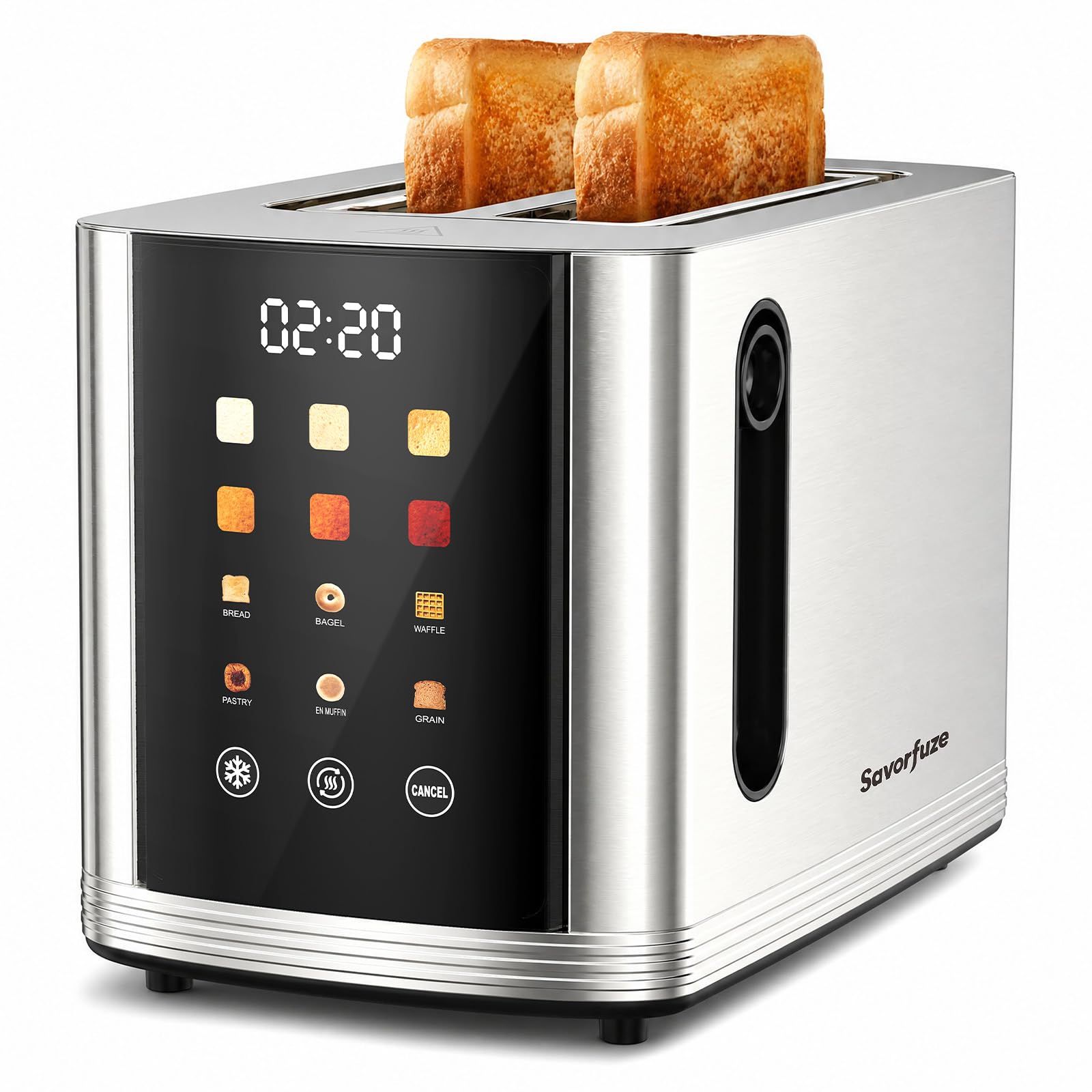
The countdown is the feature that changes the morning. A display on the touch panel shows the time left in the cycle, so you know whether there is room to start the eggs or whether you need to stand there. The Breville shows progress as a bar; this one gives you the actual time, which is a different and more useful thing when something else on the hob is timing you.

Around that sit six browning levels and six bread programs, so you pick the bread type and the shade rather than guessing a number and hoping. The hardware is more substantial than the price would suggest: a full stainless body, 1.5-inch slots that take a bagel or a thick slice, reheat, defrost and cancel, and a removable crumb tray. At 10.5 inches deep it is not a slim model, but it looks purposeful rather than plasticky on the counter.

The caution is history. This is the newest design in the group and the one with the least behind it, so there is no picture yet of how the touch panel or the lever behaves past the first year. Buy it because you want the countdown and the programs, and keep the receipt and the box for a while.

Bottom line: We recommend it to the cook who wants a countdown and bread-specific programs, and who is fine being an early adopter.
2

Proctor Silex 4-Slice Toaster

Proctor Silex 4-Slice Toaster

Budget four-slice

Our Score 8.8/10
Check Price

Worth Noting

  • No bagel setting for one-side toasting
  • Slots too short for long artisan loaves
Slices
4
Weight
4.1 lb
Footprint
10.5"D x 11"W x 7.5"H
Shade Settings
7
Read the full review

There is no bagel setting on this one. Both elements heat, so a bagel comes out toasted on the cut side and on the crust, which is fine if you like a crunchy bagel and wrong if you wanted the soft outside a bagel mode gives you. We are leading with that because it is the one thing that should send a bagel-every-morning household elsewhere.

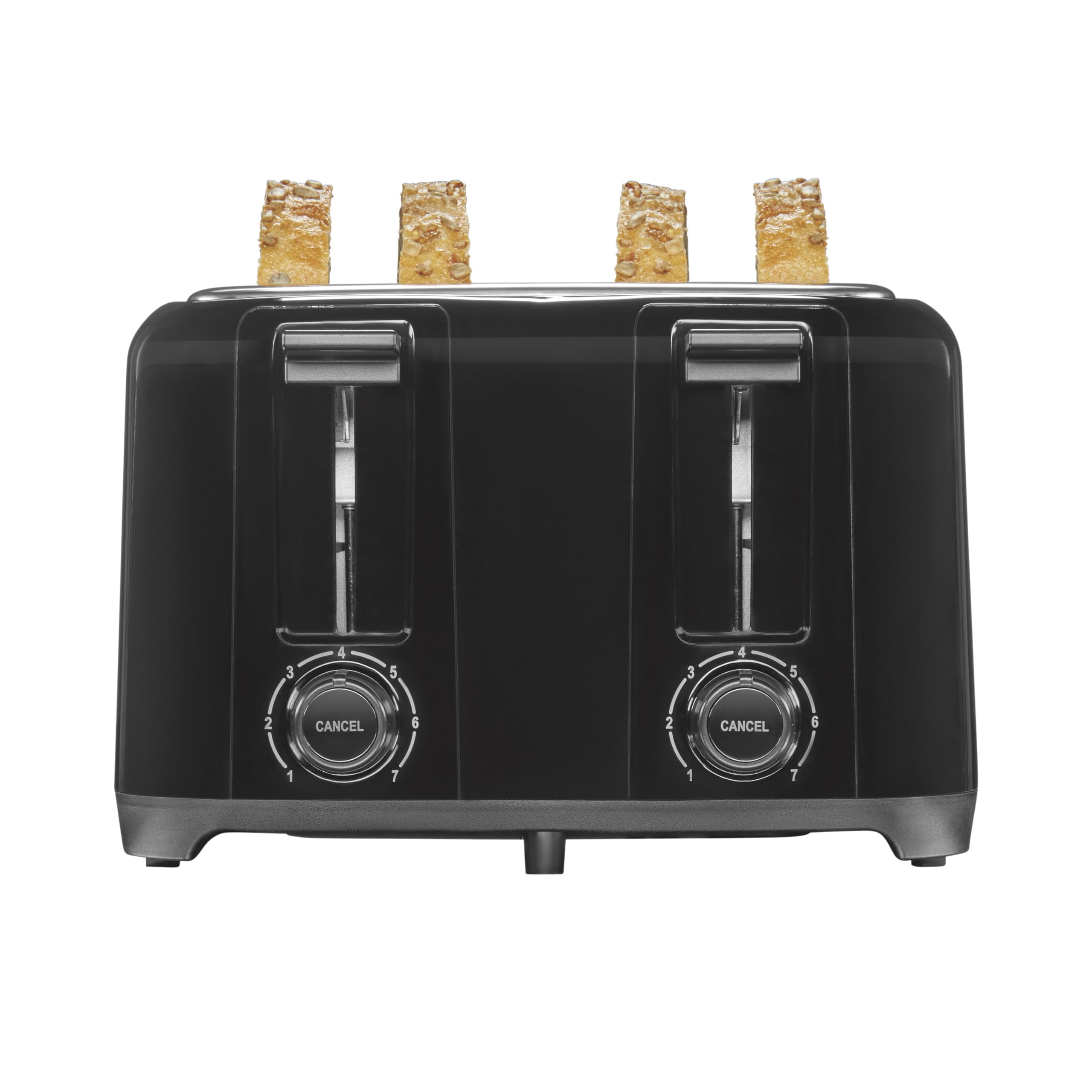
For everyone else it is the value pick of the four-slot models. Seven shades, four wide slots, a toast boost lever that lifts smaller pieces clear of the elements, and a cord wrap in the base. The practical details are all present, including a light 4.1-pound body that comes out of the cupboard without a two-handed grip. Nothing about the toasting is delicate, but it handles sandwich bread and muffins, which is what most households actually put in a toaster.

The slots are wide but not long, so a batard or a long sourdough slice stands proud and leaves the top pale. If your bread comes from a bakery counter rather than a bag, the Elite Gourmet or the bella will serve you better. And this is a plastic-bodied toaster that looks like one, tidy rather than charming, which is how it stays this affordable.

Bottom line: We recommend it to anyone feeding four who doesn't eat bagels often, since it is the cheapest route to four slots we trust.

3

GE 2-Slice Stainless Toaster

GE 2-Slice Stainless Toaster

Everyday toasting

Our Score 8.6/10
Check Price

Worth Noting

  • Long-term reliability is the weak spot
  • 5.5-inch slots are short for artisan loaves
Slices
2
Footprint
6.88"D x 11.18"W x 7.64"H
Slot Size
1.38" x 5.50"
Shade Settings
7
Read the full review

Seven shades is one more than most toasters here offer, and it isn't why this one earns the top spot. The GE wins on the part you can't adjust after buying: it browns both faces of a slice to the same shade more consistently than anything else in this group, and its slots, 1.38 inches wide and 5.5 inches long, take a bagel half without wedging it. Two slices, one carriage, no learning curve.

The body is brushed stainless with a black collar and looks more expensive than it is, which counts for something on a counter you actually look at. At 6.88 inches deep and under three pounds, it slides back beneath a wall cabinet and comes out for a big breakfast without feeling like an appliance you have to plan around. The crumb tray pulls out, the cord wraps underneath, and the seven settings run from barely warm to properly dark, so there is room between levels for the way you like your toast.

One adjustment to expect: dense breads can brown darker across the bottom than the top, so start a shade lighter than you would on sandwich bread and turn the slice for the second batch. Beyond that there's little to learn here, which is the point. Five and a half inches of slot is also short of a long artisan loaf, so if you buy boules, look at the long-slot models instead.

Bottom line: Our pick for most kitchens: it browns both sides evenly, takes a bagel, and sits under seven inches deep on the counter.

4

Amazon Basics 2-Slice Toaster

Amazon Basics 2-Slice Toaster

First apartments

Our Score 8.6/10
Check Price

Worth Noting

  • Shorter working life than midrange picks
  • Exterior runs hot during long sessions
Slices
2
Footprint
11"D x 6.5"W x 7.6"H
Slot Size
5-1/4" long by 1-1/4" wide
Shade Settings
6
Read the full review

If you are furnishing a first apartment and the toaster is item forty on the list, this is the one that ends the search. Six shades, slots of 1.25 inches that take a bagel, bagel, frozen and cancel buttons that light up when they are on, and an extra-lift lever for muffins. Nothing about it is charming; everything about it does what the label says.

The 900-watt element is quick enough for back-to-back slices, and the 5-1/4-inch slot length handles standard loaves and English muffins without complaint. The black and silver body reads exactly as what it is on the counter, so this is the one to keep in a cupboard if the kitchen is styled rather than practical, and at 2.5 pounds it goes away easily. We like it most for what it doesn't ask of you: no dial to interpret, no panel to learn.

The price buys a shorter working life, and the exterior runs hot during a long session, so keep the cord clear of the body and give it a minute before you move it. For a household toasting twice a day it is a fair trade; for one toasting once a week, it is an easy one.

Bottom line: The plainest way to get good toast: wide slots, six shades, and none of the extras that push the price up.

5

Elite Gourmet 4-Slice Long Slot

Elite Gourmet 4-Slice Long Slot

Long slices

Our Score 8.6/10
Check Price

Worth Noting

  • Browns unevenly at higher settings
  • Wide 14.68-inch footprint
Slices
4
Footprint
7.13"D x 14.68"W x 7.68"H
Slot Size
10" × 1.5"
Shade Settings
6
Read the full review

A rack that rises out of the top is the detail nothing else here offers. Push the warming rack lever and a small platform pops up above the slots for croissants, rolls, pita, or a plate you want to take the chill off, while the slots get on with the bread. It is the sort of feature you don't know you want until the first time you warm four buns without turning on the oven.

The slots are the other reason to look. Two 10-inch openings, 1.5 inches wide, long enough that a bagel half or a length of sourdough lies flat and browns along its whole length instead of charring at the top. Six settings, reheat, defrost and cancel, a high-lift lever, and a 36-inch cord that stores in the base make it a well-equipped four-slice for the money.

The catch is consistency. This toaster runs hot and unevenly: slices can come out dark on one face and pale on the other, and the gap widens as the dial climbs, so start low and watch the first batch before trusting a setting. At 14.68 inches wide it is also a real commitment on a small counter, though it stays shallow at 7.13 inches deep.

Bottom line: We like it for long loaves and warm pastries, with the caveat that you will be watching the dial closely.

6

BLACK+DECKER TR1478BD 4-Slice

BLACK+DECKER TR1478BD 4-Slice

Feeding a crowd

Our Score 8.6/10
Check Price

Worth Noting

  • Slow to toast standard bread
  • Bagel button can toast both sides
Slices
4
Weight
3 lb
Footprint
11.1"D x 10.67"W x 6.89"H
Shade Settings
7
Read the full review

Four slices at once, 6.89 inches tall, three pounds: this is the toaster for a household where everyone leaves at the same time. It slides under a wall cabinet, lifts out with one hand, and the drop-down crumb tray underneath puts the mess somewhere you can actually reach.

Seven shades, bagel, frozen and cancel buttons, and a high-lift lever for muffins are all here at a midrange price. The look is deliberately plain, black with a silver top, but it is tidy on a counter and the controls sit on the front where you want them rather than on the side.

Where it loses ground is speed and the bagel button. A cycle takes noticeably longer than on the 2-slice models here, which is the wrong trade on a school morning, and the bagel setting is the least reliable control on the machine, sometimes toasting both faces when you wanted one. Buy it for four slots in a small footprint, and don't buy it expecting the bagel mode to behave.

Bottom line: A light, compact four-slot for a busy weekday morning, provided you are patient with the timer.

7

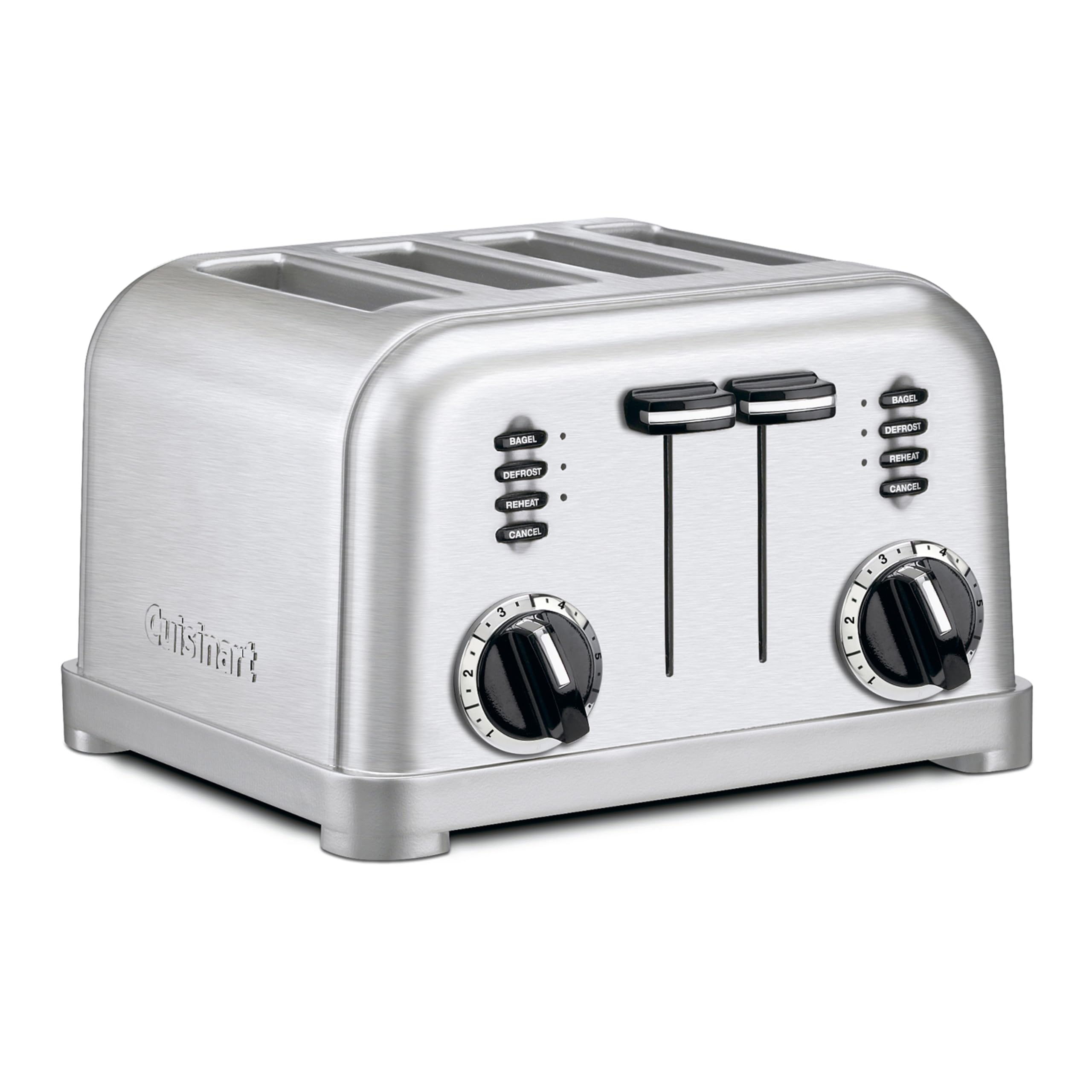
Cuisinart CPT-180P1 4-Slice

Cuisinart CPT-180P1 4-Slice

Family kitchens

Our Score 8.4/10
Check Price

Worth Noting

  • Needs 10.65 inches of counter depth
  • Build feels lighter than the finish suggests
Slices
4
Warranty
Limited 3-year
Slot Width
1.5"
Shade Settings
6
Read the full review

Three years is an odd thing to lead with on a toaster, until you remember how many of them die at the lever. The CPT-180P1 is the only model in this group with a limited three-year warranty, and in a category where one year is the standard promise, that is the most concrete durability insurance on the page. Register it the day it arrives; the receipt is the warranty.

The better reason to buy it, though, is the pair of control panels. Four slots, 1.5 inches wide, split into two independently controlled pairs, each with its own six-setting dial and its own bagel, defrost and reheat buttons. That sounds like overkill until one person wants pale toast and another wants it dark, or a household has one gluten-free eater. Two settings, one toaster, no negotiation before breakfast.

It is a substantial thing at 6.1 pounds and 10.65 inches deep, so measure the counter before committing; it wants a proper run of space rather than the sliver beside the fridge. The brushed stainless looks the part, though the body feels lighter in the hand than the finish suggests, and that is part of how the price stays where it is.

Bottom line: Buy this if two people in the house want their toast different, or if you want the only three-year warranty here.

8

bella 2-Slice Slim Toaster

bella 2-Slice Slim Toaster

Tiny counters

Our Score 8.4/10
Check Price

Worth Noting

  • Weakest long-term reliability in this set
  • Nearly 15 inches wide across the counter
Slot
10-inch long slot
Slices
2
Footprint
3.58"D x 14.88"W x 6.85"H
Shade Settings
6
Read the full review

Three and a half inches of depth is the whole argument. The bella is 3.58 inches front to back, shallow enough to sit on a windowsill, a narrow shelf, or the sliver of counter between the fridge and the wall, and at 2.5 pounds you can shift it one-handed when you want the space back. That is why it is on this list at all, and it is the one thing no other toaster here does nearly as well.

The trade is width: nearly 15 inches across, so it wants a long, thin gap rather than a square one. Inside is a single 10-inch slot, more useful than the two-slice count suggests, because two slices go in side by side and a bagel half or a length of baguette lies flat instead of standing up and burning at the top. The high-lift lever gets an English muffin out without fingers near the elements, and the six settings cover the usual range.

What you are accepting is time. Longevity is the weakest part of this toaster's story by a wide margin, with the lever and the elements the places it goes, so treat it as a good cheap toaster rather than a decade-long purchase. The finish and the color options are genuinely nice for the money, and the removable tray and cord wrap keep it tidy in a small kitchen where everything is on show.

Bottom line: We point anyone with a shallow counter here: it takes a bagel flat and disappears beside the fridge.

9

Breville Bit More BTA720XL

Breville Bit More BTA720XL

Toast obsessives

Our Score 8.0/10
Check Price

Worth Noting

  • Most expensive toaster in this group
  • No longer warranty than cheaper picks
Slices
2
Weight
5.1 lb
Footprint
7.3"D x 11.3"W x 8.2"H
Shade Settings
6
Read the full review

Two features justify this toaster, and neither is a gimmick. Lift & Look raises the carriage without ending the cycle, so you can check a slice at the two-minute mark and lower it again; A Bit More adds time at the end without starting over. On a toaster, where the gap between pale and burnt is often half a minute, that pair of controls is the most useful thing anyone has put on one of these machines.

The rest is solid. Wide slots for thick-cut bread, six browning settings, an LED bar that shows how far through the cycle you are, bagel and defrost modes, and a 5.1-pound brushed steel body that stays where you put it when you push the lever down. It is 11.3 inches wide and 8.2 inches tall, so it wants more headroom under a cabinet than the slim models here.

What the premium does not buy is a longer life. The money goes on control rather than longevity, and the one-year warranty is the same promise the budget models make. If you set the dial once and never touch it again, spend less. If you are the person who lifts the bread to check, this is the toaster that lets you.

Bottom line: Worth the premium only if you fiddle: lifting bread mid-cycle and adding time without restarting are genuinely useful.

How We Tested 12 Toasters — and What Made the Cut

We started with roughly 40 models on the shelves at major retailers, then filtered by the things that decide a purchase before anything gets plugged in: slot count and width, footprint depth and height, exterior finish and color options, and whether the controls were mechanical dials or digital buttons. That left 12 toasters spanning the price range from basic two-slot machines to long-slot four-slicers and a couple of retro-styled models with the curves people photograph. We bought every one at retail and unpacked them in the same kitchen.

Testing ran for six months of ordinary mornings. Weekdays meant two slices straight from the fridge, eaten standing up, and we noted whether the second round came out darker than the first. Weekends meant brunch for six — back-to-back cycles with no cool-down — plus bagels, English muffins, frozen waffles, thick-cut sourdough, and one gluten-free loaf that crumbles if you look at it wrong. Because counter space is where these things live or die, we ran each toaster on the counter for a week, then tucked it into a cabinet, measuring footprint and height with a tape measure, checking clearance under the upper cabinets, and lifting each one single-handed to see whether moving it was a chore.

Every batch got photographed next to a color card so we could compare browning across the full slice rather than just the middle, and we tracked how the exteriors held up over hundreds of cycles: fingerprints on glossy stainless, scuffs on painted finishes, levers that loosened, crumb trays that stuck or tipped the machine when pulled. We also weighed what each one cost per usable slot against how consistently it toasted. The models that survived six months without a frustrating morning are the ones below.

How to Choose Toasters

Slot size matters more than slice count

Extra-wide is the most oversold phrase on a toaster box. Width gets a bagel half in; length is what stops a slice of sourdough standing proud with a pale top. Put the two numbers side by side. The GE lists slots of 1.38 by 5.5 inches, which is plenty for sandwich bread and a bagel, while the bella and the Elite Gourmet run a 10-inch slot that takes a bagel half or a length of baguette lying flat.

If you buy rustic loaves or bagels more than twice a week, length is worth more to you than a seventh shade setting. If your bread comes pre-sliced from the supermarket, it barely matters.

Two slots or four

Four slots only pay off if the counter can take the depth. The Cuisinart is 10.65 inches front to back and the Black+Decker 11.1, against roughly seven for the 2-slice models here. Four slots also pull more power, 1,300 to 1,800 watts against 800 to 1,000, so don't ask the same outlet to run a kettle at the same time.

Where four slots earn their footprint is independent controls. The Cuisinart's two panels let one side run pale for a child or a gluten-free slice while the other goes properly dark, which is a different proposition from four slots sharing one dial.

Sharper control, and what it cannot fix

Shade numbers are not standardized between brands, so a four on one toaster is a six on another. What matters is having enough steps to land on your level, which six or seven settings provide. The harder problem is evenness: slices that come out darker along the bottom edge or on one face are the most common complaint in this category, and no dial fixes it.

Start a shade lighter than you think on dense breads and check the first batch before you trust the setting. A bagel button, where there is one, simply switches off the outer elements; it's worth having if you eat bagels weekly, and it is the first thing to stop working when something does.

Buy for the lever, and keep the receipt

What fails on a toaster is mechanical: the lever that latches the carriage down, or one set of elements going cold while the other still glows. That is why the warranty carries more weight here than on most small appliances. One year is the standard promise across this group; the Cuisinart's limited three-year coverage is the exception.

Register the toaster the day it arrives and keep the receipt somewhere you can find it in eighteen months. A protection plan that duplicates the first year of coverage is money you could put toward a better toaster instead.

Frequently Asked Questions

Final Verdict

The GE is the toaster we point most people toward. It browns both faces of a slice evenly, takes a bagel without a fight, and sits under a wall cabinet at 6.88 inches deep, which is the combination that keeps a toaster off your nerves by February.

If two people in the house want different toast, or you need four slices and the longest warranty here, the Cuisinart CPT-180P1 is the better buy. And if counter space rather than money is the constraint, the bella's 3.58-inch body fits where nothing else on this page will.