Kitchen

Best Stovetop Tea Kettles of 2026

A stovetop kettle is one vessel, one burner, one job — and that simplicity is exactly where the differences hide. A base that's narrower than the flame ring, a handle that's too hot to grab without a towel, a spout that dribbles down the side of the pot instead of into your cup: none of that shows up in a product photo. Get it right and you stop thinking about the thing entirely. Get it wrong and you're reminded every morning, at the exact moment you're least awake and least patient.

Over the past eight months my team and I have boiled water in 12 stovetop kettles on gas and induction burners, and the ones worth keeping share a few traits: a broad flat base, a handle you can grab bare-handed at a full boil, and a lid that lifts off without a fight. Size is the sleeper issue — a two-quart kettle is charming until it's full and weighs more than your dumbbell. What follows is what survived daily use, including the week I deliberately left water sitting in each one to see which interiors spotted.

1

Mackenzie-Childs Courtly Check

Top Pick
Mackenzie-Childs Courtly Check

Statement kitchens

Our Score 9.2/10
Check Price

Worth Noting

  • Premium price
  • Hand wash and dry immediately
Care
Hand wash
Capacity
2 quarts
Material
Enameled steel
Stovetop
Gas, electric, ceramic
Read the full review

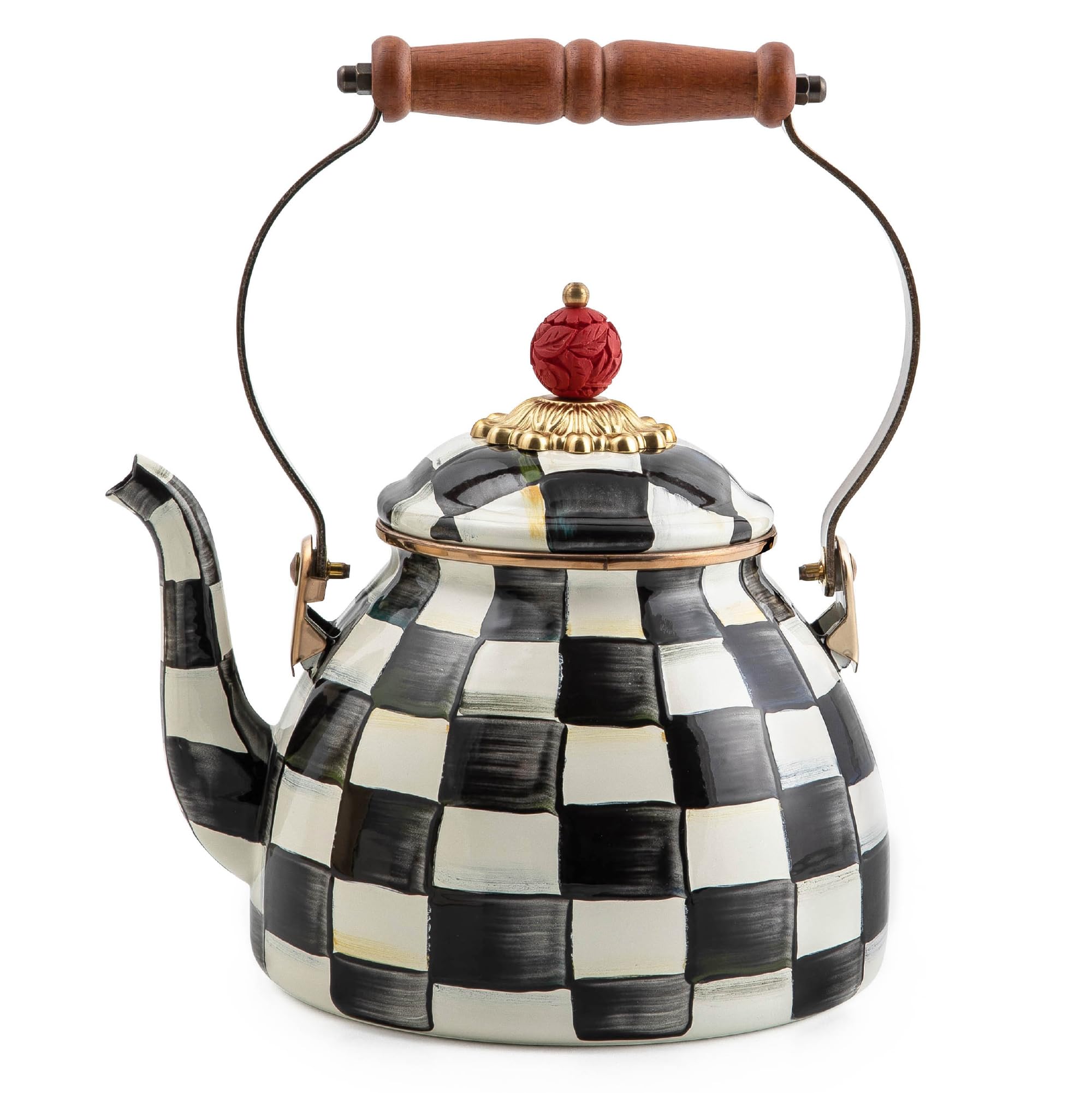
The Courtly Check kettle is a piece of kitchen decor that happens to boil water. The hand-painted black-and-white checks are color-dragged, so the pattern has a slightly irregular, hand-worked look rather than a printed repeat. The enameled steel body has real presence on the stove, and the wood handle and brass-accented lid add to the dressed-up feel.

That finish comes with care. The maker calls for hand washing and immediate drying, and the enamel can crack if it takes a hard knock. The kettle is also heavy for its size, which makes it feel planted on the burner but less pleasant to lift when full. It is not the kettle for a busy rental kitchen or a pot rack it will bang against.

For a design-led kitchen or a wedding gift, the Mackenzie-Childs earns its place. The 2-quart capacity is enough for a small household, and the broad body heats evenly on gas or electric. The price is the obvious hurdle, and the hand-wash care is the daily cost. What we appreciated most is the weight: it does not skitter across the burner when you set it down.

Bottom line: The Mackenzie-Childs is for the cook who wants the kettle to be part of the decor; it is beautifully made, but the price and hand-wash care are real commitments.

2

Café Brew Glass Kettle

Café Brew Glass Kettle

Everyday tea

Our Score 9.0/10
Check Price

Worth Noting

  • Whistle can be quiet or inconsistent
  • Glass can chip or crack if knocked
Whistle
Yes
Capacity
12 cups
Material
Borosilicate glass
Stovetop
Gas, electric, glass
Read the full review

The appeal of the Café Brew is obvious the moment the water starts moving: the borosilicate glass lets you see the boil, the water level, and any scale before it becomes a problem. We like that for a daily kettle, because you do not have to lift the lid to check how much is left, and there is no coated steel interior to rust through. The 12-cup capacity is generous for a small household, and the included heat-diffusing trivet gives the glass a more stable seat on a gas grate.

The whistle is the weak point. It can be loud enough on some boils and barely there on others, so treat it as a reminder rather than a dependable alarm. The stainless handle also gets hot if you leave the kettle at a rolling boil, and the lid comes off for pouring, which means one hand is busy. None of that is a dealbreaker in a kitchen where you stay nearby, and the glass is easy to clean inside and out.

We recommend it most for someone who wants a clear, inexpensive kettle for tea and does not mind handling glass. It is not the pick for a household that knocks kettles against the sink or wants a rugged stainless workhorse. The trivet is the detail we appreciated most: it keeps the base off the grate and makes the glass feel less precarious on a gas burner.

Bottom line: We recommend the Café Brew for anyone who wants to see the boil and avoid a rusty interior; it is the clearest, easiest-to-clean kettle in this group, provided you treat the glass with care.

3

Chefbar Gooseneck Kettle

Chefbar Gooseneck Kettle

Pour-over coffee

Our Score 9.0/10
Check Price

Worth Noting

  • Exterior can tarnish if left wet
  • Narrow fill opening needs a bottle brush
Spout
Gooseneck
Whistle
No
Capacity
0.8 liters
Stovetop
Induction, gas, electric
Read the full review

A gooseneck spout is the reason to choose the Chefbar. The narrow spout gives you a slow, controlled stream for pour-over coffee, and it works just as well when you want to fill a small teapot without sloshing water over the rim. The 0.8-liter body is compact enough for a small kitchen or an RV cupboard, and the 304 stainless steel is compatible with induction, gas, and electric burners.

It is a quiet kettle by design, so you need to stay nearby or set a timer; if you depend on a whistle, this is not the one. The fill opening is narrow enough that a bottle brush helps, and the exterior can tarnish if water sits on it. We liked the Bakelite handle and the steady balance when pouring; it feels planted in the hand rather than top-heavy.

For a two-cup tea routine or a pour-over setup, the Chefbar is the one we reach for. It is not for a family that wants a full pot or an audible alarm from the next room. The capacity is the trade-off: two generous mugs, not four.

Bottom line: For pour-over coffee or a two-cup tea routine, the Chefbar is the controlled pour we reach for; just do not expect it to whistle or serve a crowd.

How We Tested a Dozen Stovetop Kettles

We began with several dozen kettles pulled from retailer listings and reader recommendations, then narrowed the field by capacity (roughly one to two and a half quarts), base material and thickness, induction compatibility, replacement lids, and price — landing on 12 models spanning about $20 to $150. Every kettle had to work on both a gas burner and a portable induction hob, since plenty of shoppers switch kitchens mid-ownership.

Testing happened where kettles actually live: the morning kettle, the after-dinner kettle, the second pot of the evening. We timed how long a full quart took to boil on gas and again on induction, weighed each kettle empty and full, and set base diameters against a small and a large burner to see how much flame licked up the sides. We filled each one from a tall kitchen tap to check clearance, poured one-handed into a mug and watched for drips trailing down the spout, and picked up every handle bare-handed at a rolling boil before reaching for a mitt to see how much room the grip actually left.

For the whistles, we listened from the next room with the range hood running and noted pitch and whether the sound arrived in time to be useful. Cleaning meant a week of our hard tap water in each kettle, then scrubbing the scale out by hand to see whether the mouth was wide enough for a brush or a fist. Durability and rust got the least glamorous treatment: each kettle sat full of water for a full week and we checked the interior for spotting, then spent months knocking them against grates and watching painted finishes and handles hold up. Value got the final vote — several mid-priced kettles outperformed the expensive ones outright.

How to Choose Stovetop Tea Kettles

Match the base to your cooktop

Start with compatibility, because a beautiful kettle that does not sit flat on your burner is a return waiting to happen. Gas, electric coil, smooth-top, and induction all ask different things of a base; induction needs a magnetic base, while glass and enamel need a gentle heat setting rather than a roaring flame. Check the manufacturer's list for your exact cooktop and use a trivet or diffuser if the maker supplies one. We prefer a plain kettle that sits securely to a stylish one that wobbles.

Decide if you want a whistle or a controlled pour

A whistle is a convenience, not a guarantee. Whistling kettles can be loud enough to hear from the next room or quiet enough that you forget the kettle is on, so test the one you buy during the return window and do not rely on it as a safety alarm. A gooseneck, like the Chefbar, gives you a slow, precise stream for pour-over coffee and small teapots, but it makes no sound at all. Choose the whistle if you leave the kitchen; choose the gooseneck if you stand at the counter and pour.

Size the kettle to your cups

Capacity is about the number of cups you actually make, not the biggest number on the box. A 0.8-liter gooseneck is a two-mug kettle; a 1.5- to 2-quart kettle is the practical size for a couple or a small family; a 2.5- to 3-quart kettle is for a full table. Remember that you should not fill to the rim: leave an inch or two below the spout so steam has room and the whistle can work. If you mostly make one cup, a small kettle heats faster and takes less counter space.

Plan for heat, rust, and care

The long-term costs are handle heat, interior rust, and finish care. A stainless interior can develop rust spots if water sits in it, so empty and dry the kettle after each use; glass avoids that problem but can chip or crack if it hits the sink. Enamel needs hand washing and immediate drying to keep its finish, and wood handles should not soak. We prioritize a handle that stays cool enough to grip with a towel and a body you can clean without a special brush.

Frequently Asked Questions

Final Verdict

Most kitchens should start with the Café Brew Glass Kettle. It lets you see the boil, avoids the rust risk of a steel interior, and holds enough for a small household; the trade-off is glass care and a whistle that is not always dependable. If you make pour-over coffee or mostly heat two cups, the Chefbar's gooseneck is the better tool, though it is silent. The Mackenzie-Childs is the design-led choice when the kettle is also decor and you will hand-wash it.