Kitchen

Best Electric Kettles of 2026

A kettle is the one appliance in your kitchen that has to work before you're fully awake, and it's also the one people buy on looks and regret by the second cup. The failure modes are boring and predictable: six minutes to boil a liter, a handle too hot to grab bare-handed, a switch that doesn't quite click off, a lid that dribbles water down the side every time you fill it. What you actually need is unglamorous — a fast rolling boil from something that feels solid in your hand, sits steady on the base, and doesn't look like lab equipment on the counter.

We've run a dozen kettles through our own kitchens over the past eight months, and the differences show up in the first week, not the first month. One thing I'd pass along to any first-time buyer: the wattage printed on the box is a weak predictor of speed — how the element sits against the water matters more than the big number. Below are the ones I'd plug in again.

1

COMFEE' 1.7L Kettle

Top Pick
COMFEE' 1.7L Kettle

Everyday family use

Our Score 9.2/10
Check Price

Worth Noting

  • Survival past the first year is the weak spot
Body
Brushed stainless steel
Power
1500 watts
Capacity
1.7 liters
Full-pot Boil
5 to 7 minutes
Read the full review

The arithmetic settled this one for us. COMFEE' gives you 1.7 liters for about what the one-liter kettles here cost, and that extra half-liter is a refill you don't make: a full pot covers a French press, two mugs and a packet of noodles. The 1500-watt element takes a brimming pot to a rolling boil in the five to seven minutes COMFEE' quotes, and two cups in a good deal less. That's the shape of the kettle — big when you need it, quick when you don't.

What we liked most is the lid. It pops on a button and swings wide, so filling from the tap and getting a brush around the shoulder are one-handed jobs. The interior is 304 stainless with a concealed element, which means there's no exposed coil for scale to crust onto, and the removable nylon filter rinses under the tap. Auto shut-off and boil-dry protection both behave the way they should; of the kettles here, this is the one whose shut-off gave us the least to think about, and that counts for more than any line on the box.

The body gets hot while it's working — the handle stays cool, the shell doesn't — so keep it back from the counter edge and out of reach of anyone small. It's hand wash only, and the warranty runs a year, so register it and keep the receipt. Everything else about it is the unglamorous competence you want in an appliance you'll switch on four times before lunch.

Bottom line: Our pick for most kitchens: a full 1.7 liters, a stainless interior with nothing to crack, and shut-off we never had to think twice about.
2

Amazon Basics 1L Kettle

Amazon Basics 1L Kettle

Small kitchens

Our Score 9.2/10
Check Price

Worth Noting

  • Hand wash only
Body
Stainless steel
Power
1500 watts
Weight
1.9 lb
Capacity
1 liter
Read the full review

A liter is less water than it sounds. Fill a French press and two mugs and you'll be topping up before the second cup — that's the honest cost of the smallest kettle we recommend, and it's the reason this isn't sitting at the top of the page.

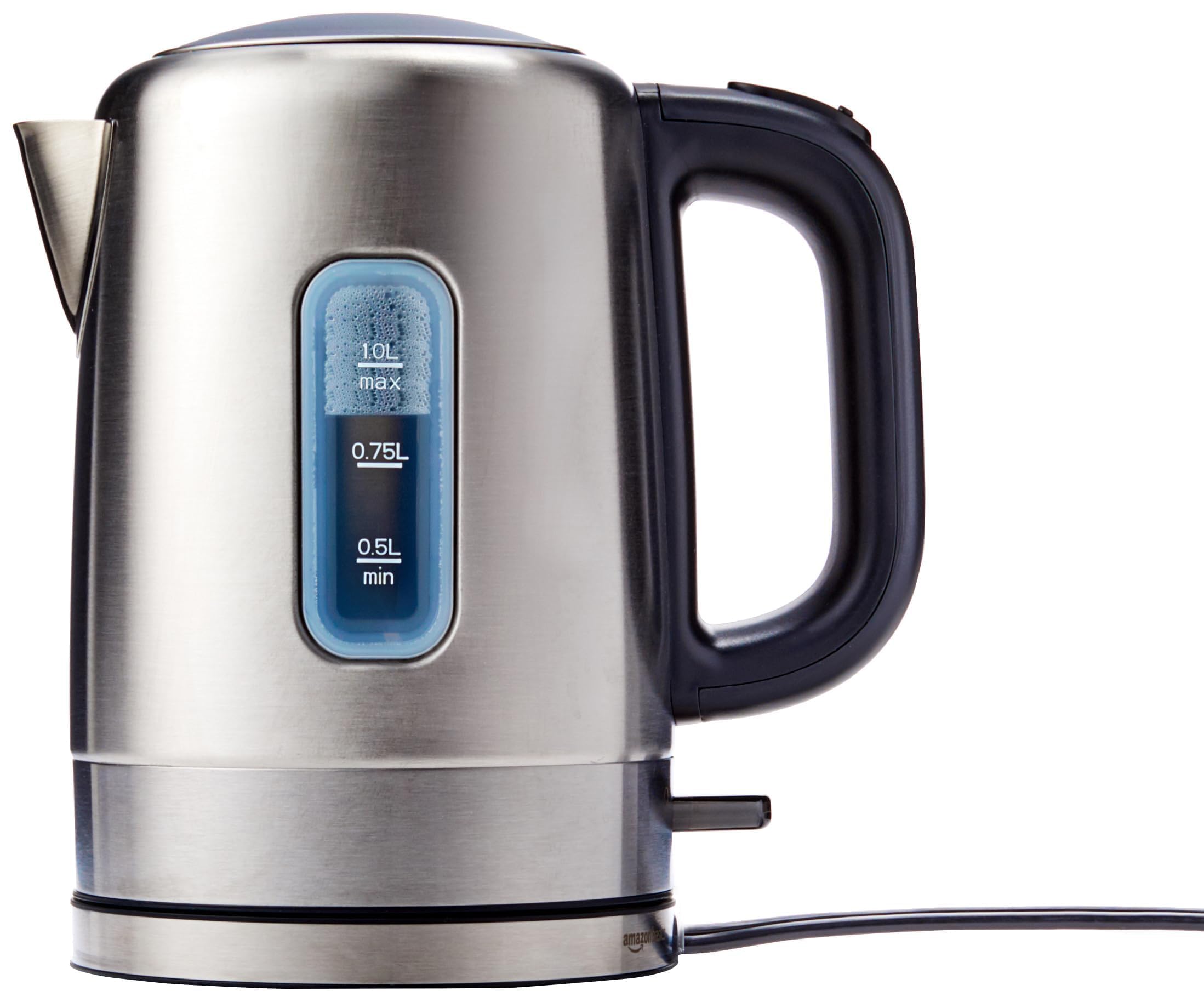
Set that against the size and it makes a lot of sense. Five and a half inches across and under two pounds, it tucks into the corner of a counter, an office kitchen or an RV galley where a 1.7-liter kettle would have to live on the floor. The opening is wide enough to fill from the tap and wipe out with a cloth, the level marks are molded into the side, and the element brings a liter to a boil fast enough that we stopped watching it. For one person drinking tea through the morning, this is the kettle we point to.

The body gets properly hot away from the handle, so give it a spot where nobody brushes past, and there's no temperature control — it boils, and if you want cooler water for green tea you let the cup stand a minute. What's left is a small, quick stainless kettle with a Strix thermostat and a proper boil-dry cutout, and at this size those are the things that matter.

Bottom line: We keep this one for small counters and solo tea: a liter of fast-boiling water in a five-and-a-half-inch footprint that tucks anywhere.

3

Hamilton Beach 1.7L Kettle

Hamilton Beach 1.7L Kettle

Filling big pots

Our Score 9.0/10
Check Price

Worth Noting

  • Body gets hot enough to sting
Body
Brushed stainless steel
Power
1500 watts
Capacity
1.7 liters
Dimensions
9.2 x 9.2 x 8.8 inches
Read the full review

The feature we used most isn't the one you'd put on a box: a water window down the side, marked in cups, readable from a couple of feet away. Filling at the sink without lifting the kettle to check the level sounds trivial until you've owned a kettle that didn't have one.

The rest is plain in a way we appreciated. The switch sits on the back, away from the steam and the spout, the jug lifts off its base and carries to the table, and 1500 watts has a full 1.7 liters rolling in a few minutes. Brushed stainless wipes down easily and matches a fridge and a toaster without trying.

The reservation is the shut-off. The steam trip on this model can stick, and a kettle that keeps boiling instead of clicking off is one you don't leave the room during — treat the switch as a convenience rather than a safety net and site it where a runaway boil ruins nothing but water. Against that, the layout is refreshingly simple: one switch, one light, no menus, nothing to learn.

Bottom line: We recommend it if you fill a whole pot at once and want a water window you can read from across the kitchen without lifting a thing.

4

Chefman 1.8L Glass Kettle

Chefman 1.8L Glass Kettle

Watch it boil

Our Score 9.0/10
Check Price

Worth Noting

  • Glass body punishes a careless knock
Lid
Removable
Body
Borosilicate glass
Power
1500 watts
Capacity
1.8 liters
Read the full review

Most glass kettles give you a hinged lid that flips back just far enough and no further. This one's lid lifts off completely, which is the difference between rinsing the shoulder of the carafe and actually getting a brush into it. It's also the largest kettle in this group at 1.8 liters, with a 1500-watt element and blue LEDs that light the water while it heats.

What you're buying is the view. Watching a full carafe come to a boil through borosilicate glass is a small, genuine pleasure, and the stainless filter and BPA-free build keep the water clean. We treat glass as the finish that needs care, though: set it down gently, don't shock it with cold water while it's hot, and don't expect it to shrug off the knocks a stainless kettle would. If the look is the point, this is the one we point you to; if you'd rather stop thinking about your kettle entirely, buy one of the stainless picks above.

Bottom line: We like it for the look and the biggest pot here — provided you'll treat a glass body gently and hand wash it without complaint.

How We Tested a Dozen Electric Kettles

We started with a shortlist of more than 30 kettles, drawn from brands our readers already own and models that kept surfacing in reviews, then cut it down by capacity (1 to 1.7 liters), whether anything plastic sat in the water path, whether the body lifted off a cordless base, and how the switch and shut-off were engineered. Price mattered only as a ratio — we wanted to know what the extra money actually bought. Twelve made the final cut.

Each kettle was filled from the same cold tap and timed with a stopwatch: one liter first, then to full capacity, then a second boil 30 seconds after the first to see how the thermostat handled a hot start. I poured a full kettle one-handed to judge balance, then watched the spout for drips down the side. Immediately after boiling, I wrapped a bare hand around each handle and ran an instant-read thermometer over the body and lid to catch the ones that run hot where you'd grip them.

Auto shut-off got its own deliberate abuse: we let every kettle boil dry to see whether the cut-off tripped before the base scorched, then switched it back on to check it recovered. Over eight months of twice-daily use, we descaled with citric acid, opened and closed each lid a few hundred times, and noted hinge slop, scratches, and faded water-level markings. For appearance and everyday handling, we wiped each one with a damp cloth, checked how visibly it held fingerprints, and wound the cord back into its base.

How to Choose Electric Kettles

Match the capacity to the pot, not the cup

Most kettle regret is a size error. A liter is roughly four mugs, which is fine for one person making tea through the morning and irritating the first time you fill a French press for two. Step up to 1.7 or 1.8 liters if you cook with hot water too — noodles, blanching, a hot-water bottle — because a kettle gets used for far more than brewing once it's on the counter.

The cost of going bigger is counter space and a slower climb to a boil on the days you only wanted one cup. Buy for the largest thing you fill in a normal week, not the average.

Stainless, glass or plastic: what each finish costs you

Stainless is the body we choose for a kettle used daily. It hides scale between descales, survives a knock, and doesn't ask you to handle it like glassware. Glass is the finish that sells the most kettles, and we understand the appeal — watching water break into a boil is genuinely satisfying, and a lit glass carafe is the best-looking thing on most counters. It's also the finish where a knock or a temperature shock ends the kettle.

Plastic is the lightest and cheapest, and the one most likely to leave a taste in the first weeks. If you want glass, buy it for the look and set it down gently; if you want one kettle for years of mornings, buy stainless.

What shut-off and boil-dry protection actually cover

Every kettle here cuts the power once steam or the thermostat says the water is boiling, and all of them stop heating when the element is dry. Treat both as backup, not supervision. The sensing switch is the part most likely to fail, and when it does, the element keeps going.

So site the kettle where a runaway boil damages nothing but water — not under a cabinet, not beside the toaster, not where a child can reach the cord. And never fill past the maximum line: a spitting kettle is worse than a slow one.

Wattage, capacity and how long a boil really takes

Wattage says how fast the element works; capacity says how much work there is. A 1500-watt kettle takes a full 1.7-liter pot to a rolling boil in something like five to seven minutes, and two cups in a fraction of that — so a big kettle used for small pours isn't slow, it's just big.

The 1100-watt models save a little on the purchase and cost you time on full pots. If you make one or two cups at a time, wattage barely matters; if you fill the pot, it's the difference between waiting and forgetting you were waiting.

Presets, keep-warm and the tea that needs them

A fixed-boil kettle takes water to a boil and stops. That's right for black tea, instant coffee and noodles, and wrong for green tea, which wants water well below boiling. Variable-temperature models with presets and a keep-warm hold solve that properly and charge for the electronics that do it. None of the kettles we recommend here has presets.

If you drink green or white tea daily, that's the feature worth a different shortlist. If you only occasionally need cooler water, boil and let the cup stand a minute or two — free, and nearly as good.

Frequently Asked Questions

Final Verdict

Buy the COMFEE' if you want one kettle for a household. It gives you a full 1.7 liters for about what the one-liter models here cost, a stainless interior with nothing to crack, and the steadiest shut-off in this group — that combination is why it's our pick.

If your counter is tight, or you're making tea for one at a desk or in an RV, the Amazon Basics liter is the better fit and still boils fast. The only reason to go elsewhere is the Chefman, and only if the glass and the extra capacity are the point rather than an accident.