Kitchen

Best Kitchen Islands of 2026

Kitchen islands are the rare upgrade that adds counter space, storage, and a place for someone to perch with a glass of wine—without a contractor. They also eat up floor space, which is why the wrong one can make a room feel tighter than it did before. Over the past eight months, I’ve lived with seven kitchen islands in my own kitchen and my teammates’ homes, and the keepers all earned their footprint in ways the duds did not.

The good ones went together without a missing-hardware scavenger hunt, stayed solid when I leaned my weight into the counter, and held a surprising amount of pots, appliances, and pantry overflow. Size mattered less than proportion—an island that blocked the oven or left no room to open a drawer was a daily annoyance, no matter how nice the top looked. And value wasn’t about the lowest price; it was about whether the storage, seating, and rolling clearance added up to something I’d reach for every day—which is exactly how the seven below separated themselves.

1

HSH 63-Inch Kitchen Island

Top Pick
HSH 63-Inch Kitchen Island

Seating and dining

Our Score 9.6/10
Check Price

Worth Noting

  • Most expensive pick in this group
  • Needs a large room and two people to build
Height
35.43 in
Seating
2 to 3
Storage
2 drawers, 2 cabinets
Worktop
63 x 31.5 in
Read the full review

Sixty-three inches wide and 31.5 deep is not an island that helps out — it's a table that happens to hold your pans. We think that's exactly right for an open-plan room where people eat at the island, and it's the only pick here built around seating for two or three.

The counter sits at 35.43 inches, standard counter height, and that decides your stools: you want a seat around 24 to 26 inches, not a 28-to-30-inch bar stool that leaves everyone perched with their knees at the drawer line. Get that pairing right and this does the work of a dining table without a second piece of furniture in the room.

Storage keeps up with the size. Two deep drawers, two press-to-open cabinets, and three oval open shelves on the ends that give you somewhere to drop a bowl without opening anything. The rustic brown wood-grain top over a black frame reads warmer than the white carts here, which is a decorating decision as much as a practical one.

The cost is size and money: this is the priciest pick in the group, and it needs 63 inches of wall plus floor to walk around. Assembly is a two-person afternoon — long panels, a heavy box — with clear instructions and spare hardware in the bag, which is more than most flat-pack furniture gives you.

Bottom line: We point people to it when the island is also the dining table: 63 inches of counter, seating for two or three, and storage that stays out of sight.

2

VASAGLE 47.2-Inch Kitchen Island

VASAGLE 47.2-Inch Kitchen Island

Everyday prep space

Our Score 9.4/10
Check Price

Worth Noting

  • No drawer or closed cabinet
  • Particleboard top, not solid wood
Height
35.4 in
Storage
3 open shelves
Worktop
47.2 x 23.6 in
Max Load
66 lb
Read the full review

The number that decided this one for us is 47.2 inches. That's the width of the worktop, 23.6 inches deep and standing at 35.4 inches, which is the same height as a standard kitchen counter. It sounds minor until you've spent a week prepping on a cart that's three inches short and felt your shoulders pay for it. Two people can stand at this one with a board and a pan between them.

We think it's the best default here because it gives you the most usable counter of any pick at counter height, and it doesn't ask you to build a cabinet to get it. The frame is steel, the top is particleboard under a finish, and the whole thing goes together with an included tool and numbered parts. Assembly is where flat-pack islands usually go wrong, and it's the part this one gets right.

What it doesn't give you is a drawer or a door. Everything sits on three open shelves, which we like for appliances — the toaster and the coffee machine are visible, reachable, and back where they belong in seconds — and which is wrong for anyone whose storage is a wall of mismatched containers. The adjustable feet are the quiet win: a slightly uneven floor doesn't turn into a wobble every time you lean on the edge, and you never chase the island around the room.

The listed maximum load is 66 pounds, enough for the appliances this thing is designed to hold and not enough to treat the top as a step stool. Give the top a look before you assemble it, too — a marked panel is a much easier conversation before the legs go on than after.

Bottom line: We recommend it as the default: a full-size counter at proper height, stable without casters, and simple to assemble — provided open shelving suits how you store things.

3

FINETONES 52-Inch Kitchen Island

FINETONES 52-Inch Kitchen Island

Expandable serving space

Our Score 9.2/10
Check Price

Worth Noting

  • Only two of five casters have brakes
  • Heavy at 106.7 pounds to reposition
Casters
5, two with brakes
Storage
2 drawers, shelved cabinet
Drop Leaf
Yes
Worktop Width
52.4 in
Read the full review

The leaf is the whole idea. Folded down, this is a 52-inch cabinet on wheels with a panelled front and a green finish that reads as furniture; folded up, the hinged extension adds a serving surface for a party or a big Sunday cook. It's the best-looking expandable pick here, and the one that holds its own when the island is in sight of the dining table.

We rate it near the top of this set on storage variety, too. Two drawers take the utensils and cloths, the cabinet behind the doors has shelves at two heights for appliances, and there's a side rack for spice jars and a rail for towels. At 106.7 pounds it is not a cart you nudge with one hand — it rolls, but it rolls like a sideboard.

Five casters sit underneath, including a center wheel that stops the middle sagging when the leaf is loaded, and two of them have brakes. That brake count is the specification worth knowing: two braked wheels hold one side of a five-wheel cart, so park it against a wall or a cabinet before you lean your weight on the overhang.

Assembly is a screwdriver job rather than a project, with one wrinkle — the leaf is much easier to fit with a second pair of hands holding it square. If you don't have the floor space to open a leaf, the VASAGLE hands you more counter with less furniture to move around.

Bottom line: We recommend it to anyone who wants a rolling island that looks like furniture and can grow extra serving space when guests arrive.

4

Casual Home 40-Inch Kitchen Island

Casual Home 40-Inch Kitchen Island

Small kitchens

Our Score 9.0/10
Check Price

Worth Noting

  • Finish scratches and chips at the edges
  • Drawer rated for only 5 pounds
Storage
1 drawer, 2 shelves
Worktop
40 x 20 in
Top Load
100 lb
Top Material
Solid American hardwood
Read the full review

This is the one we point at when someone has a small kitchen and wants a landing strip rather than a second table. Forty inches wide and 20 deep, it tucks against a wall and still leaves a walkway, and the top is solid American hardwood rather than a printed board, rated for 100 pounds. Real wood at this end of the range is unusual, and it's the reason this pick survives a category full of particleboard.

The caveat is the finish rather than the wood. It marks and chips at the edges and around the drawer front, so treat the top like a workbench — a board under the knife, a trivet under the pan — and you'll get along with it fine. Buy it expecting a showroom surface and you'll be disappointed; buy it expecting a surface that earns a few marks and it delivers what the other carts here can't.

Storage is honest but modest: one drawer and two shelves under the top. The drawer is rated for five pounds, so it's cutlery, cloths, and clutter — not the stand mixer. The shelves take the heavy things, and at 38.2 pounds the whole unit is light enough that one person can shift it a couple of feet without emptying it first.

Assembly is the least painful of the cabinet-style islands here: solid parts, holes drilled where they belong, and a job one person can finish. If you want doors and a pantry's worth of storage, one of the bigger picks serves you better; if you want a genuine wood top and a narrow footprint, this is where the money goes.

Bottom line: We choose it when the counter matters more than the cabinetry: solid hardwood, a drawer, two shelves, and a 40-inch footprint that fits a small kitchen.

5

ThreeHio 3-Shelf Island Cart

ThreeHio 3-Shelf Island Cart

Appliance parking

Our Score 9.0/10
Check Price

Worth Noting

  • Under counter height at 32.87 inches
  • Open shelves hide nothing
Frame
Metal
Height
32.87 in
Shelves
3 tiers
Worktop
36.73 x 15.75 in
Read the full review

At 32.87 inches tall, this one doesn't pretend to be a counter. That's about three inches below a standard 36-inch worktop, and it changes the job: it's a stand for the microwave and the air fryer and a place to set things down, not the surface you chop on for an hour.

Three open tiers at 36.73 inches wide, six hooks on the side for utensils, and four lockable casters — more brakes than any other rolling pick in this group. At 17.5 pounds it's light enough to carry up a step or roll into another room, which none of the cabinet-style islands can claim.

We think it's the best value here precisely because it doesn't overreach. The frame is steel, the shelves are particle board, and nothing about it pretends to be heirloom furniture. What it does is take the microwave, the air fryer, the coffee things, and the cereal off your counters in an afternoon, and in a small kitchen that is the whole job.

Two things to know. Open shelves hide nothing, so this is pantry overflow rather than clutter control. And a 17.5-pound cart moves when you lean on it — lock all four wheels and keep the heavy appliances on the bottom tier, where their weight works for stability instead of against it.

Bottom line: We recommend it as the budget answer for a small kitchen that needs appliance parking and open shelves, not a chopping surface.

6

HOSTACK 47-Inch Island Cart

HOSTACK 47-Inch Island Cart

Galley storage

Our Score 8.8/10
Check Price

Worth Noting

  • Too shallow for serious prep work
  • Door alignment takes patience at assembly
Height
34.06 in
Casters
5 swivel
Storage
2 drawers, 3-door cabinet
Worktop
47.24 x 15.75 in
Read the full review

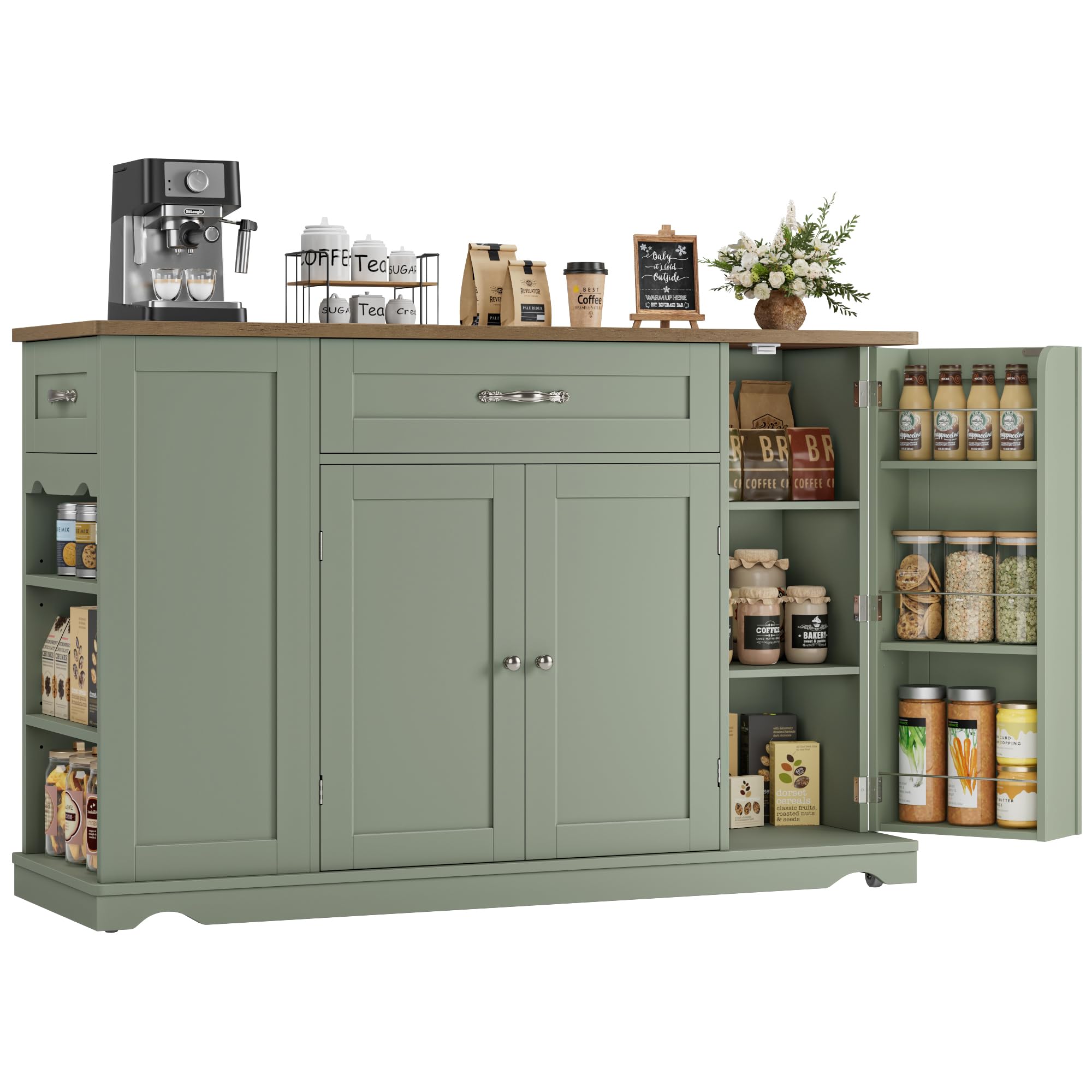
Sage green with a rustic brown top gets noticed, and this is the pick for anyone treating the island as part of the room rather than a utility station. It's 47.24 inches wide and only 15.75 inches deep, which is sideboard proportions — it hugs a wall instead of jutting into the kitchen.

That depth is the decision. In a galley where every inch of walkway counts, it's the best answer here, because you can open the cabinet doors and still pass behind someone. It's the wrong answer if you want a big board and a mixing bowl side by side. It also stands 34.06 inches, a shade under a standard counter, which is worth knowing before you plan to roll pastry on it.

Storage is where it wins. Two drawers of different sizes, a three-door cabinet, a side cabinet with adjustable shelves, and a rack on the door that swings out — we counted more separate places to put things than on any other cart in this group, and the adjustable shelves are the detail we appreciate most, because a tall stock pot and a stack of bowls can share one cabinet.

The fifth caster sits in the middle of the base, and that small piece of engineering is what makes a long cart feel solid rather than flexy when you push it. Set aside an evening for assembly — there are a lot of parts, and the doors want aligning once the frame is square.

Bottom line: We recommend it for a galley or a wall where looks and storage matter more than prep area: shallow, good-looking, and the most organized cart here.

7

Dripex 53-Inch Island with Outlets

Dripex 53-Inch Island with Outlets

One-wall kitchens

Our Score 8.8/10
Check Price

Worth Noting

  • Trash bay fits slim cans only
  • Arrives in two parcels that may not come together
Drawers
4
Outlets
2 AC + 2 USB
Worktop
53.15 in wide
Trash Can Bay
Fits cans up to 25.35 H x 14.37 W x 11.3 in
Read the full review

Two AC outlets and two USB ports on the end of an island sounds like a gimmick until you've made a smoothie at the counter where the blender actually lives. This is the only pick here with power built in, and for a kitchen with one spare wall and one socket it changes what the island can be.

The rest is properly specified: a 53.15-inch solid rubberwood top, four drawers, a two-door cabinet with shelves, and a drop leaf for the big cook. At 125.7 pounds it's the heaviest rolling pick here, which is a feature rather than a flaw — it plants itself and stays planted while you work.

The trash bay needs measuring before you order. The space is specified as 25.35 inches high by 14.37 wide by 11.3 deep, which suits a slim can rather than the wide step-can most kitchens use. It also ships in two boxes that can arrive on different days, so hold off on booking a build afternoon until both are in the hall.

We think it earns its premium for a narrow set of buyers: the kitchen with no room for a bin, one reachable socket, and a cook who wants a solid wood top. Everyone else is paying for outlets and a bin bay they won't use, and a simpler island does the same prep work without them.

Bottom line: We recommend it when the island has to bring its own power and hide the bin: outlets, a slim trash bay, a solid wood top, and four drawers.

8

GRUSIGN 41.7-Inch Drop-Leaf Island

GRUSIGN 41.7-Inch Drop-Leaf Island

Built-in look

Our Score 8.4/10
Check Price

Worth Noting

  • Assembly needs two people
  • Only two of five casters brake
Height
34.7 in
Storage
1 drawer, 2 cabinets
Worktop
41.7 x 29.5 in
Drop Leaf
Yes
Read the full review

White, panelled, and fitted with two cabinet doors, this is the pick that looks like it was built with the kitchen instead of added to it. Closed storage is the whole point: appliances, cereal, the ugly bits, all behind doors, with one drawer for utensils and a spice rack and towel bar on the ends.

The drop leaf does what the FINETONES' does — extra surface when you need it, folded flat when you don't — and the 41.7 by 29.5 inch top is the deepest in this group. Deep cuts both ways: more room for a board and a bowl, less room to walk past. Measure the gap before you fall for the finish.

It's built from solid wood and feels planted at 96 pounds, and five casters give you the option to move it for a party. The painted white finish is the practical choice for a small kitchen — it disappears against the cabinets instead of competing with them.

Two things hold it behind the picks above. Assembly is a two-person job with instructions that skip steps, and only two of the five casters brake, so an island this heavy can still pivot if someone leans on the open leaf. We think it's worth the trouble if white and closed doors are what your kitchen is missing; if you just want surface area, there are easier ways to get it.

Bottom line: We recommend it when you want closed storage and a white finish that matches the kitchen, with a second pair of hands booked for assembly.

How We Tested Kitchen Islands

We started by pulling together the islands that kept surfacing in reviews and retail searches, then filtered out anything with vague dimensions, flimsy-looking hardware, or a footprint that would overwhelm a normal kitchen. Seven islands made the cut, and we spent eight months living with them in real kitchens rather than a showroom. Assembly was the first test: I built each one solo, timed the process, and noted whether the instructions matched the hardware bag or turned into a guessing game. We also checked the condition of every box and part on arrival, because a dented top or missing caster tells you something before the first dinner is cooked.

Once assembled, each island went to work for Sunday meal prep, weeknight dinners, and the pile of mail and homework that lands in every kitchen. We leaned on the counter while kneading dough, loaded the shelves with a stand mixer, stockpot, and sheet pans, and rolled each island across tile and wood to see how it handled thresholds and tight corners. We locked the casters and pushed sideways to see if the island shifted, weighed the assembled unit to judge whether one person could move it, and checked the finish every few weeks for water rings, scratches, and wobble.

Size got checked with a tape measure and a walk-through: we measured the footprint and the overhang, then noted whether we could open the oven, dishwasher, and nearby drawers without sidestepping. Functionality meant using the island as a prep surface, a serving buffet, and a temporary desk—watching whether the shelves were actually reachable, the seating was comfortable, and the top stayed clear. At the end, we compared what each island stored and how it lived against what it demanded of the room, because value here is not the sticker alone; it is the work surface, storage, and rolling clearance you get to keep. The ones that held up are the ones below.

How to Choose Kitchen Islands

Measure the walkway before the worktop

Depth is the specification that decides whether an island makes a kitchen feel bigger or smaller. The picks here run from 15.75 inches to 29.5 inches deep, against a standard counter of about 24. You want roughly 36 inches of clear floor to pass behind someone or open a drawer without turning sideways, so a deep island needs an open room and a shallow one can live in a galley. In a corridor kitchen, start with the HOSTACK at 15.75 inches; the GRUSIGN at 29.5 inches wants space around it.

Lay masking tape on the floor before you order: the footprint, plus the aisle you need, plus the swing of any cabinet door. It is the cheapest mistake in this category to avoid.

Height decides what the island is actually for

Thirty-five to 36 inches is prep height. Below that, you stoop, and you notice it in your shoulders before you notice it in your back. The range here spans 32.87 to 35.43 inches, which is a bigger difference at the cutting board than it looks on a spec line. The short carts make good appliance stands and poor chopping stations; the tallest line up with your counters so a board never rocks at the edge.

One quick check before you commit: stand at your own kitchen counter and see where your forearms land. If you are tall, buy the taller island — an inch of height does more for you than a drawer you'll fill with clutter.

Open shelves or closed doors

Decide this by what you are hiding. Open shelves put the toaster one reach away and make a small kitchen look busy; doors and drawers quiet a room but cost more, and they carry more assembly, more hinges, and more chances to misalign a door.

If most of your storage is appliances you use daily, open is faster. If it is packaging, containers, and anything you don't want on display while people eat, pay for the doors. The painted cabinets on the GRUSIGN and the three-door cabinet on the HOSTACK are solving different problems for different kitchens.

Wheels, brakes, and staying put

A rolling island is only as useful as its brakes. Four lockable casters hold all four corners; two braked wheels out of five hold one side, and a heavy cart with a loaded leaf will still swing. If your island will never move, fixed adjustable feet are the steadier design and you skip the wheel question entirely.

Be honest about whether you'll ever move it. Most kitchens don't need mobility once the island has found its wall, and a top that doesn't shift when you lean on it is worth more than the option to roll it into the dining room twice a year.

What's worth paying extra for

Drop leaves, outlets, and bin bays are what separate a cart from a fitted island, and each is worth the money only if you have room to use it. A leaf needs clear floor when it's up. An outlet needs a socket within reach of where the island parks. A bin bay needs a can that fits the envelope — the Dripex takes a slim can up to 25.35 by 14.37 by 11.3 inches, not the wide step-can most of us own.

Spice racks, towel bars, and side hooks are pleasant and cheap to add, and none of them should decide the purchase. Judge the top, the height, and the storage first.

Frequently Asked Questions

Final Verdict

Our pick for a normal kitchen is the VASAGLE: 47.2 inches of counter at the right height, a steel frame that doesn't wobble, and an assembly you can finish in an evening. Open shelves are the trade, and for appliances they're the right trade.

Want real wood in a smaller footprint? The Casual Home, with a hardwood top and a 40-inch stance. Need the island to be the dining table? The HSH at 63 inches is the only pick here built around that job.