Kitchen

Best Espresso Machines of 2026

A bad espresso shot rarely comes as a surprise. It runs thin and sour, or harsh and bitter, and more often than not the machine — not the beans — is doing the damage. What separates one you keep for years from one you're reselling by spring is unglamorous: how steadily it holds temperature, whether the pump delivers the same pressure on shot two hundred as on shot two, and how fast it recovers for the next cup. Get those right and the espresso tastes sweet and syrupy; get them wrong and no bag of specialty beans rescues it.

I've spent the past seven months pulling shots on eight machines in my own kitchen, and the difference shows up in the cup before it shows up on a spec sheet. Heating speed and temperature stability pull against each other — the fastest machines drift a few degrees between shots, which you taste as inconsistency. Ease of use and looks matter more than I expected, since you'll face this thing half-awake every morning. What follows is what held up, and what quietly leaked onto the counter.

1

Nespresso Essenza Mini

Top Pick
Nespresso Essenza Mini

Small kitchens

Our Score 9.2/10
Check Price

Worth Noting

  • 0.6-liter tank empties after a few shots
  • Locked into Original-line capsules
Footprint
4.33"D x 12.79"W x 8.07"H
Water Tank
0.6 liters
Pump Pressure
19 bar
Capsule System
Nespresso Original
Read the full review

Four and a third inches of depth is the whole pitch, and it's a good one: the Essenza Mini pushes back against the wall where a pump machine can't go, and at 4.4 pounds you can lift it aside with one hand when the counter needs to be a counter again. In a small kitchen, or a rented one, that's worth more than any feature on this list.

The trade is straightforward. Temperature is the weak spot — hot at the spout, sometimes merely warm by the bottom of the cup, so pre-warm your mug. There's no steam wand, which makes milk a separate frother or a microwave and a whisk. And the coffee is a subscription: Original-line capsules cost more per cup than beans ever will, and you're limited to what Nespresso and its licensees make.

What it does, it does without ceremony. Nineteen bar, two programmable buttons for a short or a longer pour, and a shot ready in less time than the Breville takes to grind and tamp one. We kept reaching for it for the single after-dinner coffee: capsule in, button, done, nothing to clean but the drip tray.

Bottom line: If you want one good short coffee without a ritual, this is it: four inches of depth and nothing to clean but the drip tray.
2

Breville Barista Express

Breville Barista Express

All-round home espresso

Our Score 8.8/10
Check Price

Worth Noting

  • Durability is inconsistent; wand and grinder go first
Grinder
Integrated conical burr
Footprint
13.8"D x 12.5"W x 15.9"H
Water Tank
67 fluid ounces
Temperature Control
PID regulated
Read the full review

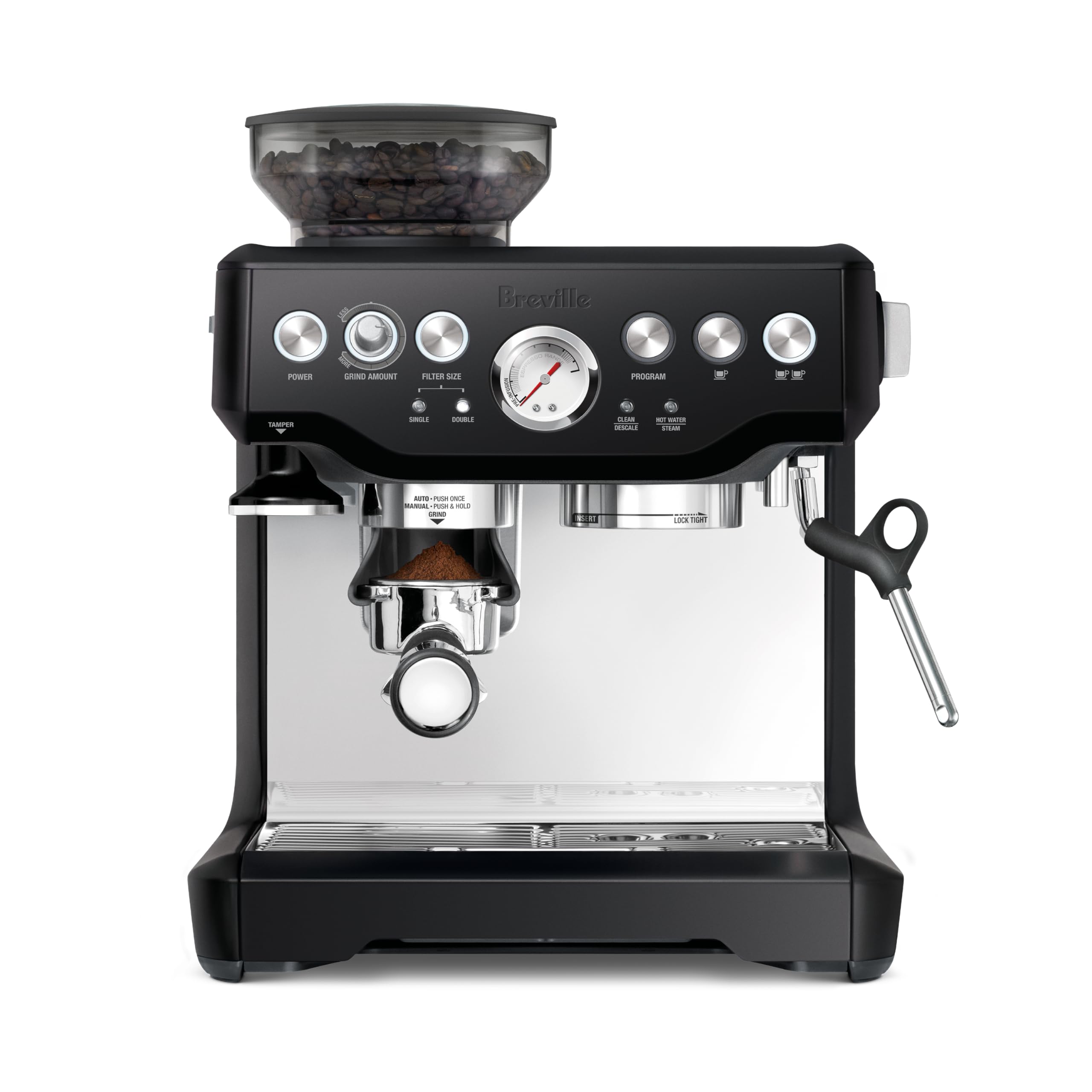
The Barista Express earns its place with one argument: a conical burr grinder, a PID-controlled brew head, low-pressure pre-infusion and a manual steam wand inside a single 12.5-inch-wide box. Bought separately, that's a grinder, an espresso machine and a lot more counter, which is why this is the one we point most people to first.

We paid closest attention to the two things that decide whether you're still using it next year — temperature and the wand. The PID holds brew temperature steady shot to shot, and pre-infusion wets the puck before full pressure arrives, which is the difference between an even extraction and one that channels and turns bitter. The wand is manual, so you control the air and the stretch; a few weeks of practice gets you microfoam that no one-touch frother here can match.

Expect a learning curve, and expect a good deal of it to be about beans. The grinder doses by time rather than weight, so you'll be moving grind and dose together until the shot runs the way you want it to. Fresh beans matter enormously — stale ones will have you blaming the machine for a week. Descale on the schedule in the manual; it's the least glamorous part of ownership and the one that keeps the boiler alive.

It stands 15.9 inches tall and weighs 22 pounds, so measure the gap under your cabinets before you commit and plan on a permanent spot rather than a cupboard. The weight is the flip side of that: it stays put while you tamp, which is worth something at seven in the morning.

Bottom line: Our pick for most people who want real espresso at home: grinder, PID-controlled brew and a proper steam wand in one box, and it rewards the practice you put in.

3

Gevi Espresso with Grinder

Gevi Espresso with Grinder

Value bean-to-cup

Our Score 8.8/10
Check Price

Worth Noting

  • No track record yet on grinder and pump life
  • 16.53 inches tall
Grinder
Built-in burr, 30 settings
Footprint
12.01"D x 11.5"W x 16.53"H
Water Tank
2.3 liters
Portafilter
58mm
Read the full review

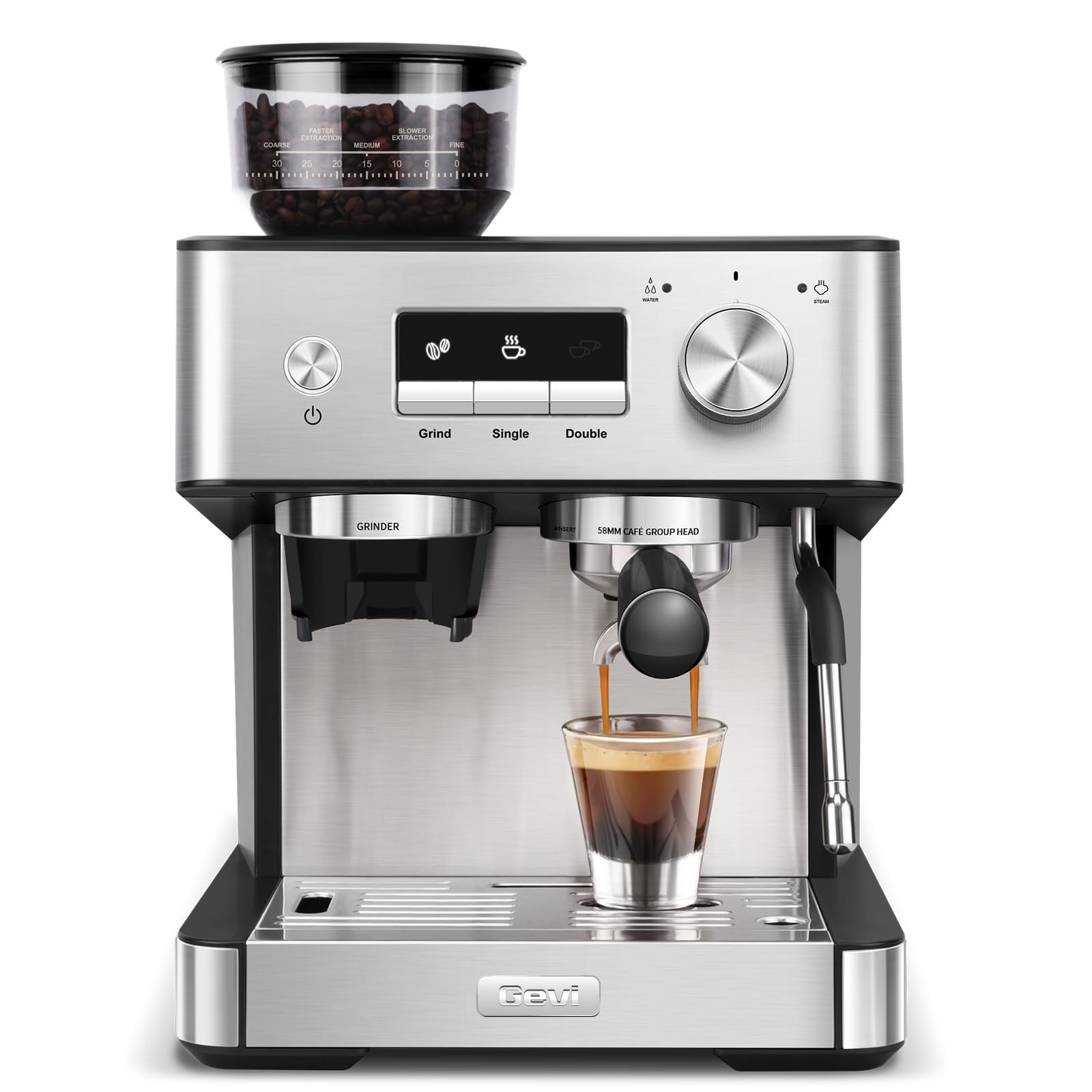
The Gevi is the cheapest route to a built-in grinder on this list, and it doesn't stop there: a 58mm portafilter, single and double baskets in both pressurized and non-pressurized versions, a 2.3-liter tank and a 30-setting conical burr grinder, all on an 11.5-inch-wide machine.

Those 58mm baskets are the reason we're recommending it. They're the commercial size, so the tamper, funnel and basket upgrades that fit the Gaggia fit this too, and the dual-wall baskets will still make drinkable espresso from supermarket pre-ground while you're learning what the grinder can do. Add PID temperature control and a cup warmer on top and the specification list reads like a machine costing a good deal more.

What it can't offer yet is a track record. The grinder and the pump are where inexpensive machines give up first, and this one is new enough that the design is the recommendation rather than a decade of history. Think of it as the value bet: you get the basket size, the tank and the temperature control, and you accept that the Breville is the safer long-term buy.

One practical note in its favor and against it: at 16.53 inches it's the tallest machine here, so it wants an open stretch of counter without a cabinet over it — and it pays that space back with a warmed cup waiting on top.

Bottom line: A burr grinder and 58mm baskets for a fraction of the Breville — the value bet, provided you accept the shorter track record.

4

Neretva 20 Bar Espresso

Neretva 20 Bar Espresso

Low cabinets

Our Score 8.8/10
Check Price

Worth Noting

  • Small 1.3-liter water tank
  • Portafilter handle is the weak point
Footprint
11"D x 12"W x 9.1"H
Water Tank
1.3 liters
Portafilter
51mm
Pump Pressure
20 bar
Read the full review

Nine point one inches of height is the Neretva's best trick: it slides under a wall cabinet that would stop the Breville dead, and the beige-and-metal body is friendlier to look at on a counter than most of this group.

For a machine at the bottom of the market it's properly equipped — a 20-bar pump, pre-infusion, a 1.3-liter removable tank, 51mm pressurized baskets, a dosing funnel, a spoon-tamper and a wand that steams milk without drama. The three-button panel is a relief after machines with menus: you press a button and coffee comes out, which is most of what a first machine needs to do.

The limits are worth knowing before you order. The coffee can land lukewarm, so run a blank shot into your cup to heat it first. The portafilter handle has been the weak point, and the whole thing feels built to a price in the hand — light, plasticky where you grip it. That's the trade at this end of the market: real espresso and a real wand for the least money here, in exchange for a machine that may not be the last one you buy.

Bottom line: Nine inches tall, cheerful and cheap: the machine to start on if your cabinets are low and your budget is lower.

5

Gaggia Classic Evo Pro

Gaggia Classic Evo Pro

Learning on café parts

Our Score 8.6/10
Check Price

Worth Noting

  • No grinder in the box
  • Can develop internal leaks over time
Valve
Three-way solenoid
Water Tank
2.1 liters
Portafilter
58mm commercial
Pump Pressure
9 bar
Read the full review

Nine bar, a 58-millimeter commercial portafilter and a three-way solenoid valve: those three specifications are what make the Classic Evo Pro interesting, and they're the parts of a café machine that actually matter. Everything else is deliberately plain — brushed steel housing, made in Italy, 9.5 inches wide, no grinder, no screen, no automatic anything.

The 58mm portafilter is the detail most shoppers skim past. It's the commercial size, so baskets, tampers, funnels and distribution tools are cheap and everywhere, and the three-way valve gives you a dry puck and no drip when you unlock the handle. There's a pressurized basket in the box for pre-ground coffee, plus commercial single and double baskets for when a grinder arrives.

We like it most for the person who wants to learn, and would rather fit a gasket than ship a machine back. That means buying a proper burr grinder as well — without one, the commercial baskets will punish you and the shots stay muddy no matter what you do with the wand. The wand itself is a commercial unit with real power, and the housing is serviceable with ordinary tools, which is the whole reason to choose this over a sealed budget machine.

Bottom line: For the buyer who wants café parts and doesn't mind supplying the grinder, this is the most repairable machine here.

6

CASABREWS CM5418

CASABREWS CM5418

Budget starters

Our Score 8.6/10
Check Price

Worth Noting

  • Reliability is mixed; some units stop working
  • 51mm baskets limit accessory choices
Footprint
12.28"D x 5.47"W x 11.97"H
Water Tank
34 oz removable
Portafilter
51mm
Pump Pressure
20 bar
Read the full review

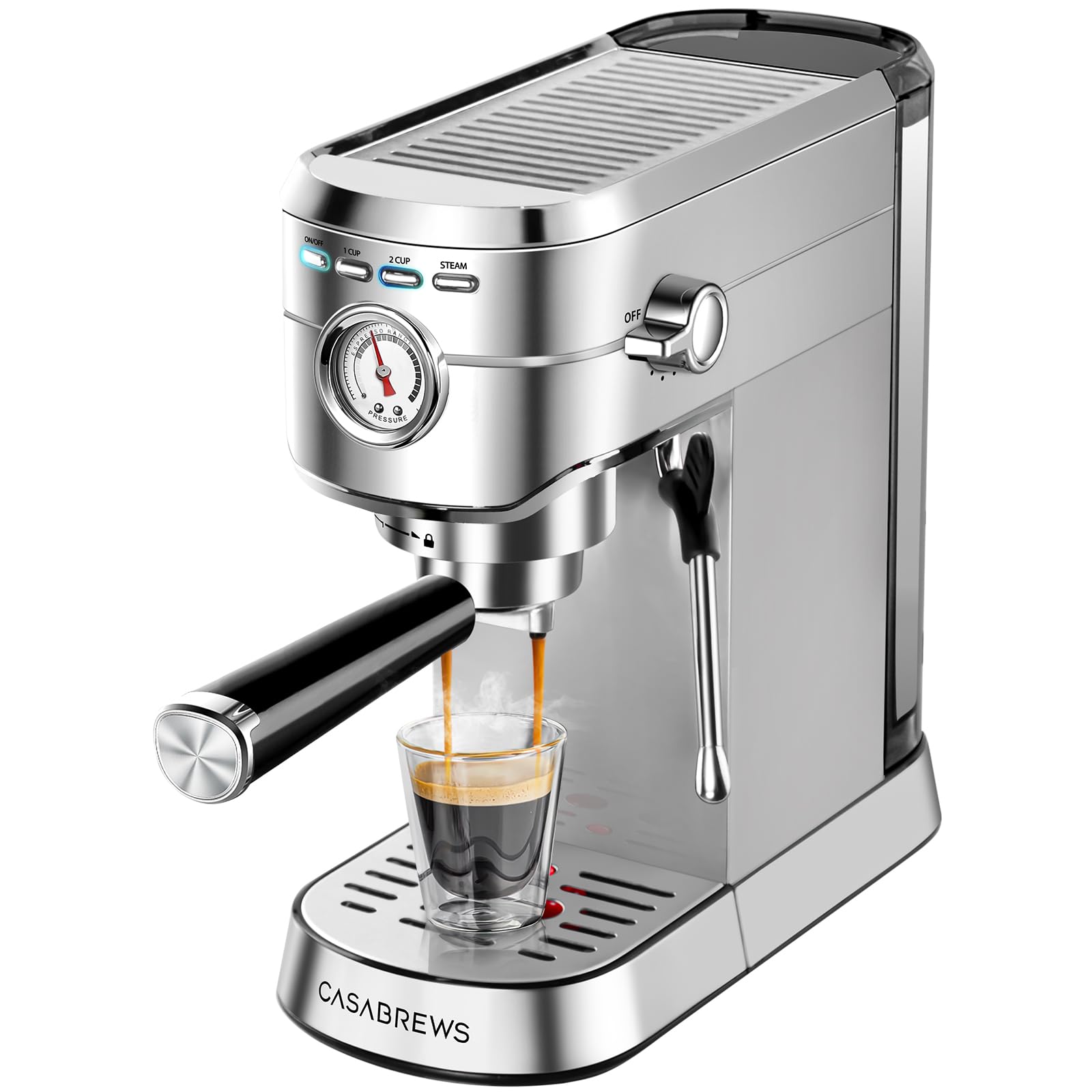
At 5.47 inches wide, the CASABREWS is narrower than most stand mixers, and that's the point: a 20-bar pump machine that fits a counter already crowded with a toaster and a kettle. The brushed stainless looks more expensive than the rest of the package, and at 8.6 pounds it slides back against the wall without a fight.

For the money you get a working pressure gauge, a 34-ounce removable tank, 51mm single and double baskets and a steam wand with more control than this class usually offers. The gauge is the detail we appreciated most — on a budget machine it's the difference between guessing and knowing whether you're in a useful pressure range.

Two practical details shape how you'll use it. The manual is explicit that you can't brew immediately after steaming; the machine has to cool first, or temperature and pressure drift out of range. That's the cost of a wand this capable at this price, and it simply means steaming last. The space under the group is also tight — a standard mug works, a tall latte glass doesn't, so measure the cup you actually use.

Bottom line: The narrowest way into a real pump machine: a pressure gauge, a proper wand and a footprint that fits a busy counter.

How We Tested Eight Espresso Machines Over Seven Months

We started by pulling together the machines that show up again and again in owner forums and specialty coffee shops — manual, semi-automatic, and bean-to-cup — then narrowed by boiler type, footprint, and what you actually get for the money at each level. Eight made the cut. Each lived on my counter for at least three weeks, and testing ran seven months in total: long enough to descale a couple of them twice and to see which ones started dripping.

Every morning started the same way: weigh 18 grams, grind, pull a double onto a scale, and write down the time and yield. I tasted each shot straight and again in milk. I logged the temperature in the cup with a probe across three consecutive shots to see whether the machine held steady or drifted, and timed how long it took to come back to ready after steaming. Steam got judged on whether I could texture milk for a flat white before it got too hot to hold the pitcher.

Then the unglamorous part. Each night I checked under the group head and around the drip tray for pooling water, felt whether the case ran hot after an hour idle, and ran the cleaning cycle as often as the manual asked to see how fussy it was. Ease of use got judged at 6:40 a.m., half awake, not on a quiet afternoon. Looks counted too, since these sit out on an open counter, and plastic where you expect metal reads cheap fast. Value came down to the cup: a couple of machines cost a fraction of the field and poured shots we couldn't pick out in a blind tasting.

How to Choose Espresso Machines

Decide the grinder before the machine

The biggest fork in this purchase is whether a grinder is included. Bean-to-cup machines like the Breville Barista Express and the Gevi fold one in and save you a second decision; a machine without one, like the Gaggia, is only as good as the grinder standing next to it. Capsules delete the question entirely, at a higher cost per cup.

Our advice is to settle the grinder first. A superb machine fed stale pre-ground coffee is an expensive way to drink mediocre espresso, and it's the most common place these purchases go wrong.

Twenty bar is not better than nine

Bar counts sell machines, and the number on the box is usually the pump's maximum rather than what arrives at the coffee. Espresso extracts at roughly nine bar, which is why the Gaggia is specified at nine on purpose while budget machines advertise fifteen and twenty.

What matters is whether pressure and temperature stay steady from shot to shot. Treat a big bar number as marketing and look instead for a pressure gauge, PID temperature control or pre-infusion — the three signs that someone was paying attention to the coffee rather than the packaging.

Milk: control or convenience

A steam wand gives you control over texture, and that control is the difference between flat foam and microfoam. It also takes practice, and on most machines here you steam after you brew rather than during, so a round of lattes takes noticeably longer than a round of espressos.

If you drink milk drinks daily, count the minutes and check the wand can angle into your jug. If you drink straight espresso, don't pay for frothing you'll never use.

Measure three things before you order

Height, depth and cup clearance. The machines here run from 9.1 inches tall to 16.53, and the gap under your wall cabinets is fixed. Depth decides whether the machine tucks against the wall or juts into your prep space — the Essenza Mini needs barely four inches, the Breville needs almost fourteen.

Then check the space under the group. A standard mug fits nearly everything; a tall latte glass doesn't. Measure the cup you actually use, not the one in the photographs.

The cost that continues after checkout

Espresso has a running cost whichever way you go. Capsules are the priciest per cup and the least flexible; beans are cheaper but want a grinder and a scale. Then comes upkeep — descaler, water filters, a gasket every year or two.

Where machines differ is repairability. The Gaggia is built from parts you can order and fit yourself, while sealed budget machines tend to be replaced rather than fixed. If you keep appliances for a decade, pay for the one that opens.

Frequently Asked Questions

Final Verdict

The Breville Barista Express is the machine we recommend to most people, because it removes the two excuses that stop home espresso working: a mediocre grinder and an unstable brew temperature.

Buy the Nespresso Essenza Mini instead if four inches of counter and a fast coffee matter more than flavor, and the Gaggia Classic Evo Pro if you want commercial parts and a machine you can service yourself — just add a grinder to the budget.