Kitchen

Best Cutting Boards of 2026

A cutting board is the hardest-working thing in your kitchen and the least considered. You chop on it three times a day, haul it to the sink, and don't think about it again until the surface is a map of scratches or it slides sideways mid-onion. Wood is kind to knives but fussy about water; plastic is cheap and dishwasher-friendly but scars; thin boards of any material skitter across the counter. What a good one fixes is small and constant — a stable surface, an edge that stays sharp, and one less thing to fight with at 6 p.m.

I've owned boards that warped after a single soak and a composite one that survived two moves. Over the past six months, my team and I have prepped, carved, and scrubbed our way through 12 boards, from thin flexible mats to thick butcher-block slabs. Thickness drives sturdiness more than material does, which is the thing first-time buyers miss. The picks below are the ones I'd hand to anyone who cooks most nights, plus a couple that are worth it only if you have the cabinet space.

1

Viretang 3-Piece Set

Top Pick
Viretang 3-Piece Set

Budget three-board setup

Our Score 9.4/10
Check Price

Worth Noting

  • Surface scratches and dulls quickly
  • Smallest board is garnish-sized
Care
Dishwasher safe
Material
Plastic
Thickness
0.35 in
Board Sizes
15.6 x 9.4, 12.4 x 7.8, 9.6 x 5.7 in
Read the full review

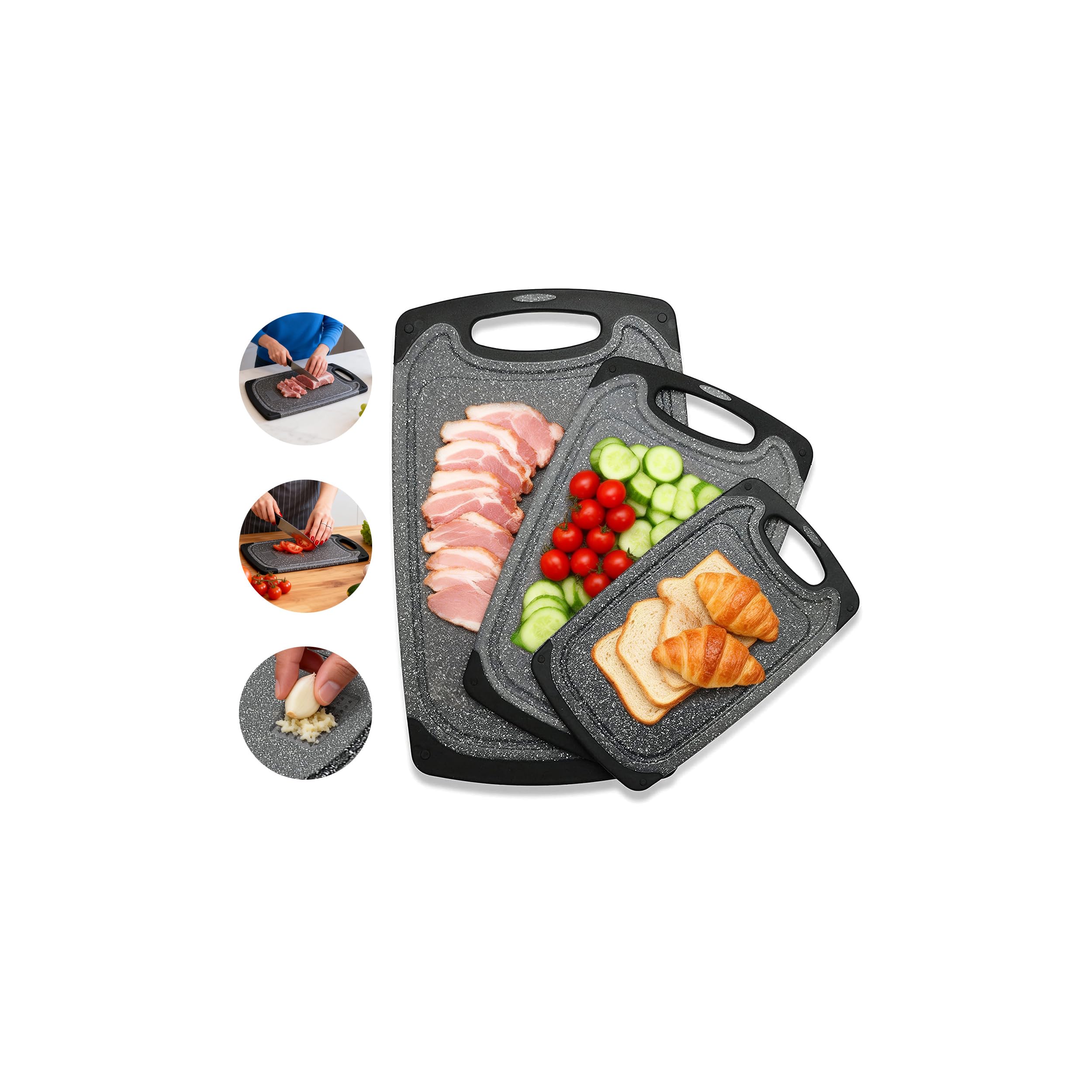
A small grinding patch is molded into the corner of the two larger boards, a rough circle for working garlic and ginger into a paste, and it is the detail that tells you someone thought about how these things get used rather than just how they look. The rest is straightforward: 15.6 x 9.4, 12.4 x 7.8 and 9.6 x 5.7 inches at 0.35 inch thick, a juice groove around each board, and rubber feet at all four corners.

This is the set we hand people first when the budget is tight, and the feet are what sell it. On a dry laminate or butcher-block counter the rubber corners hold through a fast dice, which is more than most sets at this level manage. All three go through the dishwasher, the dark marble-look gray hides the worst of everyday wear, and the three sizes step down sensibly from a board that takes a whole chicken breast to one that handles a lime.

Bottom line: The budget set we hand people first, with rubber corners that hold and a garlic-grinding patch built into two of the boards.

2

Empune XL 3-Piece Set

Empune XL 3-Piece Set

Big-batch prep

Our Score 9.4/10
Check Price

Worth Noting

  • Largest board will not fit many dishwashers
Care
Dishwasher safe
Material
Plastic
Thickness
0.4 in
Largest Board
17 x 11.8 in
Read the full review

The largest board in this set is 17 x 11.8 inches, and that number is the reason to buy it. It covers most of a sink, takes a whole cabbage and the carrots for a slaw in one pass, and gives you somewhere to rest a roast while you carve. At 0.4 inch it is the chunkiest plastic board here, with a groove on all four sides to catch the runoff.

For anyone who cooks in quantity, whether that is batch soup, Sunday roasting or a household of five, this is the set we reach for. The dark gray and black handles look tidier than white plastic after a few months of use, and the extra size costs less storage than you expect because the boards stand on edge in a cupboard.

Two things to plan for. The big board needs a big sink to wash by hand, and a hot dishwasher cycle on plastic this size is the fastest way to warp it, so hand wash the largest one and let the smaller two take the rack. The hard, slick surface can also travel on a wet counter; a damp towel under it solves that in a second.

Bottom line: The set for cooks who prep in volume: a 17-inch board that takes a whole batch in one pass and wipes clean afterward.

3

Gorilla Grip 3-Piece Set

Gorilla Grip 3-Piece Set

Everyday kitchen prep

Our Score 9.2/10
Check Price

Worth Noting

  • Knife marks show early and stay
Care
Dishwasher safe
Material
Plastic
Thickness
0.37 in
Board Sizes
16 x 11.2, 13.8 x 9.6, 11.8 x 8 in
Read the full review

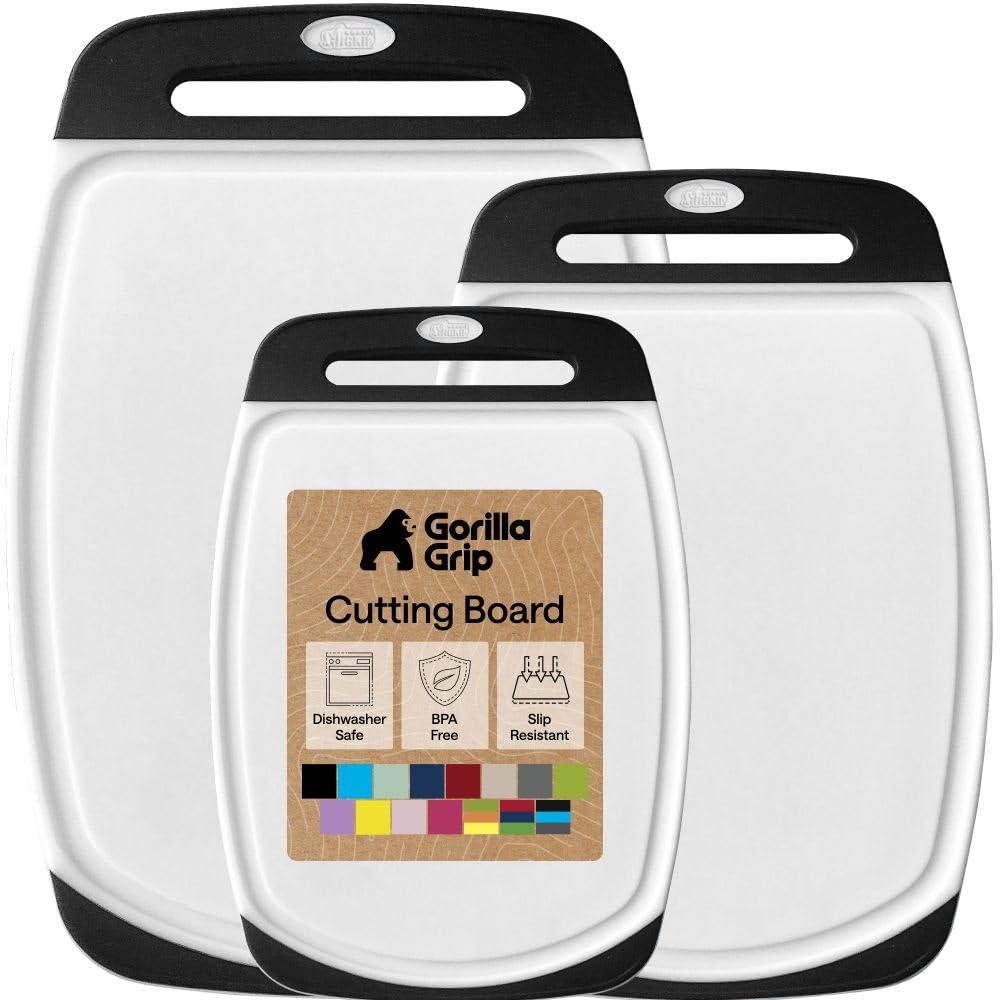
Three boards, three jobs, and that is the argument for buying a set instead of a board. The 16 x 11.2-inch one swallows a whole chicken plus the carrots going with it, the 13.8 x 9.6-inch board handles an onion and a couple of peppers without crowding, and the 11.8 x 8-inch board is the right size for a lemon or a chunk of cheese. Most people cook on one board and wash it three times per meal; this is why we point people toward three.

Thickness is what separates these from cheap plastic. At 0.37 inch they sit solid on the counter and do not flex under a heavy chop, and the set weighs a little over four pounds, so lifting one out of a drawer is still a one-hand job. A groove runs around the border of every board, which earns its keep the first time you carve a roast, and the nonporous surface does not take on the smell of last night's fish.

Grip needs a word of caution. The rubber border is designed for a dry counter and it does its job with a heavy chop on top of it, but on polished stone or with a light hand a board can still travel. We treat the rubber as a helper, not a guarantee, and keep a damp towel under whichever board is doing the work.

What you give up is a pristine surface. Knife marks appear early and stay, which is cosmetic but visible if you leave a board out on the counter. If the board has to look good between uses, go bamboo; if it has to survive a raw chicken and a hot wash on a Tuesday night, this is the set.

Bottom line: Our default recommendation: three genuinely useful sizes, dishwasher-safe nonporous plastic, and enough thickness that nothing flexes under the knife.

4

OXO Good Grips 2-Piece Set

OXO Good Grips 2-Piece Set

Small kitchens

Our Score 9.2/10
Check Price

Worth Noting

  • Soft plastic shows knife marks quickly
Care
Dishwasher safe
Material
Plastic
Non-slip
Rubber feet
Board Sizes
12.9 x 9 and 10.75 x 7.25 in
Read the full review

This pair is deliberately small: a 12.9 x 9-inch Everyday board and a 10.75 x 7.25-inch Prep board, thin enough to stand on edge in a shallow drawer and light enough to move with one hand. Soft tapered edges do the work of handles, and a drip channel runs to a pour corner, so the juice from a tomato goes where you aim it instead of across the counter. It is the most thoughtfully detailed set here at this size.

That footprint is the whole trade. A board this size is fine for an onion, a couple of chicken thighs or a sandwich; it is not the board for a whole squash or a pot of soup vegetables. You are trading square footage for a set that stores in a slot and washes without a fight.

For a small kitchen, a rental with two feet of counter, or a lunch setup at a desk, this is the one we reach for, and two boards mean raw meat and salad never share a surface. If you cook in quantity, skip it and take the Empune set; if you have the counter for it, our top pick simply covers more ground.

Bottom line: Our pick for a kitchen with one drawer of board space: two compact, well-detailed boards that go where full-size sets cannot.

5

Farberware 11 x 14 Board

Farberware 11 x 14 Board

Light single board

Our Score 9.2/10
Check Price

Worth Noting

  • Quarter-inch profile can bow over time
Care
Dishwasher safe
Material
Polypropylene
Thickness
0.25 in
Board Size
14 x 11 in
Read the full review

At 1.1 pounds and a quarter inch thick, this is the board you grab with one hand and rinse without thinking about it. It is 14 x 11 inches of polypropylene with a hand hole at one end, reversible, and thin enough to slide into the dish rack behind the plates instead of occupying a slot of its own.

The thinness that makes it easy to store is also the trade. Light plastic skates on a wet counter more than a four-pound set does, so keep a damp towel underneath and it stays where you put it. It also will not take the abuse of a cleaver the way a half-inch board does.

Where it earns a place is as the second or third board: the one for a quick sandwich, a bit of fruit, or raw chicken when the good board is already dirty. It is the least expensive board here by a wide margin, which makes keeping two of them an easy call. As an only board for a serious cook, it is too thin.

Bottom line: A light, inexpensive second board for quick jobs, and not the only board a household that cooks properly should own.

6

Royal Craft Wood Bamboo Set

Royal Craft Wood Bamboo Set

Serving and prep

Our Score 9.0/10
Check Price

Worth Noting

  • Hand wash only, with regular oiling
  • Seams can split if boards stay wet
Care
Hand wash only
Material
Carbonized bamboo
Thickness
0.6 in
Board Sizes
15 x 10, 12 x 8, 9 x 6 in
Read the full review

Deep-carbonized bamboo gives these boards a dark, even grain, and that is the reason to choose this set over plastic: it is the one here we are happy to carry to the table with cheese and crackers on it. Sizes are 15 x 10, 12 x 8 and 9 x 6 inches at 0.6 inch thick, with carved side handles and a deep groove around each board.

Bamboo also treats knives better than plastic does, and an edge that stays sharp longer is worth something in a kitchen where someone sharpens twice a year. The catch is care: hand wash in warm soapy water, dry upright, and rub in food-grade mineral oil when the surface starts looking pale. It is a two-minute job, but it is a job plastic never asks for.

We found the 15-inch board big enough for a chicken and the 9 x 6 best kept for garlic, lemon or a single wedge of cheese. This is one of the more expensive sets here, and part of what you pay for is how it looks sitting out. If you want the look without the oiling, buy plastic and a serving platter.

Bottom line: The one to buy if the board has to look good between uses, as long as you will hand wash it and oil it now and then.

7

Astercook Bamboo Set with Stand

Astercook Bamboo Set with Stand

Countertop storage

Our Score 9.0/10
Check Price

Worth Noting

  • Smooth face scratches early
  • Hand wash only
Included
Wooden storage stand
Material
Bamboo
Thickness
0.6 in
Board Sizes
15 x 10, 12 x 8, 9 x 6 in
Read the full review

A wooden stand comes in the box with these three boards, and the stand is the whole idea. Instead of a stack in a cupboard you get a rack that holds them upright, so the one you want is the one you can see. It is the only set here that solves board storage, and it arrives boxed well enough to hand over as a housewarming gift.

The boards are 15 x 10, 12 x 8 and 9 x 6 inches, 0.6 inch thick and reversible, with a deep groove on one face and a smooth surface on the other for serving. Carbonized bamboo gives them a darker, more even tone than plain bamboo, and the little feet stickers in the box let you decide which side goes down.

Bamboo care applies: hand wash, dry upright, oil occasionally. Bamboo can also lift a splinter where a knife catches a grain line, so run a fingertip over a board before the first use and keep an eye on the cutting face as it ages. None of that is unusual for the material, but it is not maintenance plastic ever asks of you.

If you want boards out where you can reach them, this is the set we point to. It costs more than the other bamboo set here for the same three sizes, and that premium buys the rack and the finish. If you keep boards in a drawer, skip it; the stand just becomes one more thing to store.

Bottom line: Our pick for keeping boards visible and organized: three bamboo boards and a stand that earns its counter space.

8

Goodluck Flexible Mats, 5-Pack

Goodluck Flexible Mats, 5-Pack

Color-coded food prep

Our Score 9.0/10
Check Price

Worth Noting

  • Thin enough for a heavy knife to score through
  • Edges curl after hot dishwasher cycles
Care
Dishwasher safe
Mat Size
14 x 11 in
Material
Plastic
Thickness
0.19 in
Read the full review

Each mat is a different color with a small printed icon on it, beef or fish or vegetables, so the one that held raw chicken never ends up under the salad. There are five of them at 14 x 11 inches and about 0.19 inch thick, and they stack flat in a drawer or hang from a hook when they are dry.

The flexibility is the real advantage. Bend a mat into a chute and the chopped onion slides straight into the pan instead of across the counter and onto the floor. You can also trim one down to fit an awkward prep strip or a camping box, which is not something you can do with a rigid board.

They are thin, and that shows up in two ways: press hard with a heavy knife and you can score through to the counter, and a hot dishwasher cycle makes the edges curl. Wash them by hand or on the top rack, store them flat, and put a damp towel underneath when the counter is wet, since the textured back grips better dry than wet.

Treat these as a supplement. We keep a couple within reach for raw meat and small prep and use a rigid board when there is real chopping to do. For a first apartment, a rented kitchen with two feet of counter, or a camper, this is the least expensive way here to keep raw and ready-to-eat food apart.

Bottom line: Inexpensive, color-coded mats for keeping raw meat apart, best treated as a supplement rather than your only cutting surface.

How We Tested 12 Cutting Boards

We started by pulling every board we could find in wood, plastic, composite, and bamboo, then cut the list to 12 that covered a real spread of sizes, thicknesses, and prices — flexible mats, standard poly boards, and thick end-grain slabs. Anything that came in only one odd size or didn't state its material got dropped. Then we spent six months cooking on them rather than inspecting them.

Each board went through the same rotation of jobs: mincing garlic and onions on a weeknight, breaking down a whole chicken, carving a Sunday roast, and slicing crusty bread, which is harder on an edge than it looks. We chopped on a dry counter and again on a damp one, noting which boards stayed put and which ones we had to chase across the countertop. We measured thickness with calipers and pressed a heavy knife through firm vegetables to see whether the board flexed or bowed under the load.

Every board was washed in hot soapy water, left wet in the rack overnight, and checked for warping, raised grain, and separation at the seams. The dishwasher-safe ones ran through repeated cycles. After each session we dragged a fingernail across the surface to feel for gouges deep enough to trap onion. At the six-month mark we lined them up and asked which we'd still leave out on the counter, then weighed price against condition — a board that costs three times as much and looks worse by summer isn't the better buy.

How to Choose Cutting Boards

Plastic, Bamboo or Wood

Plastic is the practical default: nonporous, dishwasher safe, and cheap enough to own in three sizes. It scars, and no plastic stays pretty forever. Bamboo and wood are gentler on knife edges and far better looking, but they are hand-wash, dry-upright, oil-occasionally objects, and a board left soaking can split along its seams.

Our rule is material by job: plastic for raw meat and messy work, bamboo or wood for produce, bread and serving. Treat self-healing and non-toxic labels as marketing rather than reasons to pay more. What matters is a nonporous surface, enough thickness not to flex, and care instructions that match how you actually live.

How Much Board You Actually Need

A 15- to 17-inch board takes a whole chicken or a pile of vegetables. Twelve inches is an onion-and-a-few-peppers board. Anything under 10 inches is for a lemon, a clove of garlic or a hunk of cheese, and a set that covers all three sizes usually serves a kitchen better than one impressive board.

Measure before you buy the big one. A 17-inch board is wider than many dishwasher interiors and awkward to wash by hand in a small sink, and the largest board in a set is the one most likely to sit unused because it is a hassle to clean.

Thickness, Weight and Staying Put

Thickness is the quiet specification. A quarter inch is a board that can bow and skate; 0.35 to 0.4 inch is a solid plastic workhorse; 0.6 inch bamboo has real heft. Heavier boards stay put but are harder to lift, rinse and store, so the sweet spot is the thickest board you can still move with one hand.

Rubber feet and grip borders help on dry, smooth counters, and they stop helping the moment the counter is wet or polished. A damp towel under the board is the fix that works on every surface, so treat any built-in grip as a bonus rather than a promise.

Grooves, Handles and Sets

A juice groove earns its keep when you carve meat or cut tomatoes, and it gives you a channel to scrub. If you mostly chop vegetables, though, a groove takes usable flat surface away and collects crumbs. Handles and hand holes matter more than they look: a board you can lift with one hand gets moved, rinsed and put away.

Three boards let you keep raw meat and ready-to-eat food apart without washing mid-recipe, which is the strongest argument for a set over a single beautiful board.

What Dishwasher Safe Really Means

Dishwasher-safe plastic still warps when a big board is jammed against a hot element or a heating coil. Wash the largest board by hand and let the small ones take the cycle. Bamboo and wood want warm soapy water, an upright dry, and food-grade mineral oil every month or so, more often if the surface looks pale and dry.

Whatever you buy, dry it standing up rather than flat on the counter, where the underside stays wet and the board cups.

Frequently Asked Questions

Final Verdict

For most kitchens the Gorilla Grip set is the right first buy: three dishwasher-safe sizes, enough thickness to feel solid under a knife, and a groove that catches what a roast gives up. It is the set we hand people who want to stop thinking about cutting boards.

If the board has to look good between uses, take the Royal Craft Wood bamboo set and commit to hand washing and oiling. If your kitchen has one drawer of board space, the OXO pair fits where nothing else here will.