Storage

Best Wall Hooks of 2026

I've patched enough drywall craters to know that the wrong wall hook doesn't fail quietly. It takes a crescent of paint with it, drops a coat on the floor, and leaves you holding a loose screw and a bad mood. The right one does the opposite of all that: it gets the tote bag, the dog leash, and the damp towel off the floor and off the back of a chair, then stays put long enough that you forget it's there.

Over the past four months we've hung 14 hooks — adhesive strips, small screw-in designs, and heavier load-bearing styles — across entryways, bathrooms, a kitchen, and a kid's bedroom. The differences came down to a handful of things: how much weight each one actually held, how fussy it was to put up, how well it kept a slippery strap from sliding off the end, and how gently it came back off the wall. One thing worth knowing before you buy: most failures happen well below the number printed on the package, especially on fresh paint or a spot that crosses a grout line. Here's what earned a place on our walls.

1

IBosins 8-Pack Coat Hooks

Top Pick
IBosins 8-Pack Coat Hooks

Heavy coats

Our Score 9.4/10
Check Price

Worth Noting

  • Needs a drill and a wall you can alter
Material
Zinc die-cast
Mounting
Screws, 18 included
Pack Size
8 double hooks
Holding Capacity
40 lb per hook
Read the full review

Every adhesive hook in this guide has a ceiling, and the IBosins hooks are what you buy once you have hit it. They screw into the wall, they are cast zinc rather than plastic, and the pair of prongs will take a wet winter coat, a kid's backpack and a towel that is still dripping. Forty pounds is the figure on the box, and driven into a stud it is believable.

Eight hooks and eighteen screws come in the box, enough for a mudroom rail or a run of hooks along a closet wall. The double prong is the practical part. Two garments hang separated so they dry, and a single heavy coat can spread across both prongs instead of sliding off one.

Our one reservation is the hardware. The included screws are 18 mm long, under three-quarters of an inch, which is fine into a stud and thin in drywall alone. For a coat rail carrying winter weight, swap them for longer screws or use proper anchors; the hook itself is not the weak point. The cast body feels like hardware off an old coat rail, and eight hooks with screws cost less than most of the adhesive packs here.

The catch is the wall. This is a drill, a bit and permission — no good in a rental, and no good on tile you would rather not puncture. Where you can put holes in a wall, nothing else here holds as much.

Bottom line: The one we reach for when adhesive has already failed: cast metal, forty pounds, and a screw that stays where you put it.

2

Command Large Utility Hooks

Command Large Utility Hooks

Painted walls

Our Score 9.2/10
Check Price

Worth Noting

  • Plain white plastic is conspicuous in a hallway
  • Tops out at five pounds per hook
Finish
White plastic
Mounting
Adhesive strips
Pack Size
7 hooks, 12 strips
Holding Capacity
5 lb per hook
Read the full review

Most of the walls people want to hang something on are painted drywall, and that single fact decides this pick. Command's Large Utility Hooks hold five pounds each on paint, wood, tile and metal, go up without a nail or a drill, and come off when you change your mind. We keep coming back to them for the unglamorous spots: the closet door that needs a leash hook, the cabinet side where the brushes pile up, the back of a bedroom door where a robe ends up.

A pack holds seven hooks and twelve strips, and those five extra strips matter more than they sound. Repositioning a hook takes a fresh strip, and having spares is the difference between fixing a crooked hook and living with it. Installation is a wipe with rubbing alcohol, a firm press, and a wall that finished curing at least a week ago; skip the wipe, or hang on fresh paint, and the strip is the part that gives up, not the hook.

Five pounds is honest but modest. A wet bath towel and a hand towel, a leash and a set of keys, a spray bottle — all comfortable. A loaded backpack or a heavy winter coat is not, and that is where the screw-in hooks further down this list take over. The detail we appreciate most is a small one: the hook body lifts off its base, so you can press the strip flat against the wall before the hook clicks back on.

The look is the trade-off. White plastic against a painted wall is fine inside a closet and conspicuous in a hallway, and there is nothing decorative about it. Buy these where function wins, and buy the brushed nickel version where the hook is on show.

Bottom line: Our default for painted walls: five pounds per hook, no tools, and a clean removal when you rearrange.

3

Command Brushed Nickel Hooks

Command Brushed Nickel Hooks

Visible spots

Our Score 9.2/10
Check Price

Worth Noting

  • Priciest hanging point in this guide
Finish
Brushed nickel metal
Mounting
Adhesive strips
Pack Size
2 hooks, 4 strips
Holding Capacity
5 lb per hook
Read the full review

In a bathroom, the hook is part of the room whether you planned it that way or not. Command's brushed nickel metal hooks are the pick here that looks chosen rather than installed: the finish reads as real hardware beside a towel bar, and there is no screw head or white plastic tab to give it away.

That is worth paying for in exactly one situation — a hook guests will see. In our book these belong on the back of the bathrobe door, in the entry, anywhere a strip of white plastic would read as a temporary fix. Put the same money into the utility hooks if the hook lives inside a closet: nobody sees it, and you get seven instead of two.

The rest is standard Command. Two hooks, four strips, five pounds each, on paint, wood, tile or metal, and off again without a mark. Towels and robes are the natural load. What it will not do is stand in for a curtain rod bracket: the hook opening is too tight for a standard one-inch rod, and the people who try end up with a rod on the floor.

Bottom line: The hook we put where guests will see it — brushed nickel that reads as hardware, with five pounds of no-drill hold.

4

JINSHUNFA Clear Adhesive Hooks

JINSHUNFA Clear Adhesive Hooks

Tile and glass

Our Score 9.0/10
Check Price

Worth Noting

  • Not for painted walls or wallpaper
  • Hard to move once the pad cures
Mounting
Adhesive, peel and stick
Surfaces
Smooth only, not painted walls
Pack Size
12 hooks
Holding Capacity
13 lb per hook
Read the full review

The strongest adhesive hold in this guide comes with a warning the listing does not bury: tile, glass, metal, laminate, stainless, finished wood — and no painted walls, no wallpaper, nothing textured. Take that seriously. On a shower wall these clear hooks grab harder than any strip product here; on painted drywall they can take the paint with them.

Twelve hooks come in the pack, each a small square of clear plastic around a stainless hook. The shape is more useful than the slim wire hooks everything slides off: deep enough for a mop handle, a picture frame edge or a stack of belts. Against tile they nearly vanish until something is hanging on them, which is the whole point of buying clear.

Treat them as semi-permanent rather than removable. Once the pad cures, the manufacturer's own instruction is to warm it with a hair dryer and peel slowly, and that is real work on a hook you decided to move. Plan the position before you commit.

These are the ones we point at for a shower, a kitchen backsplash, a glass door or a metal cabinet, and the ones we steer away from a painted hallway. Used in the right place they are the best grip per hook here; used in the wrong one they are why people distrust adhesive.

Bottom line: What we use on tile and glass: thirteen pounds of grip where strips struggle, and a firm no on painted walls.

5

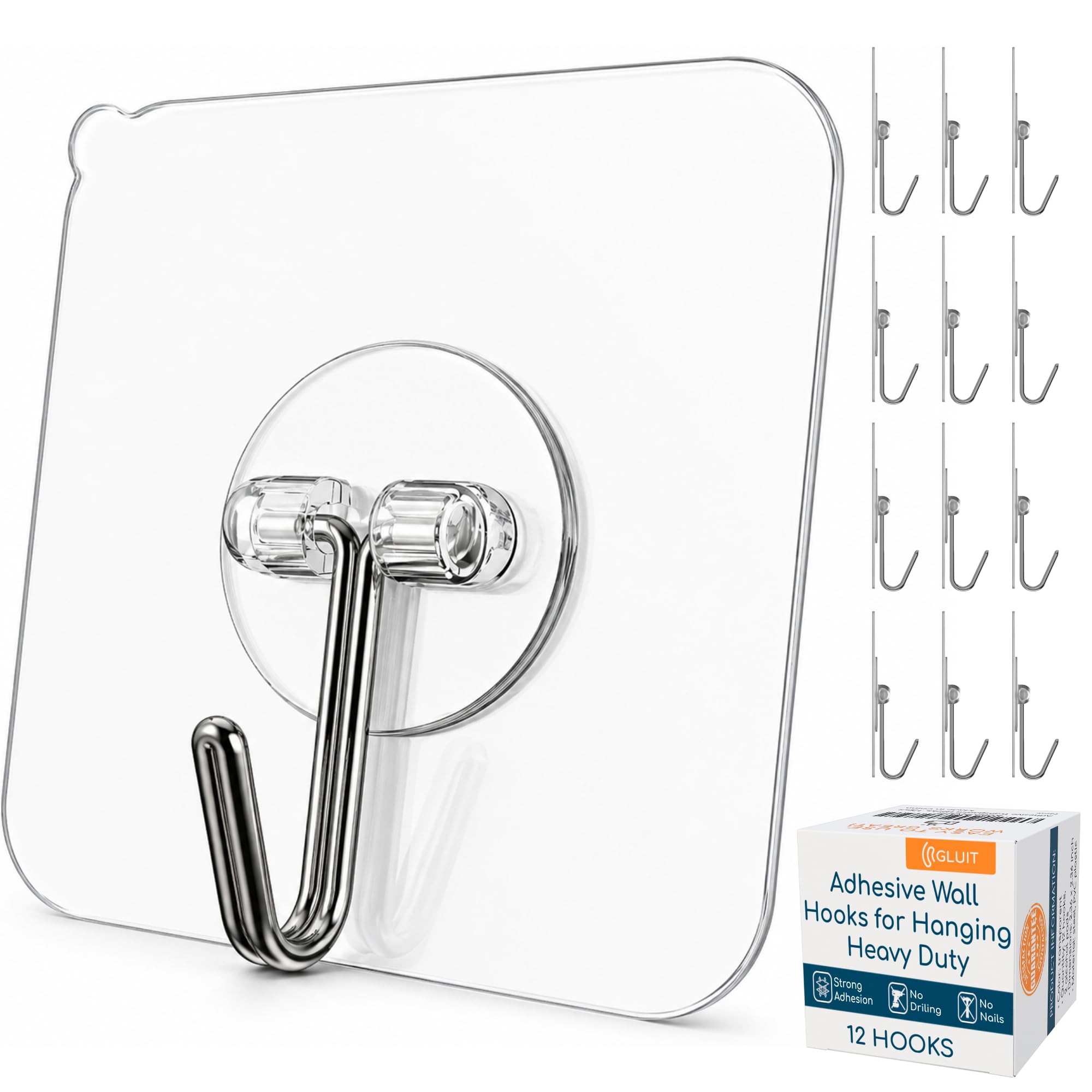
GLUIT Clear Adhesive Hooks

GLUIT Clear Adhesive Hooks

Showers and kitchens

Our Score 9.0/10
Check Price

Worth Noting

  • Twenty-two pounds needs a flawless surface
  • Comes off with effort, not in one pull
Finish
Clear
Mounting
Adhesive, peel and stick
Pack Size
12 hooks, 2 prep pads
Holding Capacity
22 lb maximum
Read the full review

The number on the front of the pack is 22 pounds. Further down, the same listing recommends these for items of 5 to 10 pounds. That gap is not a scandal — it is an honest description of what an adhesive pad manages on flawless glass versus what it manages on ordinary bathroom tile — and we trust a product more for saying it out loud.

The detail that sold us is in the box: two alcohol prep pads and a printed instruction. Almost every failure with a stick-on hook starts on a surface that was not clean or dry, and a manufacturer handing you the means to fix that is telling you how the product wants to be used.

Twelve hooks, all clear, sized for bathroom and kitchen jobs: a hand towel, utensils, a loofah, a small plant. Five to ten pounds covers all of it, and on tile, glass or metal they hold without the visual clutter of white plastic.

Removal is the part to weigh. These come off with effort rather than in one clean pull, so plan positions as if they are staying. In a rental, or anywhere the wall is painted, the strip-based hooks are the safer choice; the clear pad wins where the surface is tile or glass and nobody is going to move it.

Bottom line: We rate these for bathroom and kitchen jobs at five to ten pounds, not the twenty-two on the front of the pack.

How We Hung, Loaded, and Pulled 14 Wall Hooks

We started with a list of roughly 60 hooks sold at home and hardware retailers, then filtered by mounting type, stated weight capacity, hardware in the box, finish options, and price. Anything with a vague or missing capacity rating got cut. Fourteen made the final list, ranging from peel-and-stick strips to two-hole screw mounts.

Each hook then got a real job in a real spot for four months: the entryway (a loaded canvas tote, a leash, keys), the bathroom (a damp towel, a robe), the kitchen (a mug, a small pan), and a kid's bedroom (a backpack). We noted how easily each one went up — whether screws needed a stud, whether the adhesive wanted a full day to cure — and whether a strap or towel stayed on the hook or slid off the end. We also watched the finish after weeks of keys and zippers scraping past.

To push past everyday use, we hung weighted bags in 5-pound increments until a hook bent, pulled out, or the adhesive let go, then checked what it did to the drywall on the way out. Adhesive versions went onto painted drywall, ceramic tile, and one deliberately awkward spot across a grout line. Every removable hook came off after 30 days so we could see whether paint came with it. Finally, we weighed the cost against what was in the box — anchors, screws, spare strips — because a cheap hook that needs extra hardware isn't a bargain.

How to Choose Wall Hooks

Start with the surface, not the hook

Run a fingernail across the wall. Smooth, clean and fully cured takes adhesive; textured, dusty, wallpapered or painted within the last week does not, and no amount of pressing changes that. Painted drywall is the difficult case, because strips are designed to release from paint while clear adhesive pads grip harder and can lift the paint when they come off. If you rent, or you do not know what is under the paint, choose strips.

Treat the weight rating as a ceiling

Capacity figures are measured on ideal surfaces — clean glass, clean tile — and they fall on paint, in humidity, and when a load swings. Halve the number for anything breakable or hung above a bed or a chair. The GLUIT hooks are the clearest example here: 22 pounds on perfectly smooth tile, and a 5 to 10 pound recommendation for everyday use in the same listing. Above roughly five pounds on a painted wall, adhesive is the wrong tool and a screw is the right one.

Decide whether removal or grip matters more

Damage-free strips release with a pull and leave the wall as they found it. Clear adhesive pads hold harder and come off with effort, sometimes with paint attached. Renters, dorm rooms and anyone decorating around a deposit want strips; a shower wall or a spot that will never move is better served by the pads. Getting both from one hook is rare, so decide which one you can live without before you buy.

Count hooks, then count strips

A two-pack of decorative hooks looks expensive beside a twelve-pack, and per hook it is. Work out how many hanging points you need first: a family of four with two coats each wants eight points at the entry, and one box of eight screw-in hooks gets there for less than most of the adhesive packs here. Check the strip count too. Strips are what you run out of, especially when you reposition a hook, and the packs that include spares are the ones you stop thinking about.

Match the hook shape to the thing

A shallow decorative hook holds a robe and drops a backpack strap. Deep hooks take a mop handle, a picture frame edge or a leash loop. Double prongs are for coats and towels, where two garments hang apart and dry. Before you buy for a specific object, measure its handle or strap and compare it with the hook opening; depth, not the weight rating, is what usually decides whether something stays hung.

Frequently Asked Questions

Final Verdict

The Command Large Utility Hooks are what we tell most people to buy: five pounds of hold on a painted wall, seven hooks and twelve strips in the pack, and no patching when you change your mind. Step up to the IBosins screw-in hooks for coats, backpacks and a steamy bathroom, and take the JINSHUNFA clear hooks for a shower or tiled kitchen wall where adhesive can finally grip properly.

The one to skip is the cheap clear pad on a painted hallway wall. That is where this category earns its bad reputation, and where a strip-based hook costs you nothing but a minute.