Storage

Best Closet Systems of 2026

The real fear with a closet system isn't that it looks bad in the photo — it's that you lose a Saturday to a hex key, fill it with your actual clothes, and watch a shelf bow by spring. Most of that risk gets decided before you open the box: how the rails anchor to your wall, how thick the shelving is, and whether the drawers arrive assembled or in forty pieces. Get those right and the closet becomes the one space in the house that stays tidy on its own, because everything finally has somewhere to land.

First-time buyers tend to underrate one thing: drawers, not shelving, drive both cost and assembly time, and a six-drawer tower can take as long as the rest of the closet combined. I've built these into a crooked 1950s reach-in and into a rental where every anchor had to come back out at move-out, and the gap between kits shows up fast. Over nine months, my team and I installed 12 systems and loaded each one with clothes that were already in the house. The picks below are the ones we'd build again.

1

Rubbermaid Configurations Deluxe

Top Pick
Rubbermaid Configurations Deluxe

Standard reach-in closets

Our Score 9.4/10
Check Price

Worth Noting

  • No drawers or doors in the kit
Mounting
Wall mount
Closet Width
4 to 8 ft
Shelf Heights
Adjustable
Cutting Required
None
Read the full review

Four to eight feet is the range that makes this the system we recommend first. Telescoping rods and expandable shelves cover almost every reach-in and walk-in closet in a normal house, all the mounting hardware comes in the box, and nothing needs cutting. If your closet is a standard width and you want one order to finish the job, this is it.

What we appreciate most is how much of the layout you decide after the brackets are up. Shelf height adjusts, the rods telescope, and the whole kit can come apart and go back together in a different arrangement when your wardrobe changes — the pieces are the same ones sold individually, so a third rod isn't a special order. In a closet with an awkward return wall or a sloped ceiling, that flexibility does more work than any single feature.

Installation is a Saturday morning, not a weekend. The brackets want studs where you can find them; where you can't, use toggle bolts rated for the load and give each one a firm tug before you hang anything. The titanium epoxy finish is the detail we noticed on every reach-in: no snag points along the rods, nothing to rust in a humid laundry room, and a look that passes for built-in rather than bolted on.

Run one rod high and one low across an eight-foot span and you've roughly doubled hanging space without adding a square foot of floor. That's the trick the kit is really selling, and it's why the same system keeps turning up in guest rooms and mudrooms as well as bedrooms.

Bottom line: We recommend it as the default closet system: it covers the widest range of ordinary closets, needs no cutting, and can be rebuilt as your wardrobe changes.

2

VIPEK V5

VIPEK V5

No-drill rentals

Our Score 9.4/10
Check Price

Worth Noting

  • Fixed 68.9-inch width doesn't expand
  • Plastic connectors at the joints
Footprint
68.9 x 15.7 x 76.4 in
Rod Rating
60 lb each
Load Capacity
890 lb
Rods And Shelves
4 rods, 8 shelves
Read the full review

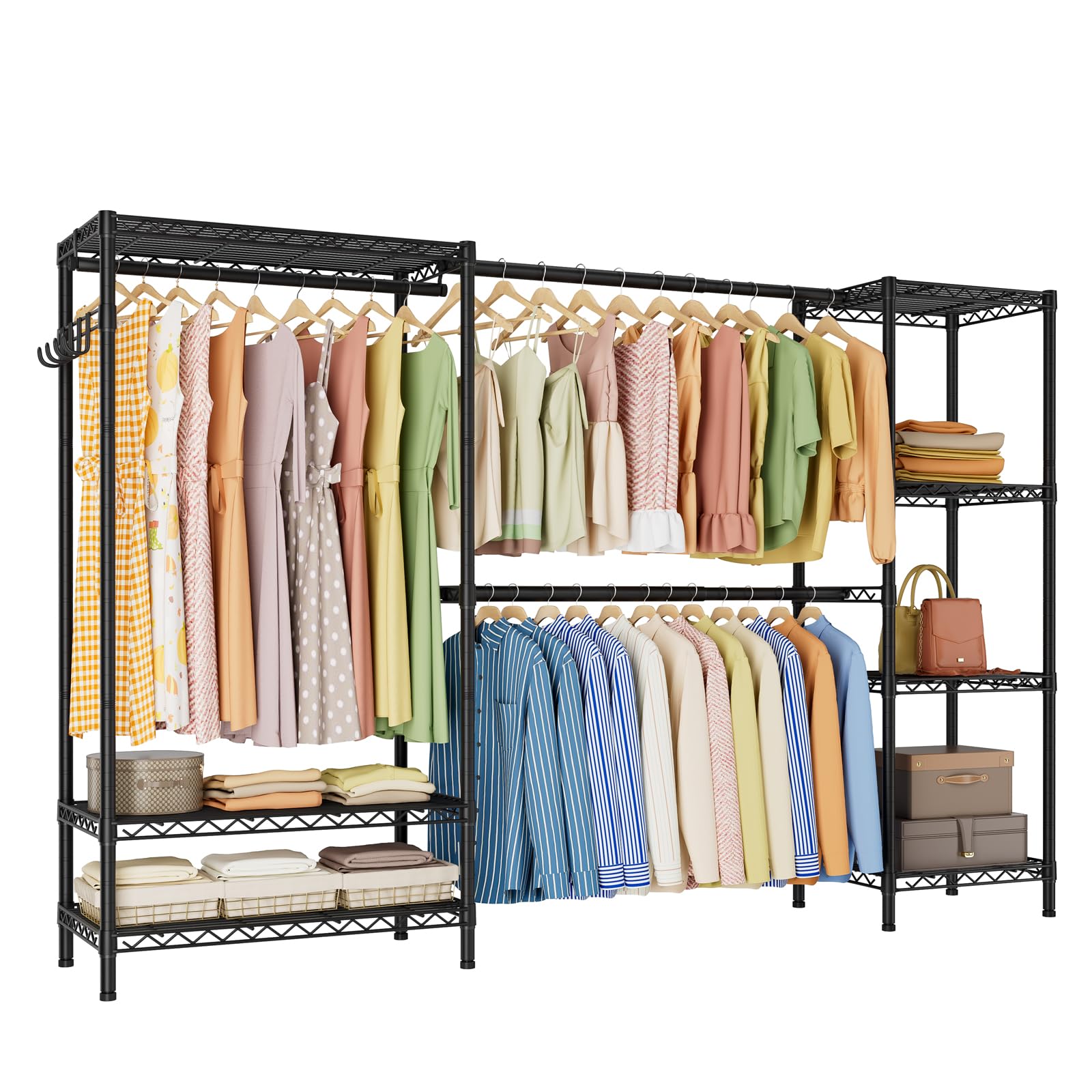
Eight hundred and ninety pounds is the number on the spec sheet, and it's the whole point: nothing about this rack hangs from your drywall. The frame stands on its own 68.9-inch footprint, 15.7 inches deep and 76.4 tall, with four hanging rods and eight shelves. For a rental, a basement corner, or a spare bedroom that never got a proper closet, that's a wardrobe in an afternoon.

Assembly is easier than the parts count suggests. The pieces arrive labeled, the instructions are clear, and it goes together with hand tools rather than a drill. The connectors are plastic, which is the honest weak point in an otherwise solid frame — keep the heaviest boxes low and save the top shelves for bedding and bags.

Four rods is what we keep coming back to. Long dresses go on one, shirts double-hang on the others, and 60 pounds per rod is a real winter rail rather than a promise. What you give up is width: 68.9 inches is fixed, so measure the wall before you order. If the space is wider, the VIPEK X3 stretches; if it's narrower, a wall-mounted kit uses the room better.

Bottom line: This is the one we send renters to: a freestanding closet with four rods, eight shelves, and room for a full wardrobe.

3

ClosetMaid ShelfTrack

ClosetMaid ShelfTrack

Narrow reach-in closets

Our Score 9.4/10
Check Price

Worth Noting

  • Shelf, rod, or track may need trimming
  • Parts warranty runs only 30 days
Shelf Depth
12 in
Shelf Space
Up to 144 in
Closet Width
4 to 6 ft
Hanging Space
Up to 96 in
Read the full review

This is the least expensive wall-mounted kit here, and the one we point to when a closet is narrow and deep. A 4- to 6-foot wall turns into up to 96 inches of hanging space and 144 inches of shelf space, and those shelves are a full 12 inches deep — enough for a folded stack rather than a single row of shoes.

The SuperSlide rod is the feature worth the upgrade. Hangers glide past the shelf brackets instead of catching on them, which sounds trivial until you've spent a winter wrestling a coat hanger before coffee. Shelves move up and down on the standards, and the vinyl coating over steel keeps the whole thing from feeling like bare wire in a builder-grade closet.

Budget a second pair of hands for the hang track. It has to sit level across its full length, and holding it while you drive screws is genuinely a two-person job. Get the layout right before the drill comes out, because the standards want studs and moving them later means patching drywall. In a tight reach-in, depth is what earns this kit its place.

Bottom line: We keep it for narrow reach-ins: deep shelves, a rod hangers actually slide along, and the lowest wall-mounted price here.

4

VIPEK X3

VIPEK X3

Walk-in closets

Our Score 9.4/10
Check Price

Worth Noting

  • Long parts list makes for a slow build
Width Range
62 to 96 in
Configuration
Straight or L-shaped
Load Capacity
1,210 lb
Rods And Shelves
4 rods, 4 shelves
Read the full review

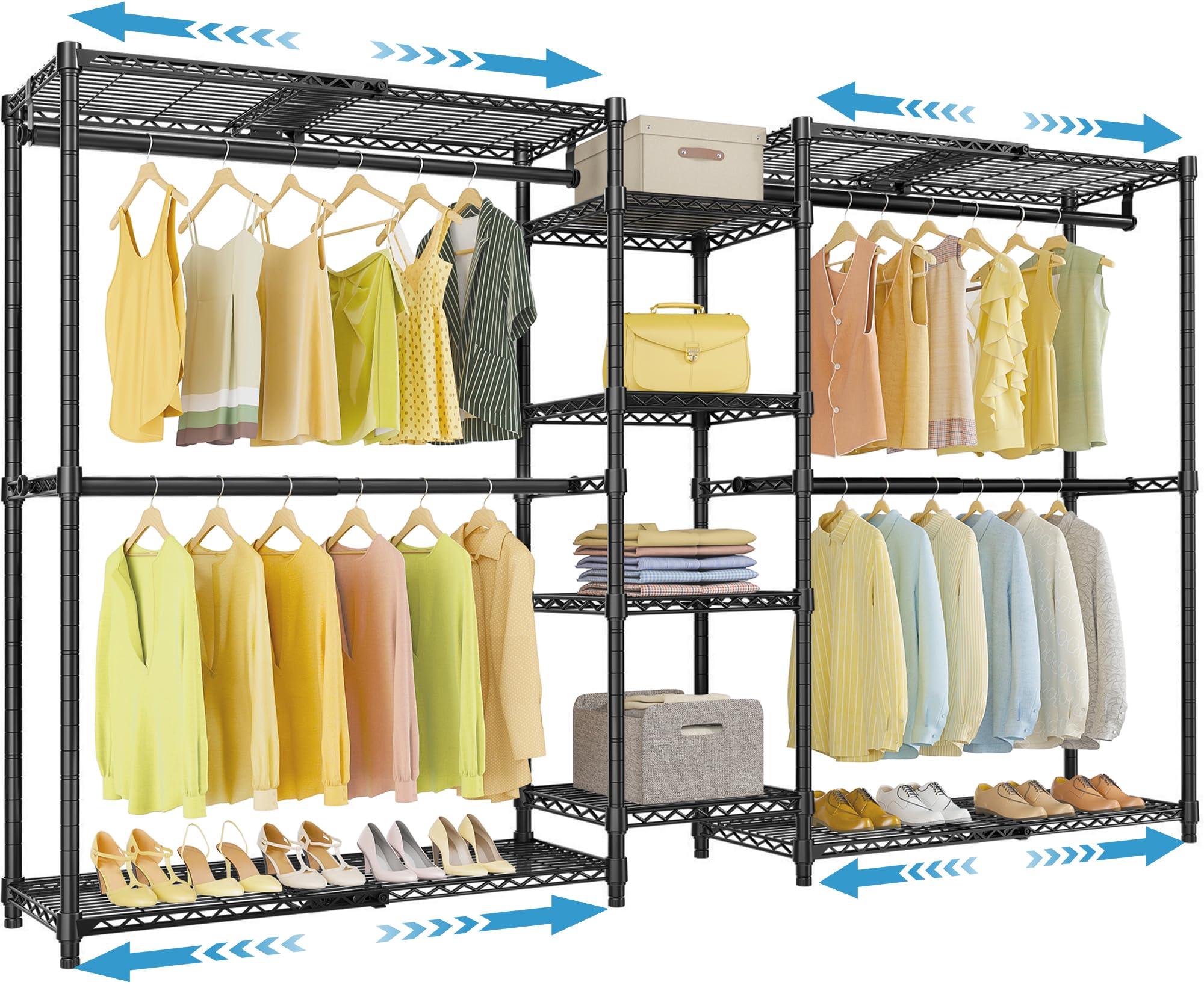
Sixty-two to ninety-six inches covers most walk-in closets, and the frame also folds into an L when the space turns a corner. Four rods and four shelves, each extendable between 24 and 41 inches, with locking collars that hold a shelf where you set it.

That adjustability is the argument. A reach-in with a return wall, a walk-in with a window, a bedroom where the closet is really an alcove — you build to the room instead of shopping for a room that matches the rack. The 1,210-pound rating is more headroom than most wardrobes need, and the leveling feet take up the slack on an old floor.

Setup takes an afternoon. There are a lot of parts, and the frame is easier to build lying down and stand up with two people. The wall straps come in the box; use them. Once they're on, the frame stops swaying when you push a rail of coats aside, which is the difference between a rack and a built-in.

What we liked most is that nothing about it feels improvised. The collars lock, the shelves sit level, and the whole thing can be shortened and reset when you move. It's the most expensive system here, and the L-shape or the extra two feet of width is what that money buys — in a genuine walk-in, it's worth it.

Bottom line: We choose it for a walk-in or a corner: it stretches to eight feet, folds into an L, and stops swaying once strapped to the wall.

5

ONBRILL H3

ONBRILL H3

Open closet looks

Our Score 9.4/10
Check Price

Worth Noting

  • Mesh shelves need bins for small items
Depth
11.8 in
Width
Up to 96.8 in
Load Capacity
950 lb
Shelves And Rods
6 shelves, 4 rods
Read the full review

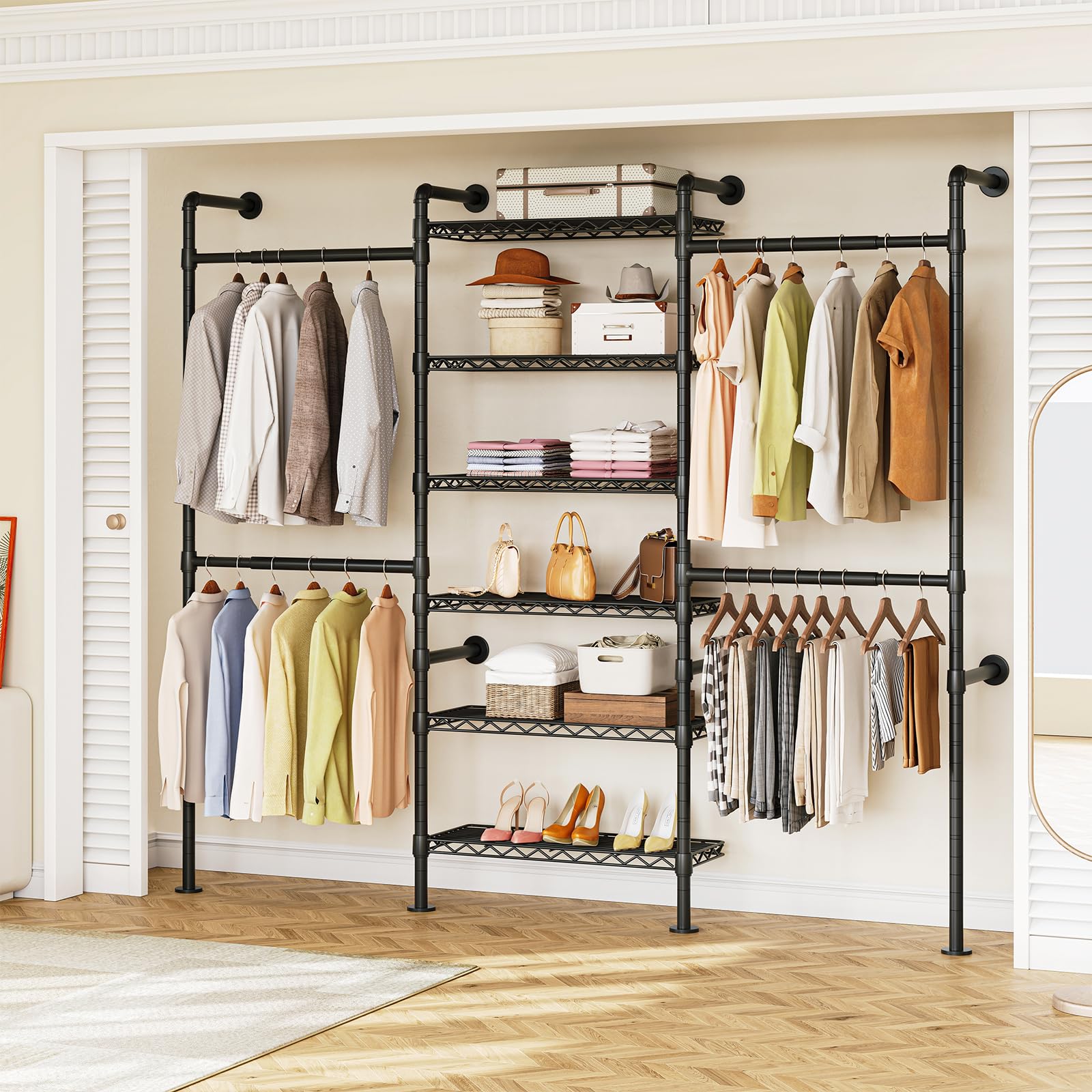
Black pipe, mesh shelves, and a wall plate where a closet rod used to be — the H3 is for anyone who has decided the closet should look like part of the room. It runs about 97 inches wide with six mesh shelves and four retractable rods, and it goes up straight, at 45 degrees, or as an L.

We like that it commits. An open closet only works when the things on it are worth looking at, and the industrial frame makes a doorless alcove feel like a decision rather than an unfinished job. The threaded joints help too: pipes twist together, so assembly is mostly hands and a little patience instead of a screwdriver at every connection.

Depth is where it asks you to be honest. At 11.8 inches it's the shallowest system here — fine for shirts, folded stacks and shoes, tight for a rail of bulky winter coats. In a small bedroom where the closet is on show every day, that trade usually pays for itself.

Bottom line: We recommend it when the closet is visible from the bed: industrial pipe shelving that holds a real wardrobe and looks deliberate doing it.

6

Golpart Heavy Duty Closet Rack

Golpart Heavy Duty Closet Rack

Heavy loads

Our Score 9.2/10
Check Price

Worth Noting

  • Small items need bins on open wire
Rods
3, two expandable
Depth
15.75 in
Width Range
70 to 88.5 in
Load Capacity
1,500 lb
Read the full review

If the VIPEK V5 is the freestanding rack we point to first, the Golpart is the one that argues back. Two expandable rods take it from 70 to 88.5 inches, three tiers of wire shelving sit between them, and the 1,500-pound rating is the highest printed number in this group.

Treat a figure like that as a ceiling rather than a working load. The layout matters more day to day: the three shelf tiers give you somewhere to stack bins and folded clothes between the hanging sections, and the extending rods let the frame meet both walls of a small room instead of floating short of one.

It arrives as 35 pounds of powder-coated carbon steel, and the shelves move in height so long coats and sweater bins can share the same run. The wall anchor in the box is a tip-over safeguard rather than a load-bearing fix, and it's worth the five minutes it takes to fit.

Bottom line: We rate it as the heavy-duty alternative: expandable width, three shelf tiers, and the highest load rating here.

7

Ulif E10

Ulif E10

Budget extra hanging

Our Score 9.0/10
Check Price

Worth Noting

  • Frame flexes more at full extension
Weight
26.8 lb
Width Range
73 to 97 in
Load Capacity
800 lb
Rods And Shelves
4 rods, 6 shelves
Read the full review

The stretchable rod is what makes the E10 worth a second look. The frame runs 73 inches wide and pulls out to 97, and the center rod extends with it, so a wall that isn't a standard size doesn't leave you with a gap at one end. Six shelves, three more rods, and an 800-pound rating round it out.

At 15 inches deep and about 27 pounds, it's light enough to build alone and easy to shift when you rearrange a room. Shelf heights adjust, so a long-coat section and a folded-clothes stack can share the same frame, and it's the least expensive route here to a genuinely long double-hang.

Flex at full extension is the honest trade for that width, and we were glad to find the anti-tip fittings in the box rather than on a parts list. Anchor it, especially in a room where kids or a dog orbit the furniture. For a spare bedroom, a basement, or a first apartment, this is the sensible buy.

Bottom line: For a long wall on a small budget, this is the freestanding rack we reach for: it stretches to 97 inches and anchors for safety.

8

ClosetMaid SuiteSymphony

ClosetMaid SuiteSymphony

Furniture-style storage

Our Score 9.0/10
Check Price

Worth Noting

  • Panel edges can chip under load
  • Tower feels wobbly until anchored
Shelves
5, two adjustable
Material
Laminated engineered wood
Closet Width
5 to 10 ft
Weight Capacity
175 lb
Read the full review

Particle board is the first thing to know. This is the only wood system here — laminated engineered wood built around a 25-inch tower with five shelves and three expandable rods that reach across a 5- to 10-foot closet — and it's the one to buy with your eyes open.

Fit is more flexible than the width suggests. The tower is 25 inches, the rods trim down or can be used on one side only, and the run can be shortened into a small reach-in or stretched across a walk-in. It arrives as 74 pounds across several flat boxes, so plan a two-person carry.

Assembly is manageable but not quick. The panels look alike, the hardware comes in one bag, and the instructions are thinner than the job deserves — lay the pieces out in order and keep the bag with them, because digging a cam lock out of the recycling is nobody's afternoon.

What it buys you is a closet that looks like furniture. The tower gives a vertical column of shelves in the middle of the run, the rods expand from 30 to 48 inches on either side, and the SuiteSymphony collection adds drawers, doors and shoe shelves later. In a bedroom where the closet doors come off, we think that's a real step up from wire.

Bottom line: We suggest it when you want the closet to look built-in: a wood tower, expandable rods, and a collection you can add drawers to later.

How We Chose and Tested the Closet Systems

I started with roughly 40 closet systems and narrowed them by the things that decide whether a kit works in a real closet: whether the widths fit a standard five- or six-foot reach-in without cutting, whether pieces could be bought individually instead of only as a full kit, what the drawer slides were made of, and whether the whole thing was actually in stock. That left 12 systems, which my team and I installed over nine months in reach-ins, walk-ins, and one very shallow bedroom closet.

Every installation was timed solo, from the first rail bracket to the last shelf, and we wrote down exactly where we stalled — a stud that wasn't where the template promised, a step that only made sense after we'd already done it wrong. We counted the pieces in each drawer box and watched whether the boxes squared up on the first try or needed a second pass, and we noted how many trips back to the hardware store each build cost us.

Then we filled them with the clothes that were already in the house. Top shelves got weighted storage bins, rods got winter coats, and we checked back at 30, 60, and 90 days for shelves that had started to dip and anchors that had pulled. We measured how much hanging space survived once a tower went in, whether a shelf could be moved without emptying the closet, and how the finish held up to hanger corners and bin edges seen from the doorway. Value came down to price per linear foot with brackets and drawer slides included — a cheap kit that needs a second trip for hardware isn't cheap.

How to Choose Closet Systems

Measure the Wall Before You Shop

Width first. A kit rated for 4 to 8 feet covers most reach-ins in a normal house, while the freestanding racks here run from about 69 inches to 97, and the top of that range won't fit a small bedroom no matter how you angle it. Then work out the depth you can give up: wire shelves at 12 inches are the shallowest wall option, most freestanding racks sit around 15.7 inches, and the pipe systems are shallower at 11.8.

Clearance is the step people skip. A 15.7-inch rack behind a sliding door can block the far panel's travel, and a shelf run that ends too close to the door frame turns the last foot of hanging space into a scrape. Treat 'compact' in a listing as a description of the assembled footprint, not a promise that it fits your alcove.

Wall-Mounted or Freestanding

The permanent option gains the most. A wall-mounted kit keeps the floor clear, looks built-in, and puts the load into studs instead of a frame — but it means finding those studs or using anchors rated for the weight, and patching drywall when you move out. Freestanding racks suit rentals, basement corners and rooms where the closet was an afterthought, and they come with you when you go.

If you rent, or your walls are plaster or masonry, buy freestanding and anchor it anyway. Every rack here ships with an anti-tip fitting for a reason: a tall frame loaded with coats is a tipping hazard until it's tied back to the wall.

Hanging Space Versus Shelf Space

Count rods, not just shelves. Four rods let you double-hang shirts and still keep one full-length run for dresses, which usually beats one rod and a wide expanse of shelf in a tall closet. Two rods in a 5-foot reach-in changes how much you can store more than an extra foot of width does.

Then read the load numbers carefully. A 1,500-pound figure describes the whole frame, not one shelf, and per-rod limits — 60 pounds on the VIPEK V5, for instance — are the numbers that decide whether a coat rail holds. Deep shelves earn their space for bins and bedding; shallow ones are for shoes.

Wire, Wood, or Pipe

Wire is the cheapest and the most forgiving: it ventilates, wipes clean, and takes a vinyl or epoxy coating against rust. Wood kits such as the SuiteSymphony read as furniture and accept drawers and doors later, at the cost of weight and panel edges that chip if you overfill them. Pipe systems are a decorating decision first — the ONBRILL H3 looks deliberate in a bedroom and shows everything it holds.

Decide whether the closet is something you hide or something you show, then buy the material that matches. A closed closet rewards deep wire shelves and capacity; an open one rewards a frame you don't mind looking at every night.

Frequently Asked Questions

Final Verdict

Most people should buy the Rubbermaid Configurations Deluxe. It covers the common 4- to 8-foot reach-in without cutting, the shelves and rods re-hang when your wardrobe changes, and the finish holds up in a laundry room as well as a bedroom closet.

The exceptions are worth knowing. If you rent, or the wall won't take anchors, the VIPEK V5 gives you four rods and eight shelves without a single hole. If you're fitting out a walk-in with a corner, the VIPEK X3 folds into an L and stops swaying once it's strapped in.