Storage

Best Gaming Setup Essentials of 2026

The worst part of a gaming setup is rarely the game. It's the headset that clamps after an hour, the mousepad that curls at the edge, the mic that makes your friends ask if you're calling from a wind tunnel. The right essentials fix that quietly: they sit where you put them, sound clean, and disappear once you're in a match. Over the past six months, my team and I have lived with 15 essentials—headsets, keyboards, mice, mousepads, stands, and the small pieces that keep a desk from turning into a cable nest—and the pattern is clear.

The trap is buying for the spec sheet. A headset with a big driver can still sound muddy, and a keyboard with every feature can still flex under your wrists. What matters is how the gear behaves on hour three, when the novelty wears off—whether the mic still sounds like you, the stand still holds its angle, and the mousepad hasn't slid halfway across the desk. The picks below survived that test.

1

Green Box 4000J Surge Protector

Top Pick
Green Box 4000J Surge Protector

PC protection

Our Score 9.6/10
Check Price

Worth Noting

  • Only six AC outlets
Outlets
6 AC
USB Ports
2 USB-C, 1 USB-A
Surge Rating
4,000 J
Outlet Spacing
1.8 in, 10° angled
Read the full review

Four thousand joules is the number that matters here. That is more than twice the surge protection of the tower above, and for the most expensive thing on your desk it is the difference we care about. Pair it with a 15A/1,875W rating and you have a strip built to sit behind a desktop rather than a phone charger.

The physical design is unusually thoughtful for the category. Six outlets sit at a 10-degree angle with 1.8 inches between them, so a power brick doesn't block its neighbor, and two USB-C ports plus one USB-A deliver up to 20W for a controller or a phone. The RGB bar has three modes and four brightness levels; it sounds like a gimmick until you are plugging something in behind a desk at night.

Six outlets is the ceiling, though, and a PC, two monitors, speakers and a lamp will use most of them. If capacity is the problem, the UWIWUTEI tower covers more plugs for less; if the electronics are what you are protecting, this is the one to buy.

Bottom line: Our choice when a gaming PC is what you are protecting: the highest surge rating here, in a strip built around chunky plugs.
2

UPERGO Walnut Headphone Stand

UPERGO Walnut Headphone Stand

Headset storage

Our Score 9.6/10
Check Price

Worth Noting

  • Controller cradle is not fixed and can slide
Holds
Headset, controller, small gear
Assembly
3-part assembly
Material
Solid walnut and metal
Dimensions
4.72 x 8.27 x 6.3 in
Read the full review

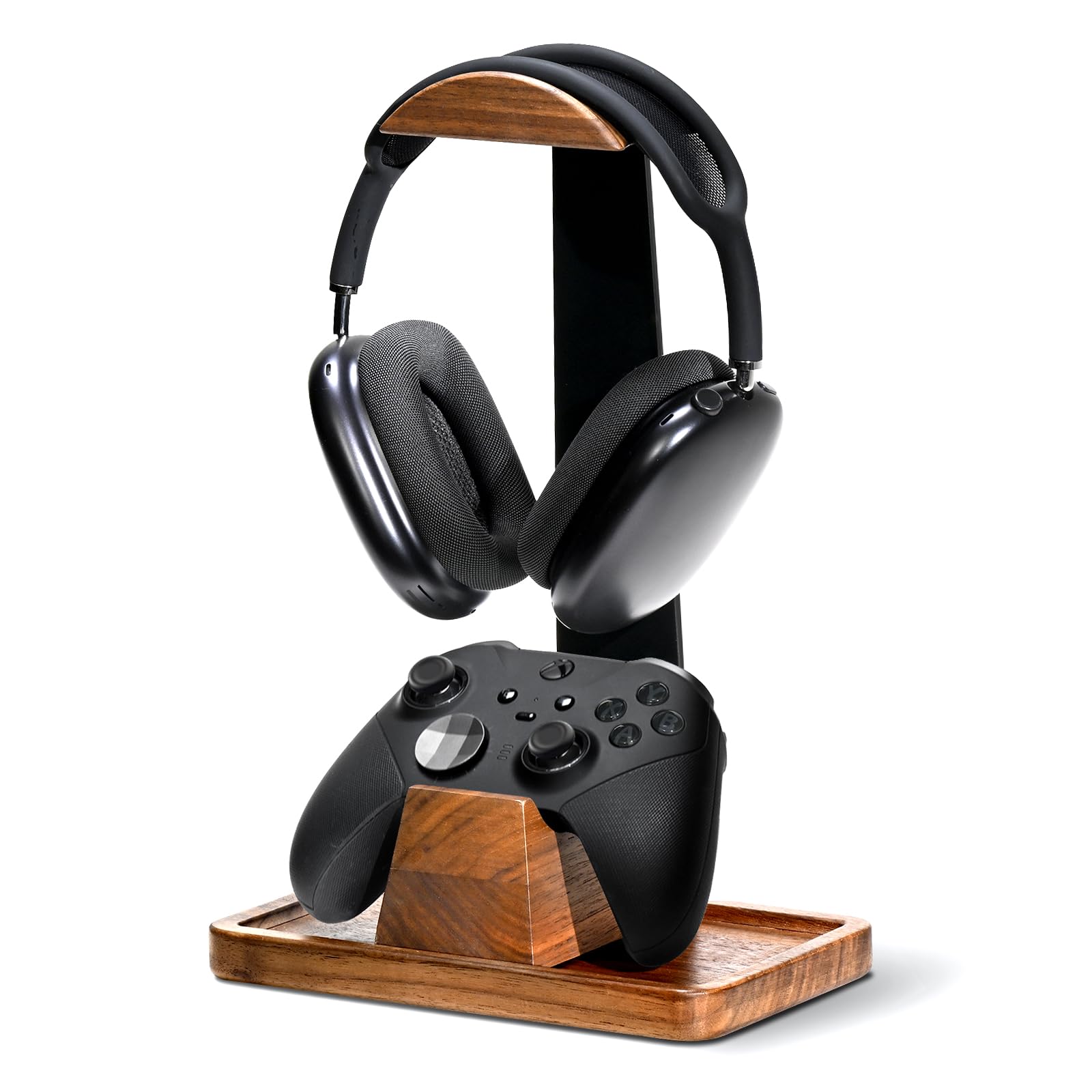
Most gaming gear is black plastic, and a desk covered in it starts to look like a LAN party. This stand is solid walnut with metal fittings, and the wood does more for a desk than any light strip: it gives the eye somewhere to rest among the monitors and the mesh.

The design is useful, not just handsome. The curved cradle holds a headset without pressing on the headband, a second holder takes a controller, PS5, Switch or Xbox, and the hollow base is the clever part. It swallows earpads, charging cables, SD cards or a couple of rechargeable batteries, which is exactly the clutter that normally spreads across a desktop.

Assembly is three pieces and a couple of minutes, and the weighted base stays planted with a heavy headset hanging off the top. The arc suits most over-ear models, though the very tallest sit close to the base.

At midrange money for a stand it earns its place, but only on a desk you actually look at. If the goal is simply a headset off the surface, the Lamicall hook below does that for a fraction of the cost. If the goal is a desk that looks considered, this is the piece that gets you there.

Bottom line: We recommend it to anyone who wants the headset and controller off the desk without the desk looking like a plastic rack.

3

UWIWUTEI Power Strip Tower

UWIWUTEI Power Strip Tower

Whole-desk power

Our Score 9.4/10
Check Price

Worth Noting

  • Light base tips with a heavy adapter on one side
  • 1,800J protection is the lower of the two strips here
Outlets
12 AC
USB Ports
2 USB-A, 2 USB-C
Cord Length
6 ft
Surge Rating
1,800 J
Read the full review

A gaming desk fills with plugs faster than anyone expects: a PC, two screens, speakers, a lamp, a phone charger, a controller dock. This tower answers that with 12 AC outlets and four USB ports, two USB-A and two USB-C, on a base about three inches square, so it claims a corner of the desk instead of a strip's worth of length along the back edge.

The details are where it earns its keep. The outlets are spaced widely enough for adapter bricks, the 0.3-inch flat plug sits flush behind furniture, and the six-foot cord reaches a wall socket without an extension. There is an 1,800-joule surge rating and a reset switch, and because the tower stands up, nothing ends up buried under a monitor riser.

For a desk that needs a lot of outlets in a small footprint, this is the one we reach for. Two things to know before you order: it is light, so a heavy adapter plugged into one side can tip it, and 1,800 joules is modest next to the 4,000-joule strip here. Neither matters much on an ordinary desk; both matter if you are protecting a very expensive PC through storm season.

Bottom line: If your desk runs out of sockets before it runs out of gadgets, this tower is the one we plug everything into.

4

BladeHawks RGB Desk Mat

BladeHawks RGB Desk Mat

Keyboard and mouse

Our Score 9.4/10
Check Price

Worth Noting

  • USB powered, so it needs a free port
  • Arrives curled and takes days to flatten
Size
31.5 x 12 in
Surface
Micro-textured cloth
Lighting
7 static, 7 dynamic modes
Thickness
4 mm
Read the full review

Thirty-one and a half inches by twelve is the number to picture: wide enough for a full-size keyboard and a mouse with room to swing, deep enough to cover the front edge of a desk in one continuous surface. It is one of the cheapest upgrades on this page and the easiest single change to make to a desk that looks unfinished. The cloth is smooth and wipe-clean, the rubber base keeps it still, and the RGB rim supplies the accent most setups are missing.

Keep your expectations level about the lighting. Seven static and seven dynamic modes, one button and a memory function that returns to your last setting are all genuinely good, but the LED strip is the first thing to fade over months. Buy it for the look and the surface, and treat the glow as a bonus that may not last as long as the mat does.

Bottom line: The upgrade we suggest first when a desk looks unfinished: one surface covering keyboard, mouse and the front edge for very little money.

5

Lamicall Headphone Hanger

Lamicall Headphone Hanger

Small desks

Our Score 9.4/10
Check Price

Worth Noting

  • Won't hold on painted or whitewashed walls
Fold
Magnetic fold-up
Mount
Adhesive, under-desk
Weight
1.44 oz
Dimensions
3.5 x 3.9 x 0.67 in
Read the full review

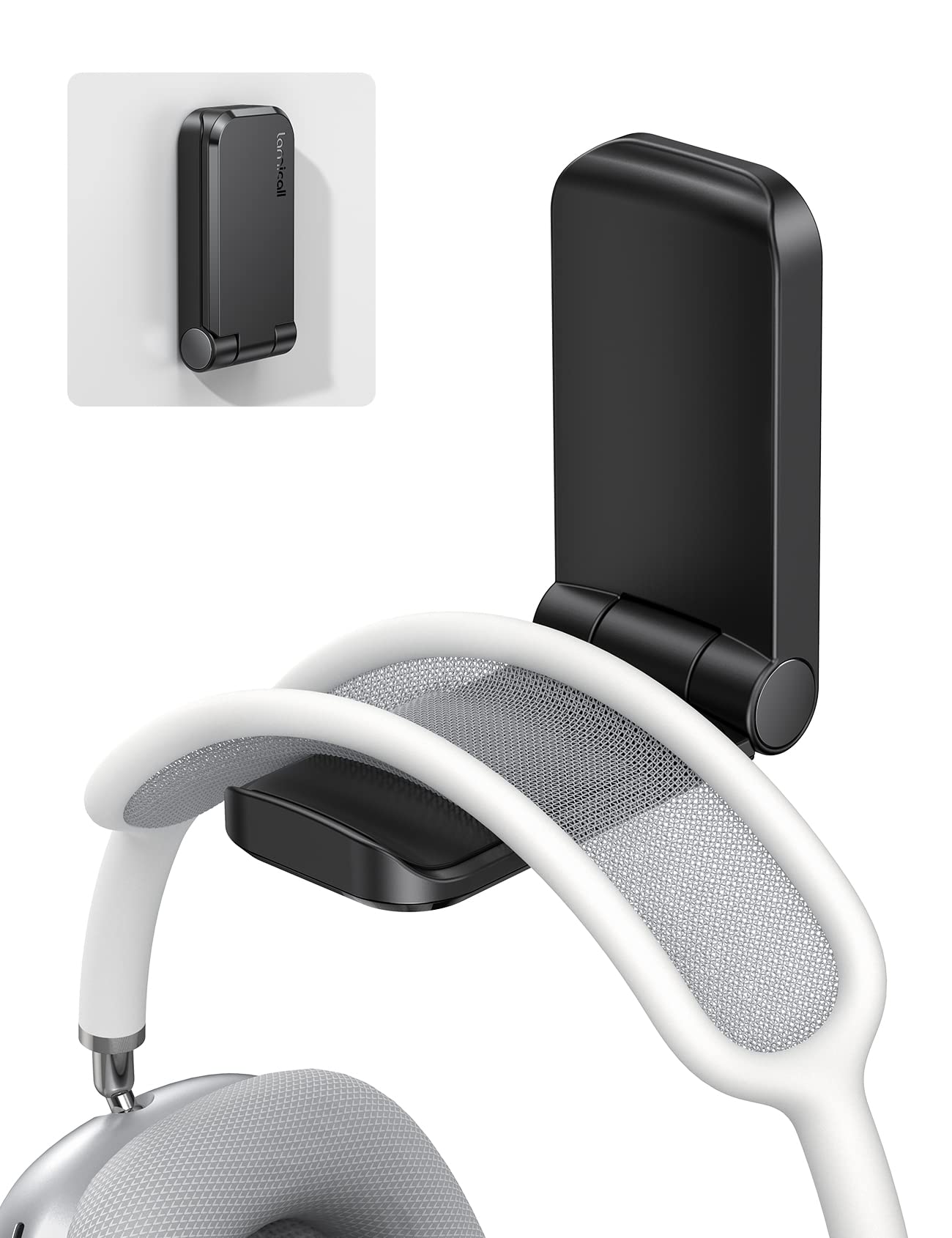
The problem this solves is small and universal: a headset with no home ends up on the desk, on top of a monitor or on the floor. This hook sticks under a desk or a shelf, folds flat against the surface when it is empty thanks to a magnet, and holds the headset by the headband, out of the way. At roughly 3.5 by 3.9 inches it fits almost anywhere you can reach.

Placement is the one thing to get right. The pad grabs hard and does not forgive a second attempt, so offer the hook up where you want it before peeling the backing; there is a spare pad in the box for the attempt you will want to redo. For a small desk, a shelf edge or a rented room where drilling isn't an option, it does one job neatly and then disappears, which is exactly what a good small accessory should do.

Bottom line: We keep coming back to this for small desks: a headset off the surface, no drilling, and it disappears when it is empty.

6

HUANUO FlowLift Dual Monitor Stand

HUANUO FlowLift Dual Monitor Stand

Dual-screen desks

Our Score 9.2/10
Check Price

Worth Noting

  • Wooden desks only, so glass and plastic are out
Motion
Tilt, swivel, rotate, height
Mounting
C-clamp or grommet
Load Per Arm
4.4-19.8 lb
Screen Size Range
13-32 in
Read the full review

Clamp two screens to this arm and the thing you notice first isn't the arm, it's the desk underneath. Both monitors lift clear of the surface, and the space that was holding two factory stands becomes somewhere to put a keyboard, a notebook and the mug that never had a home. That is the whole argument for a monitor arm, and this one makes it for midrange money.

We made it the top pick because it does the structural work the rest of a desk setup hangs off. Each arm is rated for 4.4 to 19.8 pounds and screens from 13 to 32 inches on VESA 75 x 75 or 100 x 100 plates, with tilt, swivel, rotation and height adjustment. The steel frame feels like hardware rather than a bracket, the dual C-clamp spreads its grip across a wider platform than most, and the five-year warranty is the longest promise on this page. Cable clips run along the arms, which sounds like a small thing until you have two screens and nowhere to hide their cords.

Tension is what decides whether an arm feels solid or wobbly, and it is set at each joint. An arm that hasn't been dialed in with the monitors already hanging will drift, which is why some dual-arm setups feel unstable when the hardware is fine. Expect a few minutes of adjustment after everything is mounted, and tighten the clamp properly while you are under there.

Two 27-inch screens on a wooden desk is the arrangement it was built for, and if you are coming from two freestanding stands, the desk you get back is worth more than the space the arm takes. Buy it before the mat, the stand and the lights; the rest of this list fits around the room it opens up.

Bottom line: We made this the top pick because it frees the whole desk at once and holds both screens exactly where you leave them.

7

Razer BlackShark V2 X

Razer BlackShark V2 X

Chat and play

Our Score 8.8/10
Check Price

Worth Noting

  • 7.1 surround requires Windows 10 64-bit
  • Earcups run warm over long sessions
Weight
8.47 oz
Drivers
50 mm titanium-coated
Surround
7.1, Windows 10 64-bit only
Connection
3.5 mm wired
Read the full review

At 240 grams the BlackShark V2 X is light enough that we stopped thinking about it during long sessions, which is the best thing a headset can manage. The closed earcups and memory foam seal around the ears, and passive isolation does the rest. The seal is doing most of the work, so fit matters more than the spec sheet suggests.

Sound is the reason it is on this list. The 50 mm titanium-coated drivers are clear and lively, and the software-enabled 7.1 surround genuinely helps with positional audio in shooters. On PC it is the best audio value in this roundup, and the 3.5 mm cable means the same headset works on a PlayStation, a Switch or a laptop without a dongle.

The microphone is the part to think about. The HyperClear cardioid pattern favors your voice over the room and is fine for chat, but it is the piece that gives trouble over time far more often than the earcups or the cable do. If you get serious about voice, budget for a separate mic later rather than replacing the whole headset.

For a first setup that has to cover both a PC and a console, nothing else here balances weight, sound and price as well. It is not a luxury headset and doesn't pretend to be. What it is, is the one we reach for when the evening runs long and the chat runs longer.

Bottom line: For most first setups we point people here: light enough to forget, clear enough for positional audio, and wired to work anywhere.

8

Redragon GS510 Speakers

Redragon GS510 Speakers

Quiet-room audio

Our Score 8.8/10
Check Price

Worth Noting

  • 3 W output won't fill a room
  • Static can creep in through the aux cable
Output
3 W
Channels
2.0 stereo
Lighting
4 RGB modes, touch control
Connection
USB power, 3.5 mm audio
Read the full review

Two small speakers, a volume knob on top and a light bar: the GS510 is the shape budget desktop audio has taken for years, and it does it in a compact frame. It is 2.0 channels at 3 watts, powered by USB with a 3.5 mm plug for sound, and setup is a two-cable job with no driver. The touch control on the main unit cycles four lighting modes.

We went in expecting very little from a pair this small, and the sound is better than the size suggests, as long as you keep the job modest. For hearing a game, a call or a video in a quiet room it is fine, and the cable between the two units runs up to 39 inches, which spreads the sound wider than the footprint implies. It won't fill a room and it won't replace a headset for anything where positioning matters, and static or ground-loop hum can creep in through the aux connection, so a clean source helps.

If you mostly wear a headset and want speakers for the times you don't, this is a compact way to get sound out of a desk with no room for a soundbar. If audio is the point of the purchase, the headset above does far more for gaming, and the money is better spent there.

Bottom line: Worth buying when you just need to hear your desk rather than fill a room, and not the place to spend your audio budget.

How We Tested the Best Gaming Setup Essentials

We started by pulling together a shortlist from spec sheets, customer reviews, and the gear that kept showing up in friends' setups, then filtered it by price, desk footprint, and whether the basics—connection, comfort, controls—made sense without a manual. We ended up testing 15 essentials over six months, from headsets and keyboards to mousepads, headset stands, and cable organizers.

Testing happened where the gear actually lives: weeknight ranked sessions that ran two or three hours, weekend co-op nights on voice chat, work-from-home calls that doubled as mic tests, and a living-room laptop setup with a controller and a folding table. We timed how long each piece took to unbox and connect, then noted whether we needed software or a manual for basic functions. For headsets, we recorded voice samples, made real calls, and switched between game audio and music to hear whether footsteps and bass held up. For stands and arms, we nudged, loaded, and knocked them to see how much weight they held before tipping; for mousepads, we noted whether the edges curled or the pad slid during fast swipes.

Sturdiness got checked by flexing joints, shaking desks, and carrying each piece between rooms. We adjusted headsets, stands, and keyboard feet through their full range and marked where they slipped. Mic durability meant cycling mute switches, bending boom arms, and using the same headset daily for six months to see if the cable or switch failed. We also listened for noise—fan whine, clicky keys, headset leakage—and compared what each piece cost against how often we reached for it. The ones that made the list stayed stable, adjustable, and quiet enough to forget about.

How to Choose Gaming Setup Essentials

Start With the Space Under Your Screens

A monitor arm is the highest-leverage purchase in a desk setup because it changes the geometry of everything else. Lifting both screens frees the surface and puts the bottom edge of the display at eye level, which is the difference between a desk you sit at for an hour and one you sit at all evening.

Three checks before you order: the VESA pattern on the back of each screen (75 x 75 and 100 x 100 are the common pair), the weight of each screen with its stand removed, and the thickness of the desk edge you plan to clamp. Clamp mounts specify wooden desks and rule out glass and plastic, and a screen lighter than the arm's minimum weight won't tension down properly.

Power: Count Outlets, Then Check Joules

Two numbers decide a power strip: how many outlets you can actually use at once, and how much surge energy it absorbs. Spacing matters as much as count, because one adapter brick on a tight strip blocks two sockets. Joule ratings vary enormously, 1,800J and 4,000J both appear in this group, and higher is better for expensive equipment. Look at the plug too: a flat or angled head lets the strip sit behind furniture instead of pushing it away from the wall. Keep the load sensible as well; a 15A/1,875W strip runs a PC and its peripherals easily, but not a space heater.

Audio: Headset First, Speakers Second

If you play with friends, a headset does more for you than any speaker pair at this end of the market. Read past the word surround: it is almost always software and often Windows-only, so console players should expect stereo. Weight matters more than driver size over a long evening, and a 3.5 mm wired connection is the least fussy option if you move between a PC and a console. Desktop speakers are for the times you are not wearing it, and from a small USB pair expect clarity rather than volume.

The Finishing Pieces: Mounts, Storage and Materials

Once the screens and the power are sorted, the leftover problems are small and visible: a headset with nowhere to go, cables across the desk, a surface that doesn't match anything. Adhesive mounts solve the first without drilling, but only on smooth finished surfaces, and a painted or papered wall is exactly where they let go. For looks, one considered object beats several cheap ones: a walnut stand among black plastic is the difference between a desk that looks assembled and one that looks deliberate.

Frequently Asked Questions

Final Verdict

Start with the HUANUO arm. It changes the shape of the desk rather than its decoration, and everything else on this list is easier to place once both screens are off the surface. Add the UWIWUTEI tower if your desk is short of outlets, or the Green Box strip if the gaming PC is the thing you are protecting.

If the screens are already sorted, the BlackShark V2 X and the walnut stand are the two that make a desk feel finished: one for your ears, one for the look of the thing.