Storage

Best Bullet Journal Supplies of 2026

There's a particular disappointment in finishing a spread you're proud of, then flipping the page to find a ghost of it bleeding through. A bullet journal only works when the tools get out of the way: ink lands where you put it, colors hold their saturation for months, and the tape is still stuck when you reopen the notebook in March. The right supplies turn a blank dot grid into something you want to open every morning; the wrong ones turn a good habit into a smudge.

I've kept a bullet journal for years, and over the past five months my team and I have put 16 pens, markers, tapes, and notebooks through ordinary use — Sunday spreads at the kitchen table, a pouch rattling around in a tote, pages left open while the ink dried. First-timers learn the hard way that paper weight matters as much as the pen, and a beautiful palette is worthless if it feathers on contact. The picks below survived all of it, each for a slightly different reason.

1

Sakura Pigma Micron 6-Pen Set

Top Pick
Sakura Pigma Micron 6-Pen Set

Everyday journal writing

Our Score 9.6/10
Check Price

Worth Noting

  • Dense hatching drains a pen quickly
Ink
Pigment, waterproof
Pack
6 black pens
Point Sizes
005–08 (0.20–0.50 mm)
Read the full review

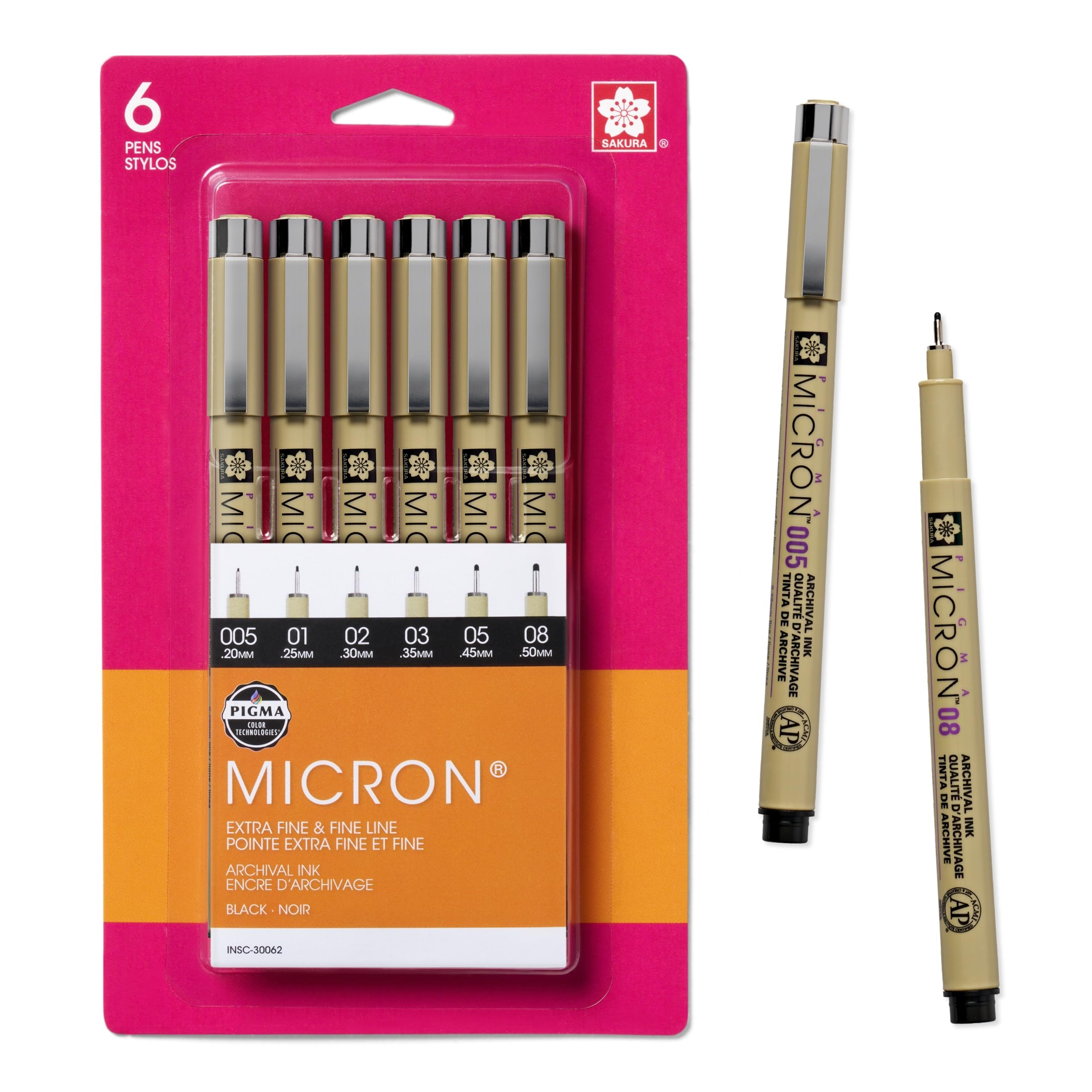
Six pens, six widths, and that is the whole argument for this set: a bullet journal runs on hierarchy, and a single pen flattens it. We keep the 08 at 0.50mm for month headers, the 03 at 0.35mm for the body of a daily log, and the 005 at 0.20mm for the tiny labels inside a habit tracker. The same black in all three is what keeps a busy page looking deliberate instead of patchy, and mixing brands to get that range is how spreads end up with four slightly different blacks on one sheet.

The ink is pigment rather than dye, and it is waterproof and fade resistant once dry. That earns its keep under a highlighter: run a Mildliner across a finished heading and the black stays black rather than greying out and smearing. On dot-grid paper the lines stay crisp, with no feathering into the fibres, and a 0.20mm nib is fine enough to label a single 5mm dot space without crowding the row beside it.

The trade-off is ink capacity. These are fineliners, not workhorses, so a 005 doing dense hatching will run dry well before a gel pen would, and leaving one uncapped while you hunt for a ruler is enough to finish the tip. Cap it between steps, store the set flat, and keep the finest sizes for detail rather than for filling in large areas.

What settles it for us is the archival claim, which matters more in a journal than in a sketchbook. A bullet journal is a record you keep, and a line that fades in a box in five years is a line you have lost. A page that will still read in a decade is most of the job done with one small purchase.

Bottom line: If you buy one pen for your journal, we think it should be this one: six widths, one consistent black, and lines that stay put under a highlighter.

2

Zebra Mildliner 15-Pack

Zebra Mildliner 15-Pack

Highlighting and layering

Our Score 9.6/10
Check Price

Worth Noting

  • Ink supply runs out faster than a liquid highlighter
Ink
Water-resistant pigment
Tips
Chisel and fine bullet
Colors
15 assorted
Line Width
1–4 mm
Read the full review

Dusty rose, sage, mustard, soft grey — the Mildliner palette is built for putting color behind your writing rather than over it. The soft, translucent ink is why these turn up in so many bullet journals: a highlighted date stays readable, and a blocked-out weekend reads as a block of color rather than a neon stripe across the page.

Each pen has two ends: a chisel that covers anywhere from 1mm to 4mm depending on how you hold it, and a fine bullet tip for underlining or writing a small label. We got more use out of the bullet tip than expected, for headings and one-word emphasis where the chisel would be too broad. The pigment ink is water resistant, so once a layer is dry you can go over it again without the first color lifting — useful when two categories overlap in the same bar chart.

Bleed-through is the caveat, and it depends on your paper rather than the pen: on heavier journal stock the color sits on top, while on thin Bible-style paper you will see a shadow of the shape from the back. They can also pick up gel ink that is not fully dry, so highlight after your writing has had a moment rather than straight after. On the paper most bullet journals use, neither of those will slow you down.

Bottom line: The muted palette keeps the writing underneath readable, which is why we reach for these over a neon highlighter when a spread needs color without noise.

3

Paper Mate InkJoy Gel 14-Pack

Paper Mate InkJoy Gel 14-Pack

Color-coded notes

Our Score 9.6/10
Check Price

Worth Noting

  • Water-based ink is not water resistant
Point
0.7 mm medium
Colors
14 assorted
Closure
Retractable
Read the full review

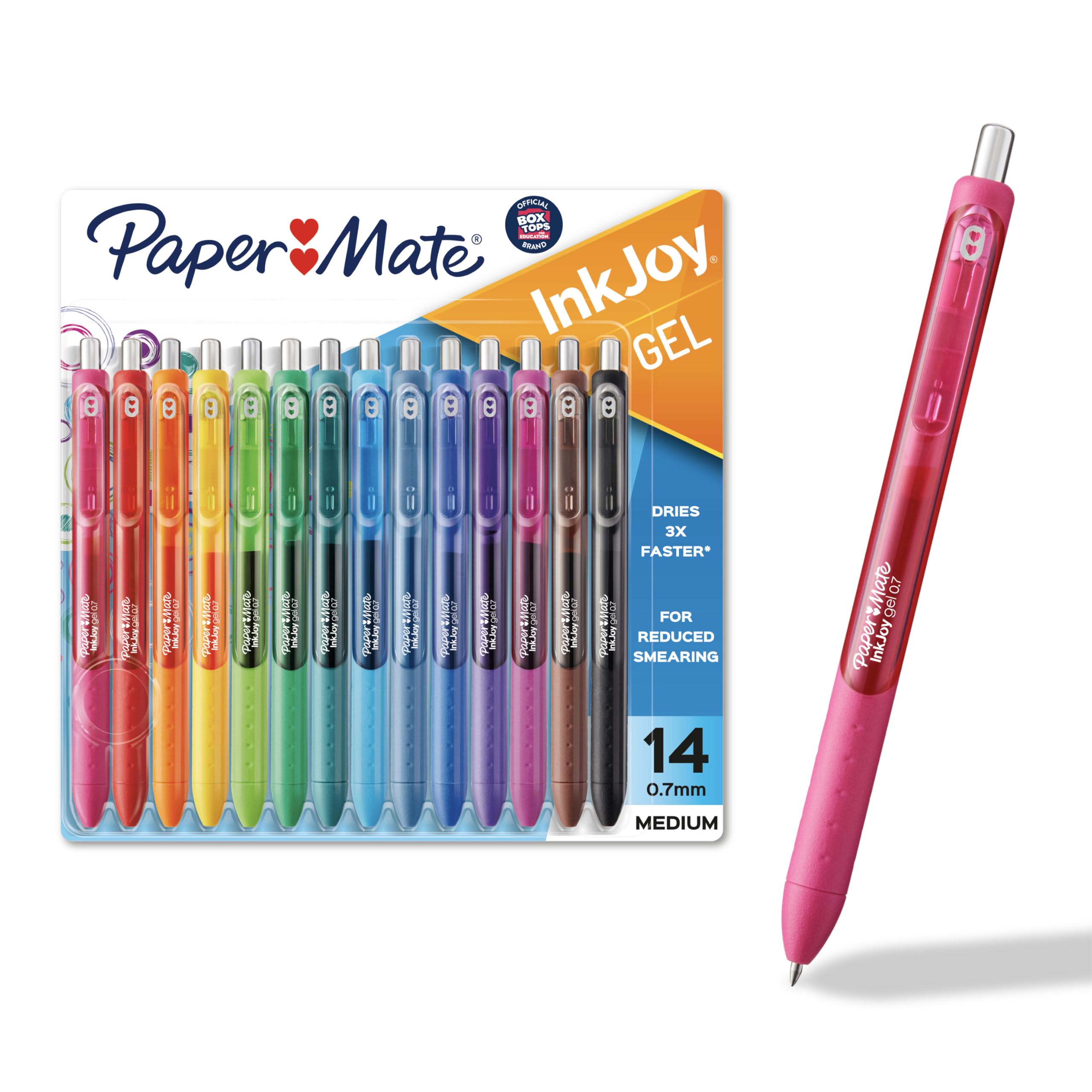
Fourteen colors and no caps to lose. The retractable body sounds like a small convenience until you are three colors into a color-coded week: we ended up clicking between colors mid-line rather than hunting for the cap that rolled under the notebook, and that is the sort of thing that decides whether a spread gets finished or abandoned until Sunday.

The gel writes wetter than a fineliner at 0.7mm, so the fast-drying claim is doing real work here. It holds up: on standard journal paper the line is dry enough to close the book on after a beat, and it does not smear under a resting hand. The line is medium-broad, though, so this is a writing pen rather than a labelling pen — for small capitals inside a weekly spread you want something closer to 0.3mm.

The gamble is per pen. Consistency across a set is uneven, so a dud out of the box is a real possibility: open the whole set when it arrives and scribble with each one while you can still exchange it. The ones that work are smooth, generously inked and pleasant in the hand, with a grip that wraps the entire barrel — which stops mattering to nobody by the third page of a long list.

Bottom line: Fourteen smooth gel colors that click shut instead of capping — our pick when you want color-coding to feel easy rather than fiddly.

4

ZICOTO Monthly Planner Stickers

ZICOTO Monthly Planner Stickers

Monthly spread decor

Our Score 9.4/10
Check Price

Worth Noting

  • Single use; stickers do not reposition
  • Some sheets sit idle until their month
Theme
Monthly and seasonal
Finish
Glossy paper
Sheets
22
Stickers
1,100+
Read the full review

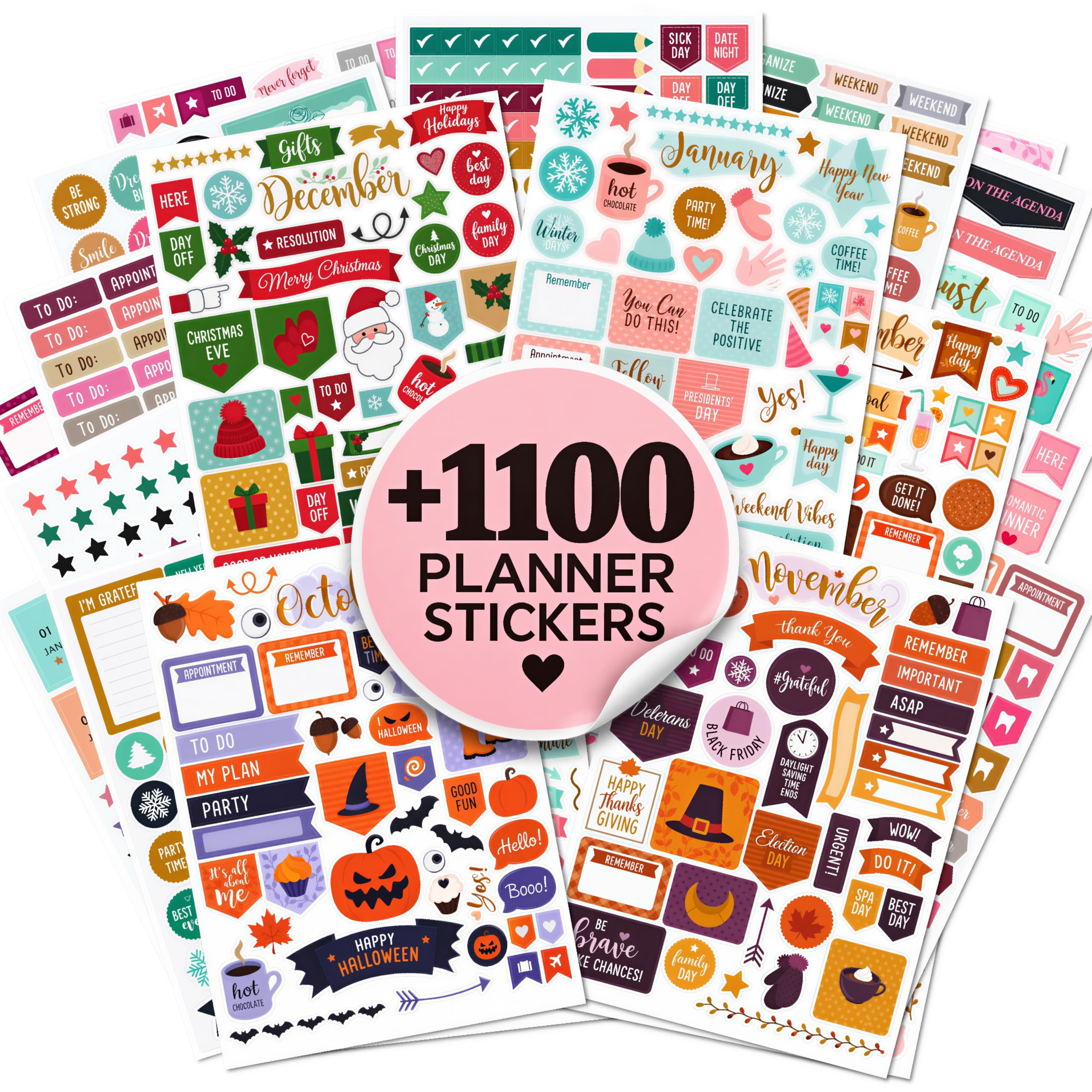
Twenty-two sheets, sorted by month: a page for January, a page for February, and so on, plus all-purpose sheets that work whenever. That structure is the difference between a sticker set you use and one that lives in a drawer, because you can decorate next month's spread in one sitting without digging through a thousand unrelated shapes to find a compatible one.

The designs are the reason we keep coming back. Each month is colour-coordinated — autumn tones for October, soft pastels for spring — so a spread looks planned even when you have stuck down four stickers and called it a day. There are goal prompts and quote stickers alongside headers, date covers and small icons, and the stickers are thick and glossy enough to sit flat on the page rather than curl at a corner.

Where the set earns its keep is a monthly log you would otherwise leave bare: a title sticker, a few date covers and one accent shape turn a plain grid into a page you want to open. For anything that needs to move — a habit tracker you redraw every week — a strip of washi is the better tool, because these are meant to go down once.

Bottom line: For decorating a month at a glance, this is the set we hand people: 22 sheets of coordinated seasonal stickers that make a plain grid look designed.

5

Mr. Pen Washi Tape 21-Roll Set

Mr. Pen Washi Tape 21-Roll Set

Fine detail tape

Our Score 9.4/10
Check Price

Worth Noting

  • Prints lean floral and pastel
Rolls
21
Length
5 yards per roll
Widths
0.12, 0.3 and 0.6 in
Material
Washi paper
Read the full review

Seven rolls at 15mm, seven at 8mm and seven at 3mm — and it is the 3mm that makes this set worth owning. A 3mm strip rules a habit tracker or marks a page edge without burying the writing underneath, which a standard 15mm roll simply cannot do. The two wider sizes handle dividers, photo corners and the band across the top of a new month.

The prints are florals, pastels, vintage leaves and a few holiday hearts: soft enough to sit behind handwriting without fighting it, and varied enough that two spreads built from the same set do not look alike. Washi tears by hand, so there is no scissors step in the middle of a spread, and a strip that lands crooked can usually be lifted and reset before it settles into the paper.

We keep coming back to it for those narrow rolls, and it is also the set to buy before you know what you like. Adhesion is the one variable worth naming: on smooth, coated planner paper a strip may lift at the edge after a few days, and on very thin paper lifting it back off can take fibres with it. Press along the length of the strip rather than at the ends, and keep the 3mm rolls for paper rather than plastic or card.

Bottom line: Twenty-one rolls in three widths, and it is the 3mm line we keep coming back to for habit trackers and page edges.

6

emmoolife Vintage Washi 24-Roll Set

emmoolife Vintage Washi 24-Roll Set

Full-page decoration

Our Score 9.2/10
Check Price

Worth Noting

  • Skews wide, with few narrow detail rolls
Rolls
24
Finish
Gold foil accents
Length
9.84 ft per roll
Widths
5–75 mm
Read the full review

A 75mm roll is a different tool from the washi you are used to. One strip covers most of an A5 page width, which makes it the fastest way to build a cover page or frame a quote block, and this set includes two rolls at that size alongside a run of narrower ones and three rolls with gold foil worked into the print.

The designs are vintage: pressed flowers, mushrooms, botanical plates, lettering sheets and small architectural drawings, printed with enough contrast to read at a glance rather than dissolving into a wash. It is a decorative set first — the pattern is doing most of the work — and the paper is thin enough that you can layer a strip over a print without the page turning into a collage.

Our view is that this is the layering tape rather than the detail tape. Pair it with a narrow roll for the grids and rules and it earns its place; expect it to handle the bands and panels instead. Unwind slowly and at a low angle, because the paper is thin enough to tear as it comes off the roll, and add a dab of glue at the ends when you stick it to cardstock or a cover board.

Bottom line: If you want one roll to carry a whole page, this is the set: 24 prints, several at 75mm wide, with gold foil for a title band.

7

Prudiut Sticky Index Tabs 240-Pack

Prudiut Sticky Index Tabs 240-Pack

Indexing collections

Our Score 9.2/10
Check Price

Worth Noting

  • Adhesive can let go on slick planner paper
  • Peeling back can lift fibres from thin pages
Size
1 × 1.1 in
Tabs
240
Design
Half clear, half writable
Read the full review

Half of each tab is clear film and half is paper you can write on, a small design decision with a large practical payoff: the tab sits over the page edge without hiding the print underneath, and the writable half takes a gel pen, a ballpoint or a pencil. At 1 by 1.1 inches there is room for a word or a short date, which is about all a tab needs to carry.

You get 240 of them in two color families — a light set and a muted retro set — so a year of collections plus an index does not exhaust what is on the sheet. They come on backing cards rather than loose, which means you can peel one at a time and keep the rest flat in a pocket of the journal.

The technique that makes them work is sticking first and writing second. Place the tab on the page edge, burnish it with a thumbnail, then label it in position so the word sits level with the page instead of drifting up or down the edge. Writing a label flat on the sheet and applying it afterwards is how you end up with a row of tabs at four different angles.

Where these earn their place is navigation. An index only helps if you can find the collection fast, and a row of labeled tabs down the fore-edge turns a flip-through into a lookup — with the clear half keeping the heading you tabbed still readable. Ours went on the index, the future log and each month, and they were the fastest thing about the journal by the second week.

Bottom line: For marking collections and month starts, we reach for these: 240 writable half-clear tabs that let the page show through.

8

Peter Pauper Metal Stencil Bookmark

Peter Pauper Metal Stencil Bookmark

Portable ruling

Our Score 9.0/10
Check Price

Worth Noting

  • Rough burrs inside some cutouts
  • Cutouts are too small for gel pens
Form
Bookmark, ruler and stencil
Size
Fits a journal back pocket
Material
Metal
Read the full review

This is the only thing in our kit that lives inside the journal rather than on the desk: a slim metal bookmark with stencil cutouts, a straight edge along both sides and a profile that slips into the back pocket of an A5. That means a ruler is with you when a spread needs a straight line and you are nowhere near a desk.

The cutouts are the draw — banner shapes, small icons and simple headings you trace and then write inside. It is a genuinely nice idea for a journal you carry, and it removes the usual excuse that your lines are wonky because the ruler stayed at home.

The catch is scale. The openings are small and they suit a 0.20 to 0.30mm nib; a 0.5mm gel pen or a marker will blob inside the shape and smear when you lift it off the metal. Pair it with the 005 from the Micron set and the stencils behave. Try it with a gel pen and you will spend the evening wiping ink off a bookmark.

As a straight edge it does exactly what you want — always there, always true — and as a stencil it is a compromise, good for a banner over a date rather than lettering a whole title. The size that makes it portable is the size that makes the symbols tiny, and that is the trade you are accepting. Buy it for the ruler and treat the shapes as the bonus.

Bottom line: We like this for the pocket it fits in: a metal ruler and stencil that lives inside the journal, as long as you keep a 0.20mm pen for the cutouts.

How We Tested Bullet Journal Supplies

We started by reading through thousands of customer reviews and pulling the supplies that show up again and again in finished spreads — fineliners, brush pens, gel pens, highlighters, washi tapes, and the notebooks themselves — then filtered by price and by whether the paper weight was actually listed. Sixteen made the cut.

Every item went into the same dot-grid notebook and the same weekly routine for five months. Each pen wrote out a test page: a line of loops, a dense block of lettering, and a wet swipe of highlighter over dried ink. I left those pages open and checked at one minute, at five, and again the next morning, noting what smudged, what feathered, and what showed through on the reverse side.

Colors were compared side by side on the same page under the same lamp, then checked again weeks later to see which had dulled with use. Washi and stickers went into a spread that rode around in a tote for a week; I looked at whether corners lifted, whether edges curled, and whether tape pulled up cleanly when I changed my mind. Versatility came down to whether one tool could do several jobs — a fineliner that also filled small boxes, a marker that stayed crisp on thin paper.

Anything that skipped, bled, or came loose got set aside. What's below is what survived five months of real planning rather than one tidy test page.

How to Choose Bullet Journal Supplies

Work Backwards From Your Paper

Bleed-through is a paper question as much as an ink question. A pigment fineliner and a translucent highlighter sit on top of heavier dot-grid stock; the same pen on thin, show-through paper ghosts the reverse of every page. Before you blame a pen, test it: rule a line and lay a strip of color on the last page of the journal, wait a minute, and turn it over. If you can read it through the paper, keep the wet inks for headings and use pigment or pencil on dense pages.

Match the Line to the Lettering

In a 5mm dot grid, a 0.30mm line sits comfortably inside one row, a 0.20mm leaves room for small capitals and labels, and anything at 0.5mm and up reads as a heading weight. That is the argument for a set rather than one pen. If you buy only one, buy the middle — around 0.35mm — because it writes small enough for a weekly log and heavy enough to read as a header when you write larger.

Plan Around Dry Time

Gel ink is wetter than pigment ink, and a 0.7mm gel line needs a beat before you close the book or run a highlighter across it. The habit that saves spreads is working top to bottom and left to right, so the ink you laid down first is dry before your hand crosses it. If you write with your left hand that order matters twice as much, or keep the gels for the right-hand page and the fineliners for the left.

Treat Adhesives as the Weak Link

Washi, tabs and stickers all hold differently depending on the paper underneath. Smooth, coated planner stock lets tape lift at the edges after a few days; porous journal paper holds better but can lose fibres when you peel something back. Test a strip on the inside cover before you commit it to a spread. Where a decorative piece has to stay on cardstock or a cover board, a dab of glue at each end does more than pressing harder.

Hold Your Finest Pen Against the Cutout

Stencils, index tabs and small sticker shapes are sized for a fine nib, and product photos rarely tell you how fine. A 0.20 to 0.30mm pen fits most letter and icon cutouts; a 0.5mm gel pen will blob inside the same shape and smear when you lift it. If you are ordering a stencil or a small tab online, assume the finest pen you own is the one that will work, and check the listing's stated opening or tab size against it before you buy.

Frequently Asked Questions

Final Verdict

Start with the Pigma Micron six-pack. One ink, six widths, and lines that survive both a highlighter and a decade in a drawer — that is the structural half of a bullet journal solved in a single purchase. Add the Mildliner set when color needs to sit behind your writing, and the InkJoy gels when you want color in the writing itself.

If your journal is more decoration than daily log, the Mr. Pen washi with its 3mm roll will change more pages than another pen will, and the ZICOTO monthly stickers will make a bare calendar grid look planned. Buy the black pen first either way; everything else is a layer on top of it.