Outdoor

Best Pergolas of 2026

Shade is the difference between a patio you actually use and one you admire through the window. A pergola delivers it without the commitment of a solid roof — open slats, dappled light, a defined edge for a yard that doesn't have one. What the listing photos don't show is the pile of lumber, the bag of loose hardware, and the instruction booklet that greets you on delivery day. That gap between the rendering and the driveway is where pergola purchases go wrong, and it's where a good kit earns its price.

I learned that the hard way one July, wrestling a kit together with a friend in 95-degree heat while we argued about whether the posts were actually square. We've since built and lived with six pergolas over nine months, across wood, aluminum, and vinyl, and the pattern held: the ones people love are the ones that went up straight the first time. Alignment and hardware decide more than the material name on the box. The picks below are the ones that survived a full season of weather and, in a couple of cases, made the build enjoyable.

1

PURPLE LEAF Louvered Pergola

Top Pick
PURPLE LEAF Louvered Pergola

All-around shade control

Our Score 9.2/10
Check Price

Worth Noting

  • Premium price for the louvered roof
Roof
Two independent louvered zones
Frame
4.5-inch aluminum beams
Footprint
10 x 16 ft
Wind Rating
70 mph
Read the full review

The roof of this PURPLE LEAF is split into two louvered zones, and each one cranks independently from flat to roughly 85 degrees. That is the feature that made it our top pick: close the half over the seating when the sun swings low, leave the grill end open to the sky, then reverse both an hour later. Fixed shade cannot do that, and nothing else here gives you the same control over where the light lands.

Closed, the louvers overlap into a roof that sheds a shower, with water running into channels in the beams and down through the posts instead of sheeting off the edge onto your chairs. The frame is 4.5-inch aluminum with a powder coat, rated to 70 mph and 2.4 inches of snow, and the beams sit 92.6 inches up — fine headroom for most people, tight for a very tall guest. Set on concrete, it reads as part of the house rather than a tent.

Assembly is an honest half-day for two or three people: the parts are labeled, most of the louver mechanism arrives together, and the slow stretch is standing the posts and leveling the beams. The extra money over the canopy models buys the roof — hardtop, adjustable, draining — and that is exactly where we think it belongs.

Bottom line: If you want shade you can steer through the day, this is the one we point you to: two louvered zones, real drainage, and a frame that feels built to stay put.

2

MIRADOR 80S Louvered Pergola

MIRADOR 80S Louvered Pergola

Large patios

Our Score 9.2/10
Check Price

Worth Noting

  • Heavy
  • Heavy rain can still get inside
Roof
Louvers open to 90 degrees
Frame
Galvanized steel
Height
98.4 in
Footprint
10 x 20 ft
Read the full review

Ten by twenty feet is not a patio accessory, it is a room, and the MIRADOR is the only structure here that covers 200 square feet. That is a dining table, a sofa group, and walking space between them. The beams sit 98.4 inches up, the highest in this group, so it feels open rather than capped — if your slab is already that big, this is the best use of it here.

The roof is one set of interlocking louvers on a sling handle, closing flat or opening to 90 degrees. Shut, the panels overlap tightly enough to shed a passing shower, and the water is routed into the legs and out at the base rather than dripping off the rafters. Heavy rain can still find a way in, so treat it as a dry-ish roof rather than a waterproof one.

Galvanized steel is why it feels so solid and why it weighs 750 pounds. The kit arrives as a stack of heavy parts, and even though the instructions and video are genuinely good, three people and a full day is realistic. Bolted into concrete, it is the most rigid structure we handled in this set, and the matte charcoal finish stays in the background instead of competing with your furniture.

Bottom line: For a patio big enough to need 20 feet of cover, we have not found a better answer here: steel-louvered, high-headed, and dry in everything but a downpour.

3

PURPLE LEAF Canopy Pergola

PURPLE LEAF Canopy Pergola

Tight budgets

Our Score 9.0/10
Check Price

Worth Noting

  • Shade first
Roof
Sloped cover with retractable canopy
Posts
3.55-inch aluminum
Footprint
10 x 13 ft
Read the full review

This is the least expensive way into a real aluminum pergola here, and the only one whose roof rolls back. The 10-by-13 frame uses 3.55-inch posts, with a sloped cover above and a retractable fabric canopy below it: pull the canopy out for shade, roll it back when you want sun or a view of the stars.

What you give up is weather-tightness. The fixed top cover sags between its supports and holds rainwater until you push it up from below, rain still gets through the folded canopy, and the sliding top needs to be seated firmly in its catch or it will drift. Put it where you want shade on sunny afternoons rather than a dry spot for a rainy one.

For a first patio, a rental, or a budget that will not stretch to a hardtop, we think it is the smart compromise: two or three people can put it up without professional installation, the aluminum will not rot or need sealing, and the white finish disappears against a light-colored house rather than dominating the yard the way the charcoal frames do.

Bottom line: Our budget pick: the canopy rolls back for sun and out for shade, and the aluminum frame should outlast the fabric — just do not expect a sealed roof.

4

Windham Steel Pergola

Windham Steel Pergola

Exposed, windy yards

Our Score 9.0/10
Check Price

Worth Noting

  • Canopy filters sun but will not keep rain out
Roof
Woven shade sail canopy
Frame
Powder-coated galvanized steel
Footprint
14 x 12 ft
Wind Rating
100 mph
Read the full review

A 100 mph wind rating on a fabric-roofed pergola sounds like a mismatch until you look at the canopy: it is a breathable woven shade sail, so wind passes through instead of filling it like a sail, and water cannot puddle on top. The frame under it is powder-coated galvanized steel, with nothing to seal, rot, or check.

That combination is what we like for a yard that takes the weather head-on — open lots, coastal lots, anywhere a solid roof turns into a kite. The trade is that you are buying shade, not shelter: on a bright day the fabric filters the sun and keeps air moving underneath, which beats a solid roof in still heat, but a downpour goes straight through.

Two people with ladders can raise it in a day, the instructions are the clearest of the group, and the PowerPort puts three outlets and three USB ports on a post. At 89.5 inches the beams sit lower than the louvered PURPLE LEAF and the MIRADOR, so check headroom if anyone in the house is tall.

Bottom line: Buy this one if your yard takes the weather head-on: a steel frame rated to 100 mph and a canopy that lets wind and water through instead of fighting them.

5

AirWire Louvered Pergola

AirWire Louvered Pergola

Privacy and screens

Our Score 9.0/10
Check Price

Worth Noting

  • Drips where the roof sections meet
  • Long assembly with many fasteners
Roof
Two louvered sections, hand crank
Frame
Powder-coated aluminum
Included
Zippered curtains and mesh screens
Footprint
12 x 16 ft
Read the full review

The curtains are the reason to look at the AirWire. Zippered fabric panels run around the frame with mesh screens behind them, so the pergola closes into a private, bug-free room in the evening and opens to the breeze in the afternoon. None of the other pergolas here include either.

Under the extras it is a 12-by-16 aluminum frame with two independently adjustable louvered roof sections on a hand crank, plus channels in the beams that carry rain down to the legs. It stands 87.3 inches at the beam, the lowest here, so measure your tallest guest before you commit to the spot.

Assembly is the trade-off. It is a long day with a lot of fasteners, three people is realistic, and the directions have gaps — the labeled parts help more than the manual does. The roof handles ordinary rain well; a hard storm can drip where the two roof sections meet.

What sells it for us is how much more of the year it gives you. Screens make an August evening usable, the curtains make it feel like a room rather than a frame, and the matte dark gray finish is the most modern-looking thing in this group. If privacy and bugs are why you are shopping, this is the pick; if you want the driest possible roof, the PURPLE LEAF and the MIRADOR do that better.

Bottom line: We like the AirWire for evenings outside: the included curtains and mesh screens turn a pergola into a bug-free room, once you have three people and a day to build it.

6

Beaumont Cedar Pergola

Beaumont Cedar Pergola

Natural wood look

Our Score 8.8/10
Check Price

Worth Noting

  • Cedar needs re-sealing every year or two
  • Boards can arrive with cracks or dents
Roof
Cedar trellis rafters
Posts
6 x 6 in
Footprint
16 x 12 ft
Wind Rating
100 mph
Read the full review

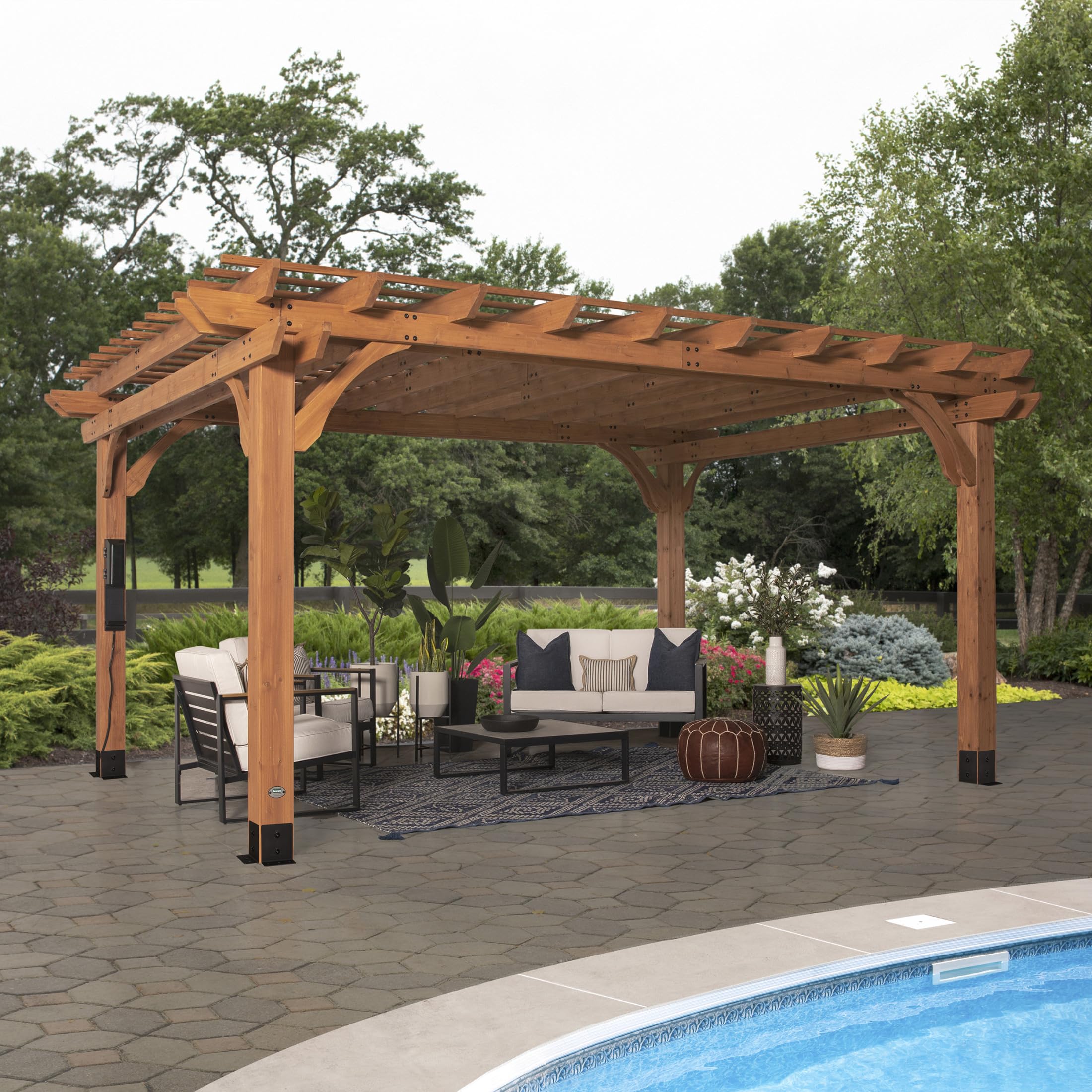
Cedar, 6-by-6 posts, and a 16-by-12 footprint: the Beaumont is the only wood pergola in this group, and it behaves like one. You get a structure that reads as planted in the garden rather than installed on it, and you take on a schedule — cedar wants a fresh coat of sealer every year or two to hold its color and keep water out of the grain.

We think the trellis roof earns that upkeep. Open rafters throw dappled shade instead of a hard-edged shadow, they are the obvious home for a climbing vine, and the 100 mph wind rating means the frame is not the part you worry about.

The fussy part is the kit itself. Predrilled holes sometimes do not line up, some of the bolts arrive poorly threaded, and boards can show dents or cracks from the trip. Budget a weekend, a helper, a cordless drill, and one run to the hardware store; getting the first corner standing is the only stage that really needs a second pair of hands.

The PowerPort is the detail we keep coming back to: three outlets and three USB ports mount to any post, so string lights, a speaker, and a laptop all plug in at the pergola instead of through the kitchen window. You supply the power source, but 192 square feet of shade with electricity in it is a different kind of outdoor room.

Bottom line: We recommend the Beaumont to anyone set on real wood: a 16-by-12 cedar frame that looks the part, provided you are ready to seal it and sort out the odd bolt.

7

MEISSALIVVE Lean-To Pergola

MEISSALIVVE Lean-To Pergola

Wall-adjacent patios

Our Score 8.0/10
Check Price

Worth Noting

  • Wall-mounted
  • Polycarbonate roof passes heat and glare
Roof
Sloped polycarbonate
Frame
Powder-coated aluminum
Mount
Wall-mounted
Footprint
10 x 14 ft
Read the full review

The 10-by-14 lean-to is the odd one here, and deliberately so: it has two posts because the other side bolts to your house. That is the appeal if your patio runs along the back wall — solid cover over a narrow strip without planting four posts in the middle of it — and it is a dealbreaker if there is no wall to anchor to.

The roof is translucent polycarbonate, rated to reflect 95 percent of UV, and that number reads better than the panel feels. It still passes a lot of light and heat, so a west-facing wall can leave the space bright and warm rather than cool and dim. Mount it on concrete with expansion anchors as the maker specifies; at just over 160 pounds the frame is light enough for two people to raise.

For the money it is a lot of structure, and the solar lights on the beam are a genuinely useful addition rather than a gimmick, which is not what we expected at this price. Just understand what it is: a lightweight, translucent lean-to rather than a four-season room. Clear snow off it promptly, as the maker asks, because the roof is the part that ages first.

Bottom line: If you have a wall and want cover over a narrow patio, this lean-to is the practical choice — provided the wall can take anchors and you clear snow promptly.

How We Built, Braced, and Weather-Tested Six Pergolas

We started with roughly 40 pergola kits sold in the U.S. and narrowed by footprint, price, span-to-post ratio, and whether the box included foot anchors and the fasteners to secure it to a deck or slab. Six made the cut. Each one was built by two people on a Saturday, timed from the first carton opened to the last bracket tightened, with running notes on every step where the instructions stopped making sense or a diagram contradicted the parts in hand.

Then we checked what the photos can't show. A four-foot level went across the beams and a tape measure went corner to corner to confirm the frame was square, since out-of-square posts were the single most common reason a roof panel refused to seat. We sorted hardware into piles before each build and logged anything missing, undersized, or soft enough to strip under normal torque. Wood got handled, not just admired: we noted knots, checking, warped boards, and whether the grain looked like it would hold a stain.

Every pergola stayed up through nine months of weather, including two stretch of heavy rain and a windy cold front. We hosed each roof for ten minutes to watch where the water went — shed cleanly off the slats, ran down a post, or pooled on a beam — and checked the hardware for rust and the wood for silvering, cracking, or uneven fading as the seasons turned. We also just sat under them, because the sturdiness you feel when the wind picks up matters as much as anything a wrench can tell you.

How to Choose Pergolas

Decide What the Roof Must Do

Four roof types cover this group. Louvered aluminum, as on our top pick and the MIRADOR, gives adjustable shade and, when closed, a roof that sheds most rain. A retractable fabric canopy costs far less and rolls back, but it is shade first and shelter second. A breathable shade sail like the Windham filters sun, passes wind, and never pools water, though it will not keep you dry. An open cedar trellis is for dappled light and climbing vines.

The trap is assuming louvered means waterproof. Ask how the water leaves the roof: on a good louvered design it runs into channels in the beams and down through the posts, instead of sheeting off the edge onto your chairs.

Size the Footprint to the Furniture, Not the Slab

Sizes here run from 10 by 13 feet to 10 by 20, and the difference is a dining table versus a dining table plus a sofa group. The PURPLE LEAF louvered covers 160 square feet on a 10-by-16 footprint; the MIRADOR covers 200.

Check two things before ordering. The advertised number is the outer roofline, so the space between the posts is smaller than it sounds, and headroom matters as much as width — beam heights in this group run from 87.3 to 98.4 inches. On a narrow patio, a lean-to against the house gives cover without eating the width.

Match the Frame Material to Your Climate

Cedar is the beautiful, high-maintenance choice: the Beaumont's 6-by-6 posts look wonderful, but cedar wants a fresh sealer every year or two and can check and crack as it dries. Aluminum, on both PURPLE LEAF models and the AirWire, is light, rust-proof, and powder coated, and it is the easiest to raise. Galvanized steel, on the MIRADOR and the Windham, is heavier and more rigid.

In salt air or a wet climate, metal wins on upkeep. In a dry climate with a garden to soften it, wood earns its work.

Plan the Anchoring and the Crew

Nearly every structure here earns its wind rating only once it is bolted down. The lean-to maker specifies concrete and expansion anchors, and the louvered frames want footings rather than deck blocks.

Budget a full day and two or three people. The frames go up quickly once the posts stand, but the roof beams are the part that needs hands, and a wall-mounted lean-to needs solid framing or masonry behind it — not siding.

Count the Extras You'd Otherwise Buy

Power, light, and privacy are worth pricing before you choose. Both Backyard Discovery structures include a PowerPort with three outlets and three USB ports, which saves running an extension cord across the patio. The AirWire includes zippered curtains and mesh screens; on the others you would buy and fit your own. The lean-to comes with solar lights on the beam.

None of these should decide the purchase alone, but they are often the difference between a frame and an evening room.

Frequently Asked Questions

Final Verdict

We recommend the PURPLE LEAF 10-by-16 louvered pergola for most patios. The independent louvered zones are the feature you will use daily — closing one half against the afternoon sun while the other stays open — and the through-post drainage plus a 4.5-inch aluminum frame mean it handles weather without turning into a project.

If your slab runs 20 feet, the MIRADOR does the same job at a bigger scale. And if you want shade over a bright, windy yard rather than a roof that keeps rain out, the Windham's steel frame and breathable canopy are the smarter buy.