Outdoor

Best Indoor Planters of 2026

A good indoor planter isn't just a pretty vessel; it's the difference between a plant that thrives and one that sulks in soggy roots. The search usually starts with looks, then hits the practical wall: does it have drainage, does the saucer stay attached, will the size fit that new fern without repotting in a month. I've killed my share of houseplants by treating a decorative pot like a proper home, and the fix is simpler than it seems. The right planter gives roots room, lets excess water escape, and keeps the mess off your windowsill.

Over the past eight months, my team and I have lived with 14 indoor planters, from glazed ceramic to lightweight resin, in living rooms, kitchens, and one steamy bathroom. We repotted real plants, watered on a schedule, and moved them around to see how they held up. Appearance matters, but so does thickness, saucer attachment, and whether the drainage hole is sized for actual soil, not just a trickle. The picks below are the ones that passed the lived-in test.

1

sietpoek Ceramic Pot Set

Top Pick
sietpoek Ceramic Pot Set

Windowsill styling

Our Score 9.6/10
Check Price

Worth Noting

  • 5.5 inches only
  • Hand wash only, no dishwasher
Set
4 pots, 4 patterns
Drainage
Bottom hole with mesh, attached saucer
Pot Height
4.7 in
Pot Diameter
5.5 in
Read the full review

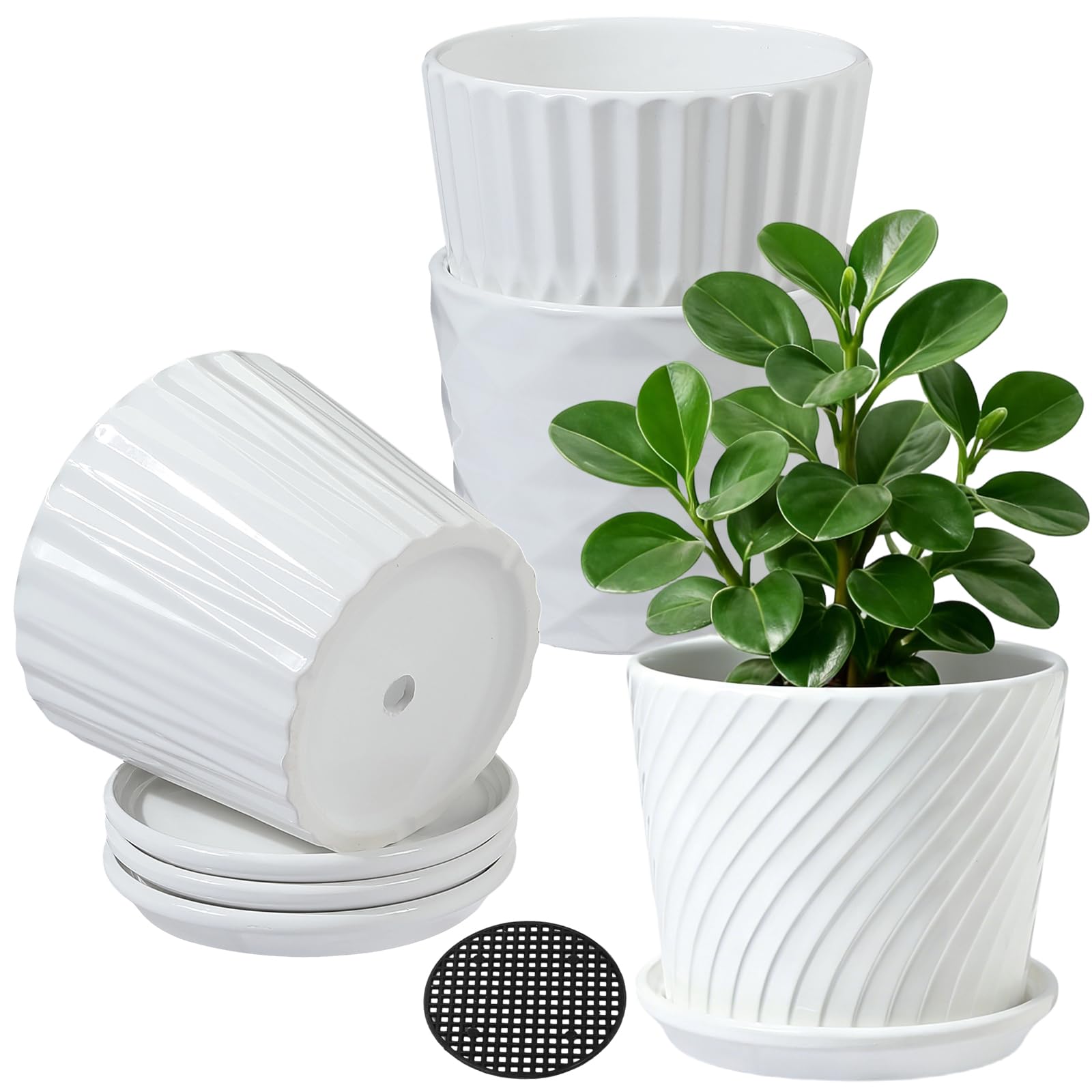
Four pots, four different patterns, and a mismatch that turns out to be the whole idea. Each pot is a plain white cylinder with a different subtle texture worked into the glaze, so a row of them along a windowsill reads as a collection you put together rather than a multipack you unpacked. We think that's the cleverest thing about the set, and it's the reason this is the one we point people to first.

The practical side holds up. Every pot has a drainage hole with a mesh filter seated over it, which keeps soil from washing out the first time you water, and the saucer is molded onto the base rather than sitting under it as a separate dish. That's what gives the set its clean silhouette, and it's the one thing to understand before buying: you can't lift the dish off to tip out the overflow. Water slowly and stop when you see it collecting, or draw the excess out with a turkey baster. A small adjustment, and the payoff is a pot that never leaves a ring on a wooden shelf.

At 5.5 inches across and 4.7 inches deep, these are small-to-medium pots: a snake plant still in its nursery pot, a pothos on a bookshelf, herbs by the kitchen window, a succulent on a desk. The ceramic is a kaolin clay body, and it's hand wash only, so don't plan on the dishwasher. For a single statement plant, the D'vine Dev pot below is the better buy; for a big floor plant, skip ahead to the 12-inch cylinder.

Bottom line: Our default pick: four small glazed ceramic pots, each with its own pattern, drainage hole, and saucer built in. If you're potting a windowsill this weekend, start here.
2

D'vine Dev Ceramic Planter

D'vine Dev Ceramic Planter

One feature plant

Our Score 9.6/10
Check Price

Worth Noting

  • One pot only
  • Shallow saucer holds very little overflow
Color
Olive
Included
Saucer, mesh, pebbles, felt pad
Material
Glazed ceramic
Potting Capacity
2 quarts
Read the full review

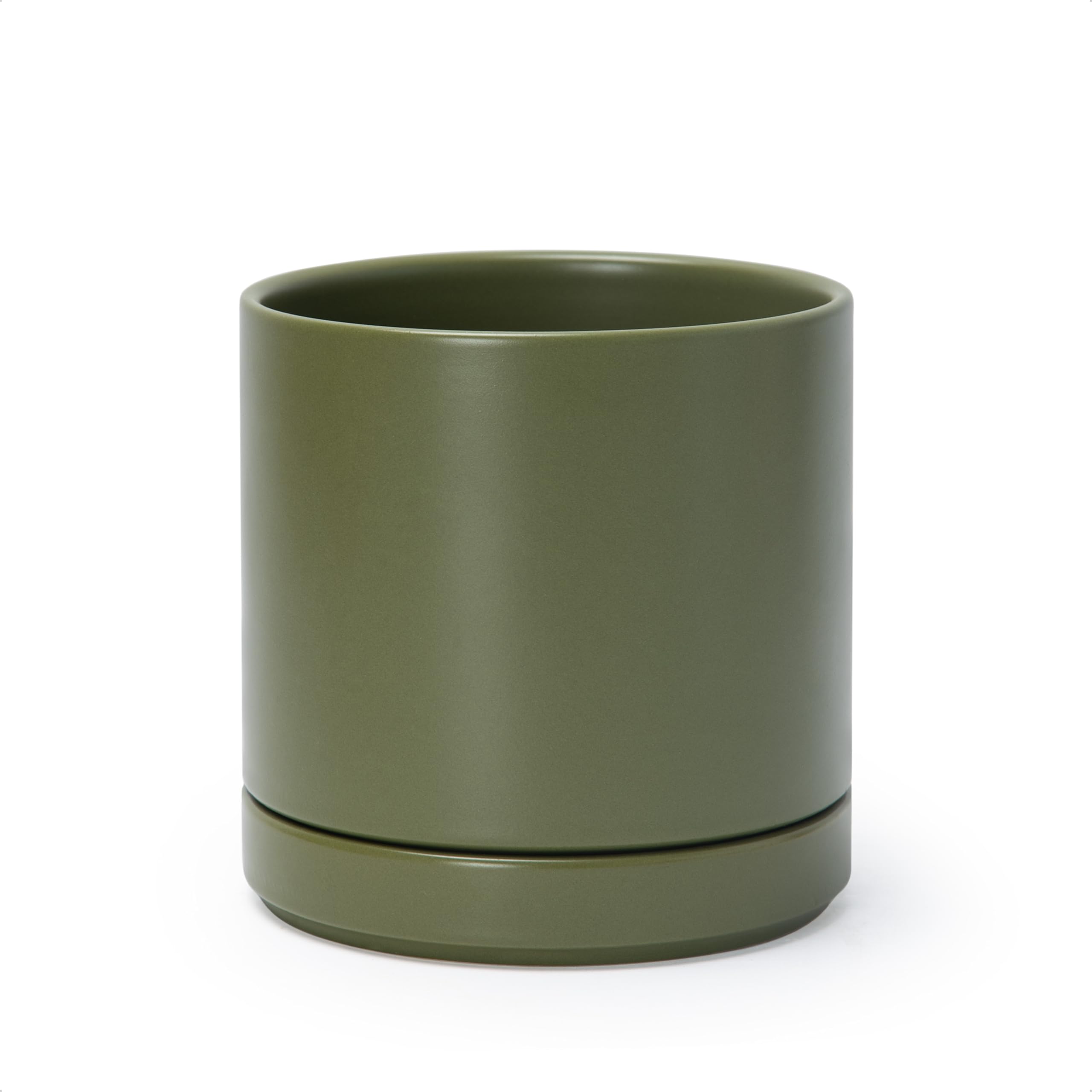
What arrives is more than a pot. Inside the box you get the glazed planter and its fitted saucer, a mesh net for the drainage hole, a small bag of ceramic pebbles, and a felt pad to sit under the base. It's the most complete package here, and the extras aren't filler — the mesh keeps soil out of the saucer, the pebbles give you a drainage layer if you want one, and the pad means you can set the thing down on a walnut sideboard without thinking about it.

The pot itself is the part we keep noticing. A straight-sided cylinder in a soft olive glaze, with a matching saucer that fits so closely you can lift both together — no wobble, no gap showing. Olive is a forgiving color; it sits quietly beside terracotta, rattan, and white walls alike. This is the planter in this group that reads as furniture rather than packaging, and for a plant you actually care about, that's worth the step up.

It takes about two quarts of potting soil, which puts it in the same territory as a six-inch nursery pot — right for a compact houseplant, wrong for the monstera you've been putting off repotting. The saucer is shallow, too: it catches a spill rather than a flood, so water in small passes and give it a minute between pours. Neither limit matters if you're buying one good pot for one good plant, which is exactly what this is.

Bottom line: If you're buying one pot for one plant you love, this is it — glazed ceramic, a fitted saucer, and a box of extras that lets you pot it up the day it arrives.

3

montresor 10-Inch Hanging Pots

montresor 10-Inch Hanging Pots

Trailing plants, ceilings

Our Score 9.6/10
Check Price

Worth Noting

  • 'Self-watering' is a recessed dish, not a reservoir
Set
2 pots
Hangers
Metal hook and macrame
Pot Size
10 in dia x 6 in H
Watering
Recessed self-watering base with drainage
Read the full review

Ten inches across and about six deep — that's a real planter, not a decorative cup. The other hanging pots here sit between five and seven inches; these two are the ones that can hold a philodendron that has already outgrown its nursery pot. Each comes with a recessed base under the pot, and both a metal hook and a macrame hanger in the box, so you choose the look without buying anything extra.

We think the self-watering in the name oversells it. There's no reservoir you fill and check through a window; the base is recessed so water draining through the soil collects there and is drawn back up. That's genuinely useful — it means you're not unhooking a dripping pot every few days — but don't plan a holiday around it. Water thoroughly, let the recess take the overflow, and check the soil with a finger before you top up.

The thing to plan is the fixing. A 10-inch pot of wet soil weighs several times what the empty plastic does, and a drywall plug won't hold it; find a joist or use a ceiling anchor rated for the load. Check the drop before you drill, too — hang a pot this size too low and you'll be ducking under a philodendron every time you cross the room.

Bottom line: Ten-inch hanging pots with a hook and a macrame hanger in the box — buy these when the trailing plant has outgrown a small boho set.

4

LE TAUCI Ceramic Pot Set

LE TAUCI Ceramic Pot Set

Staged trio display

Our Score 9.4/10
Check Price

Worth Noting

  • Hairline cracks can appear within months
  • The 4.1-inch pot is very small
Set
3 pots with trays
Drainage
Holes with attached saucers
Material
Glazed ceramic, unglazed interior
Pot Sizes
4.1, 5.1, 6.5 in
Read the full review

Three pots — 4.1, 5.1, and 6.5 inches — each with a matching tray, all in the same reactive glaze beige. The point of a graduated set isn't that you got three pots; it's that you can group them with the tallest plant at the back and the smallest in front and get a display that looks arranged rather than accumulated. Put them in a loose triangle on a console table and that surface is finished.

The glaze is what earns its price. It's soft, slightly uneven, matte rather than shiny, and it makes even a plastic nursery pot look considered. We think it's the set here that most looks like it came from a shop rather than a listing. Ceramic also buys stability: these have enough heft that a top-heavy plant on a shelf isn't a worry, and the unglazed interiors pull a little moisture out of the soil, which is a nice touch as long as you let the pots dry between waterings.

The smallest pot is genuinely small — a succulent, a cutting, or a herb, and not much else, so expect to leave it in the cupboard for a while. The saucers are fixed to the pots rather than separate, which makes watering a slow-pour job rather than a lift-and-empty one. Buy the set for the group and the finish; a single plant of any size is better served by the D'vine Dev pot above.

Bottom line: A graduated trio in a soft reactive glaze — the easiest way to stage three plants of different heights on one surface, with the caveat that the pots can crack.

5

Bouqlife Hanging Planter Set

Bouqlife Hanging Planter Set

Small hanging plants

Our Score 9.4/10
Check Price

Worth Noting

  • Smallest pot suits little more than a cutting
  • Reservoirs are small, so refills come often
Set
3 pots, 3 hangers, 3 reservoirs
Watering
Wick self-watering, detachable reservoir
Pot Sizes
7, 6, 5.5 in
Hanger Lengths
34, 27, 21 in
Read the full review

Three pots, three macrame hangers in 34, 27, and 21-inch lengths, and three small reservoirs with wicks — everything for a corner that needs something at eye level. Setup is the easy part: the pots drop into the hangers, the wicks run from the reservoir up into the soil, and each hanger hangs from a single point. It's the least fussy way in this group to get plants off a windowsill and into the air.

The graduating lengths are what make the set worth having. Hang all three together and the pots step down across a corner, so you get layers instead of a row — the effect that makes a rental living room look deliberately planted. We also like that the reservoirs detach. The pot lifts out, the water cup comes off, and you carry one small piece to the sink instead of wrestling a dripping hanger off its hook.

Watering here is a wick drawing moisture up from the cup below, which buys you a few extra days between refills rather than two weeks of freedom. The 5.5-inch pot at the bottom of the set is small: a rooted cutting or a small pothos, not the plant you've had for three years. Treat this as a display set for small things and it does its job; expect it to carry your biggest plant and you'll be disappointed.

Bottom line: Three small self-watering pots on macrame hangers — the quickest way to get greenery up off the floor in a rental, with one hook per hanger.

6

Utopia Home 5-Pack Pots

Utopia Home 5-Pack Pots

Budget shelf refresh

Our Score 9.2/10
Check Price

Worth Noting

  • Largest pot is 7 inches across
  • Plastic feels its price once you pick it up
Set
5 graduated pots
Drainage
Holes with plugs, saucer trays
Material
Polypropylene
Pot Sizes
7, 6.6, 6, 5.3 in and smaller
Read the full review

This is plastic, and the sooner you make peace with that, the better the set gets. Five pots in graduated sizes, all the same bright white, each with a saucer tray — and at arm's length the finish does a convincing impression of stoneware. We've had these on open shelving where nobody questioned them. Pick one up and the illusion ends, and the whole set is startlingly light. If you want the look without the weight or the breakage worry, that's a fair trade.

The sizes are the real argument: from a 7-inch pot down through 6.6, 6, and 5.3 to something smaller, so a plant can move up a step without the shelf losing its matching look. Each pot has multiple drainage holes with plugs and a saucer. Pull the plugs and water moves through; leave them in and you've built a watertight pot, which is the first thing to check if water ever sits on the surface after watering.

Seven inches is the ceiling here, so this is a set for medium houseplants and herbs — not for the plant that's outgrowing its corner. The plastic also shows its age faster than glazed ceramic, and the walls flex if you squeeze a full pot. For the money, though, it does what the ceramic sets do at a fraction of the outlay, and the graduated sizes mean you'll use every pot in the box rather than stashing three.

Bottom line: Five lightweight pots in graduated sizes — the cheapest way here to pot up a lot of plants at once, as long as you're not expecting ceramic.

7

YNNICO Self-Watering Pot Set

YNNICO Self-Watering Pot Set

Repotting en masse

Our Score 9.2/10
Check Price

Worth Noting

  • Largest pot is 8 inches
  • Wicks need threading and re-seating at repotting
Set
6 pots with trays
Material
Matte polypropylene
Watering
Wick self-watering, optional
Pot Sizes
8, 7, 6.5, 6, 5.5, 5 in
Read the full review

Six pots in one box, from 8 inches down to 5 in half-inch steps. If you've been putting off repotting a shelf's worth of plants because you can't face buying six separate pots in six separate styles, this is the set that ends the delay. Matte black, plain cylinders, several drainage holes in each base, and a watering lip at the rim so top-watering doesn't run straight down the outside.

The self-watering part is a wick you thread yourself, and that's the right call: fit it and the pot bottom-waters through the deep tray, leave it out and you have an ordinary pot with a big saucer. That flexibility is why we think this one suits mixed collections — the ferns get wicks, the succulents don't. The matte finish is also more forgiving than a gloss one when water splashes over the rim.

The limit is the top end: eight inches is the biggest pot here, so a plant bound for a floor stand will outgrow the set within a season or two. And the wicks are a small chore — six of them to thread, trim, and re-seat whenever you repot. Neither is a reason to skip it if what you need is a coordinated shelf of medium plants from a single order.

Bottom line: Six matte black pots from 5 to 8 inches, each with a wick and a deep tray — buy the set if a shelf of medium plants needs repotting in one order.

8

Fielda Self-Watering Pots

Fielda Self-Watering Pots

Large self-watering

Our Score 9.2/10
Check Price

Worth Noting

  • The 12-inch pot takes a full bag of soil
  • Plain white plastic, no finish to speak of
Set
3 pots
Drainage
Removable saucer trays
Watering
Wick system with level indicator
Pot Sizes
8, 10, 12 in
Read the full review

The little window near the base is the feature that earns this set its place. You can see how much water is left in the reservoir instead of lifting the pot to judge its weight or guessing from the soil surface. For anyone who has drowned a plant by watering to a schedule, that's a bigger upgrade than a prettier finish.

The three pots are 8, 10, and 12 inches, so this is the set for the plants that live on the floor: a fiddle-leaf fig, a big peace lily, a monstera that has taken over a corner. Each has a removable saucer tray and a cotton wick that draws water up from the reservoir, and the plastic is thick enough to feel solid when you carry a full pot across a room.

Two things we think you should weigh. A 12-inch pot takes a serious amount of potting mix — budget for a full bag before you start, or you'll be making a second trip mid-repot. And the finish is plain: white plastic, no texture, nothing to admire. Put it behind a sofa or among foliage and neither matters much.

Bottom line: Three big self-watering pots with a water-level window — the set that makes a fiddle-leaf or a large peace lily survivable when you travel.

9

SQKH 4-Inch Pot Set

SQKH 4-Inch Pot Set

Small starters

Our Score 9.2/10
Check Price

Worth Noting

  • Walls are thin and flex when squeezed
  • 4 inches only
Set
6 pots with trays
Colors
Mixed assorted
Drainage
Multiple holes, matching trays
Pot Size
4 in dia x 3.7 in H
Read the full review

Four inches across and 3.7 inches deep is smaller than most people picture when they order a plant pot. It's a starter size — the pot a supermarket herb or a two-inch cutting lives in for a season, not the one it retires in. What you get here is six of them, each a different color with a matching tray, and a spread of drainage holes across the base.

The colors are the reason we like this set over any other small pot: six bright shades that let you color-code by plant or by windowsill, and they look cheerful rather than childish on a kitchen ledge. The walls are thin, which at this size is fine — there's almost no weight in a four-inch pot of soil, and nothing much to chip. For a first flat, a kid's windowsill, or a tray of cuttings you plan to give away, this box does a lot of work.

Bottom line: Six four-inch pots in cheerful colors, each with its own tray — the right buy for cuttings, supermarket herbs, and a windowsill full of small things.

10

Root & Vessel 12-Inch Cylinder

Root & Vessel 12-Inch Cylinder

Large floor plants

Our Score 9.0/10
Check Price

Worth Noting

  • Glossy plastic is obvious up close
  • Tray is stiff to detach for emptying
Capacity
18.85 liters
Drainage
Built-in detachable tray
Material
Glossy plastic
Pot Size
12 in dia x 12 in H
Read the full review

From across a room, the 12-inch Majestic reads as glazed ceramic: glossy, deep white, straight-sided, with a tray that seems to be part of the pot. In your hands it's a 1.7-pound plastic cylinder with a detachable base. We minded that less than expected, mostly because nothing else in this group puts a plant this size on a shelf for anything like the money.

What it does well is volume. Twelve inches of full depth and about 18.85 liters of soil capacity will hold a ficus or a big snake plant for years, and the built-in tray means no separate dish skating around underneath. It's also light enough to move with one hand when you need to get behind it, which is more than the ceramic pots here can say.

Where it disappoints is the tray in practice. It's stiff, and pulling it off to empty the overflow takes real force; until it comes free, water sits against the base of the pot. The gloss is also unmistakably plastic at close range, and this is the most expensive plastic pot in the group. Buy it for the size and the silhouette, and accept that the material is the compromise.

Bottom line: A 12-inch glossy cylinder that looks like porcelain from across the room and gets a big plant off the floor — just know you're buying plastic with a stubborn tray.

How We Tested Indoor Planters in Real Rooms

We began by pulling together 40 indoor planters from brands we've tested before, reader recommendations, and a few wildcards, then filtered by material, price, and whether they came in more than one size. That left 14 planters, which we tested for eight months. We deliberately mixed materials, including glazed ceramic, matte resin, concrete, and one fabric planter, because the right pick depends on where it's going.

Each planter lived in three spots: a bright living-room windowsill, a low-light bedroom corner, and a humid bathroom shelf. We potted them with pothos, snake plants, and a fern using the same soil mix, then watered on a weekly schedule. We checked underneath after every watering for leaks, rings, and condensation, and lifted each one by the rim while it was full to see if the walls flexed or the saucer stayed put. We also measured the inner diameter and depth against common nursery pot sizes.

At each step we noted what actually happened: whether water drained in a steady stream or backed up, whether the saucer clipped on or just balanced, and whether the finish showed fingerprints after a wipe. We tapped the walls and squeezed the rims to judge thickness, and after eight months we looked for chips, cracks, and fading. Value came down to what was included, such as a saucer, plug, or liner, and whether the size range let you scale up without changing the look. The planters that made the list kept their appearance and their function through repotting, moving, and regular watering.

How to Choose Indoor Planters

Drainage first, saucer second

A hole in the bottom is the part that keeps roots alive, and the saucer is what makes that hole safe to have above a wooden shelf. The choice is between a saucer molded onto the pot, as on the sietpoek set and the LE TAUCI trio, and a separate tray, as on the Utopia and YNNICO sets. Attached saucers can't be lost or knocked out of line and keep the silhouette clean, but you can't lift them off to pour the overflow away, so you water slowly and stop early. Separate trays come off for emptying and slide around when you move the pot.

If a pot has no drainage at all, treat it as a cachepot: keep the plant in a nursery pot inside and lift it out to water and drain. That works well, as long as you actually lift it out rather than pouring into the decorative shell.

What the listed width actually measures

Pot sizes are quoted at the rim, and most pots taper toward the base, so a six-inch pot holds noticeably less soil than the number suggests. That's why a set with graduated sizes earns its keep: the sietpoek four-pack is one size repeated, while the LE TAUCI trio and the YNNICO six-pack let a plant step up without the shelf changing its look. If you're buying a single pot, measure the nursery pot's rim and its depth — not the plant — and match both, or you'll end up with a pot that swallows a small root ball in wet soil.

Ceramic or plastic — the weight decides

The material argument is really a weight argument. Glazed ceramic, like the D'vine Dev pot or the LE TAUCI set, sits still under a top-heavy plant, holds a color for years, and doesn't flex when you move it; it's also heavy when wet and chips if it falls off a sill. Plastic — the Utopia and YNNICO sets, the big Root & Vessel cylinder — is light, cheap, forgiving of knocks, and unmistakably plastic up close.

Go ceramic where the pot is on show at eye level or needs ballast, and plastic where it's high up, oversized, or likely to be shifted often. For hanging planters the calculation is different again: weight there is working against you.

What self-watering really means

Most self-watering indoor pots here are a reservoir, a cotton wick, and a pot with holes in the base; the wick pulls moisture up into the soil and keeps it evenly damp. That suits ferns, peace lilies, and anything that sulks when it dries out. It's the wrong tool for a cactus. A water-level window, as on the Fielda set, is worth more than a bigger reservoir, because the failure mode is not knowing when to stop.

Read the description closely, too. Some pots sold as self-watering are simply a recessed drainage dish that holds what runs through — useful, but not the same thing as a reservoir you fill.

Hanging planters are a ceiling decision

Before you buy a macrame set, work out what it will hang from. A ten-inch pot of wet soil weighs several times what the empty pot does, and drywall alone won't hold it — find a joist or use a ceiling anchor rated for the load. Then check the drop. Hangers come in fixed lengths, and a long one puts a plant at head height in a doorway or too close to a ceiling for the light it needs.

Finally, favor hanging pots whose reservoirs or saucers detach, so refilling and rinsing don't mean unhooking a dripping planter and carrying it across the room.

Frequently Asked Questions

Final Verdict

For most people potting small houseplants, the sietpoek four-pack is the answer: four glazed ceramic pots with four different patterns, drainage holes with mesh, and saucers that are part of the pot rather than a dish that goes missing. It solves the saucer problem in one decision and looks better on a shelf than anything else in this group at its level.

Change the requirement and the answer changes. One plant, one proper pot: the D'vine Dev. A plant that wants to hang: the montresor pair at ten inches, or Bouqlife for three small ones. A whole shelf on a budget: Utopia's five-pack. Buy for the plant you have now, not the jungle you're planning.