Outdoor

Best Garden Hoses of 2026

You turn the spigot, drag the hose toward the tomatoes, and it folds in on itself like a wrung-out towel. The pressure drops, you walk back to untwist it, and you've lost the light. A hose is one of the few tools you touch every day of the growing season, and a good one proves itself in small ways: it stays open around the corner of the house, it doesn't leave a groove in your arm, and the coupling doesn't drip down your wrist. That comes down to material, diameter, and fittings.

This spring I cut the tangled mess off my own reel and started fresh, and my team and I have since spent seven months dragging 14 hoses around vegetable beds, patios, and one stubborn slope. The tradeoff showed fast: the lightest hoses to coil were the ones that kinked, and the never-kink ones were a bear to haul. Listed length is measured off the reel, not under pressure, so a full hose can fall short of the far bed. The picks below are the ones that held up without asking much of me.

1

Briggs & Stratton 100 ft. Rubber Hose

Top Pick
Briggs & Stratton 100 ft. Rubber Hose

Heavy-duty durability

Our Score 9.2/10
Check Price

Worth Noting

  • Can kink when coiled tightly
  • Female coupling can drip
Length
100 feet
Material
Rubber
Couplings
Nickel-plated brass
Maximum Pressure
200 psi
Read the full review

If you are tired of replacing a hose every other summer, the Briggs & Stratton is the one that feels like a long-term purchase. It is a 100-foot rubber hose with industrial-style reinforcement, a 200 psi maximum pressure rating, and nickel-plated brass couplings that are built to be dropped, stepped on, and tightened without stripping. The rubber has a substantial, planted feel that cheaper vinyl hoses lack.

That weight is the trade-off. This is not the hose you toss over your shoulder for a quick balcony watering, and dragging 100 feet across a lawn takes more effort than the Flexzilla. The payoff is a hose that resists abrasion and stays flexible in cold weather, so it can live outside through a real gardening season without turning into a stiff snake. The crush-proof couplings are the detail we appreciate most; the ends are usually the first thing to fail, and these feel like hardware rather than plastic.

The 100-foot length is a commitment, so plan on a reel or a large hook rather than a nail by the door. For a permanent run near a large bed or a spigot you use every day, it is the heavy-duty hose we trust. Pair it with a reel and it will outlast the cheap hose it replaces.

Bottom line: Our pick for a hose that feels built to outlast cheap replacements, the Briggs & Stratton pairs 100 feet of rubber with brass couplings and a 200 psi rating.

2

UNCO 10 ft. Metal Hose

UNCO 10 ft. Metal Hose

Short patio runs

Our Score 9.0/10
Check Price

Worth Noting

  • Fittings can leak if washers are not seated
Length
10 feet
Weight
1.32 lb
Material
Stainless steel
Outside Diameter
1 inch
Read the full review

Ten feet is a specialized length, and UNCO treats it that way. This is the hose for a patio spigot, a balcony planter, or a camper setup where a 50-foot hose is more nuisance than help. The stainless-steel cover is flexible enough to bend around a corner, and at 0.6 kilograms it is light enough to toss in a tote. The package includes two extra washers, which is a small thing that saves a trip when a connection starts to drip.

The 1-inch outside diameter is chunky for a short hose, but the length keeps it manageable. We like the reinforced joint; it is the part that takes the stress when you pull the hose out of a tight spot. It is not a hose for a whole-yard watering run, and it will not replace the 100-foot option in your shed. It is the one you keep at the back door for filling a can, rinsing a step, or hooking up a short sprinkler.

For a small job that does not justify dragging out the big hose, it is a tidy, useful tool. The extra washers are the detail that makes it easy to live with, and the stainless cover is built for more abuse than a bare vinyl stub. Keep it for short runs and it earns its place.

Bottom line: We keep the UNCO for short jobs: ten feet of stainless hose is enough for a patio spigot, a balcony, or a camper, and it stores in a bucket.

3

Unywarse 50 ft. Metal Hose

Unywarse 50 ft. Metal Hose

Small yards

Our Score 8.8/10
Check Price

Worth Noting

  • Long-term durability is mixed
Length
50 feet
Nozzle
10-function
Weight
5.8 lb
Material
Stainless steel
Read the full review

Fifty feet is the Goldilocks length for a small yard, a patio, or a front bed that does not need a 100-foot commitment. The Unywarse puts that length in a stainless-steel sleeve over a PVC inner tube, with a 10-function nozzle and a lockable trigger included. At 5.8 pounds, it is light enough to carry in one hand and flexible enough to pull around a corner without collapsing into a knot.

The nozzle is the part we appreciate most. Ten patterns cover everything from a soft shower for seedlings to a jet for cleaning a patio, and the trigger lock saves your thumb during a long watering session. The aluminum connectors are extended and the hose is connectable, so you can add a second length if your plans grow. The stainless cover also stands up to being dragged over concrete and brushed against shrubs, which is more than we can say for a bare vinyl hose.

The couplings can leak if the washer is not seated, so check them before you tighten the nozzle. That is a small annoyance rather than a dealbreaker, and the included nozzle is a useful one. For a small yard, it is a practical step up from a cheap vinyl hose without the weight of a 100-foot rubber model.

Bottom line: For a small yard, we reach for the Unywarse: its 50-foot stainless body resists kinks, the 10-function nozzle is useful, and the ends connect to a second hose.

4

Flexzilla 100 ft. Hybrid Hose

Flexzilla 100 ft. Hybrid Hose

All-around yard use

Our Score 8.6/10
Check Price

Worth Noting

  • Can still kink under pressure
Length
100 feet
Weight
6.8 lb
Fittings
Anodized aluminum
Material
Hybrid polymer
Read the full review

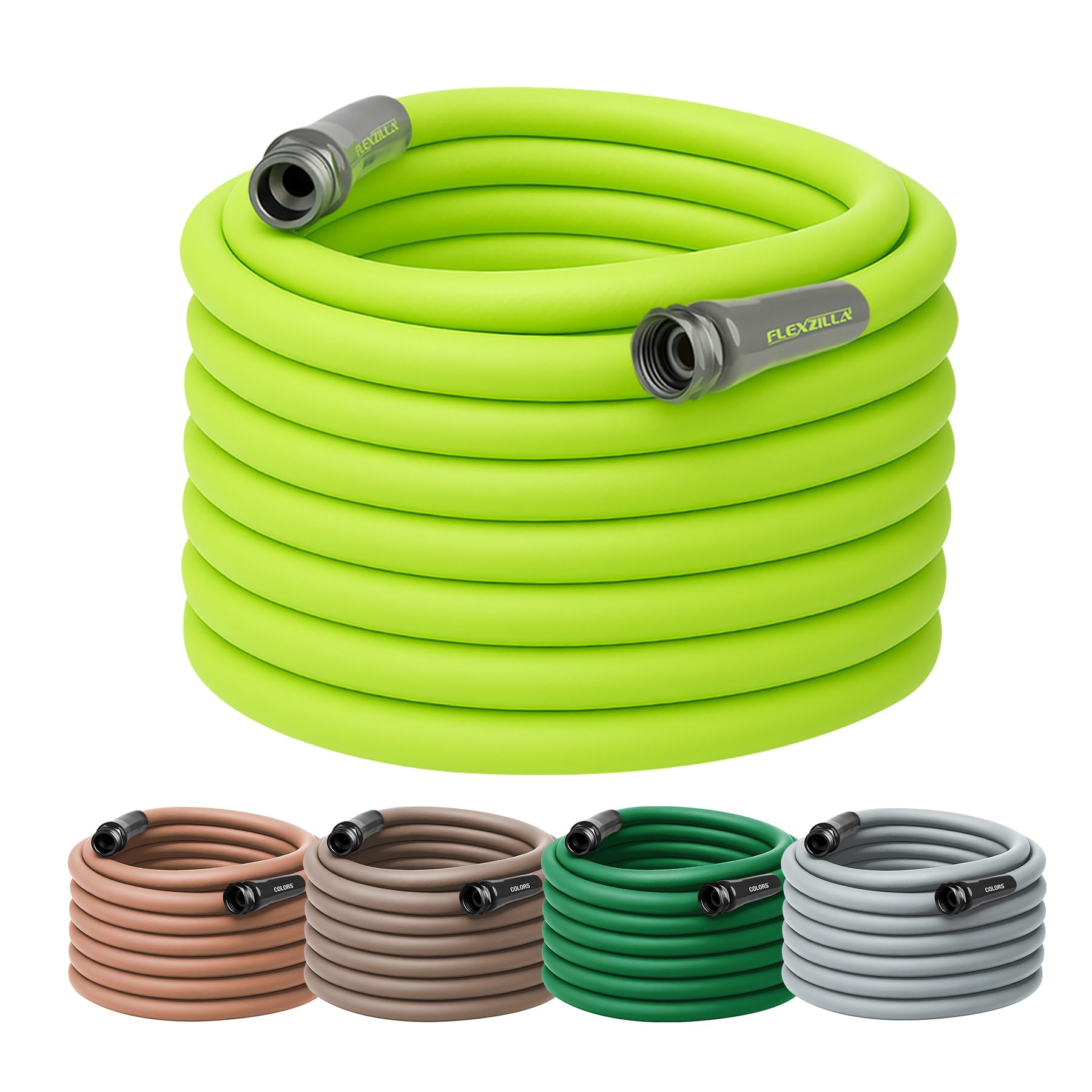
Dragging 100 feet of hose around a yard is the part of watering nobody advertises. Flexzilla attacks that with a hybrid polymer that feels softer and lighter than rubber, and it stays pliable in cold weather instead of turning into a stiff coil. The chartreuse cover is loud, but it is also easy to spot in grass, which matters when you are hauling the end back to the spigot.

That combination is why it is our top pick for most yards. The 100-foot length reaches across a typical backyard, the anodized aluminum fittings resist crushing, and the O-ring connection is designed to seal without cranking down on the spigot. At 6.8 pounds, it is not weightless, but it is far easier to move than a rubber hose of the same reach. We also like the limited lifetime warranty; it does not make the hose indestructible, but it is the only stated lifetime coverage in this group.

The soft coil is easy to hang on a hook or wind onto a reel, and it lays flat instead of holding the shape of the package. That is the difference between a hose you leave out and one you avoid using. For a patio, a couple of beds, and a lawn, it hits the sweet spot between a rubber hose's toughness and a metal hose's light weight.

If your priority is zero kinks at any angle or the longest possible service life, the Briggs & Stratton rubber hose is the more conservative choice. For everyone else, the Flexzilla is the hose we reach for first. Standard 3/4-inch fittings mean it works with the nozzles and sprinklers you already own.

Bottom line: We recommend the Flexzilla as our all-around hose for most yards: it stays flexible in cold weather, is light enough to drag, and carries a lifetime warranty.

5

Rcfunkid 100 ft. Metal Hose

Rcfunkid 100 ft. Metal Hose

Large yards

Our Score 8.6/10
Check Price

Worth Noting

  • Can leak at the couplings
  • Long-term durability is mixed
Length
100 feet
Nozzle
10-function
Weight
10.6 lb
Material
Metal
Read the full review

At 100 feet, this is a hose for the back forty, not a balcony. The stainless-steel cover gives it the same kink-resistant, tangle-free feel as the shorter metal hoses here, and the included 10-function nozzle means you can go from a gentle spray to a hard jet without hunting for a separate head. The ends are connectable if you need to extend the run.

At 10.6 pounds, it is the heaviest hose in our metal group. That weight is noticeable when you lift the coil, but it also helps the hose stay put when you drag it across a lawn. We like the three spare washers; they are the kind of small extra that keeps a connection from dripping after a season of use. The 10-function nozzle has a thumb control that is easy to work with one hand, which matters when you are holding a hose in the other.

This is a hose for a fixed run near the far beds, not one you carry from job to job. Leave it on a reel or a hook, and the reach and kink resistance make a large yard feel smaller. The metal cover is the reason to choose it over a rubber hose of the same length; the weight is the reason to think twice if you move the hose every time you water.

Bottom line: We recommend the Rcfunkid when a large yard needs a full 100 feet of metal hose: it resists kinks, includes a 10-function nozzle, and stays put on the ground.

6

KETTOYA 100 ft. Fabric Hose

KETTOYA 100 ft. Fabric Hose

Lightweight storage

Our Score 8.6/10
Check Price

Worth Noting

  • Inner tube can leak
Length
100 feet
Nozzle
10-pattern
Material
PVC, ABS, composite alloy, polyester
Maximum Pressure
35 bar
Read the full review

KETTOYA's non-expanding hose is aimed at the gardener who wants 100 feet of reach without a heavy coil to wrestle back onto a reel. The fabric cover is up to three times lighter than a standard vinyl hose, and the whole thing rolls into a small bundle that hangs from the included strap. The 360-degree swivel connectors at both ends are the best detail: they let the hose turn with you instead of twisting against the spigot.

The 10-pattern nozzle is similarly practical, with a rotating head that covers everything from a fine mist to a direct stream. The 35 bar pressure rating is more than enough for a typical outdoor tap, and the 3/4-inch connectors fit standard US fittings. We like that the hose does not shrivel when the water is off; it stays limp and easy to move, which is the whole point of a fabric hose.

The caveat is that this is a lightweight hose for gentle use, not a hose to drag over gravel or leave in the sun for years. The inner tube is the part that decides its lifespan, and the long-term durability is the open question. If you want a full-length hose that stores in a small space and is easy on your arms, it is a smart pick; if you need old-school rubber toughness, spend elsewhere.

Bottom line: We like the KETTOYA for a 100-foot run that stores small: the fabric cover is light, the swivel ends move freely, and the 10-pattern nozzle is included.

How We Tested the Best Garden Hoses

We started by pulling every hose we could find with a real warranty and metal fittings, then sorted them by diameter, length, and price until 14 were left standing — a mix of rubber, vinyl, and hybrid constructions, plus a couple of expandable styles for comparison. Testing ran for seven months, from the first spring planting through the last fall watering, across a fenced city yard with four raised beds and a suburban half-acre with a long run to the back fence. None of these were tested on a bench. They lived on the spigot.

At hookup, we wrapped a dry paper towel around each coupling, opened the spigot all the way, and checked the paper after ten minutes — that's how we caught the hoses that only leaked once the washer seated wrong. For kinking, we dragged each one around the sharp corner of the house and over a patio edge, counting how many times we had to walk back and untwist before the far bed got watered. Ease of use was judged with wet hands: threading the coupling, swapping a nozzle mid-fill, and coiling the whole thing back onto a wall rack at dusk.

Weight we recorded two ways — dry on a kitchen scale, and full of water while carrying a 50-footer out to the back fence. Flexibility got checked on cold mornings, when a stiff hose refuses to uncoil and a soft one flops into the beds, and we noted whether each stayed put when dragged over gravel or snagged on every stiff stem. Durability meant leaving a coil in full sun on the patio all season and watching for cracks, bulges, and frayed jackets. Appearance counted too, since a hose hangs on the wall or snakes across a patio for six months straight, and value came down to cost per foot weighed against the warranty.

How to Choose Garden Hoses

Match Length to the Walk, Not the Catalog

Start with the distance from the spigot to the farthest bed, then add a few feet of slack. A 50-foot hose is easier to handle on a patio or small yard; 100 feet is for a real backyard, but it also adds drag, coiling bulk, and more places for a kink or leak to develop. Do not buy 100 feet just because it is the biggest option. If you need more than 100 feet, consider a second hose or a different spigot before you commit to a longer run.

Choose the Material You Can Live With

Rubber is the heavy-duty choice: it resists abrasion and stays flexible in cold, but it is the most work to drag. Hybrid polymer is lighter and softer, which is why the Flexzilla is our default for most yards; it can still kink under pressure. Stainless steel is light and puncture-resistant, but the inner tube and crimped connections decide how long it lasts. Fabric and expandable hoses store small, yet their inner tubes are the most vulnerable. Pick the material that matches your tolerance for weight and maintenance, not the one with the boldest claim.

Treat the Connections as the Weak Point

Most hose failures start at the spigot, the nozzle, or the joint between the two. Look for metal couplings, a seated rubber washer, and a hose that does not need to be cranked down to stop dripping. Check the connection with the water on before you bury the hose under mulch or wind it onto a reel. If a coupling drips, replace the washer first; if the leak is behind the fitting, the hose is usually done. A spare pair of washers is cheap insurance.

Plan Storage Before You Buy

A hose lasts longer when it is drained, coiled loosely, and kept out of the sun. A 100-foot rubber hose needs a reel or a large hook; a lightweight fabric or metal hose can hang on a smaller bracket. Do not leave a hose pressurized for days, and drain it before the first freeze. If you have limited shed space, the storage size matters as much as the length. The hose you can put away without a fight is the one you will actually use.

Frequently Asked Questions

Final Verdict

For most yards, the Flexzilla is the hose we point to first. Its 100-foot hybrid polymer is flexible in cold weather, lighter than rubber, and backed by a limited lifetime warranty; the occasional kink is a fair trade for how much easier it is to move.

If you want the longest-lived conventional hose and do not mind the weight, choose the Briggs & Stratton. If your yard is small, the 50-foot Unywarse gives you metal durability and a useful nozzle without the bulk.