Outdoor

Best Bird Feeders of 2026

A bird feeder is supposed to bring the action closer—a flash of wings while the coffee’s still hot. What it shouldn’t do is turn into a squirrel gymnasium, a seed clog, or a faded plastic eyesore by midsummer. The right feeder pulls birds in quickly, keeps squirrels working for every calorie, holds enough seed that you’re not refilling it every morning, and comes apart for cleaning without a fight. It should survive weather, look decent doing it, and feel worth the money—because this is something you’ll see every day.

I’ve hung feeders outside a kitchen window and from a pole at the edge of a lawn, and the differences show up fast. Over eight months, we tested 12 feeders, paying attention to which ones birds found first and which ones squirrels defeated. One thing I’ve learned: capacity cuts both ways—a bigger hopper means fewer refills, but it also means more seed to keep dry and fresh. The picks below are the ones that earned their spot.

1

Squirrel Buster Standard

Top Pick
Squirrel Buster Standard

Squirrel-heavy yards

Our Score 9.2/10
Check Price

Worth Noting

  • 1.3 lb capacity needs frequent refills
Warranty
Lifetime limited
Feeding Ports
4 perches
Seed Capacity
1.3 lb
Squirrel Defense
Weight-activated closing shroud
Read the full review

The test every feeder here faces is simple: does it still have seed in it once the squirrels have had a go. The Squirrel Buster Standard is the one we trust most. A spring-loaded shroud slides down over the ports whenever something heavier than your birds lands on the perch, so a squirrel ends up clinging to a smooth plastic sleeve instead of eating. It is not magic — a squirrel can still sit on top and look hopeful — but the seed stays in the tube, which is the entire job.

The adjustable spring is the detail we appreciate most. Set it light and only small birds can feed; set it heavier and cardinals and blue jays use the perches without tripping the shroud, while a squirrel's weight still drops it. That range is why this feeder suits a mixed yard rather than a finch-only one, and the wire shroud gives clinging birds somewhere to hold on while the four perches serve everyone else.

Capacity is where it gives ground. At 1.3 pounds it sits near the bottom of this group, and once word gets out among the local flock you will be out there refilling every day or two. What you get in exchange is a compact 13.25-inch tube that hangs tidily under a hook or eave without swinging like a pendulum.

Two things we did not expect to matter as much as they do: the ventilation that keeps seed loose instead of clumping in humid weather, and a lifetime limited warranty, which is unusual in this group and says something about how confidently Brome expects that shroud to keep working.

Bottom line: We recommend it to anyone feeding in a yard with squirrels: the weight-set shroud turns them away without locking out cardinals, and the lifetime warranty backs the mechanism.
2

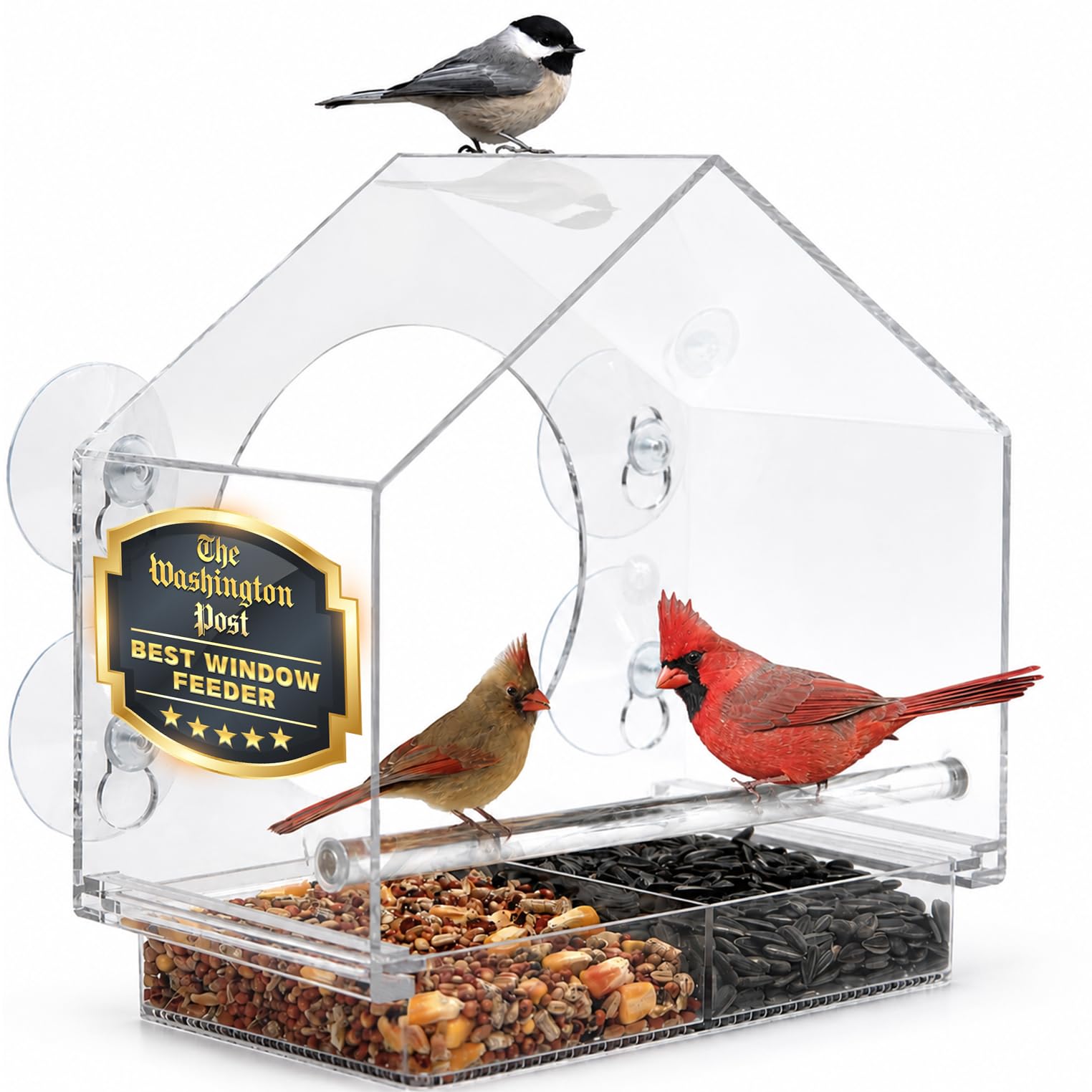
Nature Anywhere Window Feeder

Nature Anywhere Window Feeder

Window watching

Our Score 9.2/10
Check Price

Worth Noting

  • 15-ounce capacity needs frequent refills
  • Only squirrel-resistant with 10 feet of clearance
Mounting
4 suction cups
Refilling
Slide-out tray
Dimensions
10 x 10 x 5 in
Seed Capacity
15 oz
Read the full review

The sliding tray is what makes this window feeder worth its place. You slide it out, fill it, slide it back. No wrestling the whole unit off the glass and hoping four suction cups seat again — a small thing that decides whether a window feeder stays stocked or sits empty with a sad inch of seed in the corner.

The other half of the appeal is proximity. The clear front and the wide opening put cardinals and woodpeckers close enough to watch them work out a sunflower seed, and the perch gives them somewhere to land. That is why this is the feeder that keeps children and cats occupied at the same window. Give birds a week or two to find it; a new object on the glass takes time to stop being suspicious.

At 15 ounces it is a small feeder, and that is the honest trade: you will refill more often than you would a hanging tube, but you get the closest look at your birds of anything here, for about the same money as a mid-range hanging feeder. We think that is the right trade for a kitchen or living-room window.

Suction is the part to get right. Clean the glass first, press the cups on firmly, and hang it where squirrels cannot lean across from a roof edge or a nearby branch — the maker's own guidance is 10 feet of clearance, and the mixed accounts of squirrel resistance here mostly come down to whether that gap exists.

Bottom line: Our pick for the closest possible view: the slide-out tray makes refilling a ten-second job, and 15 ounces is a fair trade for birds at the glass.

3

Kingsyard Metal Feeder

Kingsyard Metal Feeder

Wet climates

Our Score 9.2/10
Check Price

Worth Noting

  • Not squirrel-proof
  • Plastic hopper can crack over time
Perch
360-degree ring
Material
Powder-coated metal
Dimensions
7.87 x 7.87 x 12.48 in
Seed Capacity
4 lb
Read the full review

Wet seed is the quiet failure of most feeders: it clumps, sours, and ends up kicked onto the patio. The Kingsyard's answer is a metal roof over an enclosed hopper with drainage in the base tray, so what does get in can get out instead of stewing at the bottom.

Four pounds is the biggest seed capacity in this group, and the 360-degree perch ring lets several birds feed at once instead of one bird defending a single port. It arrives assembled — lid off, seed in, hook on — and the smooth powder-coated finish wipes clean with a damp cloth. Cardinals, chickadees and sparrows all work the ring comfortably, and the tray catches what they drop.

What it is not is squirrel-proof, and it does not seriously claim to be. The body is metal where it counts, but the seed hopper is plastic, and that hopper is the part to watch — it is what eventually lets the feeder down after a long run of sun and squirrel traffic.

For a wet climate, an exposed hook, or a yard where moldy seed has been the recurring problem, this is the feeder we rate highest in this group on keeping seed dry, and it costs less than either Brome. If squirrels are the headline problem rather than the weather, put the money into a shroud design instead.

Bottom line: For wet weather and a big appetite, this metal hopper keeps seed dry and holds four pounds — just don't expect it to stop a squirrel.

4

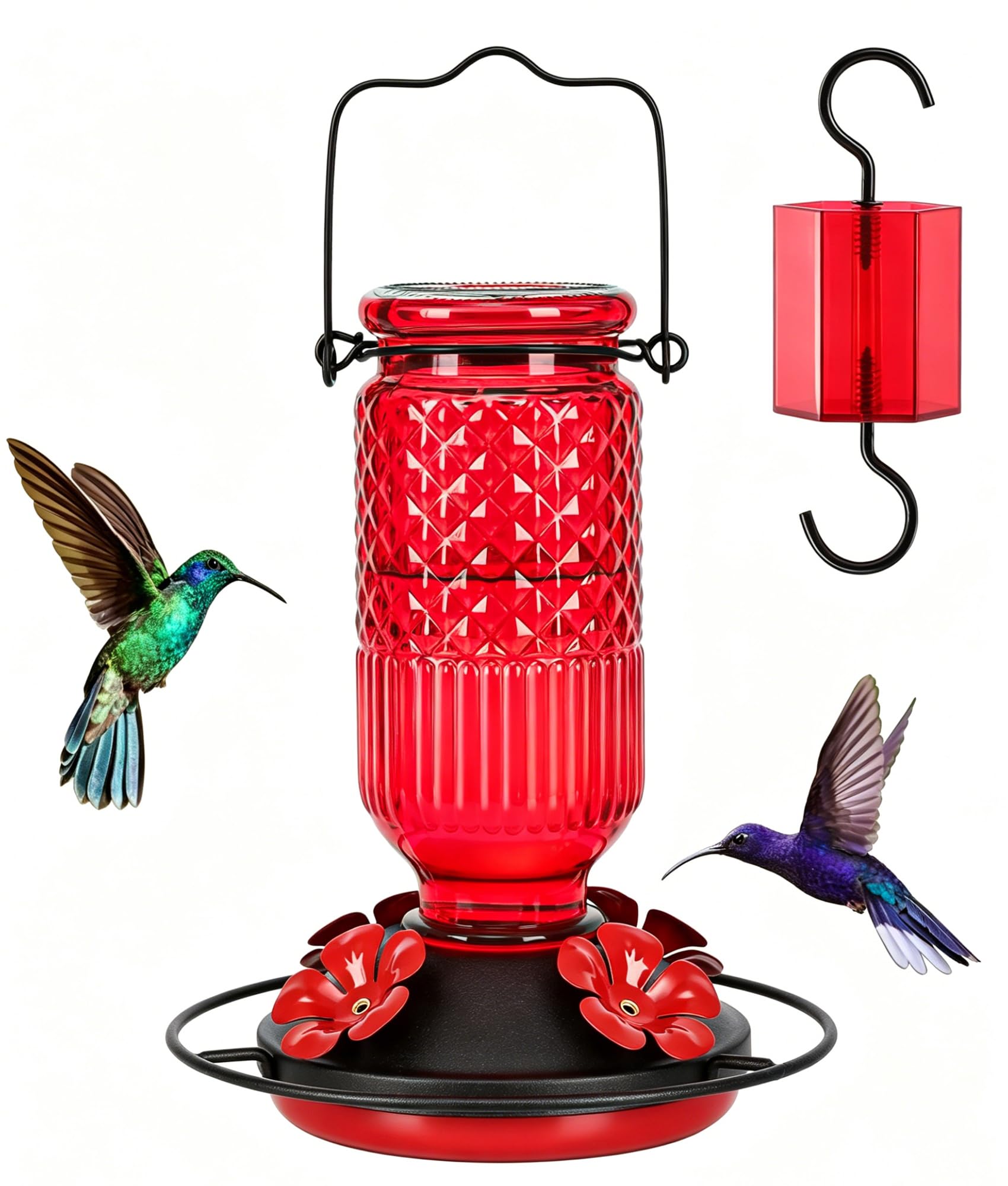
FEED GARDEN Hummingbird Feeder

FEED GARDEN Hummingbird Feeder

Hummingbird nectar

Our Score 9.2/10
Check Price

Worth Noting

  • Hand wash only
  • Glass can chip if it swings into something
Material
Glass and metal
Ant Control
Built-in ant moat
Feeding Ports
4 with bee guards
Nectar Capacity
16 oz
Read the full review

Ants and cleanup are what ruin hummingbird feeders, and this glass model handles both better than anything else here. The ant moat is built into the feeder rather than sold as a separate cup you lose in the shed, and the four flower ports carry bee guards so the wasps do not claim the nectar first. We like that the pest control is part of the design instead of an accessory.

The bottle is glass with a wide mouth, which matters more than it sounds: glass does not hold onto the smell of old nectar the way plastic can, and a bottle brush reaches the corners. Sixteen ounces is a sensible size for a couple of hummingbirds — big enough to be worth hanging, small enough that you are not pouring out half a bottle. The metal perches ring the base, so several birds can sit and drink at once.

Two things to accept. It is hand wash only, and the glass means you want to hang it where it will not swing into a fence or wall on a windy day. A territorial male will still try to guard the whole feeder no matter how many ports it has — that is hummingbirds, not the product.

Bottom line: The best hummingbird feeder here: a built-in ant moat, bee-guarded ports and a glass bottle that actually cleans up properly.

5

DY-SKTY Window Feeder

DY-SKTY Window Feeder

Budget window feeding

Our Score 9.2/10
Check Price

Worth Noting

  • Acrylic can crack if it falls
Material
Acrylic
Mounting
5 suction cups
Seed Tray
Removable
Dimensions
8 x 3.4 x 7.8 in
Read the full review

This is the cheapest window feeder here, and it does the two things that matter: five suction cups hold it on the glass, and the tray lifts out for filling. A sloped roof and drainage holes keep seed from turning into a soggy block after rain, and the clear acrylic gives you the same up-close view as feeders costing more.

For a first window feeder, a kid's bedroom, or a second window you don't want to spend much on, this is the one we point to. You trade the slide-out tray and the oversized cups of the Nature Anywhere for a lift-out tray you reach around to fill; you keep the birds at the glass for a good deal less money.

The acrylic is the weak point. It is thinner than the premium window feeders, and a feeder that comes off the glass in a gust can crack when it lands. Press the cups onto clean glass, check them when the weather turns, and hang it where a fall lands on grass rather than concrete. At 8 inches wide it suits a kitchen window and a finch-and-sparrow crowd rather than cardinals.

Bottom line: A cheap, cheerful window feeder that sticks and refills easily; expect a shorter life than the pricier glass-and-acrylic options.

6

Squirrel Solution 200

Squirrel Solution 200

High-traffic yards

Our Score 9.0/10
Check Price

Worth Noting

  • Most expensive feeder in this group
  • 24-inch height needs hook clearance
Height
24 inches
Feeding Ports
6
Seed Capacity
2 quarts
Squirrel Defense
Weight-activated shroud
Read the full review

If the annoyance with a squirrel-proof feeder is the refilling, this is Brome's answer: a two-quart tube with six feeding ports, so a flock feeds at once and the seed goes further between top-ups than in the compact Standard.

For a yard with a crowd — a hedge full of house finches, a feeder that empties in an afternoon — the extra capacity is worth the extra money, and this is the one we reach for. The six ports matter as much as the volume: birds queue less, and the shroud still drops under anything heavier than they are. Chew-proof materials where squirrels gnaw, and all the parts that touch seed come off by hand without a tool.

The 24-inch height is the practical catch. Check the drop from your hook before you order: on a short shepherd's hook the lowest ports end up near the ground, which is exactly where a squirrel can lean in without putting its full weight on the shroud. Brome also includes a seed funnel that stores in your seed container, which sounds trivial until the first windy refill.

Bottom line: Buy this one if a busy flock empties your feeder in a day — six ports and a two-quart tube trade money for far fewer refills.

7

DesGully Solar Feeder

DesGully Solar Feeder

Garden decoration

Our Score 9.0/10
Check Price

Worth Noting

  • Not squirrel-proof
  • Chain and finish wear first outdoors
Light
Solar, 8-10 hour battery
Material
Metal
Seed Capacity
2.4 lb
Feeding Outlets
6
Read the full review

Most feeders disappear at dusk. This one turns into a lantern — a solar panel on the roof charges a battery that runs the light for eight to ten hours — and the pattern it throws through the hollow metal is the reason it is the one we hang where guests can see it rather than out behind the shed.

By day it is a working feeder: 2.4 pounds of seed, six outlets around a circular platform, and a gazebo roof that shades the seed from sun and rain. The chain and hook support far more weight than seed will ever put on them, so the hardware is not the weak link, and it arrives fully assembled.

Two things to know. It is not squirrel-proof — a squirrel can ride the roof and pick at the tray — and seed can get damp and clump if it sits through a long wet spell, so empty and dry it out after heavy rain. The finish and the chain are the parts that show their age first outdoors.

As a decoration that also feeds birds, it is the nicest thing in this group, and the light genuinely adds something to a patio after dark. As squirrel defense it is not in the conversation, so hang it for the evenings and keep a shroud feeder for the seed you actually want the birds to get.

Bottom line: Hang it where you sit in the evening. It's a decent 2.4-pound feeder and a genuinely lovely lantern, but squirrels will get their share.

8

iBorn Copper Tube Feeder

iBorn Copper Tube Feeder

Small birds

Our Score 9.0/10
Check Price

Worth Noting

  • Small capacity and perches limit it to small birds
  • Finish can dull and spot outdoors
Material
Copper-plated metal
Tube Length
14 inches
Feeding Ports
6
Seed Capacity
1.4 lb
Read the full review

The copper finish is what makes this one worth a look in a garden where the feeder is part of the view rather than something to hide behind a shrub. It is a slender 14-inch tube with a copper-plated body, a thick metal roof and base, and a stainless hanger that resists rust instead of fraying like rope.

Six metal ports and perches do the practical work: metal where beaks and squirrels chew, a flip-top lid for filling, and a 1.4-pound tube that suits smaller species. This is a finch, chickadee and titmouse feeder, and the short perches are exactly why jays and grackles do not empty it in an afternoon.

That narrowing is the appeal for us. If the big birds have been bulldozing your tube, this one quietly excludes them without a mechanism to jam, adjust or refill twice a day — and it looks better against a fence than anything else in this group. Keep it out of constant spray and the copper keeps its tone instead of spotting.

The capacity is small, so a busy flock means refilling every couple of days, and the finish will dull with time outdoors whatever you do. Neither is a fault so much as the price of a feeder that behaves like a garden object.

Bottom line: The prettiest feeder in the group, and a deliberately small one — perfect for finches and chickadees, too tight for jays and cardinals.

How We Put 12 Bird Feeders to the Test

We began by pulling together feeders in the styles shoppers actually buy—tube, hopper, window-mounted, and suet—then filtered for capacity, materials that hold up outdoors, and whether replacement parts and cleaning instructions were available. We ruled out anything that looked impossible to scrub or depended on squirrel resistance that was just a smooth pole and hope. Price relative to construction stayed part of the conversation from the start, not an afterthought.

We tested 12 of them over eight months, hanging each outside a kitchen window, from a deck rail, and on a pole at the edge of a lawn. We filled them with black oil sunflower seed, checked them after rain and wind, and refilled them on the same morning schedule a normal household would. The point was not to coddle them—they stayed out through heat, storms, and a few freeze-thaw mornings.

Bird attraction got judged by first visits and repeat traffic: I noted which feeders drew birds within days, whether small birds could use the perches, and whether bigger birds monopolized the seed. Squirrel resistance was a contact sport—we watched squirrels approach from fences, ground, and branches, then recorded whether they could climb, hang, pry a lid, or clean out a port. We also cleaned every feeder by hand, weighed each one empty and full to see how often it would need refilling, and checked seams, rust, fading, chew marks, and loose screws after weather. Value came down to construction and replacement parts versus what the feeder cost; appearance got a simple test—would I leave it visible outside my own kitchen window?

How to Choose Bird Feeders

Start with the squirrel, not the feeder

Only one mechanism reliably defends seed: a shroud or cage that closes when something heavier than your birds lands on it. The Brome feeders here let you set that trigger, which is how they can bounce a squirrel and still feed a cardinal. Placement does the rest — a feeder within leaping distance of a fence, roof edge or branch hands squirrels a free ride, and 10 feet of clear air is the number to aim for.

Treat 'squirrel-proof' plastic with suspicion. Squirrels chew, and a plastic port or perch is a snack, not a barrier. Metal ports and chew-proof resin are what hold up.

Match capacity to your refill rhythm

A 1.3-pound tube and a four-pound hopper are different commitments. A small tube suits a couple of birds and a window you pass every day; a busy suburban yard can empty it in a day or two, and constant refilling is what makes people quit on the hobby.

Work out how often you are willing to fill, then buy to that number. Two quarts to four pounds covers most yards, which is exactly the gap the Squirrel Solution 200 and the Kingsyard fill.

Window, hanging, or hummingbird

Where the feeder hangs decides more than the feeder does. Window models give the closest view and need smooth, clean glass — suction cups will not hold on textured panes or grime — and they are the only option for an apartment. Hanging feeders carry more seed and shrug off weather but need a hook or branch with clearance underneath.

Hummingbird feeders are a separate purchase, not a variant: nectar rather than seed, and a cleaning routine that has to be kept up.

Ports and perches decide your clientele

Port size and perch length select birds as effectively as any cage. Short perches and small ports favor finches, chickadees and titmice; a wide ring and a deep tray invite cardinals and jays. If the big birds have been bulldozing your tube, a small-bird feeder is the solution, not a limitation — decide who you want before deciding the feeder is too small.

Materials, weather and the long haul

A metal roof, drainage holes and a powder-coated finish are what keep seed dry through winter; plastic hoppers crack first, and thin acrylic window feeders can split if they fall. Solar feeders are decoration first — the light is lovely, but judge the feeder as a feeder and the lantern as a bonus.

The honest test of any feeder is whether it still works in February, so weight build quality and warranty accordingly.

Frequently Asked Questions

Final Verdict

Start with the Brome Squirrel Buster Standard. Its weight-set shroud is the most convincing squirrel defense in this group, the lifetime warranty backs the mechanism, and it hangs neatly almost anywhere. If a busy flock empties 1.3 pounds in a day, the Squirrel Solution 200 is the same idea with a two-quart tube and six ports.

And if you have no yard at all, the Nature Anywhere window feeder delivers more of the actual pleasure of bird feeding — birds inches from the glass — than anything else here.