Lighting

Best Recessed Lighting of 2026

A recessed light is really three decisions stacked into one hole in your ceiling: the housing behind the drywall, the trim you actually see, and the module that makes the light. Get all three right and a room looks finished. Get them wrong and you're squinting at a dim spot, staring at a trim that hangs a quarter inch off the ceiling, or listening to a faint buzz every time the dimmer comes up. My old kitchen had six cans that flickered whenever the fridge kicked on, which is where this whole project started.

The fix is usually a retrofit, not a rewire, and the differences between kits show up fast once they're in a ceiling. We've spent eight months living with 12 of them across a kitchen, a basement, a hallway, and a shower ceiling, and the pattern held: the ones that win fit the hole you already have, dim without strobing, and read as a plain white disc rather than a light fixture. Measure the inside diameter of your existing can before you order anything — that one number eliminates half your options. The ones below made the cut.

1

Ensenior 6-Inch Canless 12-Pack

Top Pick
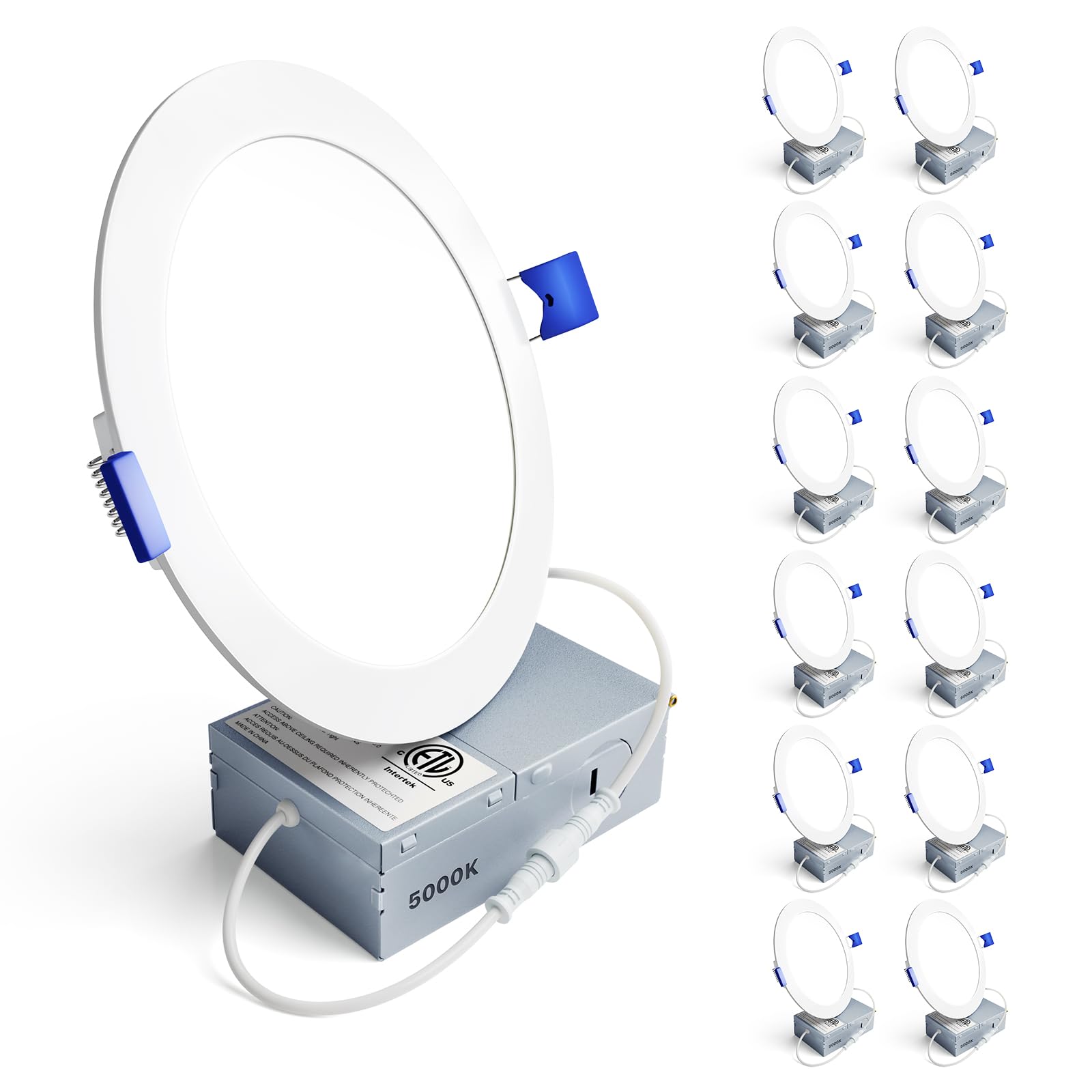
Ensenior 6-Inch Canless 12-Pack

Bright utility spaces

Our Score 9.6/10
Check Price

Worth Noting

  • Fixed 5000K daylight only, no warm option
  • Early fixture failure is the reliability risk
Size
6 inch
Depth
0.59 inch
Brightness
1200 lm
Color Temperature
5000K daylight
Read the full review

Same twelve-count box, same 6-inch wafer shape, a little more money, and 150 lumens more from every fixture. Ensenior's case rests on that output: 1200 lumens from 12 watts, the highest of anything in this group, in a body just 0.59 inch deep.

Where the extra light pays off is a garage, a laundry room, a basement or a workshop — rooms where you want the space switched on rather than lit. The catch is color. This fixture is fixed at 5000K daylight, with no warm setting and no switch to change your mind, and the tone reads crisp and slightly blue. In a utility space that is exactly right. In a living room it looks clinical, and the only fix later is a different fixture. We reached for this one when the room's job was seeing, not lounging.

Installation is the standard template-and-clips routine, and the ETL and FCC listings plus a five-year warranty are the reassurance on the parts you cannot inspect from the ladder. The full 6.73-inch trim is wide enough to forgive a cut that wandered, and at 0.59 inch the body is thinner than the drywall it sits in — which is why it works in a ceiling where a housing can would never fit.

Bottom line: Buy this when the room's job is seeing rather than lounging — 1200 lumens is the most light here, and the fixed daylight white suits garages and workshops rather than living rooms.

2

Amico 6-Inch Canless 12-Pack

Amico 6-Inch Canless 12-Pack

Whole-room lighting

Our Score 9.4/10
Check Price

Worth Noting

  • Tops out below the brightest pick here
Size
6 inch
Pack Size
12 fixtures
Brightness
1050 lm
Color Temperature
2700K, 3000K, 3500K, 4000K, 5000K
Read the full review

Five color temperatures sit on a switch on the side of the junction box, and that one detail is why this is the set we recommend first. You choose 2700K for a bedroom, 4000K for a kitchen, 5000K for a workbench, all from the same carton, before the fixture goes into the ceiling. Nobody has to guess what a listing's warm white means and then live with the answer for a decade.

The rest of the numbers line up the same way. Each wafer puts out 1050 lumens on 12 watts, which is comfortable general light at eight feet, and the body is 0.9 inch deep, so it slips past joists that would stop a remodeling can. We appreciated the 6.7-inch trim, which covers a cut that came out slightly ragged, and the spring clips bite hard enough that the fixture sits tight to the drywall instead of hanging a hair proud of it.

Dimming ran down to 5 percent and stayed clean on the LED-rated switch we used. An old incandescent dimmer is the usual reason a wafer flickers, not the wafer itself. It is IC rated for insulated ceilings and damp rated for bathrooms, so it moves between rooms without a second thought. If you want the absolute brightest fixture in this group, Ensenior's 1200 lumens beats it — for everything short of a workshop, we did not miss the extra 150.

Bottom line: This is the box we point most people toward: five color temperatures in one fixture mean you get the light right on the first try, and 1050 lumens suits an eight-foot ceiling.

3

TORCHSTAR 4-Inch Ultra-Thin 6-Pack

TORCHSTAR 4-Inch Ultra-Thin 6-Pack

Shallow ceilings

Our Score 9.4/10
Check Price

Worth Noting

  • Driver is the part that fails
CRI
90
Size
4 inch
Clearance
2 inches
Brightness
800 lm
Read the full review

Two inches of clearance is the whole pitch. In a shallow soffit, a furred-down bulkhead, or the sliver between a duct and the drywall, a standard wafer will not go, and this 4-inch TORCHSTAR will: the light itself is 0.42 inch deep and the whole assembly wants about two inches.

The reason we kept it in the roundup, though, is color rendering. CRI 90 is unusual in this set and it is the difference between an oak floor that looks like oak and one that looks faintly green — the same for brick, for painted cabinets, and for anyone checking their face in a bathroom mirror. At 800 lumens from 9 watts in daylight white, a small room reads bright and accurate rather than merely bright.

Longevity is where it gives ground. When one of these goes, it goes at the driver in the junction box, and a dimmer that is not rated for LED loads turns a small mismatch into visible flicker at the low end — check your switch against the fixture's compatibility list before you commit, or replace the switch along with the lights. Four inches also covers less ceiling per fixture, so the same room wants more of them: six is a hallway or a tight soffit run, not a kitchen.

Bottom line: The pick for a shallow ceiling or a room where color accuracy matters: CRI 90 and a two-inch profile, as long as you accept more fixtures per room and a driver that is the weak point.

4

Meconard 4-Inch Canless 4-Pack

Meconard 4-Inch Canless 4-Pack

One-room projects

Our Score 9.4/10
Check Price

Worth Noting

  • Won't dim to a genuinely low level
  • Snug junction box for extra cable joins
Size
4 inch
Depth
0.47 inch
Brightness
750 lm
Color Temperature
3000K/4000K/5000K
Read the full review

Four fixtures is the number that actually fits a project: one bathroom, a hallway, a stairwell, the two dark corners of a basement. That is what this carton covers, at 750 lumens and 9 watts apiece, in a 4-inch body just 0.47 inch deep — thin enough that a joist showing up mid-layout costs you a few inches, not a replan.

We hand this one to anyone lighting a single room. Three color temperatures, 3000K, 4000K and 5000K, are set on the junction box before installation, which is the right amount of choice for a bathroom you will repaint once a decade. The small commitment is the point: you are not storing twenty spare fixtures in the garage for a job that needed four. Energy Star and ETL listings plus a five-year warranty round it out.

The limit worth knowing is dimming. These do not go genuinely dim — even near the bottom of the range they are still putting out usable light, so a hallway you cross at 2 a.m. or a nursery is better served by a fixture with a night mode. For a bathroom you use with the lights on, it never comes up.

Bottom line: Four fixtures and three colors is the smallest sensible commitment in this group — the right buy when one bathroom, hallway or stairwell needs light and you do not want a spares drawer full of wafers.

5

VOLISUN 6-Inch Canless 24-Pack

VOLISUN 6-Inch Canless 24-Pack

Whole-floor remodels

Our Score 9.4/10
Check Price

Worth Noting

  • More fixtures than a single room needs
  • Trim may not cover oversized old can holes
Size
6 inch
Depth
0.47 inch
Brightness
1080 lm
Color Temperature
2700K/3000K/3500K/4000K/5000K
Read the full review

Twenty-four fixtures is a remodel, not a repair. If you are re-lighting a whole floor, or a whole small house, this box gets you there in one order at 1080 lumens and 13 watts per fixture, with enough left over that a dead one in three years is a swap rather than a scavenger hunt for a matching model.

The body is the thinnest 6-inch wafer here at 0.47 inch, which matters more than it sounds. A furred-down ceiling, a soffit, or a joist bay that leaves you an inch will take these where a deeper fixture will not go, and the 6.8-inch trim is broad enough to sit cleanly over a normal cut.

Five color temperatures run 2700K to 5000K on a slide on the junction box, dimming goes from 100 percent down to 5, and the fixtures are IC rated with ETL and UL listings on the terminals. We noticed the 13 watts: a full run of these pulls slightly more than the 12-watt fixtures here, which only matters if you are stacking a lot of them on one switch leg.

Our one caution is for anyone patching over old 6-inch can openings — measure the hole before you order. The trim has to be wider than the opening, and a cut that has been enlarged over the years will need a trim ring to close the gap. On fresh drywall, we had nothing to complain about.

Bottom line: Twenty-four six-inch wafers with five colors and the thinnest body in this group — the practical choice when one order has to re-light a whole floor.

6

CycevSun 4-Inch Night Light 16-Pack

CycevSun 4-Inch Night Light 16-Pack

Hallway night lighting

Our Score 9.4/10
Check Price

Worth Noting

  • Most expensive per fixture here
  • Exterior use in freezing weather is a question
Size
4 inch
Pack Size
16 fixtures
Brightness
750 lm
Night Light
2000K amber
Read the full review

Flip the wall switch off and back on and these drop from a 750-lumen downlight to a 2000K amber ring — a night light built into the same 4-inch fixture. That halo is the reason it is here. In a hallway, a bathroom, or under a back-yard soffit it gives you light to navigate by without waking your eyes up, from a fixture that otherwise looks like every other wafer on the ceiling.

The rest is standard for the size: 9 watts, 750 lumens, five downlight temperatures from 2700K to 5000K set on the junction box, and both modes dimmable from 5 to 100 percent. They are IC rated, ETL listed and damp rated, 0.79 inch deep, with an acrylic diffuser that softens the ring so the amber reads as a glow rather than a dotted circle.

What you pay for that is position: this is the most expensive per fixture in the group, which is a lot to spend on a hallway unless the night mode is the point — put them where you actually walk after dark and the math changes. If you are putting them outside under an eave, cold weather is the thing to check before committing, since the electronics sit in the coldest part of the assembly. Inside, in a warm hallway, it never comes up.

Bottom line: Worth the premium when a hallway, bathroom or porch needs a light you can walk by at 2 a.m. — the amber ring is the feature, and it comes at the highest per-fixture cost here.

7

Amico 5/6-Inch Retrofit 24-Pack

Amico 5/6-Inch Retrofit 24-Pack

Existing can lights

Our Score 9.2/10
Check Price

Worth Noting

  • Dimming stops at 10 percent
Base
E26
Size
5/6 inch
Pack Size
24 fixtures
Brightness
950 lm
Read the full review

If there are already 5- or 6-inch cans in your ceiling, ignore everything above about cutting holes. This one screws into the existing E26 socket like a bulb, and its springs pull the trim flush. It is the least disruptive lighting upgrade in this set — no attic trip, no drywall dust, no electrician — and for a house full of tired baffle cans from the 1980s, that is the whole argument.

Each fixture gives 950 lumens on 12.5 watts with the same kind of color switch as the canless Amico, though the range runs higher here, 2700K through 6000K, and that top setting is genuinely useful over a garage bench or a laundry sink. The trim is 7.3 inches across, wide enough to hide the ring and the paint line the old can left behind. It is damp rated and IC rated, so bathrooms and insulated ceilings are fine.

It hangs 1.4 inches below the ceiling, which reads as a fixture rather than a flush disk — noticeable in a low hallway, invisible in a basement. And dimmers are where these get fussy: a switch rated for LED loads keeps them steady, while an old incandescent dimmer will not. In an older house, plan on buying the switch with the lights and you will skip the troubleshooting entirely.

Bottom line: The least disruptive upgrade here for a house that already has cans: it screws into the existing socket, so you get new light without cutting drywall or crawling through an attic.

How We Tested the Best Recessed Lights

We started by pulling every kit that arrived as a complete unit — housing, trim, and light module together — then filtered by can size, wet-location rating, dimmer compatibility, and price per light. Anything that required a proprietary driver, or a ceiling cut that didn't match a standard 4- or 6-inch hole, got cut. That left 12 kits, which we installed over eight months in a kitchen ceiling, a basement rec room, a hallway on a dimmer, and a bathroom directly over the shower.

Installation was timed solo, on a step ladder, with no second pair of hands: how long from cutting the breaker to first light, whether the spring clips bit into old drywall or spun loose, and how flush the trim sat against a ceiling that is not perfectly flat. We held a light meter at counter height and at floor level to compare real brightness against the rated lumens, and stood back to judge whether each fixture's white matched the one beside it.

Flicker got its own pass. Every light went onto a new LED-rated dimmer, then onto an old incandescent-era dimmer pulled from a 1990s panel, and we swept from full brightness to the bottom of the range, watching for strobing and listening for buzz at the driver. Durability we judged by living with them: driver heat after an hour, trim color after a summer, and whether anything worked loose in a ceiling that flexes under the floor above. We also added up what a whole room actually costs, since a cheap light that ships without a trim or junction box isn't cheap.

How to Choose the Right Recessed Lighting

Start With What Your Ceiling Already Has

Three formats cover almost every job. A canless wafer carries its own junction box and clips into a cut hole in drywall; it needs a switched feed in the ceiling and either attic access or enough hole to work through. A retrofit can light screws into an existing E26 socket, so it only makes sense where cans already exist. A new-construction can with a trim is for a ceiling that is still open. The trap is that canless still means wiring — clipping the fixture in is a ten-minute job, while turning a wall switch into a live ceiling feed is the part that calls for an electrician.

Four Inches or Six

Size is about coverage and layout, not quality. Six-inch fixtures — the Amico and Ensenior wafers, the VOLISUN pack — throw a wider pool, so an eight-foot ceiling wants roughly one every four feet. Four-inch fixtures such as the TORCHSTAR and Meconard suit tight spacing, soffits and pools of light, and you will use more of them for the same square footage. Check depth as well: 0.47 inch clears nearly anything, while a fixture that needs two inches will not fit a shallow soffit. And cut with the template in the box rather than the nominal size, because a 4-inch light does not take a 4-inch hole saw.

Set the Color Before the Fixture Goes Up

Color temperature decides whether a room feels warm or clinical. Roughly, 2700K to 3000K for living rooms and bedrooms, 3500K to 4000K for kitchens and bathrooms, 5000K for garages, workshops and laundry rooms. A selectable fixture gives you all of it in one box, which is what we recommend when you are lighting several rooms from a single order. The trap is where that switch lives: on the junction box, set before the fixture goes into the ceiling. Change your mind afterward and it is a ladder and a pulled fixture, not a wall switch — unless you buy a night-light model, where the wall switch toggles between two modes and nothing else.

Dimming Depends on the Switch, Not Just the Light

Flicker and drop-out are usually a dimmer problem, not a fixture problem. LED fixtures want a dimmer rated for LED loads; an older incandescent dimmer will make even a good fixture misbehave. The fixture's own number — a 5 percent or 10 percent floor — tells you how low it will actually go, and it is worth knowing before you plan a nursery or a hallway you cross at night. Match the switch to the manufacturer's compatibility list, and if you are replacing lights anyway, replace the switch at the same time. It is the least expensive way to avoid a flicker you would otherwise blame on the fixtures.

Lumens, Spacing, and What a Pack Covers

Output runs 700 to 800 lumens for the 4-inch models here and 950 to 1200 for the 6-inch ones. More, dimmer fixtures generally beat fewer bright ones: an eight-foot ceiling with fixtures about four feet apart runs comfortably at 60 to 70 percent, which is where LED dimming behaves best anyway. Pack size should follow the project — four for a bathroom, twelve for a room and a half, twenty-four for a floor or a small house. Buying a box larger than you need is not waste. Drivers fail, and a spare from the same batch matches its neighbors exactly.

Frequently Asked Questions

Final Verdict

Start with the Amico 6-inch canless set. Five color temperatures on the fixture let you light each room the way you want it before anything goes into the ceiling, 1050 lumens is right for a standard eight-foot room, and installation is a template, a hole and two spring clips.

Two things move us off it. If your ceiling already has cans, the Amico retrofit screws in without touching the wiring. If the ceiling is shallow, TORCHSTAR's two-inch profile is the one that fits.