Lighting

Best Picture Lights of 2026

A picture light is supposed to make art look better than it does in daylight, and most of them don't. I learned that the cheap way, with a clip-on fixture over an oil painting in my hallway that turned deep greens a chalky olive and dropped a bright puddle of light across the top of the frame. The right fixture does the opposite: it spreads an even wash from edge to edge, keeps the colors honest, and disappears into the frame so nobody notices the hardware.

We hung 11 picture lights over six months — corded, rechargeable, and magnetic — and the differences showed up fast. One thing worth knowing before you shop: a fixture should run about half the width of the artwork and sit two to three inches above the frame, or you'll get dark corners no bulb can fix. Below are the ones that earned their spot on the wall, including the best value of the bunch and the ones actually worth the splurge.

1

EZVALO 16-Inch Picture Light

Top Pick
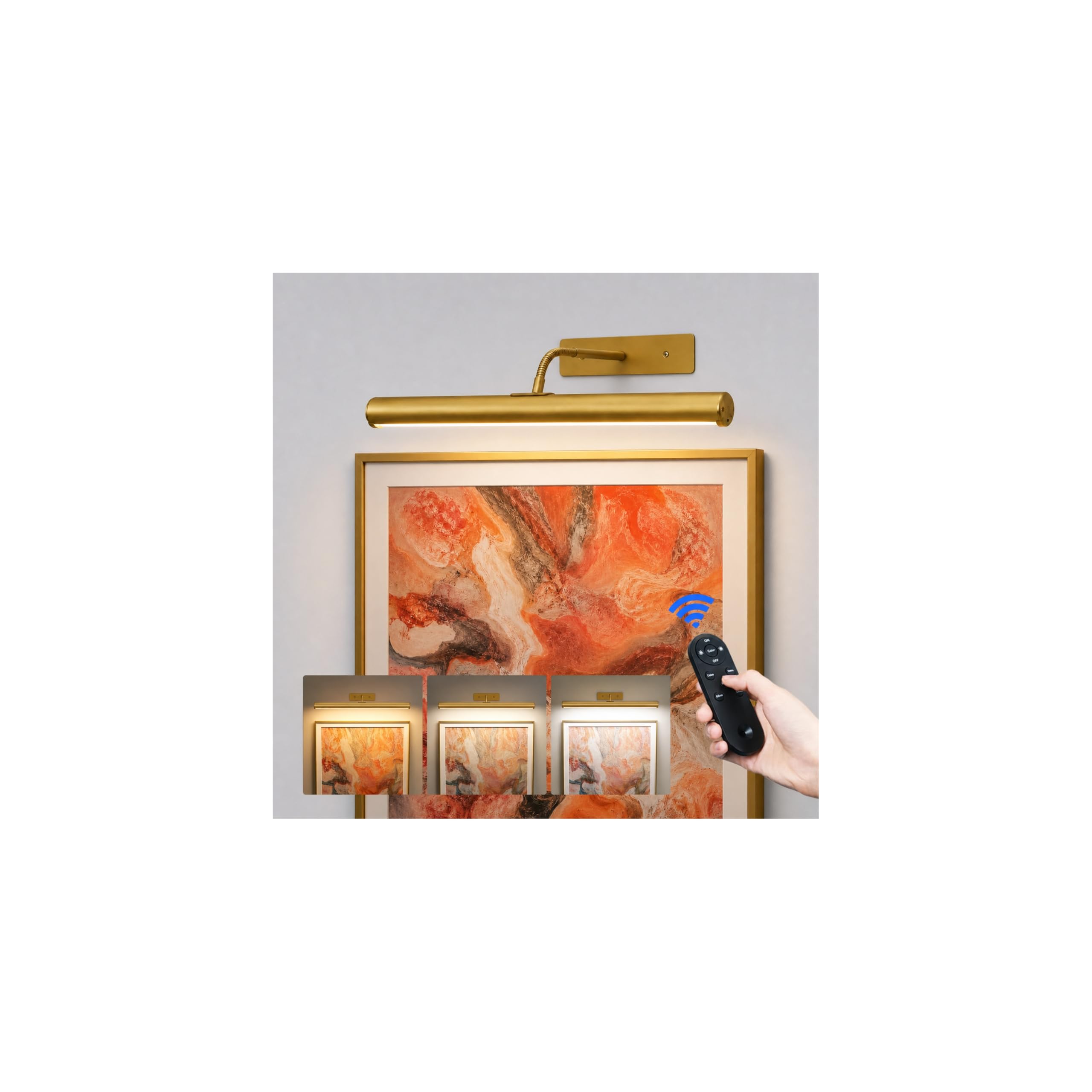
EZVALO 16-Inch Picture Light

Medium frames

Our Score 9.2/10
Check Price

Worth Noting

  • 120 lumens is modest for large art or bright rooms
  • Screw mounting only, so renters need to drill
Battery
6000mAh, up to 18 hrs
Bar Length
16 in
Light Output
120 lm
Color Temperatures
3 (2700K-6500K)
Read the full review

Sixteen inches of bar and a 6000mAh cell are the two figures that separate this one from the rest of the group. The width spreads light across a medium canvas instead of pooling it in the middle, and the capacity means the bar doesn't come off the wall every few evenings for a charge. EZVALO rates it at up to 18 hours, the longest figure here.

The light itself is what we cared about most. Color rendering is listed at CRI 90 or better, and the three settings run from a warm 2700K that flatters oils and warm-toned prints to a 6500K that suits cool contemporary work. Five brightness steps give you somewhere to land between too dim to see the brushwork and bright enough to glare off the glass.

Output is 120 lumens, which is honest rather than spectacular: this is a wash for one or two medium frames, not a spotlight for a six-foot mural. Mounting is a screw bracket with anchors in the box, and the bar lifts off for USB-C charging. The remote reaches about 16 feet, and there's a touch switch on the bar that we used more than the remote in a hallway where the clicker never stays put.

What earns it the top spot is the combination: a wide, color-accurate wash, an 18-hour battery, and hardware that doesn't need an electrician. If your room is genuinely bright or the print is large, step up in output — the LYTARA below more than doubles it. For one or two frames on an ordinary wall, this is the one we point people to.

Bottom line: We tell most people to start here: a wide, color-accurate wash, an 18-hour battery, and screw-in hardware that needs no electrician.

2

LYTARA Dimmable Picture Light

LYTARA Dimmable Picture Light

Large, bright rooms

Our Score 9.2/10
Check Price

Worth Noting

  • Runtime falls off quickly at full brightness
Battery
5000mAh, about 10 hrs
Bar Length
14 in
Light Output
350 lm
Color Temperatures
3 (3000K-6500K)
Read the full review

At 350 lumens, this is the brightest bar in this group, and the difference shows the moment you aim it at a large print in a room with a lot of daylight. Seventy LED beads behind 14 inches of bar give a broad, even spread rather than a hotspot, and the stepless dimmer lets you pull it down to something that reads as accent rather than task light.

The gold metal body is the other reason this one earns a place. It's a thin curved cylinder rather than a plastic strip, and the finish looks closer to a wired fixture than to anything battery-powered. Installation is a screw bracket with a magnetic bar, so the light lifts off for charging and clicks back without tools; the infrared remote handles dimming, color temperature and the timer.

Battery is where we temper the enthusiasm. The listed runtime is about ten hours, which in practice means a weekly top-up if you run it at full brightness every evening rather than the monthly ritual the number suggests. For a bright hallway or a big canvas that needs real output, that is a trade worth making.

Bottom line: Buy this one when the wall is bright or the canvas is big: 350 lumens and a stepless dimmer, in a gold body that looks wired.

3

EZVALO Magnetic 3-Pack

EZVALO Magnetic 3-Pack

Small frames

Our Score 9.0/10
Check Price

Worth Noting

  • Adhesive pads can lift paint when removed
  • 80 lumens per puck suits small frames only
Pack
3 lights
Battery
2000mAh each
Control
Remote and tap
Light Output
80 lm each
Read the full review

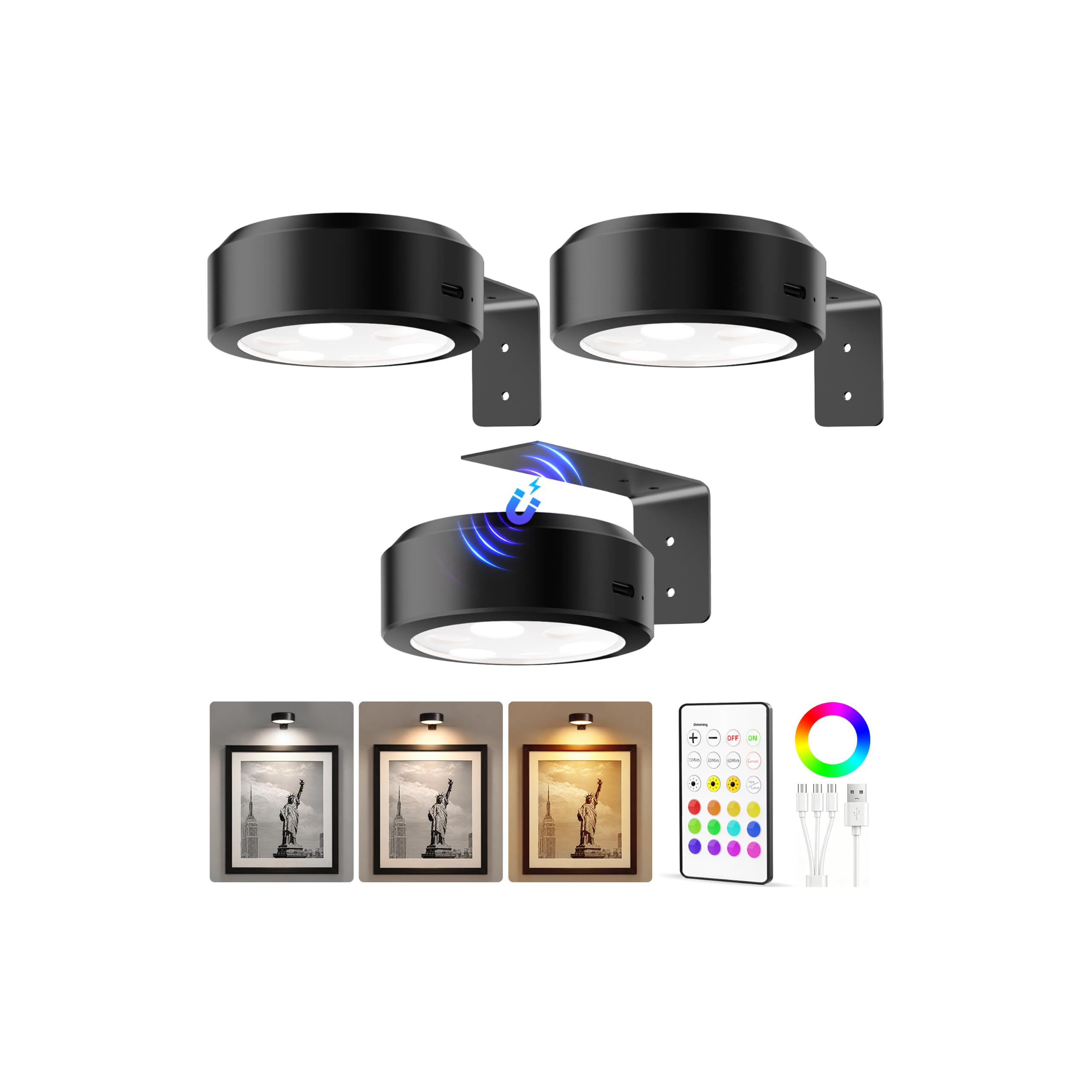
These aren't bars. They're three small pucks, roughly three inches across, and that changes the job they do: instead of washing a wall, each one drops a focused pool of light onto a single small frame. Across a row of 8x10s in a hallway that reads as deliberate. Over one large canvas it reads as a spotlight.

The package is generous for the money — three lights, one remote that runs all of them, tap control on each shade, three color temperatures, dimming from 10 to 100 percent and a timer. What we minded is the mounting. The magnetic plate and adhesive pad are the easy route, and on clean, sound paint they hold, but the pads can lift paint on the way down and the screws come in the box because adhesive doesn't forgive a textured wall. Each puck carries a 2000mAh cell and 80 lumens, so plan on charging them in rotation rather than all at once.

Bottom line: Three little pucks that make a row of small frames look curated — buy them for tight spaces, not for one big canvas.

4

Xuolder 3-Pack Picture Lights

Xuolder 3-Pack Picture Lights

No charging routine

Our Score 8.8/10
Check Price

Worth Noting

  • Batteries not included
  • Output fades as the cells drain
Pack
3 lights
Power
3 AA batteries each
Control
Remote with timer
Light Output
300 lm
Read the full review

Three AA batteries per light, none in the box. That's the trade this set makes. You give up the charging routine entirely — no cables, no lifting a fixture off the wall, no waiting for a full cell — and you take on a battery budget instead. For lights high on a staircase or over a doorway, where reaching them is the annoying part, that's a swap we happily make.

The rest is familiar: a bracket that screws to the wall, a magnetic puck that pops off for battery changes, two remotes for three lights, three color temperatures, dimming and a timer. Output is listed at 300 lumens, and the honest read is that it fades as the cells drain — the last evening before a change is noticeably weaker than the first.

Buy rechargeable AAs and keep a spare set charged, and this becomes the least expensive way here to put three lights on a wall. The part to watch is the mount: the adhesive is the weak link on textured or freshly painted surfaces, so use the screws anywhere the light hangs above something breakable.

Bottom line: For lights you never want to take down: standard AA power, three fixtures, and no charging cables to keep track of.

5

ERMTCTS 3-Pack Picture Lights

ERMTCTS 3-Pack Picture Lights

Colorful accents

Our Score 8.8/10
Check Price

Worth Noting

  • 100 lumens suits small accents only
  • Magnets can release from the bracket
Pack
3 lights
Battery
2000mAh
Light Colors
3 white temps, 12 RGB
Light Output
100 lm
Read the full review

Twelve RGB colors and two dynamic modes, on top of the three white temperatures. This is not a museum light and it makes no attempt to be one: it's for a teenager's poster wall, a dorm room, a game corner where colored light is the point rather than a compromise. Tap the shade to cycle through, or use the remote.

As accent lighting it's good fun for the money; as picture lighting it's limited. At 100 lumens per puck and a 2000mAh cell you get a small pool of light and a regular charging habit. The magnet is the part we trust least, since the same plate that holds firmly on smooth painted drywall can let go on textured surfaces or release from the bracket itself. Hang these where a fall costs nothing.

Bottom line: A colorful accent set for a kid's room or poster wall — fun and inexpensive, but not the one for a serious print.

6

Craftersmark 3-Pack Picture Light

Craftersmark 3-Pack Picture Light

Gallery walls

Our Score 8.6/10
Check Price

Worth Noting

  • Plastic body parts at the top of the price range
  • Stepped brightness rather than stepless
Battery
5000mAh, up to 13 hrs
Bar Length
16 in each
Light Output
350 lm each
Color Rendering
CRI 95+
Read the full review

A gallery wall is a different problem from a single painting. You want three or four lights that match, that behave the same, and that don't each demand their own charger and their own remote. This set answers all three: three 16-inch bars, one remote that talks to every one of them, and a memory function so the setting you dialed in survives the next switch-on.

Each bar puts out 350 lumens at CRI 95+, the kind of color fidelity that keeps a deep red from going muddy, and a 290-degree swivel lets each bar aim at its own frame. You get three color temperatures and three brightness steps — 40, 70 and 100 percent — rather than a stepless dial. Mounting is screws and expansion plugs with no adhesive involved, which we count as a plus for anything hanging above a sofa.

It's the most expensive set here and parts of the body are plastic rather than metal, which you notice next to the gold bars. We also noticed that a set of three multiplies your exposure: if one unit misbehaves, you're packing up three. Test all of them on a table before you drill, and keep the packaging until you have.

Bottom line: The gallery-wall answer: three matching 16-inch bars, high color fidelity, and one remote that runs the lot.

7

FULEN 2-Pack Picture Lights

FULEN 2-Pack Picture Lights

Accurate color

Our Score 8.6/10
Check Price

Worth Noting

  • Runtime is the shortfall; expect short sessions between charges
Pack
2 lights
Battery
4500mAh
Light Output
300 lm
Color Rendering
CRI 95+
Read the full review

CRI 95+ is the number that matters here, and it's the reason we kept coming back to this pair. Rendering that high keeps the skin tones in a portrait and the greens in a landscape close to what the artist intended, and 300 lumens per bar is enough light to show it. Two lights in the box makes it the least expensive way here to light a pair of frames properly.

The install is the friendliest of the lot: a magnetic plate, no screws needed, and the bar lifts off to charge over USB. That's a real advantage in a rental or on a wall you'd rather not drill. Both bars are 8.7 inches and slim, so they sit close to the frame instead of hovering over it, and the head angles to push light where the piece needs it.

Stamina is the catch. The 4500mAh cell looks generous on paper, but this is a light for an hour or two in the evening rather than all-night gallery lighting, and the battery is the first thing to plan around. The remote is the other weak point: test it in the first week, while a replacement is still simple.

Bottom line: The color-accurate pair for renters: CRI 95+, tool-free mounting, and the least money here for two properly lit frames.

How We Tested the Best Picture Lights

We started with roughly 40 fixtures sold by big retailers and specialist lighting shops, then narrowed by the specs that matter once the box is open: the length of the arm and shade, whether the light dims smoothly, the color temperature of the bulb, and how the thing attaches to a wall or a frame. Anything that couldn't span at least half the width of a standard print got cut, as did fixtures that demanded hardwiring for no good reason. That left 11, which we hung and lived with for six months.

Each light went up over real artwork — a stretched canvas in a hallway, a glazed print above a sofa, a small sketch in a bedroom — and we timed every install with a screwdriver and a drill, noting when a second pair of hands was genuinely needed and whether the mounting hardware fit drywall anchors cleanly. Corded models were routed down the wall into a cord cover. Battery and magnetic ones were checked for how easily the bar seated on its bracket and whether it stayed put when we deliberately nudged the frame.

For brightness and lighting quality, we photographed the same print from the same spot at night with each fixture on, then compared frames side by side: a hot spot at the top edge, a visible falloff near the bottom, or a shift in the color of a gray card meant the light was doing the artwork a disservice. We also checked for glare bouncing off glazed prints and noted which dimmers actually went low enough for evening.

Battery and magnetic models got their own round of use: we ran each at full brightness until the output visibly dropped and timed it, and we tested magnet strength by loading and unloading the bracket repeatedly. Over the months we tracked durability and appearance — shades that yellowed or hoarded dust, finishes that scuffed, joints that loosened, switches that went sticky — and judged value for money by whether a fixture still felt worth its price once the novelty had worn off.

How to Choose Picture Lights

Match the bar to the art

Bar length does more for the result than raw brightness. A 14- to 16-inch bar throws an even wash across a frame in the two- to three-foot range, while three-inch pucks are for 8x10s and small prints, one pool of light each. Put a narrow, high-output fixture over a big canvas and you get a bright center with dark edges, which looks worse than leaving the wall alone.

Our picks run from 80 lumens a puck to 350 lumens a bar for exactly this reason: output only means something next to the width of the fixture and the size of the frame. A 16-inch bar at 120 lumens is a soft wash; 14 inches at 350 lumens is a spotlight you have to dim.

Choose color temperature for the work, not the room

Settings around 2700-3000K flatter oils, warm-toned prints and wood frames; 4000-4500K is neutral and the safest bet for photography; 6500K suits cool, graphic, contemporary pieces. Color rendering matters just as much: CRI 90 and above keeps reds and skin tones from going flat, and two picks here list 95+.

Whatever the setting, most art reads better at half brightness than at full. Full output flattens brush texture and puts a sheen on canvas, so buy a fixture with real dimming range rather than the brightest one you can find.

Runtime, and how you'll recharge it

Every runtime figure is quoted at full brightness on a fresh cell, so treat the top number as the best case and expect less once you start dimming and topping up on a schedule. The bigger question is how the light comes off the wall: a magnetic bar that lifts away makes charging painless, while a screw-fixed fixture with a port underneath means a cable hanging down your wall for a few hours.

If the light sits high on a staircase or above a door, buy one that detaches, or one that runs on standard batteries so you can swap cells without a cable at all.

Mounting: screws, adhesive or magnet

Screws and anchors are the only option that doesn't care what your wall is made of, and they're what to use above a sofa, a bed or anything breakable. Adhesive plates are the renter's friend and the painter's enemy: on sound, clean paint they hold a light puck indefinitely, but they can take a layer of paint with them on the way down, and they don't forgive texture.

A magnetic plate splits the difference — screw the plate on once, lift the light off whenever you need to. That's the arrangement we look for on anything mounted out of easy reach.

Controls worth paying for

Dimming isn't optional; stepless is nicer than three steps, but three steps will do. A timer earns its place on a hallway light you don't want burning all evening, and a memory function saves you re-dialing your setting every time the light cycles.

If you're lighting more than one frame, check that a single remote can address several lights. Every multi-light set here manages it, and not buying three separate remotes is a large part of why those sets make sense.

Frequently Asked Questions

Final Verdict

If you want one light and no further reading, buy the 16-inch EZVALO. It washes a medium frame evenly, renders color well enough for real art, holds the longest charge here, and screws to the wall with the hardware in the box.

Step up to the LYTARA if the room is bright or the piece is large — 350 lumens is the difference between accent and illumination. Lighting a row of frames instead? Three matching 16-inch Craftersmark bars on one remote beat three unrelated singles.