Kitchen

Best Kitchen Trash Cans of 2026

A trash can asks you to pick between two things you want at once: a lid that seals in last night's fish and a lid you can flip open with one hand while holding a pile of carrot peels. Lean too far toward airtight and you're fumbling with a latch using wet fingers; lean too far toward convenient and the whole kitchen smells like dinner. What you actually want is a can you stop thinking about — one that opens smoothly, closes without a bang, keeps the bag where you put it, and looks like it belongs in the room instead of beside it. Get that right and the thing disappears into your routine, which is the highest praise a trash can can earn.

I've owned plenty that didn't earn it. Over the past eight months, my team and I have lived with 12 kitchen trash cans of every style — step, sensor, swing-top, and pull-out — checking footprints against actual cabinet gaps, timing how long each lid takes to settle, and watching how bags sat once they were loaded. Here's the thing nobody tells a first-time buyer: the quart capacity on the box tells you almost nothing, because the bag has to fit the rim, not the volume. The picks below are the ones that got all of that right.

1

simplehuman 50L Step Can

Top Pick
simplehuman 50L Step Can

Everyday kitchens

Our Score 9.4/10
Check Price

Worth Noting

  • No lid lock to keep pets out
  • The priciest can in this set
Opening
Step-on pedal
Capacity
50 liters / 13.0 gallons
Warranty
10 years
Dimensions
19.8"L x 12.8"W x 25.7"H
Read the full review

The hinge on this simplehuman lives inside the body, and that single decision is why it is our top pick. Nothing protrudes at the back, so the can sits flat against the wall or the end of a cabinet run instead of leaving a hand's width of dead floor behind it, and rubber pads on the base hold it steady without marking tile. In a kitchen where every inch is spoken for, that is worth more than anything printed on the box.

We paid close attention to the pedal, because the pedal is what fails first on a cheap can. This one is steel and rated to 150,000 steps — twenty a day for twenty years — and the lid comes down on a damper rather than dropping. Push the lid back and it stays open while you scrape a plate. The inner bucket lifts out by its handle, and a standard 13-gallon liner settles into the rim without a fight.

Fifty liters is the size most households settle into, and it means a 13-gallon bag goes in with room to spare rather than stretched to the point of splitting. The brushed stainless wipes down in one pass and does not hold onto fingerprints the way a polished finish does. The internal hinge pays off twice here, because you can put the can right up against a wall without hearing the lid knock it every time someone steps on the pedal.

What the money buys is the parts you never look at: a ten-year warranty, a damper refined to the point where it simply works, and a body that does not flex when a heavy bag goes in. It is the can we point to when someone wants to buy once and stop thinking about the trash.

Bottom line: Our default for most kitchens: a steel pedal and a damped lid built to outlast the can, in a body that sits flush to the wall and wipes clean in one pass.

2

EKO Hudson 75L Step Can

EKO Hudson 75L Step Can

Big households

Our Score 9.4/10
Check Price

Worth Noting

  • Takes larger liners than a 13-gallon can
Opening
Step-on pedal
Capacity
75 liters / 20 gallons
Dimensions
16.3"L x 14.3"W x 31.4"H
Extra Storage
Rear bag compartment
Read the full review

Seventy-five liters is half again the capacity of the 13-gallon cans that dominate this group, and that changes the rhythm of the chore more than any feature on a spec sheet. A bigger body means fewer trips out to the bin, and in a house of four or five that is most of what you wanted from a new can in the first place.

The extras are the sort you notice in week two. There is a compartment at the back that holds a roll of liners, so changing the bag does not turn into a walk to the pantry, plus a deodorizer slot under the lid for a scent puck. The pedal is steel and rated for 200,000 presses, the lid settles on a damper, and the matte stainless does not show fingerprints the way a polished finish does.

The capacity is what we loved most about it, and the liner compartment is a close second — a small thing that removes an annoyance you did not know you had. It asks for something in return: at 31.4 inches tall the lid needs headroom above it, so it wants a spot at the end of a run rather than under a shelf.

Bottom line: For a family that fills a 13-gallon can twice a week, the extra seven gallons are the point: fewer trips to the curb, with the same soft-close manners.

3

simplehuman 40L Slim Step Can

simplehuman 40L Slim Step Can

Tight spaces

Our Score 9.2/10
Check Price

Worth Noting

  • Lid closes slowly enough to feel hesitant
Opening
Step-on pedal
Capacity
40 liters / 10.6 gallons
Lid Lock
Slide lock
Dimensions
18.6"L x 10.1"W x 24.9"H
Read the full review

Ten inches is the whole argument. At 10.1 inches across, this is the narrowest can we cover, and it is the one that disappears into the slot between the fridge and the counter that nothing else will take. Nearly twenty-five inches of height means it still handles a real kitchen's worth of trash despite the skinny profile.

We wondered whether the plastic body would feel like a step down after the steel cans, and it does not — the lid rides the same slow-close damper, the pedal is steel, and there are built-in wheels so you can roll it out for a wash instead of hauling it. The slide lock is the detail that earns it a place here: push it across and the lid stays shut against a dog's nose or a toddler's hands, which the steel simplehuman above will not do for you.

The trade-off is volume: 40 liters is the smallest body here, so a busy household pulls the bag more often, and the five-year warranty is half what simplehuman gives the steel can. Neither matters much in a galley kitchen where the alternative is a can standing in the middle of the floor.

Bottom line: Ten inches wide, so it is the one that fits the gap nothing else does — and the slide lock earns its keep in a house with a dog or a curious toddler.

4

Glad 13-Gallon Stainless Step Can

Glad 13-Gallon Stainless Step Can

Odor control

Our Score 9.2/10
Check Price

Worth Noting

  • Full bags fight the bag rings on the way out
  • Dents if it tips over during cleaning
Opening
Step-on pedal
Capacity
13 gallons
Dimensions
16"L x 16"W x 23"H
Odor Protection
Clorox-treated lid and frame
Read the full review

The lid and the frame on this Glad are treated with Clorox odor protection — an antimicrobial finish rather than a filter or a cartridge — and the lid seats flat on the frame instead of resting on top of the liner. That flat seat is the part doing the everyday work here: a lid that sits proud lets smell out no matter what it is coated with.

The bag rings are the other good idea. Two metal bars drop over the liner and hold it tight against the rim, so the plastic does not slip down and nothing hangs over the edge looking untidy. There is also a compartment at the back that swallows a roll of bags, which we were also impressed by — bag changes stop being a hunt for a liner.

The hinge is where this design is most likely to let you down. A lid that stops seating flat undoes the odor protection you bought the can for, and that is the failure to watch for. If you want the mechanism itself to feel heavier, the EKO Madison is the better answer for a little more.

Bottom line: The lid is treated to fight odor and the bag rings keep the liner sealed down, which makes it our pick for a kitchen where the can sits close to where you eat.

5

EKO Madison 50L Step Can

EKO Madison 50L Step Can

Value stainless

Our Score 9.0/10
Check Price

Worth Noting

  • Lid can spot with rust in humid kitchens
Lid
Soft open and close, stay-open lock
Opening
Step-on pedal
Capacity
13.2 gallons / 50 liters
Dimensions
16.9"L x 14.3"W x 25.4"H
Read the full review

The Madison is what we point to when the top pick's price is the sticking point. It is brushed stainless, it takes standard 13-gallon liners, and the lid opens on a steel pedal and settles on a damper instead of dropping. In a lineup of cans that all look similar from three feet away, that is most of what you actually wanted.

We think it is the best value in this set. The pedal is rated for 200,000 presses, the finish resists fingerprints, and the inner liner lifts out by two handles — the difference between a two-minute bag change and a wrestling match. The lid eases up on its damper as well as down, so it does not pop open at your shins, and a stay-open lock holds it back while you scrape plates.

Two things to know. The body is a little wider and a little shorter than the simplehuman's, so measure the gap before you commit. And look over the side panels for shipping dents before the return window closes, because a dented panel is much easier to swap than to live with — once that is done, you can stop shopping.

Bottom line: If the top pick's price is the sticking point, this is the can we hand people: the same stainless look and a soft-open, soft-close lid for noticeably less.

6

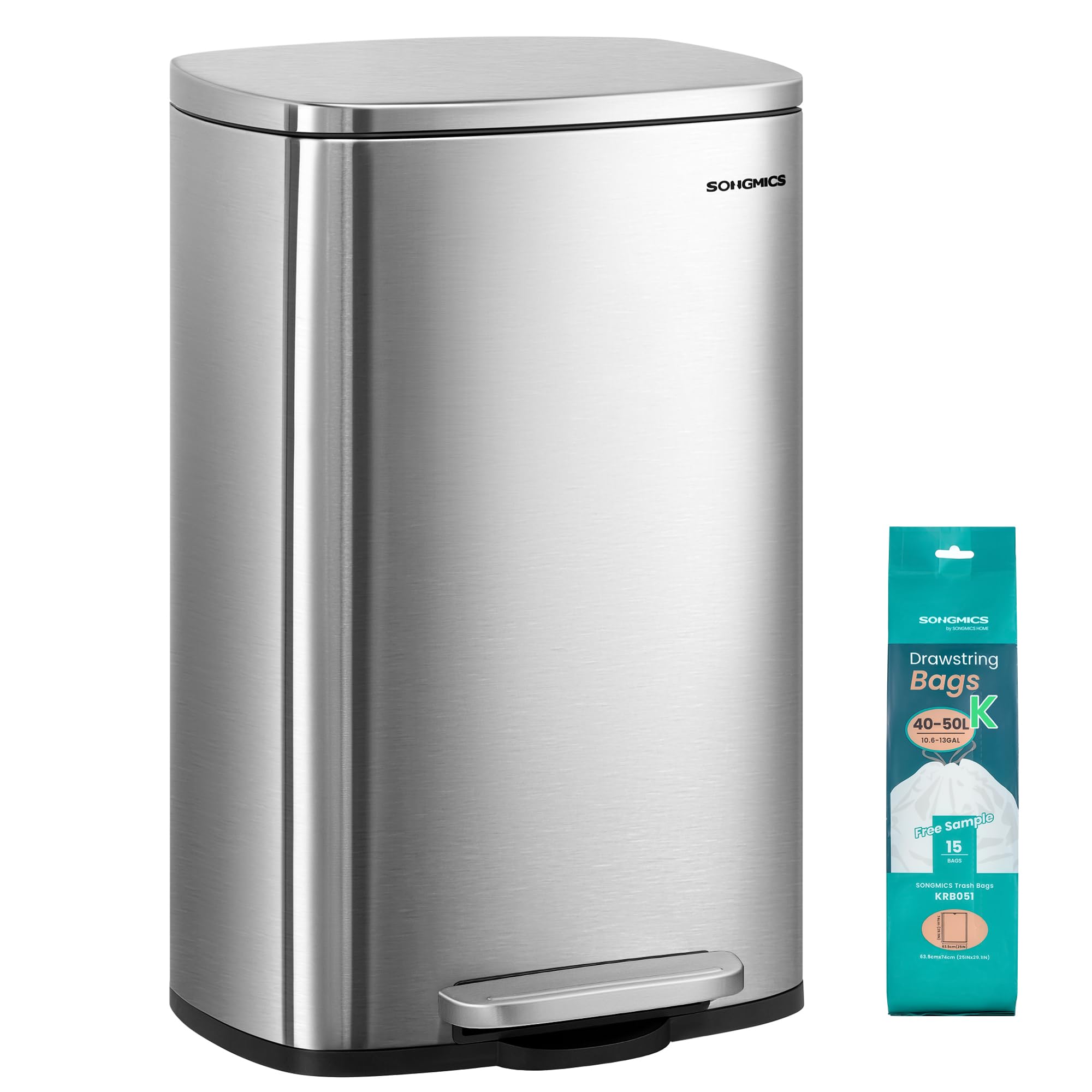
SONGMICS 13-Gallon Step Can

SONGMICS 13-Gallon Step Can

Budget steel

Our Score 9.0/10
Check Price

Worth Noting

  • Lid can stop seating properly over time
Capacity
13 gallons / 50 liters
Material
Stainless steel, plastic inner bucket
Dimensions
17"L x 14.6"W x 24.9"H
Inner Bucket
Removable, with bag hole
Read the full review

There is a hole at the back of the inner bucket on this SONGMICS, and you push the excess liner through it instead of draping plastic over the rim. The result looks deliberate from across the kitchen — no ruffled skirt of bag catching the light. It is the kind of detail that costs almost nothing and makes an inexpensive can look less inexpensive.

The rest is standard-issue steel can: brushed body, soft-close damper, a pedal, and a lid you can push back to stay open while you scrape. At 12.8 pounds it is heavy enough to stay put when you step on the pedal, and the plastic inner bucket lifts out for washing.

So while we recognize this as the value pick among the steel cans, it is a can for someone who wants the stainless look without paying for the last word in mechanism. Liners can slide back into the bucket between changes — tuck the tail through that hole and pull it snug and the problem goes away. The bag hole does most of the design work here, and for the money that is a fair trade.

Bottom line: The cheapest steel can here, and a tidy one — the inner bucket hides the bag overhang, provided the lid keeps seating the way it should.

7

Amazon Basics 50L Step Can

Amazon Basics 50L Step Can

Easy emptying

Our Score 8.8/10
Check Price

Worth Noting

  • Damper can give out and let the lid slam
Capacity
50 liters / 13.2 gallons
Material
Stainless steel, plastic inner bucket
Dimensions
16.73"L x 14.65"W x 25.87"H
Inner Bucket
Removable with carry handle
Read the full review

The inner bucket on this Amazon Basics comes out of the can entirely and it has a carry handle, which turns bag day into one trip: lift the bucket, carry it to the bin, drop the bag, put it back. Most cans make you wrestle a full liner up over a rim while it is still sitting in the kitchen.

It is a 50-liter body, so standard 13-gallon liners fit, and the footprint is close to the simplehuman's — slightly wider, slightly shorter. The stainless is smudge-resistant, the lid has a stay-open position for long chores, and it costs less than the other full-size steel cans here.

The panels are thinner than the steel on the EKO or the simplehuman, and one can arrive with a crease in the side, so open the box and look before it goes out with the recycling.

We rank it below the EKO Madison on the strength of the mechanism rather than the capacity — the parts you touch every day are where the difference shows. As a second can for the basement, a rental kitchen, or a household that is not ready to spend much on a bin, it earns its place.

Bottom line: The easiest bag change in this group: a removable inner bucket with a carry handle, in a full-size steel body that costs less than the cans it competes with.

How We Tested Kitchen Trash Cans

We started by gathering every can we could find in the 8- to 20-gallon range, then narrowed the field by price, lid mechanism, and whether the manufacturer published the bag size the can actually takes — you'd be surprised how many don't. From that list we bought 12 and set them up in real kitchens rather than a showroom, rotating them through the same spots so each one handled the same mess.

Each can lived through a normal week: peeling vegetables at the counter with both hands full, scraping plates after dinner, bag changes on a Sunday, and one deliberately chaotic holiday meal where every can took a beating. We opened and shut each lid dozens of times barefoot and in socks, timed how long it took to close and whether it slammed, and noted whether a sensor fired on a passerby or refused to open with a hand full of scraps. We measured height and depth against a standard counter overhang, filled each one to the point of resistance to see whether the liner slipped off the rim, and tested how easily the lid and inner bucket came out for a wash.

Over the eight months, we looked for the slow stuff too: pedals that went soft, hinges that started to sag, stainless that collected fingerprints, plastic that scuffed when a bag dragged across it. The cans that held up were the ones where nothing felt hollow when you bumped them, and the extra money bought thicker steel or a better lid mechanism rather than a logo.

How to Choose Kitchen Trash Cans

Start with the liner, then the can

Most American kitchens run on 13-gallon liners, so a can built around that size wastes neither bag nor floor space. Read the inner bucket rather than the headline number: 50 liters and 13.2 gallons are the same can, and both should take a standard tall liner without stretching it to splitting point.

Go bigger and you are buying larger, less common bags along with the extra capacity. That is a fair trade for a family of five and an unnecessary one for two people, who will just be tying off half-empty bags.

Measure the gap, not the can

Width decides more purchases in this category than capacity does. The cans here run from 10.1 inches across to 16, and that spread is the difference between a bin that slots beside the fridge and one that stands in the middle of the floor. Check depth and height too, and whether the lid swings up into a counter overhang or a wall cabinet.

The hinge is worth a look while you have the tape out. An internal hinge lets the body sit flat against the wall; an external one spends two or three inches of your gap on hardware.

Pedal, sensor, or hand

A step pedal is the least dramatic and most reliable way to open a can: one moving part, no batteries, nothing to recalibrate. A motion sensor is genuinely useful with raw chicken hands, but it adds a motor, a sensor and a battery habit to something you use twenty times a day, and its lid opens for whatever moves in front of it.

We treat touchless as a convenience you pay for twice. It is worth it when the hands-free moment actually matters to your cooking; otherwise the pedal wins on the odds of it still working in year three.

What actually breaks

Nearly every failure in this category is mechanical — a damper that loses its drag, a hinge that cracks, a pedal that snaps. That is why warranty length is worth more than the finish: simplehuman backs its steel can for ten years and its plastic one for five, and EKO rates its pedals at 200,000 presses.

A heavier pedal and a lid that eases down rather than dropping are not vanity details. They are the two parts your foot and hand meet every day, and they are what you are paying for when you move up the range.

Pets, toddlers, and odor

A lid that seats flat on the frame keeps smell in better than one that rests on top of the liner, and treated lids and deodorizer compartments help at the margin. If the reason you are shopping is a dog or a toddler, look for a slide lock — the slim simplehuman has one, and most of the steel cans here do not.

Bag rings and inner buckets matter more than they sound. A liner that stays tucked under a ring keeps the rim clean and the smell down, while a bag that slides into the bucket leaves yesterday's leftovers smeared around the top edge.

Frequently Asked Questions

Final Verdict

The simplehuman 50-liter rectangular can is the one we send most people to. The internal hinge, the 150,000-step pedal and the ten-year warranty are what separate it from a can you replace in three years, and the body swallows a standard 13-gallon liner without a fight.

If price is the barrier, the EKO Madison gives you stainless, a soft-open lid and a 200,000-press pedal for less. If floor space is the barrier, the 40-liter simplehuman is a shade over ten inches wide and still takes a full kitchen bag.