Kitchen

Best Kitchen Drawer Organizers of 2026

There's a particular frustration that only comes from a kitchen drawer: you reach for a spoon and get an avalanche of spatulas, lids, and takeout menus. A good organizer is meant to end that, dividing the space so everything has a home and you can see what you own at a glance. The catch is that most drawers are slightly odd — an inch too shallow, a hair too narrow, a screw head poking up right where you wanted to set a tray. So the difference between an organizer that disappears into your kitchen and one that ends up in the donate pile usually comes down to fit.

Over the past six months, my team and I tried 14 organizers — expandable bamboo dividers, modular plastic trays, wire baskets — and measured each one against the same handful of drawers. The winners weren't the cleverest designs; they were the ones that felt sturdy under a full load of silverware and looked decent enough to leave visible when the drawer is pulled open. What follows covers deep drawers, shallow drawers, and the narrow galley-kitchen kind where every half inch counts.

1

Criusia 26-Piece Clear Bin Set

Top Pick
Criusia 26-Piece Clear Bin Set

Large utensil bins

Our Score 9.6/10
Check Price

Worth Noting

  • More bins than one drawer can use
Sizes
5
Pieces
26 bins
Material
PET plastic
Bin Height
2"
Read the full review

Twenty-six bins in five sizes, with the smallest still big enough for a garlic press — that's what separates this set from the small-tray kits. These are sized for kitchen utensils rather than hair ties, and the PET is rigid and clear, so a loaded bin doesn't bow when you lift it out of the drawer.

We used them to rebuild a utensil drawer that had become a heap: spatulas and tongs in the longest bin, measuring spoons and small gadgets in a short one, the odd stuff in a third. Because the bins come in five sizes, the layout follows the drawer's width instead of fighting it, and 2 inches of height clears a shallow counter lip.

Of the two clear bin sets here, this is the one for a kitchen. The Vtopmart set is cheaper and better for a junk drawer full of small things; the Criusia bins are bigger and stiffer, and they handle the awkward long tools the smaller bins can't. Neither replaces a tray in a drawer of loose cutlery — bins organize categories, not individual forks.

One practical warning: twenty-six bins is more than a single drawer needs. Plan to split the set between the kitchen, a bathroom vanity and a desk drawer, or you'll end up finding storage for your storage.

Bottom line: Our choice for a utensil drawer full of bulky tools, since these bins are sized for spatulas rather than spoons.

2

ukeetap Expandable Tray

ukeetap Expandable Tray

Most kitchen drawers

Our Score 9.4/10
Check Price

Worth Noting

  • Needs a drawer at least 16.5 inches deep
Depth
16.5"
Material
BPA-free plastic
Width Range
12.4" to 21"
Compartments
7 to 9
Read the full review

Twelve point four inches closed, twenty-one at full stretch: no other tray here covers as much drawer width, and that range is the reason it's our default pick. Two sliding panels lock at whatever width you set, so the organizer fills the drawer instead of drifting around inside it, and the compartments go from seven to nine as the sides come out.

For everyday cutlery we ended up preferring this plastic to bamboo. It's BPA-free, the matte finish wipes clean in a few seconds, and it doesn't ask for the damp-cloth-and-dry routine wood does. The compartments are deep enough for a full handful of spoons and long enough for butter knives to lie flat, and the tray sits level without rocking.

Build quality is solid for molded plastic: the panels slide without binding, the buckles hold the width you set, and nothing rattles when the drawer shuts. It measures 16.5 inches front to back and 1.77 inches tall.

Where it gives ground is looks. In an open drawer that guests see, the bamboo trays here are warmer and more finished; the matte black is purposeful rather than pretty. In a working kitchen that's a trade we make happily, and it's the reason this one stays in our own cutlery drawer while the wood trays live in the drawers people compliment.

Bottom line: We recommend the ukeetap first because it fills more drawer widths than anything else here and wipes clean in seconds.

3

Pipishell Bamboo Expandable Tray

Pipishell Bamboo Expandable Tray

Bamboo look and feel

Our Score 9.4/10
Check Price

Worth Noting

  • Compartments run shallow for bulky tools
Depth
16.92"
Material
Bamboo
Width Range
13" to 19.6"
Compartments
6 to 8
Read the full review

Bamboo is the reason to pick this one. The Pipishell expands from 13 to 19.6 inches and opens from six compartments to eight, and it has the warm, finished look that makes a cutlery drawer feel built in rather than filled. It's the best-looking tray here, and ours still sits flat with no lifting at the sliding joint.

In use it behaves like a proper cutlery tray. Forks, spoons and knives each get a lane, the grooves let you pinch a spoon without dragging the whole row, and the width stays where you set it. The bamboo is sanded smooth enough that a damp cloth handles cleanup, and it's heavy enough not to need pads underneath.

It's a flatware tray first, which is the job it does well. Serving tools and cooking utensils want the longer slots of the Lifewit bamboo tray or a deeper box set, and a drawer that narrows below 13 inches needs the compact Lifewit or a set of dividers instead.

For a family's everyday cutlery in a standard-width drawer, this is the one we point to when the inside of the kitchen matters as much as the capacity. The bamboo has aged better than we expected, which is the quiet argument for spending up on wood.

Bottom line: Buy this one if you want the drawer to look as good as it works; the bamboo is the best-looking build in this set.

4

Vtopmart 25-Piece Bin Set

Vtopmart 25-Piece Bin Set

Cluttered mixed drawers

Our Score 9.4/10
Check Price

Worth Noting

  • Small bins outnumber the large ones
Sizes
4
Pieces
25 bins
Bin Height
2"
Non-slip Pads
100 silicone pads
Read the full review

Twenty-five bins in four sizes is less a tray than a kit, and that's the point. You empty the drawer onto the counter, lay bins out until the arrangement works, then stick the silicone pads on the ones that need to stay put. Nothing is fixed, so the layout can change when your utensils do.

This is the set we reach for when a drawer has no natural structure: the junk drawer, the baking drawer, the one where the measuring cups and the birthday candles live. The plastic is rigid enough that a loaded bin doesn't bow when you lift it, and the pads genuinely work. Bare clear plastic skates across a painted drawer bottom every time you close it, and these stop that.

Scale is the trade-off. These bins are sized for small things — cutlery, gadgets, packets, batteries — and a long spatula or a rolling pin has nowhere to go. If your drawer is mostly flatware, an expandable tray covers the same width with far fewer pieces to shuffle.

Two details worth knowing before you order. The set leans on small bins, so a drawer full of chunky tools runs out of big ones before it runs out of floor space. And there are a hundred silicone pads in the box, which means you can pull a bin out and re-stick it somewhere else without rationing.

Bottom line: Our pick for a drawer with no layout at all: twenty-five bins you rearrange until the clutter has somewhere to live.

5

VaeFae Bamboo Drawer Dividers

VaeFae Bamboo Drawer Dividers

Custom drawer layouts

Our Score 9.4/10
Check Price

Worth Noting

  • Spring grip can slip in a non-square drawer
  • Won't contain small items without bins
Height
2.4"
Dividers
6
Material
Moso bamboo
Width Range
16.6" to 21.8"
Read the full review

These only work in a drawer whose inside width falls between 16.6 and 21.8 inches, because the spring inside each divider has to brace against both walls. Measure that before you order anything. If you're in range, six bamboo dividers turn a wide drawer into whatever compartments you want, and you can move them without drilling a thing.

We like them most in the drawer that has no insert and never will: the one holding cling film, foil, zip bags and the rolling pin that fits nowhere else. Two dividers make a lane for the boxes, two more corral the utensils, and the last pair can sit in a cupboard until the day the layout changes. Nothing is permanent, which is the appeal.

The build is what sells them: solid Moso bamboo, foam pads at both ends so the drawer doesn't get scratched, and enough tension that ours haven't shifted once set. They look like cabinetry rather than an insert, which is the highest compliment we can pay a piece of bamboo in a drawer.

What they don't do is hold anything. A divider creates a section; it won't stop a knife sliding along the drawer floor or cradle a fork at an angle the way a molded tray does. Plan on pairing them with a bin or two, and treat them as the structure rather than the storage.

Bottom line: For a wide drawer you want to divide your own way, these spring-loaded bamboo dividers are the simplest tool here.

6

Royal Craft Wood 5-Piece Box Set

Royal Craft Wood 5-Piece Box Set

Deep, awkward drawers

Our Score 9.4/10
Check Price

Worth Noting

  • Boxes have no internal dividers
  • Small items slip through gaps between boxes
Sizes
Assorted
Finish
Varnished
Pieces
5 boxes
Material
Bamboo
Read the full review

Deep drawers swallow things. The five bamboo boxes in this set sit on the bottom and build a layer of order on top of them: cutlery in one, utensils in another, the junk in a third, and two left over for wherever they fit.

We used them in a deep drawer that had already defeated two flat trays, and the difference is height. A box holds a pile; a tray holds a row. Scoops, tongs and a meat mallet stand up in a box instead of lying on top of each other, and you can see what you own the moment the drawer opens.

The bamboo is varnished and smooth, the corners are tight, and the boxes are heavy enough to stay put without pads underneath. Because they're separate, they fit around an awkward corner or a drawer that narrows at the back, which no single tray can do.

Compared with the expandable trays here, you're trading a fixed cutlery lane for flexibility and vertical space. That's the right trade for a deep drawer, a wide drawer with an obstruction, or a dressing table. For a plain cutlery drawer, a tray is still quicker to load and easier to keep neat.

Bottom line: A smart buy for deep or awkward drawers, where five separate boxes beat any flat tray.

7

Lifewit Bamboo Utensil Tray

Lifewit Bamboo Utensil Tray

Cooking utensil drawers

Our Score 9.4/10
Check Price

Worth Noting

  • Five slots at full width, thin for flatware
Depth
14"
Material
Bamboo
Width Range
12.6" to 22.8"
Large Compartments
12.9" D x 3.7" W
Read the full review

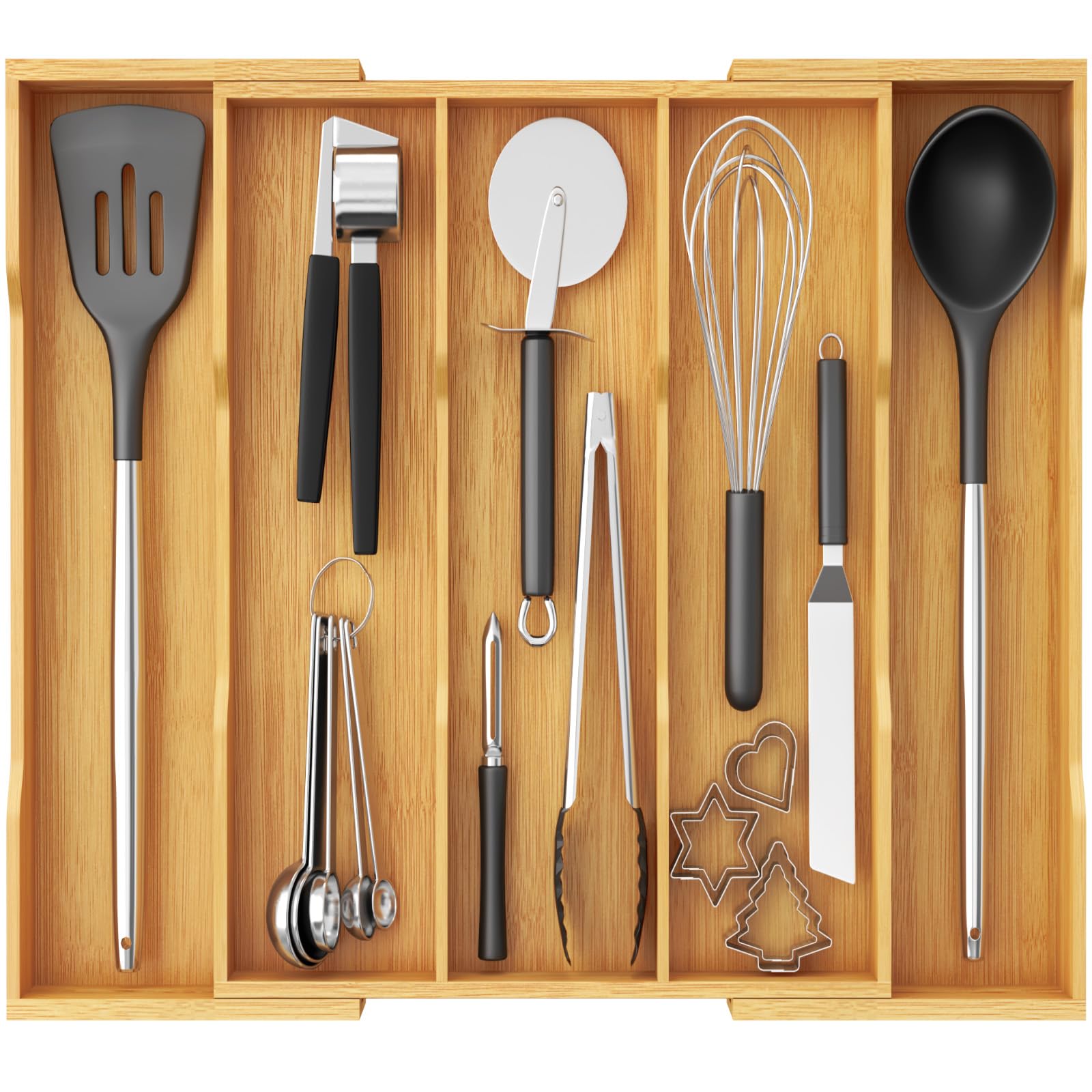
Three of the compartments here measure 12.9 by 3.7 inches — long enough for tongs, a ladle, a spatula and the wooden spoons that never fit a cutlery tray. The whole thing expands from 12.6 to 22.8 inches, the widest range in this group, and goes from three slots to five as the sides slide out.

That layout is why ours lives in the drawer beside the stove, where tongs, a ladle and two spatulas used to lie in a heap. Long slots let those tools lie flat instead of leaning, and the bamboo is finished smoothly enough for a damp cloth to handle cleanup.

Height is 1.8 inches and depth 14, so it slips under a counter lip that stops deeper trays, and the sliding sides set the width to the inch rather than to a preset notch. The expansion is smooth rather than stiff, which is what you want on a wood slider.

Where it earns its place is width. At 22.8 inches fully open it covers drawers that leave the other trays rattling around, and the bamboo looks far better than a plastic tray doing the same job. If your drawer holds forks and knives and nothing else, the ukeetap or the Pipishell sorts them more finely.

Bottom line: Worth it if your drawer is wide and full of cooking tools; nothing else here reaches 22.8 inches.

8

Lifewit Compact Expandable Tray

Lifewit Compact Expandable Tray

Small, narrow drawers

Our Score 9.0/10
Check Price

Worth Noting

  • Hand wash only, so no dishwasher
Depth
11.2"
Height
1.4"
Width Range
8" to 13.8"
Compartments
7
Read the full review

Narrow drawers are where most organizers fail: a tray that expands to 19 inches is useless in a 9-inch gap. This Lifewit starts at 8 inches and stretches to 13.8, which puts it in a different class for apartment kitchens, camper galleys and the little drawer beside the stove. We keep one for exactly that reason — it fits where nothing else here does.

Seven compartments hold a small household's flatware comfortably, and the 1.4-inch height slides under a countertop lip that would stop a bamboo tray dead. The PP plastic is matte black, wipes clean, and hides scratches better than clear plastic does.

The compromise is capacity, and it's arithmetic rather than a fault. The slots are sized for teaspoons, forks and butter knives; chunky steak knives crowd the row, and a serving spoon won't sit down in it. At 8 to 13.8 inches wide, that's simply the space you have.

If your drawer clears 13 inches, get the ukeetap or a bamboo tray instead — more compartments, longer slots, an organizer that fills the space. This one earns its place in the drawer that has no room to spare.

Bottom line: The one to buy when the drawer is under 13 inches wide and every other tray here is too big to fit.

How We Tested 14 Kitchen Drawer Organizers

We started by gathering every organizer we could find that published real dimensions — expandable dividers, modular trays, bamboo inserts, wire baskets, and a few drawer liners with built-in compartments — then cut anything whose listed footprint wouldn't clear a standard-depth drawer or whose expansion range left an obvious dead zone at the sides. Price mattered less than whether the material and construction matched the job, so thin, flexible plastic trays that would bow under a stack of plates came off the list early. That left 14 units, which we lived with for six months.

Each organizer went into a real drawer and stayed there. We loaded silverware drawers until the tray was full, stacked baking sheets and cutting boards on edge, and let the junk drawer do what junk drawers do. We opened and closed each drawer dozens of times a day and watched for trays that slid out of position, dividers that let utensils migrate between compartments, joints that loosened, and corners that lifted when the drawer slammed. At the end of the first week and again at six months, we checked whether finishes had scratched, whether plastic had warped or yellowed, and whether the thing still looked like something you'd leave visible.

Fit got its own round of measuring. We compared each organizer's actual footprint against what the listing claimed, then tried it in drawers a half inch narrower, an inch shallower, and in one case obstructed by a drawer-pull screw. Last, we wiped each one with a damp cloth after a flour spill and a dribble of pasta sauce, and ran the dishwasher-safe ones through a cycle to see how the finish held up.

How to Choose Kitchen Drawer Organizers

Measure the inside of the drawer first

Take the inside width at the front, the inside depth front to back, and the clearance under the counter lip. Drawers taper, so measure at the narrowest point the organizer has to pass. Treat the word expandable as a maximum, not a promise: it tells you the widest the tray will go, never that it will reach your drawer's edge.

Height is the measurement people forget. Most trays here run 1.4 to 2.4 inches, and anything taller can foul a drawer front or a lip above it. Depth catches people too: a tray that's 16.5 inches front to back will jam in a 14-inch drawer however wide it opens.

Choose a format before a material

A fixed expandable tray gives every fork a lane and is the fastest thing to use, which makes it the right call for a cutlery drawer. Modular bins organize categories rather than individual pieces — baking, gadgets, the junk — and they adapt to a drawer that isn't a neat rectangle. Spring dividers build sections in a deep or wide drawer and move without tools.

If your drawer does two jobs, combine them: dividers for the structure, one tray or a few bins inside. That's usually better than forcing one product to do everything.

Bamboo, plastic or PET

Bamboo buys looks and weight. It sits still, feels solid and reads as part of the kitchen rather than an insert dropped into it. The trade is care and joints: wood wants wiping and drying, and the sliding joint on an expandable bamboo tray is the part to inspect, because that's where a forced side can split.

Plastic and PET trays are lighter, plainer and usually cheaper, and molded panels don't split the way a strained bamboo slider can. If the drawer is a working drawer rather than a showpiece, plastic is the more forgiving buy.

Count compartments against what you cook

Seven to nine compartments sort a family's flatware with room for serving pieces; five is plenty for one or two people. Slot length matters as much as slot count — if the drawer holds tongs, ladles and spatulas, look for compartments around 12 inches long or more, and check the depth of the slot against your fattest handle.

Before you buy, count what's actually in the drawer: a fork, knife and spoon per person plus the serving tools is the load the tray has to carry.

Frequently Asked Questions

Final Verdict

The ukeetap tray is what we tell most people to buy. It spans 12.4 to 21 inches, the widest range here, so it fills the drawer instead of sliding around inside it, and the BPA-free plastic wipes clean without the fuss of wood.

If the drawer is on show, the Pipishell's bamboo is worth the step up in looks and feel. And if your drawer is under 13 inches wide, ignore both and get the compact Lifewit — it's the one that actually fits.