Home Decor

Best Fireplace Accessories of 2026

Fireplace accessories are the least romantic part of a fire and the part that decides whether the evening goes well. I spent one winter tending a wood stove with grill tongs and an oven mitt, and by February I'd scorched the mitt, dropped a burning split across the hearth, and dusted the living room in ash twice. The right tools fix all of that — long enough to keep your hands back from the flames, heavy enough not to flex around a burning log, and built so the scoop, the hinge, and the lid still work in year five.

My team and I spent eight months with 12 pieces — three tool sets, a bellows, three pairs of gloves, two log carriers, two ash buckets, and a box of creosote treatments — across a stove insert, an open hearth, and a backyard fire pit. One thing first-time buyers get wrong: longer is not better. A 34-inch poker looks impressive on the stand and then bangs into a shallow firebox every time you turn a log. What follows are the pieces I kept reaching for, grouped by the hearth they suit.

1

Amagabeli Waxed Canvas Firewood Carrier

Top Pick
Amagabeli Waxed Canvas Firewood Carrier

Hauling firewood indoors

Our Score 9.6/10
Check Price

Worth Noting

  • Soft-sided, so it will not stand in for a log basket
Handles
Padded web with cinch strap
Material
Waxed canvas
Dimensions
40 x 19 inches
Water Resistance
Water resistant
Read the full review

The trail of bark and splinters between the front door and the hearth is the small daily tax on owning a wood fireplace, and this sling is the fix. It is 40 inches long and 19 wide, open at both ends, with a padded strap through the middle and a metal buckle that cinches a full load so nothing shifts on the way through the house.

Waxed canvas is the right material choice. Both the shell and the lining are water resistant, so the bag can sit on a snowy step or a wet deck without soaking the wood, and it is light enough to carry with one hand when empty. Padded handles sound like a small thing until you have carried a load in bare webbing; the center strap does most of the work of keeping a mixed pile of splits together.

What it is not is a log basket. It is soft-sided and open on top, so it will not stand beside the stove holding a week of wood — buy a holder for that and keep this for the trip in. As a carrier, though, it is the piece we reach for most often after the gloves, and it is the one that keeps a living room from looking like a wood yard.

Bottom line: Buy it if you bring wood through the house: a wide waxed-canvas sling that holds a full load, keeps the bark contained, and wipes clean.
2

F2C 5.5-Gallon Ash Bucket

F2C 5.5-Gallon Ash Bucket

Ash cleanup

Our Score 9.4/10
Check Price

Worth Noting

  • Lid is a loose cover, not a seal
  • Thin steel dents under a full load
Handle
Metal with wood grip
Capacity
5.5 gallons
Included
Bucket, lid, shovel
Material
Powder-coated galvanized iron
Read the full review

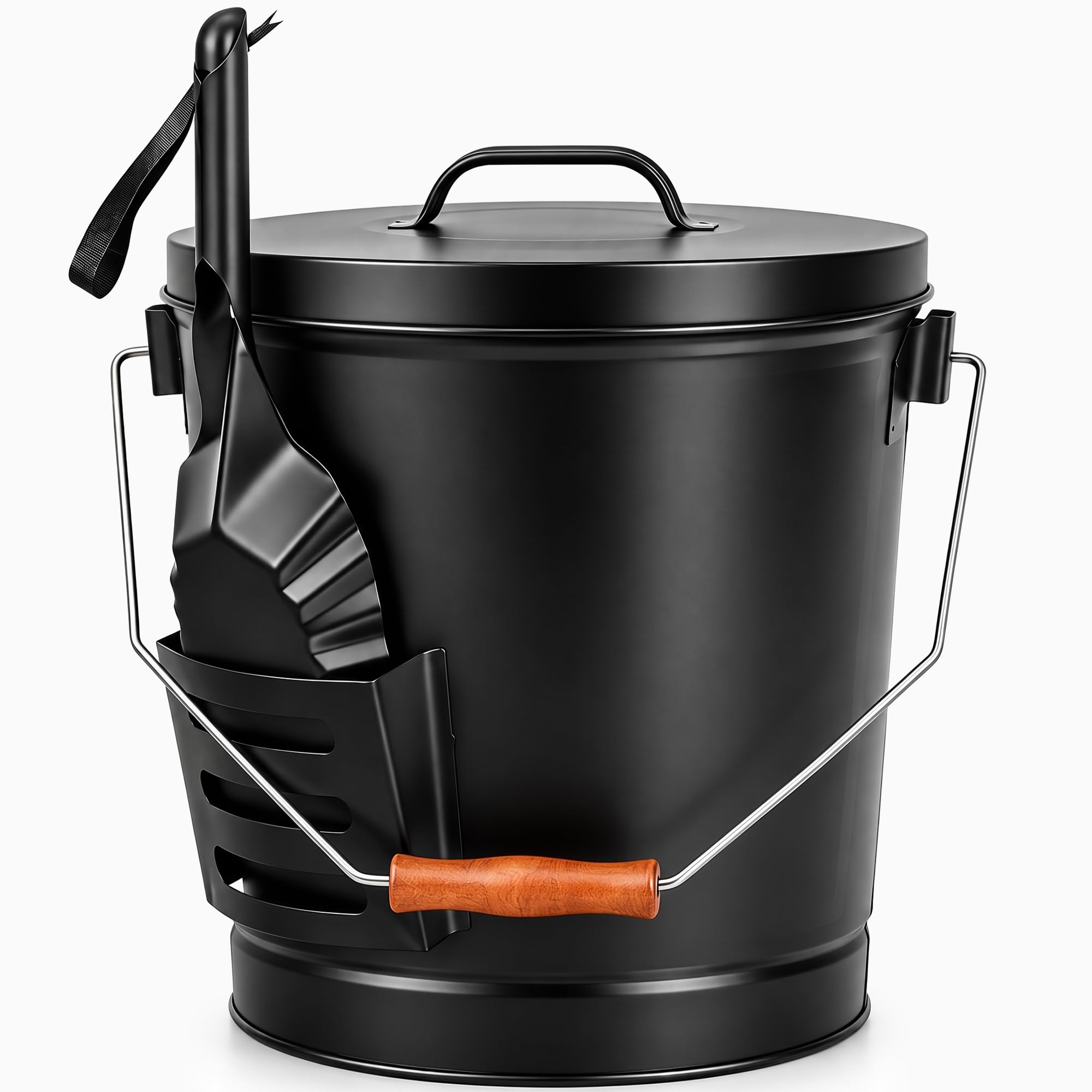
Cleaning out a firebox decides whether a fireplace feels like a pleasure or a project, and the answer is mostly capacity. At 5.5 gallons, this pail swallows the ash from several fires before it needs emptying — the difference between a weekly job and a morning ritual. The lid sits over the rim, the shovel clips into a pocket on the side, and the handle has a wood grip that stays comfortable when the bucket is heavy.

The steel is where the corners were cut. Galvanized iron with a black powder coat is the right idea, but the walls are thinner than a stove-shop pail's, and a knock against a stone hearth can leave a dent. Treat it as a bucket that lives in one place rather than something to swing at your side, and lift it from the base when it is full.

It earns its place beyond the fireplace, too. Fire pits, charcoal grills, pizza ovens — the job is the same, and the lid means you can carry ash through a room without a dust trail. For a wood stove that needs emptying every few days, that capacity is the whole argument.

Bottom line: The most useful thing we tested for the job nobody enjoys: a big lidded pail that turns a filthy cleanup into a short one.

3

whumsdog Magnetic Fireplace Cover

whumsdog Magnetic Fireplace Cover

Idle-season drafts

Our Score 9.4/10
Check Price

Worth Noting

  • Only grips a steel or iron surround
  • Soft panel can bow in a hard downdraft
Fit
Iron or steel frames
Magnets
12 built-in
Material
Flame-retardant oxford cloth
Dimensions
39 x 32 inches
Read the full review

An open flue in January is a hole in the wall. Cold air pours down it, the room nearest the fireplace ends up the coldest in the house, and the furnace works to make up the difference. Twelve magnets sewn around the edge of this quilted cover grab a steel fireplace frame and hold a flame-retardant oxford panel across the opening. Putting it up takes seconds, and taking it down takes the same.

Fit decides whether it works. The sizes run from 30 by 30 up to 51 by 39 inches, and the measurement that matters is your frame's outer edge, not the firebox opening — you want the panel to overlap metal on all four sides, or the magnets have nothing to pull against. Ours went over glass doors without any adjustment.

The routine is the only friction: it comes off before every fire and goes back up when the firebox is cold and swept, which becomes a two-second habit. In place it reads as a dark, empty firebox rather than a plastic sheet, and that is the part we did not expect — it does not undo a room you have decorated around the hearth.

Bottom line: If your fireplace sits cold half the year, this magnetic blanket stops the draft it leaks — as long as your surround is iron.

4

Billy Buckskin 10 lb Fatwood

Billy Buckskin 10 lb Fatwood

Lighting wood fires

Our Score 9.4/10
Check Price

Worth Noting

  • Strong resin smell where the box is stored
Form
Split sticks
Weight
10 lb
Material
Resin-rich fatwood pine
Per Fire
2 to 3 sticks
Read the full review

Fatwood is the old answer to a stubborn fire: pine stump wood so loaded with resin that it takes a match and holds it. This is the plain version — split sticks, no additives, ten pounds of them in a box. Two or three laid among the kindling is all it takes, and after a week of testing we stopped reaching for anything else to get a fire going.

The size of the box is half the appeal. It is enough starter that you stop rationing it, and a couple of sticks per fire means the box outlasts a winter's worth of kindling by a wide margin. It also lights when it is damp, which is the claim that matters most when your woodpile lives outside and the kindling is never quite as dry as you promised yourself it would be.

The catch is the smell. Fatwood is resinous, and a full box gives off a strong pine-tar odor that will scent whatever room it sits in — some people love it, and if you are not one of them, store it in a garage or shed. Against wax cubes, this is the choice when you want a wood fire that smells like one; the cubes are odorless and better suited to a grill.

Bottom line: The fire starter we keep coming back to: resin-rich pine that catches from a match, even damp, and needs two or three sticks per fire.

5

RAPICCA 16-Inch Fireplace Gloves

RAPICCA 16-Inch Fireplace Gloves

Tending live fires

Our Score 9.2/10
Check Price

Worth Noting

  • One-size glove runs roomy on smaller hands
  • Stitching can come apart under heavy use
Size
One size
Material
Fire-resistant leather, aluminum foil, cotton
Heat Rating
932°F (500°C)
Glove Length
16 inches
Read the full review

Every fire has a moment when the hand goes further into the firebox than is comfortable: a half-burnt split to reposition, a log that rolled forward, a poker left too close to the flames. That moment is what these gloves are for. Sixteen inches of fire-resistant leather, with 7.5-inch sleeves, covers the wrist and most of the forearm, and the exterior is rated to 932°F — the only piece in this roundup with a stated heat rating at all. We noticed the coverage before anything else about them.

Where they stop is worth knowing before you order. That rating describes the material, not a guarantee that you can carry a burning log across the room; heat builds through leather, and the foil layer in the middle slows it rather than stopping it. Short, deliberate grabs are what these are built for. The thick leather also makes fiddly work — flicking a lighter, turning a damper — clumsier than bare hands, which is the trade you make for the protection.

Against the tongs below, gloves do the jobs a grabber cannot: opening a stove door, lifting a hot grate, turning a log wedged against the back wall. They are also the accessory guests ask about, because a pair hanging by the hearth reads as a household that actually uses its fireplace. After a season, the palm is where wear shows first — which is exactly where you want it.

Bottom line: The first accessory we tell anyone with a working fireplace to buy: 16 inches of leather rated to 932°F, so hot logs stop being a two-handed gamble.

6

Stanbroil 26-Inch Fire Tongs

Stanbroil 26-Inch Fire Tongs

Reaching into the fire

Our Score 9.2/10
Check Price

Worth Noting

  • Shorter reach than a full-size tool set
Design
Scissor-action grabber
Length
26 inches
Storage
Folds flat
Material
Powder-coated steel
Read the full review

Twenty-six inches is shorter than the poker that comes with a full tool set, and that is the first thing we noticed — in a deep firebox you lean in further than is comfortable. What the length buys back is grip. The scissor jaws open wide enough for a big split and close tight on a half-burnt chunk, and the whole thing folds down to a short bundle that stores in a drawer or a camp tote.

Powder-coated steel is easy to live with: it wipes clean with a rag once it is cool, and there is nothing to come unscrewed, which is more than we can say for the jointed tools that dominate this end of the market. The folding pivot is the part to watch; keep it dry and it stays stiff instead of flopping open when you pick it up.

It pairs with the gloves rather than replacing them — tongs for reach, gloves for anything your hand has to go near, and between the two you can run a fire without touching a hot surface. For a shallow fireplace, a wood stove, or a fire pit, the grabber does most of what a five-piece set does, in a fraction of the space by the hearth.

Bottom line: A folding grabber that grips a split from either side without putting a hand near the flame — the cheapest thing here that earns its place.

7

Midwest Hearth Rock Wool

Midwest Hearth Rock Wool

Gas log glow

Our Score 9.2/10
Check Price

Worth Noting

  • For gas fireplaces only
Weight
6 oz
Venting
Vented and vent-free
Material
Asbestos-free mineral fiber
Fuel Compatibility
Natural gas and propane
Read the full review

Gas logs look like what they are — a burner under ceramic logs — until something glows where the flame touches. That is the whole job of this bag. The mineral fiber catches the flame and lights up like a coal, and a light dusting across the top of the burner changes the look of the firebox more than anything else in this roundup.

What surprised us is how little it takes. A full-size burner wants a fraction of the six ounces, and the rest keeps for the next time you rearrange the logs. The technique matters more than the quantity: brush a light dusting where flames will actually touch, do not pack it in, and keep it clear of the burner ports. Cover the holes and the flame runs uneven and patchy instead of glowing.

It is honest about what it is not. This is decoration, not heat, and it is for gas only — a wood fire has real embers and no use for it. It is listed for natural gas and propane, vented and vent-free, though your appliance's own manual comes first.

Bottom line: Six ounces of mineral fiber that turn a flat gas log set into a bed of glowing embers — cosmetic, and worth it if you have gas.

8

Pine Mountain Creosote Buster

Pine Mountain Creosote Buster

Chimney maintenance

Our Score 9.0/10
Check Price

Worth Noting

  • Not a replacement for an annual chimney sweep
  • Costs more per fire than a starter stick
Weight
3.5 lb
Frequency
Once a season or every 40 fires
Compatibility
Wood-burning fireplaces
Read the full review

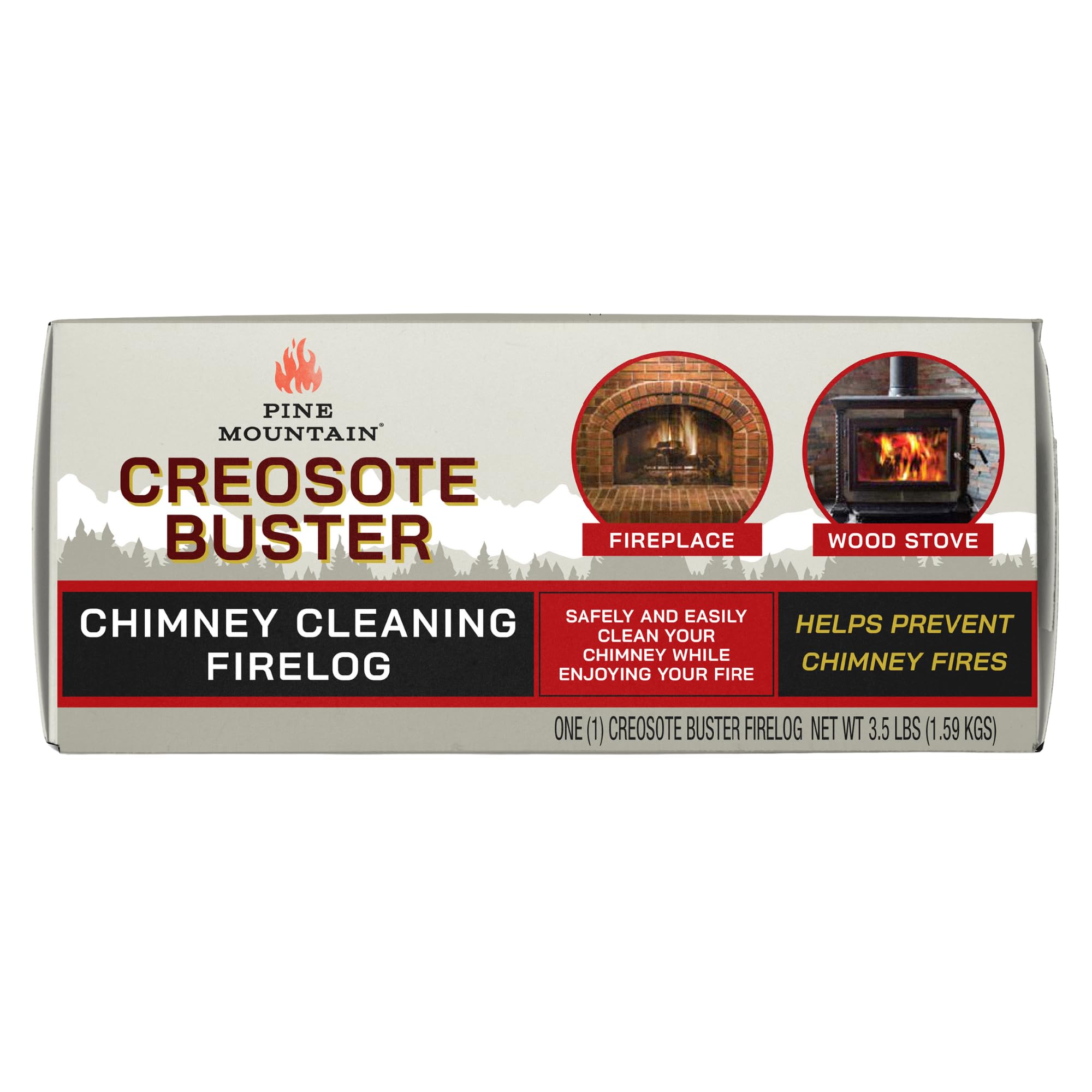
The pitch is simple: build a hot fire, add this log, and the powder inside vaporizes into a gas that goes up the flue and attacks creosote. One log per season, or every forty fires, added to a fire you were going to have anyway. The timing is what makes it useful — midwinter, when the flue has a few months of buildup and nobody wants to book a sweep in the middle of a cold snap.

The part that stays with us is what it does not do. A log in the firebox sends a finite amount of vapor up a chimney; it can loosen and dry light deposits, but glazed, tar-like creosote needs a brush and someone who knows how to use it. If you have had a chimney fire, or you have been burning wet wood all season, call a sweep before you buy a log.

Practical notes from testing: it lights like any firelog and burns about as long, and the smoke has a chemical edge that makes it a log for a day you are not sitting in the room. Some arrive cracked, which makes them harder to get going. Burn it with the damper wide open and let the flue do the work.

Bottom line: A once-a-season firelog that knocks back creosote between professional sweeps — useful maintenance, not a substitute for one.

How We Tested 12 Fireplace Accessories Through a Full Burn Season

Every pick started on a shortlist built from spec sheets and owner reviews, then got cut for the usual reasons: ornamental welds, gloves rated for oven racks rather than open flame, ash cans whose lids rested on top with nothing to clamp them down. The 12 survivors — three tool sets, a bellows, three pairs of gloves, two log carriers, two ash buckets, and a box of creosote treatments — went into eight months of fires in my stove insert, a neighbor's open hearth, and a backyard pit.

Tools were judged the way they're actually used: one hand, late at night, fire still live. I turned a half-burned split and noted whether the tongs twisted in my grip or the log slipped, then checked each poker handle bare-handed after 20 minutes beside the flames. Anything longer than the firebox could swallow got in its own way.

Gloves rearranged burning wood and lifted a hot grate, then sat on the hearth ledge between fires to see whether the leather stiffened or the palms went slick. The bellows got a stopwatch and a sulking bed of coals — I counted squeezes until the fire caught. Ash buckets were filled to the rim, carried downstairs, and set down hard to see if dust puffed out around the lid; log carriers were loaded with a week of splits and hauled across the yard. Every set was also priced per piece against buying the tools loose.

Creosote treatments burned to the letter of their instructions, and afterward I checked the flue for flaking and noted how the room smelled during and after — one left a chemical tang that outlasted the fire. At the end of the season, the metal spent two weeks outside to see what rusted, and I went back over every weld, hinge, and stitched seam.

How to Choose Fireplace Accessories

Start with your hands

We rank heat-rated gloves above any matching tool set, because they are the only accessory you reach for every single time. A stated temperature rating is a material claim, not a promise about how long you can hold something hot: leather slows heat transfer, and the cuff buys you the wrist and forearm. Look for 14 to 16 inches of length if your firebox is deep or the stove door swings toward you.

Tongs come next, and their job is reach rather than protection. A 26-inch grabber keeps your arm out of the flame while you reposition a log that is already burning. A matched five-piece set looks like better value, but the joint where handle meets tool is where cheap sets loosen, so buy the two tools you actually use.

Measure the surround, not the opening

Anything that covers the firebox is bought on dimensions, and the measurement people get wrong is which one. Size a magnetic draft cover to the outer edge of your fireplace frame so the panel overlaps metal on all four sides; matching the firebox opening leaves you a cover that barely reaches the magnets. A freestanding screen works the other way — it should be wider than the opening so it stands past the hearth.

Check the material before you fall for a magnetic cover. Magnets need steel or iron, so a stone, brick, or tile surround calls for a screen instead, however good the panel looks in the photos.

Match the accessory to the fuel

Wood and gas fireplaces share almost nothing but the opening. A wood burner needs a log carrier, a lidded ash pail, and long-handled tools. A gas log set needs none of those and benefits instead from ember wool, which glows where the flame touches it and adds nothing but looks.

Vented and vent-free appliances also differ in what they tolerate. A vent-free set burns inside the room, so anything you put in the firebox follows the appliance manual before it follows the bag. If you are outfitting both kinds of fireplace, buy for the one you use most and resist doubling up on tools.

Decide where it lives between fires

Fireplace gear is only convenient if it stays within reach, and the hearth is a small piece of real estate. A sling-style carrier folds flat on a hook behind the door, a five-gallon pail wants a corner of stone or concrete rather than carpet, and a folding grabber tucks into a drawer. Match the storage to the object before you buy, and the room keeps its shape.

The draft cover is the one accessory you will want to leave in place for months, so choose a size that overlaps properly and a finish that reads as part of the fireplace rather than a sheet stretched over it.

Frequently Asked Questions

Final Verdict

The gloves are the answer for most people: the only piece here with a stated heat rating, and the one that makes every other job on this list safer. If your fireplace sits cold half the year, add the magnetic cover. If you are hauling wood through a finished room, start with the carrier instead.

Buy the gloves first either way. They are the accessory that changes how a fire feels to run, and everything else on this page is a refinement of that.