Bedding

Best Wool Blanket of 2026

Wool blankets carry a reputation they mostly haven't earned. Say the word "wool" and plenty of people still picture the scratchy surplus-store blanket that lived in a car trunk — heavy, faintly sheepy, rough enough that you slept in a sweatshirt rather than touch it. Which is a shame, because a good one does something no fleece throw can: it traps warmth while still letting your body breathe, so you stay cozy instead of waking up clammy at 3 a.m. The right blanket is soft enough for bare legs on the sofa, weighty enough to feel reassuring rather than oppressive, and sturdy enough that ten winters from now it's still the one you reach for first.

My team and I spent seven months living with a dozen wool blankets, and the biggest surprise was how little the wool content told us on its own. Pure-wool blankets landed all over the map on softness and shedding, and a couple of blends quietly beat their 100 percent cousins on both. We also learned that the label lies less than the hand does — a blanket that feels slightly crisp out of the bag often softens within a week, while one that's buttery on day one can pill by February. What follows is what we'd hand a friend without a single caveat.

1

Desert Breeze Alpaca Wool Blanket

Top Pick
Desert Breeze Alpaca Wool Blanket

Cold bedrooms

Our Score 9.4/10
Check Price

Worth Noting

  • Pills where it rubs
  • One size only, full/queen
Care
Gentle machine wash or dry clean
Size
Full/queen, 86 x 82 in
Fiber
50% alpaca, 50% sheep wool
Weight
6 lb
Read the full review

No synthetic fiber at all: 50% alpaca, 50% Peruvian sheep wool, brushed on both sides and woven at a small mill in the Andes. That is a different proposition from every other blanket here, and it shows in the surface, which is smooth rather than fuzzy, with the stripes woven in rather than printed.

At 86 by 82 inches and about six pounds it is a bedding blanket, not a throw. Weight is the part that matters: it drapes over a full or queen mattress and stays there, and six pounds of alpaca and wool is why it sleeps warm without the three-in-the-morning overheat that heavy synthetics cause.

This is the one we point at for a bedroom you are actually dressing. Earth-tone stripes read as texture from across the room rather than as a pattern, and it is the only blanket in the group that looks like it belongs on a made bed. It is also the most expensive thing here by a wide margin, and what that buys is fiber and finish rather than versatility.

Care is a Saturday job: gentle cycle with no agitation, cool water, a mild wool wash, then lay it flat, or send it out. Expect a genuine sheep-and-alpaca smell for the first week or two; airing it on a line speeds that up, and then it is gone.

Bottom line: For a cold bedroom you are actually dressing, this is the pick: half alpaca, half sheep wool, six pounds of drape, and a brushed finish that is soft on bare skin.

2

PuTian Merino Wool Throw

PuTian Merino Wool Throw

Sofa styling

Our Score 9.4/10
Check Price

Worth Noting

  • Lightweight, so it is not a bed layer
Care
Machine wash cold, tumble dry low
Size
87 x 63 in
Fiber
30% merino wool, 40% polyester, 16% acrylic, 7% cotton, 7% nylon
Warmth Class
Lightweight
Read the full review

Bohemia orange, geometric stripes, 87 by 63 inches: this is the one that looks like a decision rather than a default, and it is the best sofa throw in the group. The print is bold without being loud, the kind of thing that pulls a room together, and it is wide enough that two people can share it without negotiating.

Underneath the pattern it is a merino-and-synthetic blend, with wool making up the smaller share and polyester, acrylic, cotton and nylon doing the rest. That is the honest trade: you give up the dense wool character of the Molithe or the Desert Breeze, and you get a blanket that is soft against bare arms, washes cold, and is the only one here that can go in the dryer on low. It is light, which is the point: a throw for the sofa and the foot of a bed.

Bottom line: The best-looking throw here and the easiest to live with: wide enough for two, soft against bare arms, and the only one you can tumble dry.

3

Arcturus Rainier Wool Blanket

Arcturus Rainier Wool Blanket

Beds and tents

Our Score 9.2/10
Check Price

Worth Noting

  • Wool-to-synthetic ratio is not stated
  • Some lint in the first wash
Care
Machine wash cold, line dry
Size
Twin, 88 x 64 in
Weight
4.5 lb
Sizes Offered
Throw, twin, queen, king
Read the full review

Four and a half pounds across 64 by 88 inches is the figure that decides this one: heavy enough that you feel it settle over you, light enough that you are not wrestling it at two in the morning. Arcturus builds the Rainier as a size range rather than a single blanket, throw through king, so the same weave goes over a sofa arm or across a mattress. That range is the main reason it is our top pick.

The care label seals it. Cold machine wash, line dry, and the blanket is pre-washed to limit shedding, which is more than most of the wool here allows and the reason this one gets used rather than saved. The edges are contrast-bound and lock-stitched, so the border is built to hold its line instead of fraying into a fringe after a winter of sofa duty.

Wool being wool, it arrives with a sheep-ish smell that mostly airs out; some arrive stronger than others, so unfold it over a chair for a few days before it goes on a bed. Underneath, it is warmer than 4.5 pounds suggests, without the clammy feeling a synthetic throw develops after an hour, and the fibers relax in the wash rather than stiffening.

What you do not get is a stated wool-to-synthetic ratio, so if the exact blend matters, and with a wool blanket it reasonably might, the Molithe states 100% and the Woolly Mammoth states 80%. For everyone else this is the safe buy of the article: bed-sized, washable, genuinely warm, and plain enough to leave out in a living room.

Bottom line: Our default pick: 4.5 pounds of washable wool blend in throw-to-king sizes, so it works as a sofa throw, a bed blanket and a tent layer.

4

Arcturus Military Wool Blanket

Arcturus Military Wool Blanket

Camp and car

Our Score 9.2/10
Check Price

Worth Noting

  • Sheds lint onto dark clothes
Care
Washable
Packed Size
19.33 x 12.01 x 5.04 in
Package Weight
4.37 lb
Read the full review

The number you will not find on this product page is the wool percentage, and it is worth saying plainly up front: this is a wool blend with a dense, classic blanket feel rather than a pure-wool heirloom. Everything else is spelled out well enough to plan around, including 4.37 pounds shipped, a bundle about 19 by 12 inches, a washable finish, and a design brief aimed at stadiums, picnics, cars and survival kits rather than at making a bed.

What the weight buys is a tight, heavy drape that stays where you put it. The density that makes it a poor bedspread makes it excellent on a cold bench, over a sleeping bag or under a dog on the back seat, and it softens with washing rather than stiffening.

New ones can carry a chemical edge that hangs about for a few days, so unroll it somewhere airy before it goes into a car or a cupboard; after that it is a faint wool smell and nothing more. Where it beats the fancier blankets is at being used hard. Mud, campfire smoke and a wash cycle are all survivable, and this is the one we hand people who want a wool blanket they do not have to be careful with.

Bottom line: The one we throw in the trunk: washable, dense enough for a cold bench, and cheaper than our top pick.

5

ACUSHLA Merino Wool Throw

ACUSHLA Merino Wool Throw

Decor throw

Our Score 9.2/10
Check Price

Worth Noting

  • Pattern is printed on one side only
Care
Machine wash cold
Size
79 x 63 in
Fiber
25% merino wool, 72% polyester, 3% nylon
Weave
Jacquard
Read the full review

A quarter of this blanket is merino wool. That is the number to start with, because the rest, 72% polyester and 3% nylon, decides what it is: a soft, light, patterned throw rather than a wool blanket in the traditional sense.

Judged as a throw, it is very good. The jacquard weave gives the pattern real definition, the surface is soft enough that nobody reaches for a sheet, and it is pre-washed to knock down loose fibers and odor. Sixty-three by 79 inches covers a sofa seat and a pair of legs with room over.

The colors hold through washing and it needs no careful handling, which is more than the wool-heavy blankets here can say. At this weight it is a three-season throw at best: lovely in October, not what you reach for in January.

Buy it for the look and the softness, not for wool warmth. If you want a patterned throw for a sofa or the end of a guest bed, it does that job better than anything else here. If you want the warmth of a real wool blanket, the Molithe is priced about the same and gives you four times the wool.

Bottom line: Buy it as a patterned throw, not as a wool blanket: a quarter merino, three-quarters synthetic, and one of the softest things here to sit under.

6

Molithe 100% Wool Blanket

Molithe 100% Wool Blanket

Pure-wool buyers

Our Score 9.0/10
Check Price

Worth Noting

  • One size, 62 by 86 inches
Size
86 x 62 in
Included
PU carry strap
Wool Content
100% virgin wool
Fabric Weight
600 GSM, fibers up to 25 microns
Read the full review

A cold tent is the job this one is built for, and it is the only blanket here that states 100% virgin wool on the label. Sixty-two by 86 inches, 600 GSM, fibers up to 25 microns, a PU strap for carrying it rolled: this is a camp blanket in the surplus tradition, olive and plain, not a throw for the sofa.

Twenty-five microns is what you are feeling when you first unfold it. That is coarser than the merino in the throws here, and it reads as a proper wool blanket: dense, a little robust against the skin, the thing your grandfather kept in the car. If softness is the whole point, look at the PuTian or the Desert Breeze; if you want wool that behaves like wool, this is the pick.

The strap turns out to matter more than it sounds, because rolled and buckled it goes on a pack or in a boot, which none of the other blankets here manage. Edges are reinforced against the seam wear that finishes cheap blankets, and washing it cold by hand keeps the hand-feel. Expect some fiber in the water, because a 100% wool blanket sheds a little and this one is no exception.

Bottom line: If the label has to say 100% wool, this is the one: virgin wool at 600 GSM, a carry strap, and a classic blanket feel rather than merino softness.

7

Stansport Wool Blend Blanket

Stansport Wool Blend Blanket

Budget backup

Our Score 8.8/10
Check Price

Worth Noting

  • Dry clean only
  • Thinner than a surplus blanket
Care
Dry clean only
Size
60 x 80 in
Weight
3.4 lb
Wool Content
55% wool, 45% synthetic
Read the full review

The cheapest wool blanket in this group, and cheap in a way that holds up: 55% wool, 45% synthetic, 60 by 80 inches, three and a half pounds, with a water-repellent finish and the ability to hold heat when it is damp. It is a camp blanket in the old sense: ground cover, tablecloth, an extra layer over a sleeping bag, a wrap for the stands.

Where it earns its place is as the blanket you do not have to protect, folded in a truck bed, in a guest-room drawer, over a dog's spot on the sofa, in a kit you hope never to open. Ours smelled faintly of burlap for a week and then settled, and a few days on a line does the same for most of them. Real cold is where it surprises you, because a 55% blend at this end of the range has no business being this warm.

Bottom line: A wool blanket for the truck, the guest room and the dog: 55% wool, three and a half pounds, and the lowest price in the group.

8

Woolly Mammoth Merino Blanket

Woolly Mammoth Merino Blanket

Softness first

Our Score 8.6/10
Check Price

Worth Noting

  • Dry cleaning recommended
  • Strong smell on some blankets
Care
Dry clean recommended
Size
66 x 90 in
Weight
4.3 lb
Wool Content
80% wool, 12% polyester, 5% nylon, 3% other fibers
Read the full review

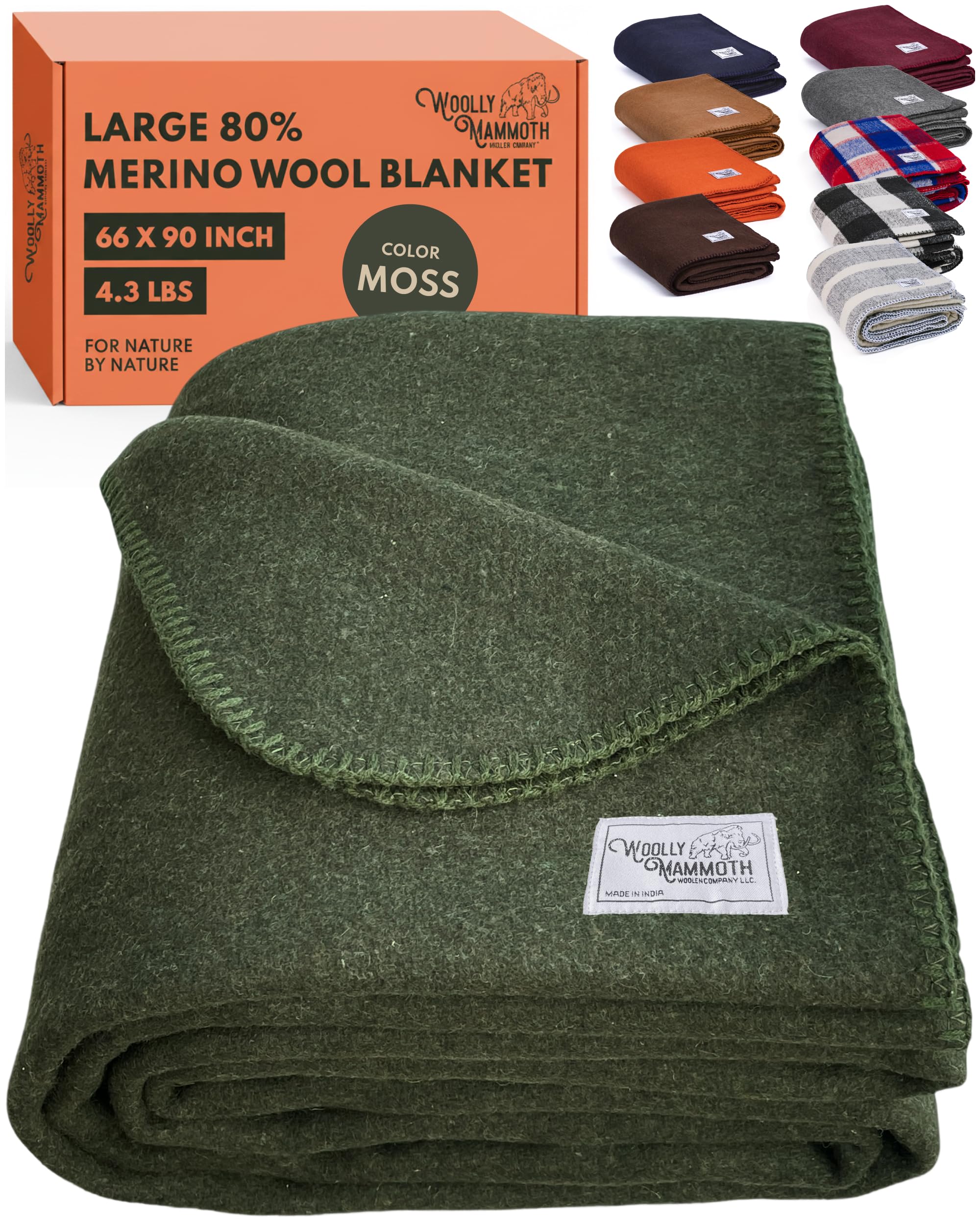
At 4.3, this is the lowest-rated blanket we kept, and it is still here because of how it feels in the hand: a tight twill weave, softer than most of the wool-heavy blankets in the group, and finished by someone who cared about the edges.

The fiber is 80% wool, and the wool in it is merino, which is where the softness comes from: 66 by 90 inches, 4.3 pounds, rolled into its own carry bag, so it travels without looking like camping gear.

In use it is the most comfortable of the wool-heavy blankets here. The twill is dense and even, the surface is smooth rather than fuzzy, and it does not prickle through a T-shirt the way a traditional blanket can. New ones do leave fibers on dark clothes for the first few washes before that settles.

The choice is softness against a number. This is the softer blanket by a clear margin; the Molithe is the purer one, and 80% is plenty of wool for anyone who wants warmth rather than a specification. It is the blanket we reach for on a cold evening when comfort matters more than provenance.

Bottom line: The softest wool-heavy blanket in the group: merino-rich, tightly woven and warm for its weight, with a hand-feel better than its rating suggests.

How We Tested the Best Wool Blankets

We started with more than 30 blankets from heritage mills and smaller weavers, then narrowed by three things: what the blanket is actually made of (pure wool, lambswool, merino, and recycled-wool blends all made the cut, synthetic-heavy ones did not), whether the care instructions were something a normal person would follow, and price spread — we wanted the cheapest credible option in the room alongside the most expensive. Twelve blankets came home with us, and we used them for seven months, from the first cold week of fall through a full winter.

Every blanket went into rotation rather than into a closet. They lived on the sofa for evening reading, went onto beds as an extra layer on genuinely cold nights, spent a week each on a guest bed, and were washed according to their own care labels. To judge softness, we laid each one against bare arms and the side of the neck — the spot that gives a scratchy wool away fastest — and noted whether the itch faded after a week of use. For warmth and comfort, we slept under each one alone with the thermostat turned down, and paid attention to whether it trapped heat evenly or left shoulders cold and shins sweating.

Weight got a kitchen scale and a real-world test: lifting each one off a shelf one-handed, and seeing whether it slid off the bed when someone rolled over. Shedding was checked by shaking each blanket out over a dark sheet and running a lint roller across a black sweater after a movie night underneath it. We smelled every blanket straight out of the packaging, again after a week on a bed, and once more after washing, since a woolly or chemical odor that lingers after a wash is the kind that doesn't leave. Durability came down to three wash cycles where the label allowed it, then a close look at pilling, seam and edge binding, and whether fibers were migrating into the air. Finally, we asked whether each blanket felt worth what it cost next to the least expensive one we tested — value here is earned by stitching and hand, not by a hangtag.

How to Choose the Right Wool Blanket

Wool percentage is the real price tag

Above 80% wool you are buying the fiber's actual behavior: warmth without much weight, a lanolin smell when it is new, and a blanket that creases and drapes like cloth rather than fleece. Drop to 55% or 30% and you are buying softness, washability and color. Those are legitimate things, especially for a sofa throw, but they are not the same blanket.

Our rule is 80% and up for a bed, a tent or anything that has to hold heat, and below that buy it for how it looks and feels rather than for wool's warmth. When a listing will not state the percentage at all, treat that as information too.

Size and weight decide where it lives

The word throw covers everything from a lap square to an 87-inch blanket, so go by the inches. Roughly 60 by 80 inches and three to four pounds is one person on a sofa, a car seat or a ground layer. Around 86 by 82 inches and six pounds is a full or queen bed. The crossover, about 64 by 88 inches at four and a half pounds, is the one to buy if you want a single blanket for the couch, the guest bed and the tent.

Heavier is warmer only up to the point where you stop wanting to move it. A dense six-pound blanket on a bed is a pleasure; the same blanket over your shoulders on a camping chair is a chore.

Buy the care label you will actually follow

Wool does not need washing often, but it does need washing properly, and the labels here sort into three groups. Cold machine wash and line dry is the easiest, and it covers the Arcturus blankets. A gentle cycle with no agitation and flat drying is the next step up, which is what the alpaca blend asks for. Hand washing or dry cleaning is the price of the most traditional fibers here, and if a maker sells its own wool wash next to a dry-clean label, take the hint about how much attention that blanket wants.

Hot water and a hot dryer felt wool. A blanket you cannot wash cold is a blanket that ends up in a cupboard, so be honest about the household it is going into.

What is normal when it arrives, and what is not

A new wool blanket smells of lanolin, which is to say sheep, and that fades over days to a couple of weeks; airing it outdoors speeds it up. Fiber in the first wash or two is normal for a blend and it settles down. What is not normal is a chemical, fuel-like smell that survives a wash and a week on a line. That is a treatment rather than the wool, and it is the one fault worth returning over.

Fire-retardant finishes have their place around a campfire, but they are also where that smell usually comes from, so air any treated blanket before it goes near a bed.

Frequently Asked Questions

Final Verdict

The Arcturus Rainier is the blanket to buy if you want one that covers a sofa, a bed and a tent: 4.5 pounds, four sizes, machine washable, and warm without being suffocating. It is the least fussy wool blanket here that still behaves like wool.

Spend elsewhere when the job is narrower. The Molithe if 100% wool on the label matters, the Desert Breeze if the blanket is going on a made bed in a cold room, the Stansport if it is going in the back of a truck. Each of those is better at something specific; none is better at everything.