Storage

Best Room Dividers of 2026

A room divider has to do two opposite jobs at once: create privacy and keep the room from feeling smaller. I’ve lived with more folding screens and panel dividers than I can count, and the difference between one that earns its footprint and one that becomes a tripping hazard comes down to hinges, weight, and finish. Over the past eight months, our team set up and lived with 12 dividers, and the pattern was clear. The right one gives you a defined workspace, a tucked-away guest corner, or a hidden shelf of clutter without a renovation.

Appearance mattered more than I expected: a divider sits mid-room, so its finish is on display. We checked whether you could see through the panels, whether it blocked enough light to create a separate zone, and how it felt to move from room to room. We also folded and unfolded each one daily and compared its cost against how solid and well-finished it felt. The picks below are the ones that stayed sturdy, moved without a wrestle, and looked intentional enough to leave out.

1

Roundhill Shoji 4-Panel

Top Pick
Roundhill Shoji 4-Panel

Bedrooms and offices

Our Score 9.4/10
Check Price

Worth Noting

  • Paper face has to be cleaned dry
Panels
4
Weight
15 lb
Material
Wood frame, heavy-duty rice paper
Overall Size
69.5"W x 70.5"H
Read the full review

Rice paper sounds like the fragile choice, and this screen overturns that assumption. The panels are a heavy, fiberglass-reinforced paper, taut in a natural wood frame, and they do the thing a good divider should do — stop the sightline without stopping the daylight. Stand on one side and you're a shape, not a person reading a laptop. Stand on the other and the room is still lit. At 70.5 inches tall it clears standing eye level for most adults, which is the line between a screen that feels like a wall and one that feels like furniture.

It arrives assembled, folds flat, and weighs 15 pounds, so one person can carry it from bedroom to office without taking it apart first. Four panels at 17 inches each come to 69.5 inches overall on paper. In practice you stand a freestanding screen in a shallow zigzag so it holds itself up, and that stance eats into the width — figure on closer to five feet of real coverage than six. Wedging one end into a corner or behind a sofa arm settles the whole thing.

What it won't do: it won't quiet a room, and the paper face wants a dry cloth rather than a spray. Neither is a problem for the job it's built for. The natural finish is also the most forgiving in this group — it doesn't announce itself the way a black frame does, so it works in a dining room and a home office without redecorating around it.

Bottom line: The one we point most people to: real visual privacy that still lets the daylight through, with nothing to assemble.
2

VEVOR 4-Panel Fabric Screen

VEVOR 4-Panel Fabric Screen

Blocking light

Our Score 9.0/10
Check Price

Worth Noting

  • Ships creased; iron before assembly
  • Assembly instructions are thin
Panels
4
Weight
17.4 lb
Material
Coated polyester, steel frame
Overall Size
89.8"W x 67.9"H
Read the full review

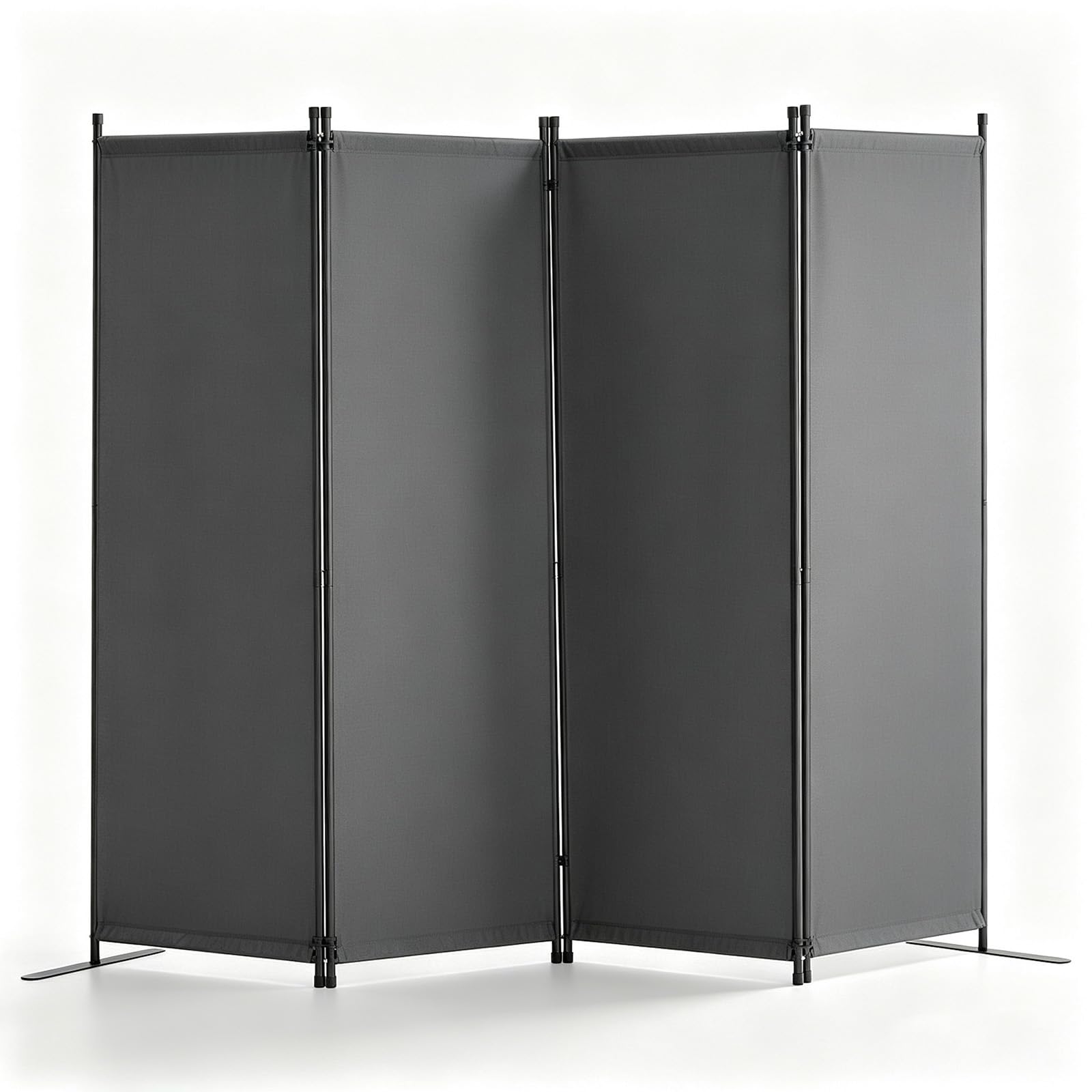
Every other screen in this guide is a sieve for light. This one isn't: the panels are 180 g polyester with a coating on them, so a lamp on the far side stays on the far side. Four panels open to 89.8 inches wide and 67.9 inches tall on a carbon steel frame, and unlike the folding wood screens it stands on two metal bases rather than on its own zigzag.

That makes it our pick when privacy has to include light — a sofa bed in a studio, a corner where someone sleeps, a glass door you'd rather not be seen through after dark. The grey fabric is the plainest thing here, and the most effective at what a divider is nominally for.

The trade is assembly. The frame snaps together and one person can manage it, but the instructions are thin, and the fabric arrives creased — iron the panels before you clip them on, or you'll be looking at those folds for as long as you own the screen. At 67.9 inches it also runs two or three inches shorter than the tallest screens here, so it screens a seated sightline more surely than a standing one.

Bottom line: Buy it when privacy means light too: a coated fabric screen that stops the lamp behind it, on feet instead of a balancing act.

3

HOMCOM 3-Panel Wicker Screen

HOMCOM 3-Panel Wicker Screen

Small spaces

Our Score 9.0/10
Check Price

Worth Noting

  • Covers only about four and a half feet
Panels
3
Weight
8 lb
Folded Size
17.7"W x 2.4"D x 70.9"H
Overall Size
53.1"W x 70.9"H
Read the full review

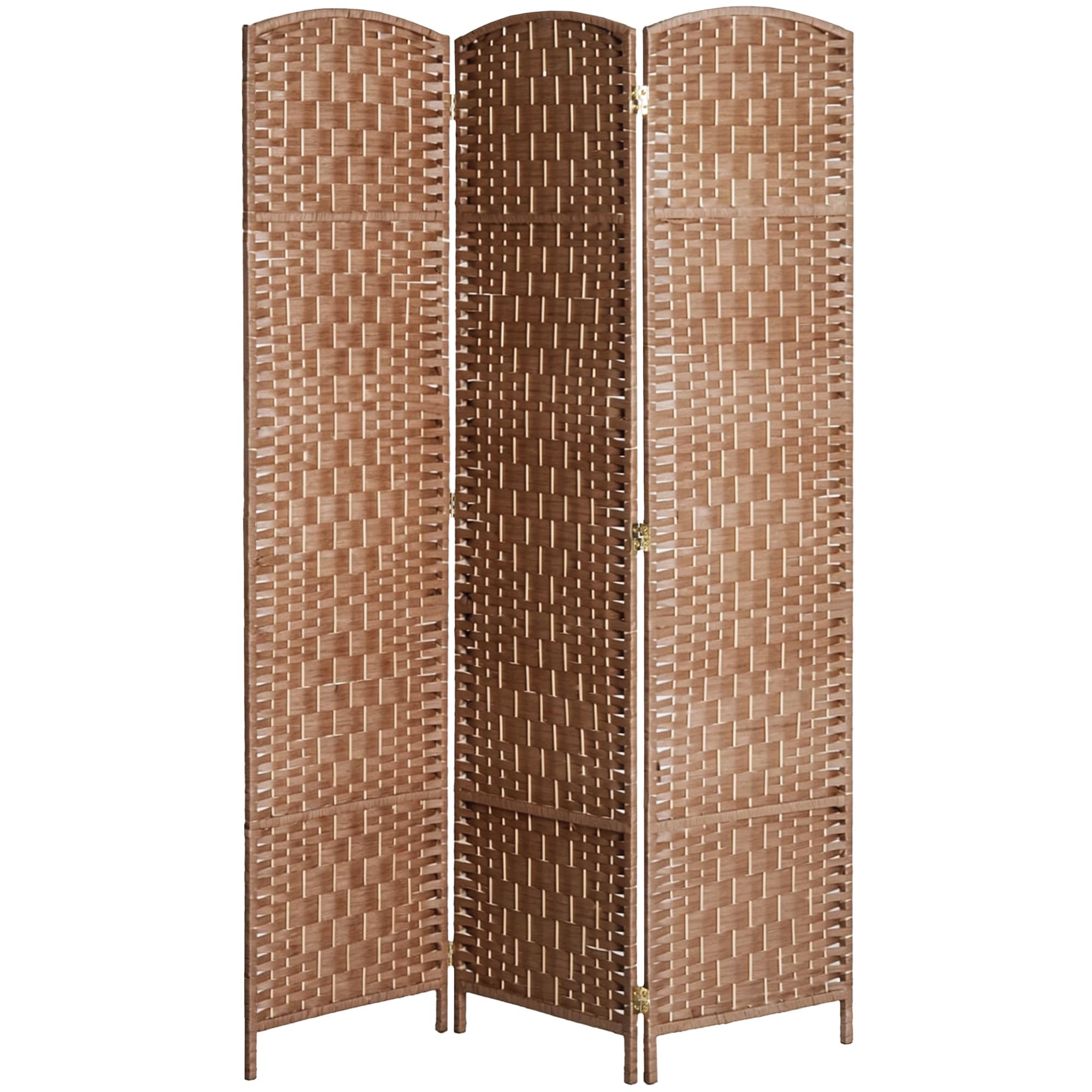
This is the divider for the corner that needs hiding rather than the room that needs splitting. Three panels open to 53.1 inches wide and 70.9 inches tall, and the whole thing weighs 8 pounds — light enough to lift over a bed with one hand and reposition while you're still deciding where it should go. For a litter box, a water heater, an exercise bike or the gap between a desk and a wall, that's the right amount of screen.

The paper-rope diamond weave sits in a poplar frame with an arched top, which is why it reads as furniture from either side rather than a barrier someone put up in a hurry. The 360-degree hinges let it stand in a Z or a W with no base at all, and on a hard floor that stance holds better than the panel count suggests. What it can't do is divide a room: 53 inches is a corner's worth of coverage, and the fourth panel that would make it a room splitter isn't there.

Bottom line: For corners, not room splits: 8 pounds of woven screen that hides the clutter without walling anything off.

4

RHF 4-Panel Room Divider

RHF 4-Panel Room Divider

Tight budgets

Our Score 9.0/10
Check Price

Worth Noting

  • Open weave gives only partial privacy
  • Light frame shifts with a knock
Panels
4
Weight
8.9 lb
Panel Width
16 inches
Overall Size
63"W x 71"H
Read the full review

It's the least expensive route to a six-foot screen in this group, and the numbers don't read like a compromise: four 16-inch panels, 63 inches across, 71 inches tall, 8.9 pounds, a dark coffee finish and a bent-wood arched top. If you want the outline of a proper folding screen without spending much, this is where the search ends.

What the money doesn't buy is opacity. The medallion diamond weave is open enough that a lit room on the far side shows through, which makes it a screen for hiding a washer-dryer stack, a changing corner or a shelf of boxes rather than a bedroom split. The short legs lift the bottom edge clear of the floor, so it doesn't gather a grey stripe along the hem the way a panel sitting flush does.

Judged as a utility screen, it earns its place. The coffee finish hides scuffs better than the pale beiges here, the two-way hinges fold in either direction, and 8.9 pounds means you can move it whenever the room changes. It will shift if someone knocks it, so give it a wall or a sofa back to lean into.

Bottom line: A six-foot screen for very little money: fine for a utility corner, too open for a bedroom split.

5

FDW 4-Panel with Shelves

FDW 4-Panel with Shelves

Home office

Our Score 9.0/10
Check Price

Worth Noting

  • Tips with a solid knock
Panels
4
Shelves
2
Material
Wood
Panel Size
17.3"W x 71"H
Read the full review

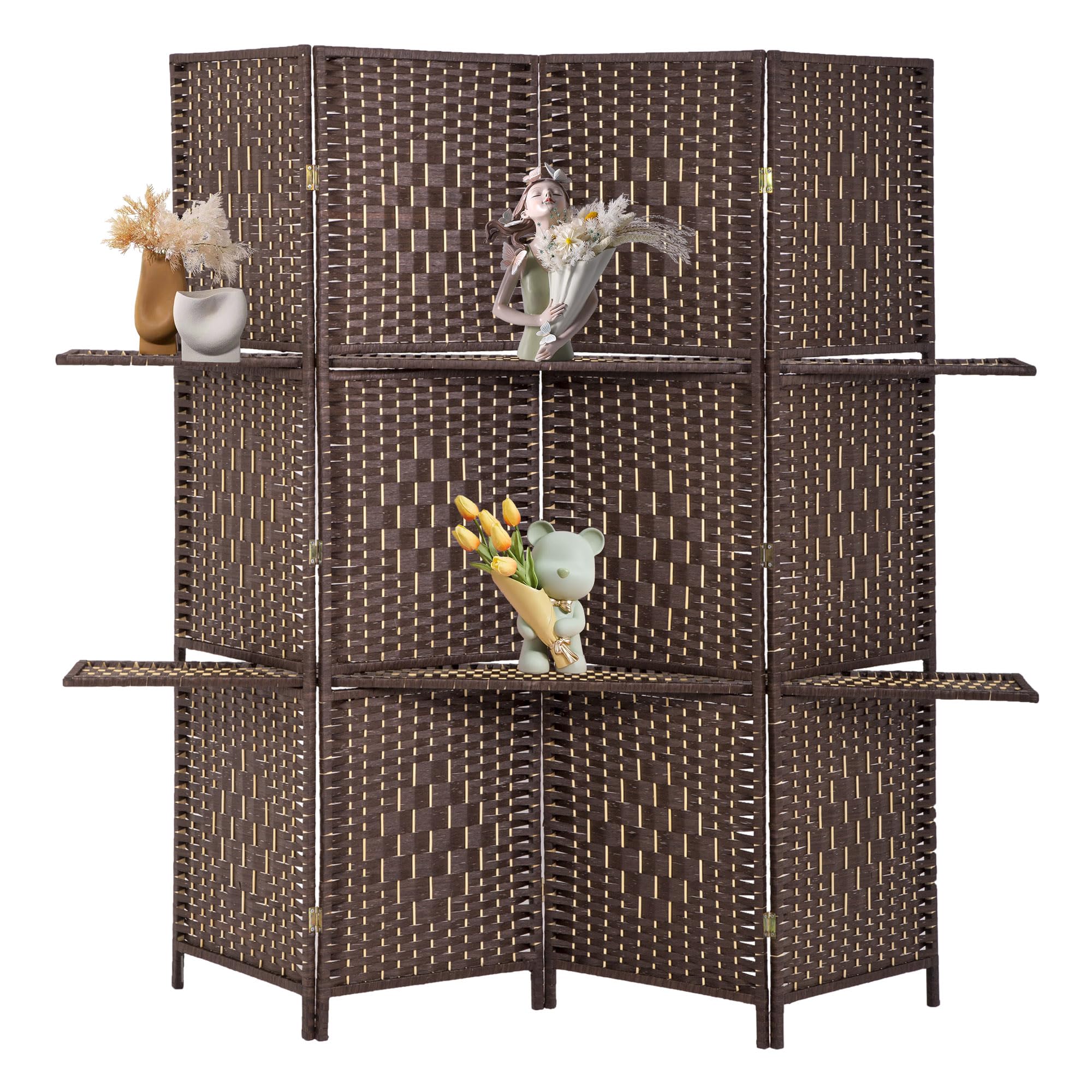
Two shelves run through slots in the panels and are usable from either side, which makes this the one screen here that does a second job. Set it around a desk and it divides the room while holding the things that would otherwise be stacked on the floor beside it.

Setup is an unfold and two slides: the shelves drop into their slots with no tools and no hardware, and the panels are 17.3 inches wide by 71 inches tall, so four of them give you a full six feet of screen. Take the shelves out and it folds down like any other divider.

The caveat is what goes on the shelves. Frames, a plant, a couple of paperbacks — not a bookcase's worth. It's a folding screen with storage let into it, not a shelf unit that happens to fold, and a solid knock still moves it, so it's happiest at an angle against a wall.

Judged against the plain screens in this guide, it does noticeably more for slightly more money, and it's the only pick that solves the clutter problem at the same time as the privacy one. If the desk moves out next year, it becomes an ordinary room divider — not a bad second act for a piece of furniture.

Bottom line: For a desk that has to live in a living room, this is the one: it screens the workspace and gives the clutter somewhere to go.

6

JOSTYLE 6-Panel Rattan Divider

JOSTYLE 6-Panel Rattan Divider

Wide openings

Our Score 8.8/10
Check Price

Worth Noting

  • Open weave shows shapes against a lamp
  • Frame feels light for the price
Panels
6
Weight
Under 14 lbs
Material
Rattan, wood frame
Overall Size
118.2"W x 71"H
Read the full review

118 inches is the number to hold onto here. Six panels, 71 inches tall, nearly ten feet of coverage — enough to cut a studio apartment into a sleeping end and a living end instead of merely hinting at a boundary. It weighs under 14 pounds, so one person can walk it across the room and reset it in a different shape without folding it down first.

We like it for the blank wall that a four-panel screen leaves half-finished, and for renters who can't put up a track and a curtain. The rattan weave is open, though, so it's a sightline screen rather than a privacy one: with a lamp on the far side, shapes read through. In daylight it's handsome; at night it's suggestive.

Two-way hinges let the panels fold in either direction, which matters more than it sounds in a corner where the screen has to wrap around a sofa. The sage green is the most decorative option in this group and the one most likely to be mistaken for a piece of furniture rather than a temporary fix — which is the point of buying a divider that wide in the first place.

Bottom line: For a long, open wall you actually want divided: nearly ten feet of screen that one person can walk across the room.

7

FDW 4-Panel Woven Screen

FDW 4-Panel Woven Screen

Zoning a room

Our Score 8.8/10
Check Price

Worth Noting

  • Tips over with a light knock
Frame
Wood, matte black
Panels
4
Weight
15.4 lb
Panel Size
18"W x 71"H
Read the full review

Give this one a nudge and it goes over. That's the honest starting point for a 15.4-pound screen standing six feet tall on nothing but hinge friction, and it's something to plan around rather than be surprised by. The fix is placement, not reinforcement: an angle, a wall, a piece of furniture behind it.

What you get in return is a lot of screen for the money. Four panels at 18 inches each give six feet of coverage, the frame is wood in a matte black finish with a hand-woven mesh over it, and it arrives assembled and folds flat. At 15.4 pounds it has enough substance to feel like furniture rather than a prop, which is more than the lightest screens here manage.

Set it in a shallow zigzag with one end against a wall, or behind a sofa where nobody walks into it, and it does its job quietly — the black mesh reads as a considered dark screen rather than a temporary partition. Stand it in a straight line across a doorway and you'll be picking it up twice a day. Between this and the shelved version from the same maker, this is the one for pure screening.

Bottom line: Buy it for a zone nobody brushes through — a bed area, a storage nook — and it settles in; put it in a hallway and you'll be picking it up.

8

COCOSICA 6-Panel Woven Divider

COCOSICA 6-Panel Woven Divider

Large bright rooms

Our Score 8.8/10
Check Price

Worth Noting

  • See-through when lit from behind
  • Woven face is the first thing to suffer
Frame
Solid wood
Panels
6
Panel Width
15.75 inches
Overall Size
94.5"W x 70.5"H
Read the full review

Woven is not the same as opaque. Put a lamp on the far side of this screen and the diamond weave gives it away; in a bright room with nothing behind it, the question never comes up. That distinction decides which rooms the screen can go in, and it matters more here than the panel count.

The panel count is generous, though: six panels at 15.75 inches, 94.5 inches wide and 70.5 inches tall when extended, in a solid wood frame with a gently arched top. Nearly eight feet of coverage, no tools, and light enough that moving it is a one-person job — the kind of divider that turns a long room into two without putting up a wall.

The weave is also the soft point. It's what makes the screen look good, and it's the part most likely to suffer — a separating or torn face is the failure that comes up. Sturdiness belongs to the same story: this is a screen you set in a zigzag and leave, not one you rearrange every week. Do that, and neither issue is a daily worry.

For a wide, bright opening it makes real sense: nearly eight feet of coverage for less than the shoji screen costs, and from across the room it looks like joinery rather than a temporary fix.

Bottom line: For a wide, bright opening where you want the room softened rather than sealed, six panels and nearly eight feet of it.

How We Tested Room Dividers

We began by researching the room dividers with the most consistent praise in retailer reviews and editorial roundups, then filtered the list by material, dimensions, assembly requirements, and price. We dropped anything with repeated complaints about wobbling, missing hardware, or panels arriving damaged. The final 12 included folding screens, panel dividers, and freestanding partitions in wood, fabric, metal, and mixed materials.

Testing ran for eight months in real rooms: a small apartment living room that doubles as a home office, a guest bedroom corner, and a studio space where I needed to hide a shelf of supplies. I set up each divider solo and noted whether the hardware matched the instructions and whether the frame felt tight. Then I lived with each one for at least two weeks, walking past it daily, opening and closing the panels, and moving it between carpet and hardwood to see whether it slid, dragged, or caught.

To judge sturdiness, I gave each one a gentle shoulder bump and a nudge with the vacuum, then checked for wobble, sway, and hinges that pulled loose. For privacy, I stood on the other side in daylight and at night to see whether silhouettes or clutter showed through, and whether the divider blocked enough light to define a zone without making the room gloomy. For appearance, I looked at the finish up close and from across the room, checking for uneven seams, visible fasteners, and fabric that wrinkled or sagged. For value, I compared the materials, hardware, and stability against the price, and asked whether I would move it to a new home or leave it behind.

I also weighed and carried each divider up a flight of stairs and through a doorway, because a divider that is miserable to move tends to stay put. The highest scorers were not the heaviest or most expensive; they stood firm, looked good from both sides, and were light enough to reposition when the room changed.

How to Choose Room Dividers

Decide what the screen has to stop

Two families do two different jobs. Paper, rattan and woven screens give you a silhouette barrier: nobody on the far side can make out what you're doing, but daylight still crosses, so the room behind doesn't go dark. Coated fabric stops the sightline and the lamp together, which is what you want if someone sleeps there or a bright window sits behind the panels.

The test takes ten seconds. Stand where the screen will go with the light on behind it, and see whether you'd accept being seen as a shape. If you wouldn't, buy the fabric screen.

Count panels, not the width in the title

A freestanding screen only stands up when its panels are angled, and the angle costs you width. Four 17-inch panels are quoted at around 69 inches, but once they're zigzagged, figure on closer to five feet of real coverage. Read the panel count as the honest measure and treat the overall width as a ceiling rather than a promise.

As a rule: three panels suit a corner, four handle a bed or a desk nook, and six are for a long wall or splitting a studio. Buying a four-panel screen to divide an eight-foot run leaves both ends open, which is how dividers end up looking like decorative punctuation.

Match the height to the sightline

Nearly everything worth buying in this category is six feet or just over, which is the height at which a standing adult can't see over the top. Drop to 67.9 inches — the fabric screen here — and you're screening a seated sightline far more reliably than a standing one.

So check who needs to be hidden. Privacy from someone sitting at a desk is solved at six feet. Privacy from someone standing in a doorway needs every inch, and the shorter screens give it away at the top edge.

Stability is a stance, not a spec

Shoppers look for sturdiness and get a frame that doesn't rack, which is not the same thing as a screen that won't tip. With nothing fixed to the wall, what holds these upright is the angle of the panels, the friction of the floor, and whether anyone walks into them.

Carpet grips; smooth wood lets the panels slide. Two metal bases, as on the fabric screen, are the only real departure from the zigzag rule in this group. If the screen will sit in a corridor, choose the one with bases.

Setup, folding and where it lives

Most folding screens arrive assembled — unfold, place, done. The fabric panel screen is the exception: its frame clips together, so plan a session with the connectors and an iron before it looks like the photo.

Folded, these screens are shallow. The three-panel one here closes to 17.7 inches wide and 2.4 inches deep, which is something you can stand behind a door or slide into a closet. Two-way hinges earn their keep in a corner, where panels need to fold in both directions to wrap a sofa.

Frequently Asked Questions

Final Verdict

The Roundhill shoji screen is the one we recommend first, because most people asking for a room divider want exactly what it does: to be out of sight without sitting in the dark. Its limits are the limits of the category — it stands at an angle, and it doesn't stop sound — but nothing here handles the everyday job better.

If light is the problem rather than sight, the VEVOR fabric screen is the one that actually blocks it. And if the opening is long, the six-panel JOSTYLE covers nearly ten feet where the four-panel screens give up around five.