Storage

Best Garage Shelving of 2026

The first time I tried to park in my own garage, I had to squeeze past a tower of plastic bins that leaned like a game of Jenga waiting to lose. Garage shelving is supposed to fix that—give the rake, paint cans, and holiday boxes a place off the floor so the car fits again. But the wrong unit becomes its own problem: shelves that sag under a single tote, brackets that strip halfway through assembly, and a footprint that fights the water heater for space.

Over the past eight months, I've lived with 12 different shelving units—some assembled solo in twenty minutes, others that needed a second person and patience—and the ones worth keeping held a full load without a wobble. They fit the odd strip of wall between the door and the utility sink and looked tidy enough that I stopped noticing them. A garage shelf is only as strong as its weakest joint, usually where the particle board meets the post, and that's the first place I check now. Below are the units that earned their footprint.

1

REIBII 55.5-Inch Shelving

Top Pick
REIBII 55.5-Inch Shelving

Heavy garage loads

Our Score 9.6/10
Check Price

Worth Noting

  • Wants 55.5 inches of uninterrupted wall
Shelves
5
Shelf Surface
Wire
Weight Capacity
3,200 lb total
Assembled Dimensions
55.5" W x 18" D x 71" H
Read the full review

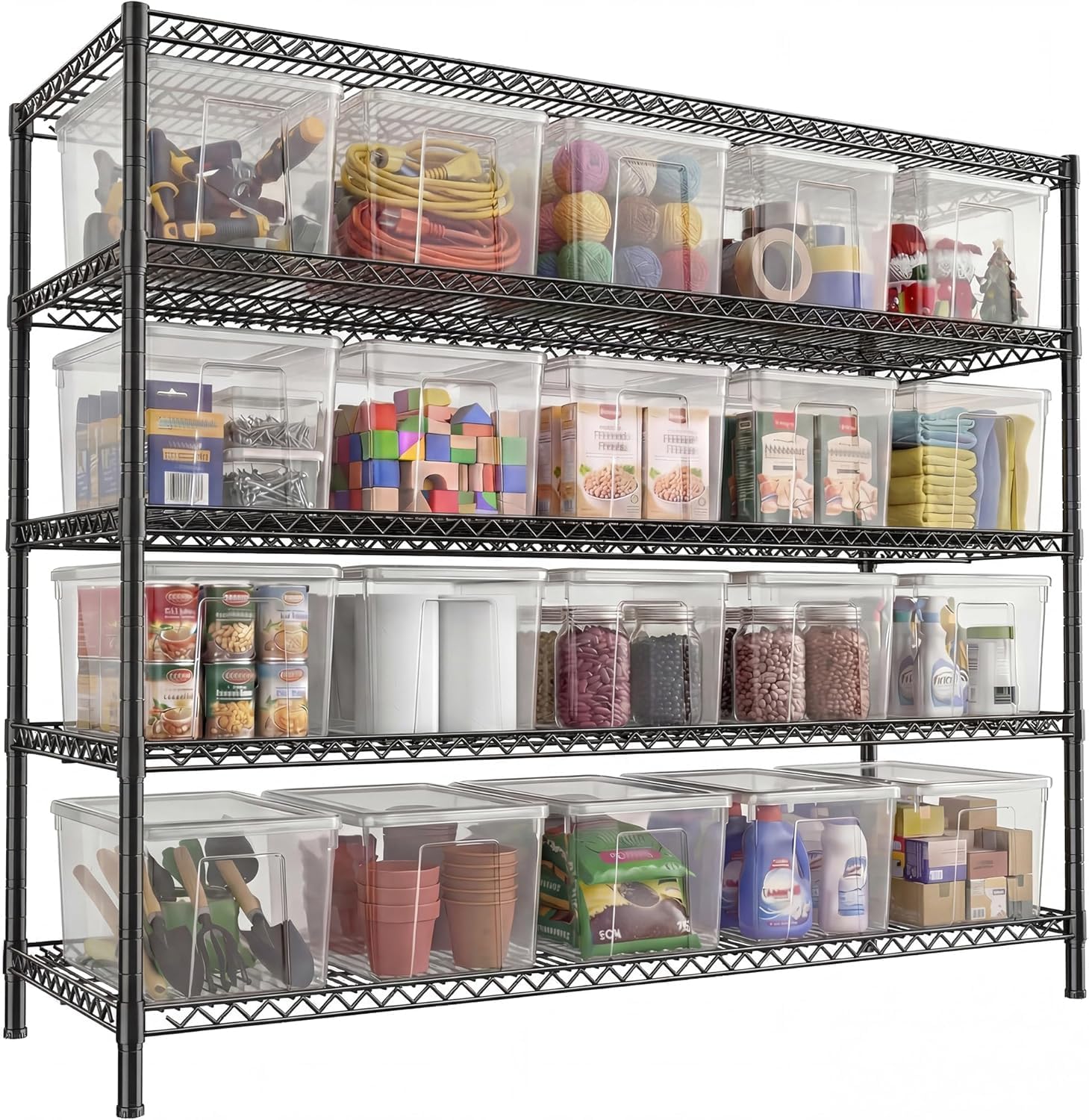
At 55.5 inches wide and rated for 3,200 pounds, this is the widest rack in the guide and second only to the Seville on load. What settled it as our top pick is the pairing: width is what makes a garage feel organized, because long bins, folded camp chairs and cases of bottled water finally have somewhere to go that isn't the floor, and the frame is rated to take them.

Assembly is the other half of the argument. Posts and shelves press together without a single bolt, and the V-braces under each shelf are what the load rating hangs on. The top deck finishes at 71 inches, so the last shelf goes on above most people's reach — set it before the frame gets tall, or stand on the second shelf the way we did. The anti-tip bracket and the leveling feet both come in the box, and in a garage those are not extras: slabs run downhill toward the door, and a rack that rocks never stops rocking until you dial the feet out.

Eighteen inches of depth is the quiet win. That's a row of 12-inch storage bins or a line of oil jugs with a walkway left over. Wire decks let dust sift through rather than settle, though anything small — screws, washers, single-serve packets — needs a liner underneath. What you're buying here is the shape of the thing as much as the rating: a long, low-clutter wall that swallows the awkward items the shorter racks turn away.

Bottom line: The rack we recommend for most garages: the widest deck here, near the top of this set on load, and it goes together without tools.

2

AOAORGG 45.6-Inch Shelving

AOAORGG 45.6-Inch Shelving

Wide light storage

Our Score 9.4/10
Check Price

Worth Noting

  • 440 lb total is light for its width
  • MDF boards don't suit a damp garage
Shelves
5
Shelf Surface
Metal frame, MDF boards
Weight Capacity
440 lb total
Assembled Dimensions
45.6" W x 17.7" D x 71.2" H
Read the full review

Forty-five inches wide and rated for 440 pounds total: those two numbers don't sit comfortably together. Width is usually what you pay for in capacity, and here the rating is a fraction of what the wire racks across a similar span will take. That's not a dealbreaker for a garage storing holiday boxes, but it's a sorting decision you make before assembly rather than after.

What you get is a wide frame with pre-punched notches for shelf height, corner connections that lock it square, and anti-slip foot caps that protect a painted floor. Assembly wants a rubber mallet and a wrench and asks for two people — nothing unusual at this height, but worth knowing before you start alone on a Saturday.

For paper goods, sports gear, pantry overflow and the seasonal boxes that clutter a garage, the width is exactly right and the MDF decks look tidier than open wire. For a shelf of paint cans or a wall of liquids, put the money into the REIBII or the Seville instead; this one is for the garage that needs space rather than ballast.

Bottom line: A wide, tidy rack for light garage storage — as long as you keep it to boxes and paper goods rather than a wall of paint cans.

3

Amazon Basics 5-Shelf Rack

Amazon Basics 5-Shelf Rack

Budget garage storage

Our Score 9.2/10
Check Price

Worth Noting

  • Wire decks drop small parts without a liner
Shelves
5
Weight Capacity
1,750 lb total
Shelf Adjustment
1-inch increments
Assembled Dimensions
36" W x 14" D x 72" H
Read the full review

Fourteen inches of depth is the number that decides this one. Cases of bottles, paint cans, toolboxes, a shop vac, jars of screws — all fine. A 27-gallon tote is not: it hangs over the front edge and no amount of shelf adjustment fixes that. If the garage storage plan is built around big black-and-yellow bins, this isn't the rack for it, and one of the 24-inch picks is.

What it is, is the sensible first rack. Each of the five wire shelves carries 350 pounds, they move in one-inch steps so a tall bottle or a deep bucket only costs you the space it needs, and the whole thing goes up by hand — no tools, no hardware, no second person for the bulk of it. A 36-inch rack disappears into the corner of a one-car garage without crowding the car door, which matters more in daily use than any number on the box. Set the leveling feet, load the bottom shelf first, and it settles into something far steadier than its 27 pounds suggests.

Bottom line: We point first-time buyers here: 350 pounds a shelf, a 36-inch footprint that fits almost any wall, and assembly by hand.

4

Seville Classics UltraDurable

Seville Classics UltraDurable

Rolling heavy loads

Our Score 9.2/10
Check Price

Worth Noting

  • Chrome finish is specified for dry spaces
Shelves
5
On Casters
500 lb total
Weight Capacity
800 lb per shelf
Assembled Dimensions
48" W x 18" D x 72" H (75" H with wheels)
Read the full review

Three-inch casters are the reason to start here. A loaded rack rolls across a concrete slab instead of being dragged an inch at a time, and the wheels lock so it stays parked. The catch is the one every caster conversion carries: capacity. On its feet this unit is rated 4,000 pounds; on its wheels, 500. Decide which version you're building before anything goes on the shelves, because the answer changes how much you can pile on.

The rest of it is workshop-grade hardware. Five chrome wire shelves at 800 pounds each, 48 by 18 inches of deck, poles an inch across, and an NSF listing for dry food-equipment use — which sounds like paperwork until you're stacking cases of canned goods and want to believe the plating. The ten-year limited warranty is the longest of anything in this guide, and the reported experience of rolling one of these fully loaded across a floor matches the spec sheet's confidence.

For a garage with a table saw in it, this is the pick we'd back with the real weight: a transmission case, a stack of concrete blocks, a winter's worth of road salt. It's the premium option here and priced accordingly, but the money goes into joints, pole thickness and plating rather than a wider footprint, and you feel the difference every time you push a full rack out of the way to sweep.

Bottom line: If the garage is a workshop, this is the rack we trust with the heavy end: 800-pound shelves, casters that survive a load, and a ten-year warranty.

5

HOMEDANT 47.7-Inch Shelving

HOMEDANT 47.7-Inch Shelving

Big tote storage

Our Score 9.2/10
Check Price

Worth Noting

  • Clip-in joints can release under overload
  • Priced above the stronger REIBII
Shelves
5
Shelf Surface
Steel frame, engineered wood boards
Weight Capacity
771 lb total
Assembled Dimensions
47.7" W x 24.1" D x 71.3" H
Read the full review

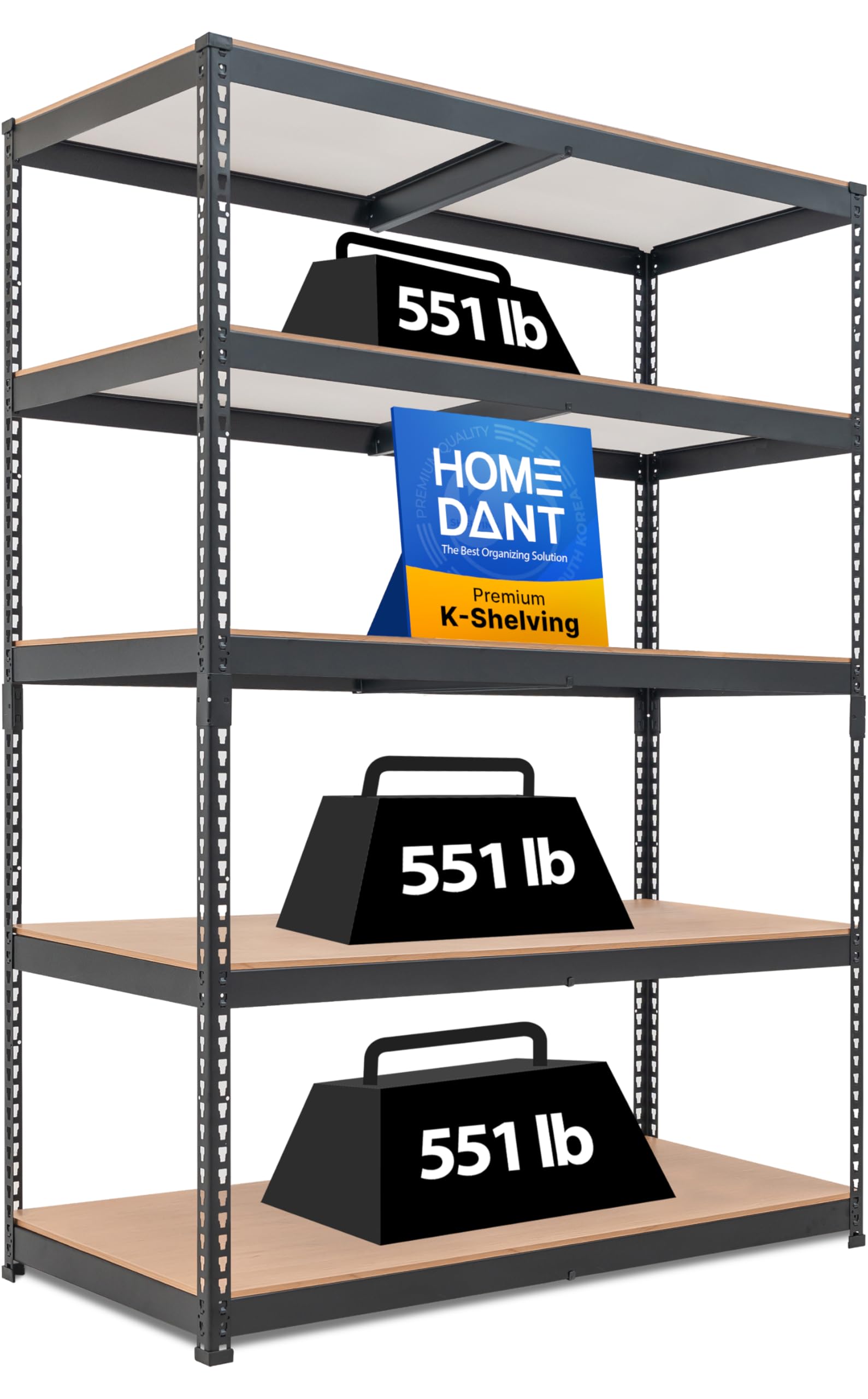
At 24 inches deep, this is one of two racks here that can swallow the big bins with their lids still on. That single dimension changes what shelving is for: instead of buying new containers to suit a 14-inch shelf, you put the garage you already have up in the air.

The decks are solid engineered-wood boards on a steel frame rather than wire, so a weeping bottle of oil stays on the shelf instead of dripping onto the box below, and there's no liner to buy for screws and sockets. Assembly is boltless — beams hook in, shelves tap down, no hardware — and the whole unit is around 40 pounds, which one person can walk around a garage.

The 771-pound total is the modest part. At 257 pounds a shelf this is a bins-and-bulky-goods rack rather than a home for an engine block, and the clip-in joints are the piece to treat with respect: overload a shelf and the joint, not the steel, is what lets go.

Where it wins is a garage already organized around matched totes. Solid decks that wipe down, 24 inches front to back, and shelf heights you can re-space without dismantling anything — if that's the storage you have, the depth and the boards are worth the extra money over a wire rack.

Bottom line: For a garage built around big plastic bins, this is the pick: 24-inch-deep solid decks that take loaded totes and wipe clean.

6

Sakugi 33-Inch Shelving

Sakugi 33-Inch Shelving

Narrow wall gaps

Our Score 9.0/10
Check Price

Worth Noting

  • Shallow shelves rule out deep bins
Shelves
5
Shelf Surface
Wire
Weight Capacity
1,000 lb total
Assembled Dimensions
33" W x 12.6" D x 72" H
Read the full review

12.6 inches deep is the whole point. That slides between a parked car and the wall, beside the water heater, or at the end of a workbench run where a 24-inch rack would block the walkway. We think of it as the shelf you buy for the gap you already have rather than the wall you wish you had, and it's the only pick here sized for that job.

For the footprint it carries a surprising amount: 1,000 pounds across five shelves, wire decks on 0.9-inch posts, and non-slip feet under the frame. Assembly is tool-free and the pieces are light enough that one person can walk the whole unit into position before it's loaded. Set it against a wall, load the heavy end low, and a 72-inch tower on a 12.6-inch base behaves itself.

Bottom line: The one we recommend when floor space is the constraint — a 12.6-inch footprint that still carries a thousand pounds.

7

VEVOR 48-Inch Shelving

VEVOR 48-Inch Shelving

Two-rack setups

Our Score 8.8/10
Check Price

Worth Noting

  • Listing quotes two conflicting load ratings
Shelves
5
Configuration
Splits into two racks
Shelf Surface
Carbon steel, engineered wood boards
Assembled Dimensions
48" W x 24" D x 72" H
Read the full review

Two racks come out of one box here. The unit splits into two shorter storage racks with their own legs, and 16 rubber foot pads ship in the carton so the second set doesn't scratch a painted floor. In a garage where one tall wall unit would sit in front of the window or foul the door, that's a genuine option rather than a gimmick — a bench-height rack for tools and a short one for the corner is more useful than a tower nobody can reach around.

The dimensions do the rest: 48 inches wide, 24 deep, 72 tall, with engineered-wood boards over a carbon steel frame and a powder coat that shrugs off a scrape. It arrives as one heavy box at around 65 pounds, so plan on two people getting it out of the packaging. For a garage that needs one tall wall of storage and one low unit, this is the most flexible thing in the guide.

Read the load numbers before planning around them. The listing quotes 2,000 pounds total in one place and a 400-pound maximum in another, and those can't both be right, so we treat it as a mid-duty rack — fine for bins and cases, not for the heaviest things in the garage. The press-fit joints also want a proper mallet hit; a joint that isn't fully seated leaves the frame loose for good.

Bottom line: It earns its place by coming apart into two shorter racks — one bench height, one for the corner — when a single 72-inch tower won't work.

How We Tested Garage Shelving

We started by pulling every garage shelving unit we could find from major retailers, then narrowed the list by depth, height, and assembly style—there was no point testing a 72-inch unit for a garage with a low ceiling. We landed on 12 units in plastic resin, wire, steel, and wood, including freestanding and wall-mounted styles.

Each unit was assembled solo in a real garage with a screwdriver, mallet, and the included hardware. I timed the build, noted whether the instructions matched the parts, and flagged steps that genuinely needed a second set of hands. Then I measured the footprint against a 24-inch strip of wall and an 8-foot ceiling, because the difference between fits and doesn't is usually an inch of depth or clearance.

Once built, I loaded each shelf with 40-pound storage bins, paint cans, and a stacked set of tires—working from the bottom up—and checked for bowing, sway, and any creak that suggested a connector was about to give. I dragged bins on and off for eight months to see how the finish held up, whether the shelf surface scratched, and if the coating chipped. Appearance mattered more than I expected: some units looked like warehouse scaffolding, while others disappeared against the wall. I also compared usable cubic feet against the footprint each one took up, and weighed that against what it cost—value here wasn't the lowest sticker price, but how much weight and volume the unit handled without wobble or rust.

How to Choose the Right Garage Shelving

Start with what's actually going in it

Depth decides what a rack is for, and it's the number most shoppers skip. A 24-inch deck takes a loaded 27-gallon tote with the lid on. A 14-inch deck takes cases, cans, toolboxes and paint, and nothing wider. Measure the deepest thing you plan to store, then measure the wall: the widest rack here runs 55.5 inches and needs a clear run with room to swing a shelf into place.

On capacity, plan with the per-shelf figure rather than the total. The big number on the box assumes weight spread evenly across all five shelves, which is not how a garage loads.

Stability starts at the floor

Garage slabs are poured to drain, so they slope toward the door. A rack with fixed feet will rock on that slope however well it's built, which makes adjustable levelers the difference between a shelf that holds still and one that walks. Set the feet before anything goes on the shelves.

Then anchor it. Tall wire racks sway side to side until there's weight low down, and a bracket into a stud is a ten-minute job. We treat anchoring as part of assembly rather than an optional extra.

Wire decks or solid boards

Wire is cheaper, lighter, and lets dust fall through instead of settling, which is why most garage racks use it. The trade is that anything smaller than a golf ball disappears into the gaps, so budget for a liner — hardboard, corrugated plastic, or the made-to-fit panels. Solid boards, whether steel or engineered wood, hold small parts, wipe clean and need no liner, and they're what you want under anything liquid. Engineered wood is the version to keep out of a garage that runs damp.

Feet or casters

Casters earn their keep if you sweep the floor more than once a season, and they charge you in capacity. The rating printed on the box is a static figure with the unit on its feet; fit the wheels and the working load drops sharply — one rack here goes from 4,000 pounds to 500. Wheels also add height, which matters under a garage door track. Decide which configuration you're building before you load a single shelf, because the answer changes how much goes on it.

Assembly: hands, tools and reach

Boltless and press-fit racks go up with a rubber mallet and nothing else, and one person can handle a 36-inch unit. Wider ones are a two-person job, not because they're complicated but because a 48-inch shelf is awkward to hold level at shoulder height.

The top shelf is the real obstacle. On a 71- or 72-inch rack the last deck goes on above most people's reach, so set its clips before the frame gets tall, or plan on standing on a lower shelf with someone spotting you.

Frequently Asked Questions

Final Verdict

For most garages, order the REIBII and be done with it: the widest deck here, near the top of this set on rated load, and a tool-free build one person can manage. Make the swap when your storage is different in kind. A wall of 27-gallon totes wants the HOMEDANT's 24-inch solid boards, and a workshop with engines and cases on the shelves wants the Seville's casters and 800-pound decks — the premium buys joints and plating you feel every time you roll it loaded.