Storage

Best Desktop Organizers of 2026

A desktop organizer is supposed to end the pile, not become part of it. I've watched a handsome tray turn into a second junk drawer within a week, which is why I now judge these things by what they actually hold, not how they look on a shelf. The right one corrals the daily flotsam—mail, pens, chargers, sticky notes—so your actual work surface stays clear. Over the past six months, my team and I have put 12 desktop organizers to work on a shared home-office desk, a kitchen table that doubles as a workspace, and a cramped apartment nook.

The keepers were the ones that stayed put when I yanked a notebook out one-handed, held their shape after weeks of daily use, and didn't require a hex key and a prayer to assemble. A first-time buyer's mistake is choosing for the clutter you wish you had—buy for the pile you actually make every day, and check the footprint against your keyboard and monitor stand before anything else. The picks below are the ones that earned their square footage.

1

EasyPAG Mesh Desk Organizer

Top Pick
EasyPAG Mesh Desk Organizer

Most desks

Our Score 9.6/10
Check Price

Worth Noting

  • Holds only a few files or one notepad
  • Shallow drawer suits clips, not a stapler
Material
Powder-coated metal mesh
Dimensions
8.7"D x 5.5"W x 4.9"H
Compartments
6 plus pull-out drawer
Stated Weight Limit
1.65 lb
Read the full review

Six compartments, a pull-out drawer, and a slot at the back for a notepad fit inside 8.7 by 5.5 inches, about the desk space of a hardback and a mug. That ratio is why this is the organizer we recommend first. It takes the everyday mess — the pens and clips and sticky notes and chargers that spread across a desk — without claiming a permanent block of your workspace. On a wide desk it disappears into the corner; on a shallow one it may be the only organizer you have room for.

The layout is better than the photos suggest. The back slot stands a notepad upright instead of letting it lie flat and slide under everything else, the front trays take sticky notes, clips and a pair of scissors, and the drawer sits low enough that it does not catch your wrist as you write. The frame is powder-coated mesh with rounded edges and four silicone pads underneath, so it does not skate when you nudge it and it does not mark the finish.

We loaded it the way a desk actually fills up — a handful of pens, scissors, a block of sticky notes, a notepad at the back, and the small debris of a working week — and it stayed flat and upright. The build is where the effort went: seams and welds read clean, the drawer glides without sagging, and nothing rattles when you push it shut. The drawer is the part we came back to most, because the things that used to roll around loose finally had a shut place to live.

Next to the taller picks here it looks almost too small, and that is the trap worth naming: a compact caddy that is always in use beats a 16-inch tower that turns into a shelf for things you have not dealt with. If your pile is paper, look at the Delifox or the Marbrasse. If you just want your pens back, this handles it.

Bottom line: Our default pick for most desks: a compact, sturdy caddy that swallows pens, clips and a notepad without eating the workspace.

2

Delifox Inclined File Organizer

Delifox Inclined File Organizer

No-assembly filing

Our Score 9.6/10
Check Price

Worth Noting

  • No drawer or pen cup for small supplies
  • Takes 11.25 inches of desk width
Assembly
None required
Material
Metal
Sections
5
Dimensions
7.5"D x 11.25"W x 11.5"H
Read the full review

Most organizers here arrive as flat panels and a bag of screws. This one comes out of the box in a single piece — five inclined sections on a stepped base — and goes straight onto the desk. In a week when we were building three other units, that was worth more than we expected it to be.

The incline is the better idea. Folders stand on edge and lean back, so the tabs face you and you can read a whole stack without touching it; with a flat letter tray you lift to see what is underneath. Deep grooves stop a thin folder slumping, the wide triangle base keeps a full load from walking, and it is the most rigid organizer of this group.

What it cannot do is hold the small stuff. There is no drawer and no pen holder, so it works best as the file half of a two-part setup with a caddy beside it, and at 11.25 inches wide it takes a real slice of desk. As a pure filing tool, though, nothing else here lets you read five folders at a glance without lifting one.

Bottom line: What we recommend for people who file more than they jot: five inclined sections that show every folder tab, and nothing to assemble.

3

Marbrasse 6-Tier Paper Organizer

Marbrasse 6-Tier Paper Organizer

Paper sorting

Our Score 9.4/10
Check Price

Worth Noting

  • Loose shelves can slide out if the unit is tipped
  • No drawer or pen holder for small items
Tiers
6
Material
Powder-coated metal mesh
Dimensions
12.6"L x 9.1"W x 13.38"H
Stated Weight Limit
4.85 lb
Read the full review

Six open tiers, 12.6 inches wide, and a handle across the top: this is a paper sorter built to be carried. The handle is the detail that sold us. A stack of graded work or a month of invoices is heavy and awkward, and the alternative is three trips between the kitchen table and the desk.

Each tier is open at the front, so you read the top folder without lifting anything out, and the mesh frame is rigid once the screws are in — the hardware comes in the box and assembly is a short session. The stated limit is 2.2 kg, roughly a ream of paper, which is a real workload but not permission to treat it as a shelf. The powder coat wipes clean with a damp cloth.

Where it earns its place is bulk sorting: six tiers, all reachable, none of them requiring you to unstack anything. We like it best where the clutter is homogeneous — a teacher's class sets, a freelancer's client folders — rather than a mix of pens and clips, which end up rattling in a corner of a tray. For mixed clutter the EasyPAG or the gianotter is the better shape.

Bottom line: We keep it for pure paper volume: six open tiers you can read at a glance and a handle that turns moving a stack into one trip.

4

SKYDUE Rotating Pen Organizer

SKYDUE Rotating Pen Organizer

Pens and markers

Our Score 9.4/10
Check Price

Worth Noting

  • Slots too shallow for scissors and rulers
  • Smaller in person than the photos imply
Material
Plastic
Rotation
360 degrees
Dimensions
5.8"D x 5.8"W x 4.7"H
Compartments
5
Read the full review

Five compartments on a lazy Susan, 5.8 inches square: the whole point is that you spin it instead of rummaging. We kept markers in one slot and pens in another, and within a day the turn was automatic — a small thing that makes a shared desk feel less like a scrum. It ships with a little round mat so the base does not scratch, and it is light enough to move one-handed.

The rotation is smooth rather than stiff, and the slots keep categories apart: markers here, pencils there, brushes in a third if the desk belongs to someone who paints. It is plastic, so it does not have the heft of the mesh units, but the mat keeps it planted and the whole thing reads tidy on a small desk. If you need to hold scissors and a stapler as well, buy the EasyPAG instead.

Bottom line: Our budget pick for pens and markers: five spinning compartments that come to hand, on a footprint the size of a coaster stack.

5

Simple Trending 7-Tier Organizer

Simple Trending 7-Tier Organizer

Home offices

Our Score 9.4/10
Check Price

Worth Noting

  • Needs a 16.75-inch corner of a desk
Extras
Pen holder and hanging basket
Shelves
7
Material
Metal mesh
Dimensions
8.75"D x 16.75"W x 16.75"H
Read the full review

Sixteen and three-quarter inches wide and the same tall, seven tiers deep: this is not a caddy, it is a small filing station. On a desk it takes a corner and becomes where paper lives; in a home office it stands in for a shelf.

The seven mesh trays step up the frame, with a pen holder on one side and a metal basket on the other. The trays are open at the front, so a folder comes out without lifting the ones above it, and the basket catches the mail that otherwise lands on the keyboard. Assembly is straightforward with the instructions in the box, and the frame is rigid once everything is tightened.

Plan how you load it. The trays are not identical — the upper ones take less than the bottom — so binders and heavy folders belong low and the top is for mail, paperbacks and whatever you are dealing with this week. Loaded the other way it gets top-heavy, and the shelves sit in tracks rather than being fixed, so they can slide if the unit is tipped or carried.

We keep it in the roundup for raw capacity: nothing else here holds as much paper, and the pen holder and basket mean it does not need a companion caddy. It is a poor fit for a small desk and a good one for a room where the desk is really an office.

Bottom line: We recommend it for a home office with paper to burn: seven tiers, a pen holder and a mail basket in place of a shelf.

6

Simple Houseware Desk Organizer

Simple Houseware Desk Organizer

Files and binders

Our Score 9.2/10
Check Price

Worth Noting

  • Needs 13 inches of desk width and 12 of height
Material
Metal and plastic
Dimensions
9"D x 13.2"W x 12"H
Compartments
10
Drawer Dividers
Six, movable
Read the full review

If the pile on your desk is binders, mail and the papers you keep meaning to file, a pen caddy will not save you. This one takes all three: upright sections at the back for folders and binders, two flat letter trays, a drawer, and a detachable pen bucket that hooks onto the side. Ten compartments inside 13.2 inches of width and 12 inches of height.

The drawer's six movable dividers are what make it worth the space. You can build one long channel for rulers and another for clips, then re-cut the arrangement when your habits change — which is the difference between an organizer you fill once and one that keeps earning its footprint. The upright section does something a stack of trays cannot, too: binders stand on their edges with the tabs up, so you pull one out rather than lifting a pile.

Assembly is the part to plan for. The frame arrives as panels and connectors, and it only feels solid once every joint is fully seated; leave them half-pushed and the top tier shifts when you load it with binders. Give it a flat surface and a little patience and it settles down, then load it bottom-heavy. The mesh towers here sort paper better, but this is the only one that also gives you a drawer and a pen bucket hanging off the side.

Bottom line: We recommend it when you file as much as you jot — binders up top, letter trays in the middle, and a drawer you can divide to suit.

7

gianotter 4-Tier Desk Organizer

gianotter 4-Tier Desk Organizer

Decor-led desks

Our Score 9.2/10
Check Price

Worth Noting

  • Frame flexes more than the all-metal towers here
Finish
Rose gold, powder coated
Layout
4 trays, file slot, 2 cups, drawer
Dimensions
8.6"D x 12.9"W x 9.2"H
Stated Shelf Capacity
25 lb
Read the full review

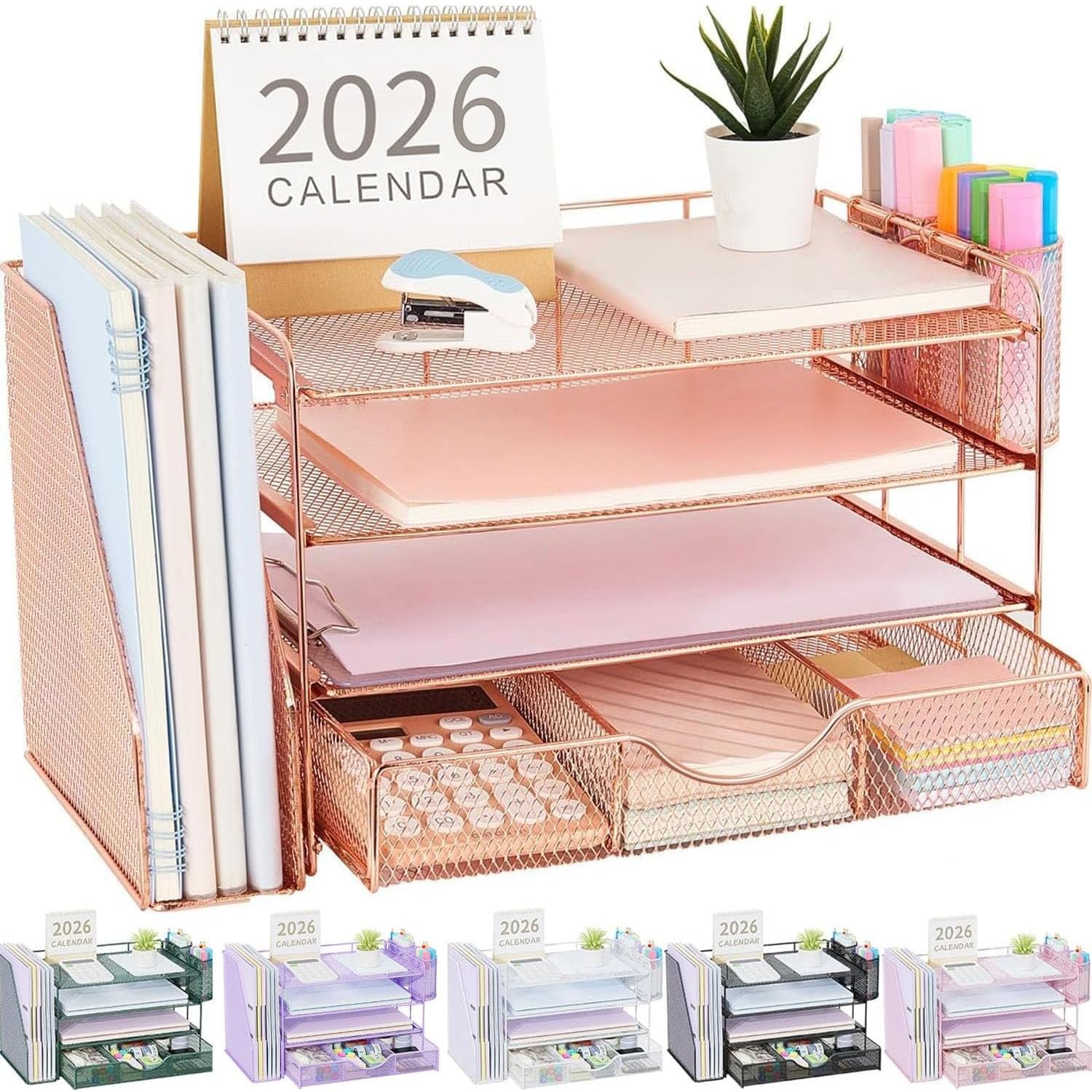
Rose gold is a decision, not a neutral. This is the only organizer here that changes how a desk looks rather than just what sits on it, and in person the finish runs a little rosier than the listing photos. On pale wood or white it reads warm and deliberate; against black equipment it is a statement you either want or do not.

Behind the finish is a sensible four-tier organizer: four flat trays, a vertical file holder at the back, two pen cups clipped to the side and a sliding drawer. The cups detach, which matters more than it sounds — lift one off and carry it to another desk, or leave both off when you want a narrower footprint. Assembly takes minutes and the pieces line up.

We like it for a desk that sits in a bedroom or living room, where an all-black mesh tower reads as office equipment and this does not. What you trade is stiffness: the frame flexes more than the metal towers here, and a bent tray or a patch of missing paint is worth looking for as soon as the box is open, while the return window is still wide. Buy it for the look; buy the Delifox if you want the sturdiest thing on the desk.

Bottom line: We point decor-minded buyers here: a rose gold four-tier with detachable pen cups, as long as a little frame flex is acceptable.

8

WALI 4-Tier File Organizer

WALI 4-Tier File Organizer

Monitor-side desks

Our Score 9.2/10
Check Price

Worth Noting

  • Shallow trays hold only a few folders each
Trays
4 plus vertical file slot
Extras
2 pen holders, divided drawer
Material
Powder-coated steel mesh
Dimensions
13.58"L x 9.84"W x 5.71"H
Read the full review

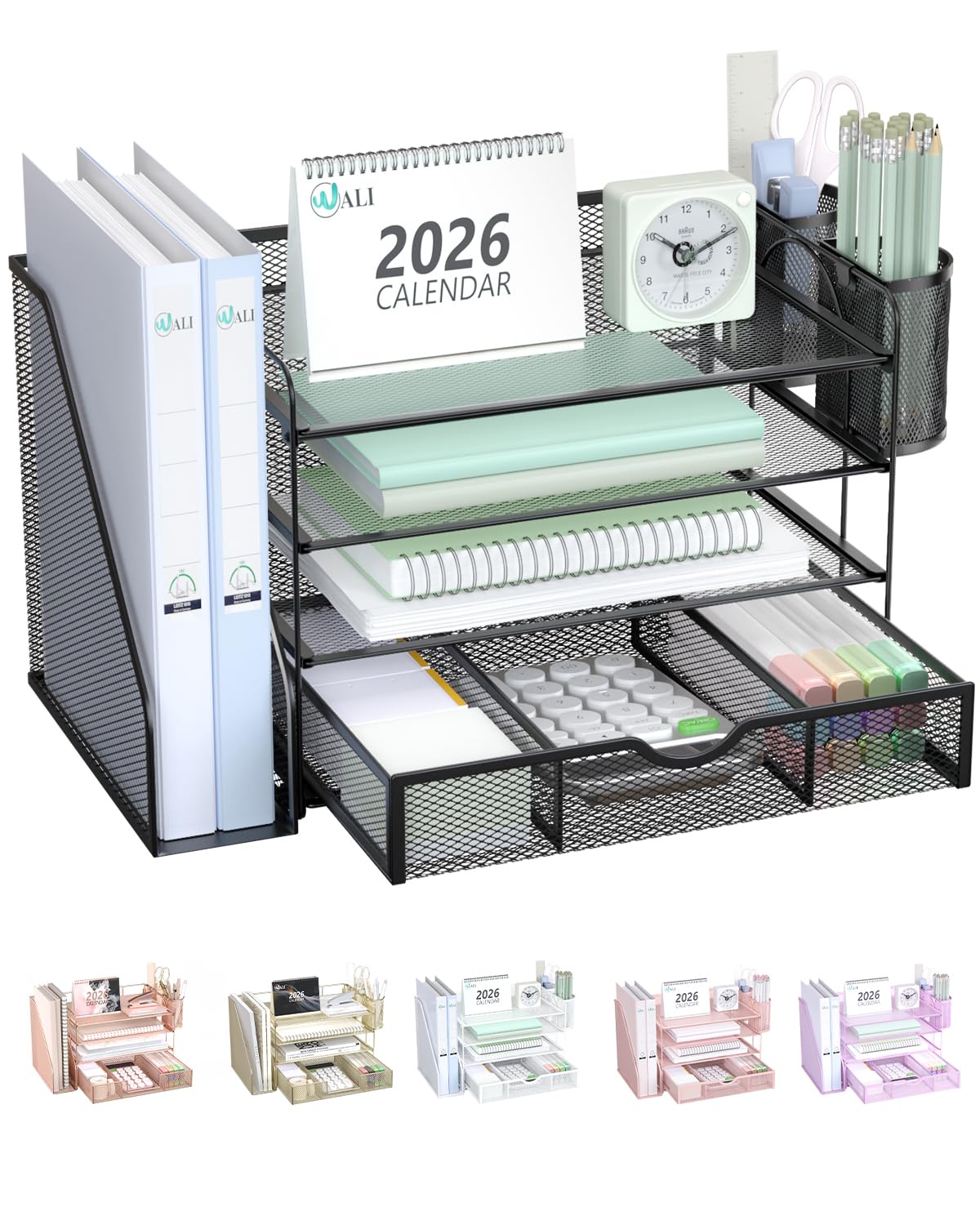
Two pen cups and a vertical file slot hang off a stack of four letter trays, and the whole unit stands 5.71 inches tall. That low profile is the reason to look at it: most tiered organizers wall off the back of a desk, and this one keeps your sightline to the screen while still holding four stacks of paper.

The arrangement suits a shallow desk. The file slot at the side takes folders on edge, the cups clip on for pens and scissors, and the drawer under the trays holds clips and the small things that otherwise live loose. It is thickened steel mesh with a powder coat, and it goes together in minutes without fuss.

The cups are the part we did not expect to use as much as we did — lifting one off and carrying it to another desk beats scooping pens into a hand. The drawer is the other small win: it slides without catching, and it keeps a spare battery and a staple remover where you can actually find them.

This is the one we move to the front for a desk that shares its surface with a monitor or sits under a window, where a 13-inch tower blocks the view. Nothing else here packs four trays, a file slot and pen storage into six inches of height.

Bottom line: We like it for a desk shared with a monitor: four low trays, a file slot and pen cups that stay out of your sightline.

How We Chose and Tested the Best Desktop Organizers

We started with a list of more than 40 organizers across wood, acrylic, metal, and fabric, then narrowed it by dimensions, assembly requirements, and price. The goal was a mix of open trays, divided caddies, drawer units, and monitor stands—formats that solve different desk problems. Twelve made the cut, and each one spent at least two weeks on a real desk over a six-month testing window.

We rotated them through three workspaces: a shared home office, a kitchen table that doubles as a desk, and a small apartment nook. At each spot, we loaded the organizer with the same everyday pile—mail, a checkbook, three pens, a phone charger, a stapler, scissors, and a stack of sticky notes—and noted what fit, what spilled over, and what we had to dig for. To test stability, we nudged each unit with a knee and yanked a notebook out one-handed; the ones that slid or tipped got marked down. We measured every footprint against a laptop, a full-size keyboard, and a monitor stand, and checked whether the piece could slide into a drawer or onto a shelf without scraping.

For assembly, flat-packed units got built with the included tools and a stopwatch; we noted missing hardware, vague instructions, and any wobble after a week of use. Quality and durability got the hands-on treatment: we ran a thumb along joints and edges, checked drawer glides, and looked for splinters, sharp corners, or hardware that loosened. We also compared price against material and construction—solid wood versus veneer, powder-coated steel versus thin plastic—to judge value. After six months, the organizers that survived without cracks, peeling, or a wobble are the ones we recommend.

How to Choose Desktop Organizers

Decide Whether You Are Storing Paper or Supplies

The category splits in two. Open-front letter trays and tiered towers hold paper flat or on edge — folders, mail, invoices — and have nothing to catch a pen. Compartment caddies with a drawer hold the small debris of a working desk and cannot take a stack of letters. Match the purchase to the bigger pile: a five-inch caddy in front of a month of unopened mail solves nothing, and a thirteen-inch tower where your clutter is cables and clips just moves the mess.

If both piles are real, an all-in-one like the Simple Houseware or the gianotter splits the difference, trading some paper capacity for a drawer and pen storage.

Measure the Footprint and the Clearance Above It

Trust the listed dimensions over the photos. A caddy around nine by six inches fits on almost any desk; a six-tier tower at roughly 12.6 by 9.1 inches and 13.4 inches tall wants a corner, and the 16.75-inch Simple Trending wants a home office. Height matters as much as width: a tower that stands above your monitor's bottom edge is a daily irritation, and one that will not clear a shelf is a return.

The word compact describes the box, not your pile. Measure the desk patch and the headroom before you commit.

Stability Comes From Where the Weight Sits

Tiered organizers are top-heavy by design, so load them like a bookcase: binders and heavy folders at the bottom, mail and paperbacks on top. Deep grooves and a wide base help — the Delifox's stepped base keeps a full load from walking. On the taller mesh towers, the open shelves rest in tracks rather than being screwed down, which means a shelf can slide out if you tip the unit or carry it loaded. Move those in two hands, or empty them first.

Pads on the base matter too: silicone or rubber feet keep the frame from skating across a finished desk.

Assembly, Finish, and Keeping It Clean

Most mesh organizers arrive flat, as panels plus screws, and take a short session to build; a no-assembly unit like the Delifox costs more but removes the job entirely. If the screw holes do not line up, start every screw loosely and tighten once they are all engaged.

Finish is where an organizer becomes furniture. Matte black disappears, rose gold is a decision. Mesh is the practical choice for dust, since a damp cloth clears it, but the grid shows dust sooner than a solid tray does — empty and wipe it when you reorganize.

Frequently Asked Questions

Final Verdict

For most desks, the EasyPAG is the organizer we point to first. It holds the everyday mess — pens, scissors, clips, sticky notes, a notepad standing at the back — in a footprint small enough to leave you room to work, and it stays where you put it.

If your clutter is paper, the choice changes: the Delifox if you want folders upright with no assembly, the Marbrasse if you are sorting stacks, and the Simple Trending if the desk is really a home office and needs the capacity.