Smart Home

Best Smart Speakers of 2026

A smart speaker is really two products in one box: a decent speaker and an always-listening microphone that runs your lights, your timers, and your shopping list. Most models are good at one and merely fine at the other, which is where the shopping gets confusing. What you're actually buying is fewer trips across the room to check something, plus music in the kitchen without a phone propped against the fruit bowl.

I've kept one on my nightstand for years, mostly for the alarm and the weather, and over the past six months my team has lived with 12 of them on counters, shelves, and desks around the house. Setup was the first filter: if pairing to Wi-Fi and to my phone took more than a few minutes, I lost patience. After that it came down to how they sounded at conversational volume, how often they dropped off the network, and whether they heard me over a running faucet. Size and finish mattered more than I expected, since these sit in plain view all day.

1

Amazon Echo Dot

Top Pick
Amazon Echo Dot

Bedside and kitchen

Our Score 9.4/10
Check Price

Worth Noting

  • Mixed reliability; some units stop working entirely
Room Sensors
Motion and temperature
Wi-Fi Extender
eero, up to 1,000 sq. ft.
Voice Assistant
Alexa
Multi-room Audio
With compatible Echo devices
Read the full review

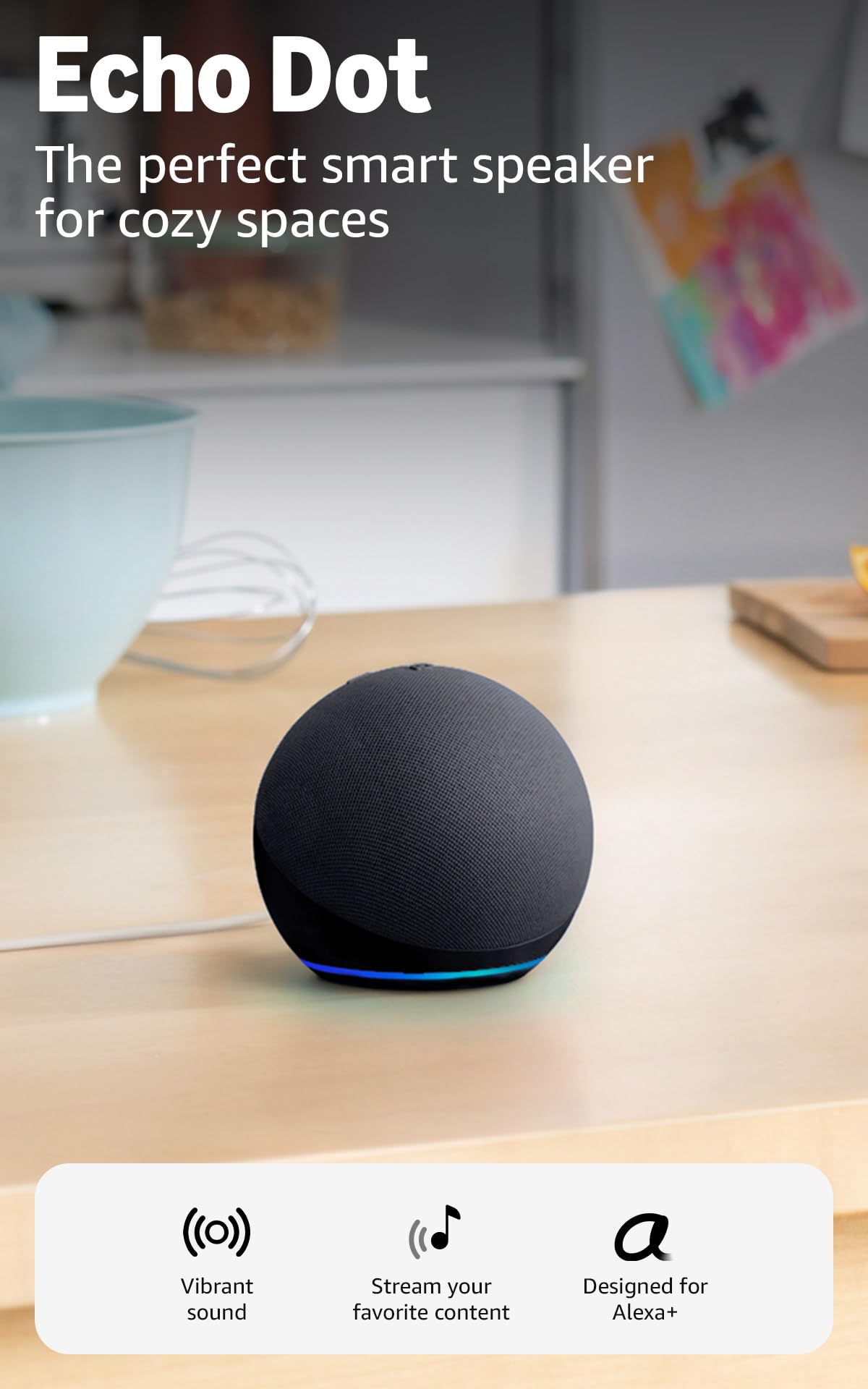
For most people, this is the smart speaker to buy first. The Dot answers questions, sets overlapping timers, reads the weather, plays Amazon Music, Apple Music, Spotify or a Bluetooth feed from your phone, and switches lamps on and off through Alexa — for less money than anything else on this page. Setup is the part we appreciated most: plug it in, open the Alexa app, join the Wi-Fi, and it's listening. No manual, no account gymnastics.

What shoppers tend to miss is everything packed in beside the speaker. There are motion and indoor temperature sensors inside, and Alexa can trigger routines from them, so a lamp can come on when you walk into a room or a fan can start when the bedroom warms up. On an existing eero network the Dot also doubles as a mesh extender, adding up to 1,000 square feet of coverage — genuinely useful if you already own eero gear, and a line to ignore if you don't.

Sound is where the money went missing, and it's an honest trade. The Dot is built for bedrooms, dining rooms, and offices, and that's where it's at its best: podcasts, a kitchen playlist, the radio. Give it a big open living room and the bass and body run out long before you want them to. If that's the room you're shopping for, the Dot Max is the same idea with a real low end.

Bottom line: We point most people here first: it's the cheapest way to get Alexa into several rooms, and it handles the daily small jobs without fuss.
2

Sonos Era 100

Sonos Era 100

Music-first rooms

Our Score 8.8/10
Check Price

Worth Noting

  • App-based setup and Wi-Fi pairing can be fiddly
Dimensions
7"D x 5.1"W x 7.22"H
Room Tuning
Trueplay
Connectivity
Wi-Fi, Bluetooth, 3.5 mm line in
Voice Assistant
Alexa
Read the full review

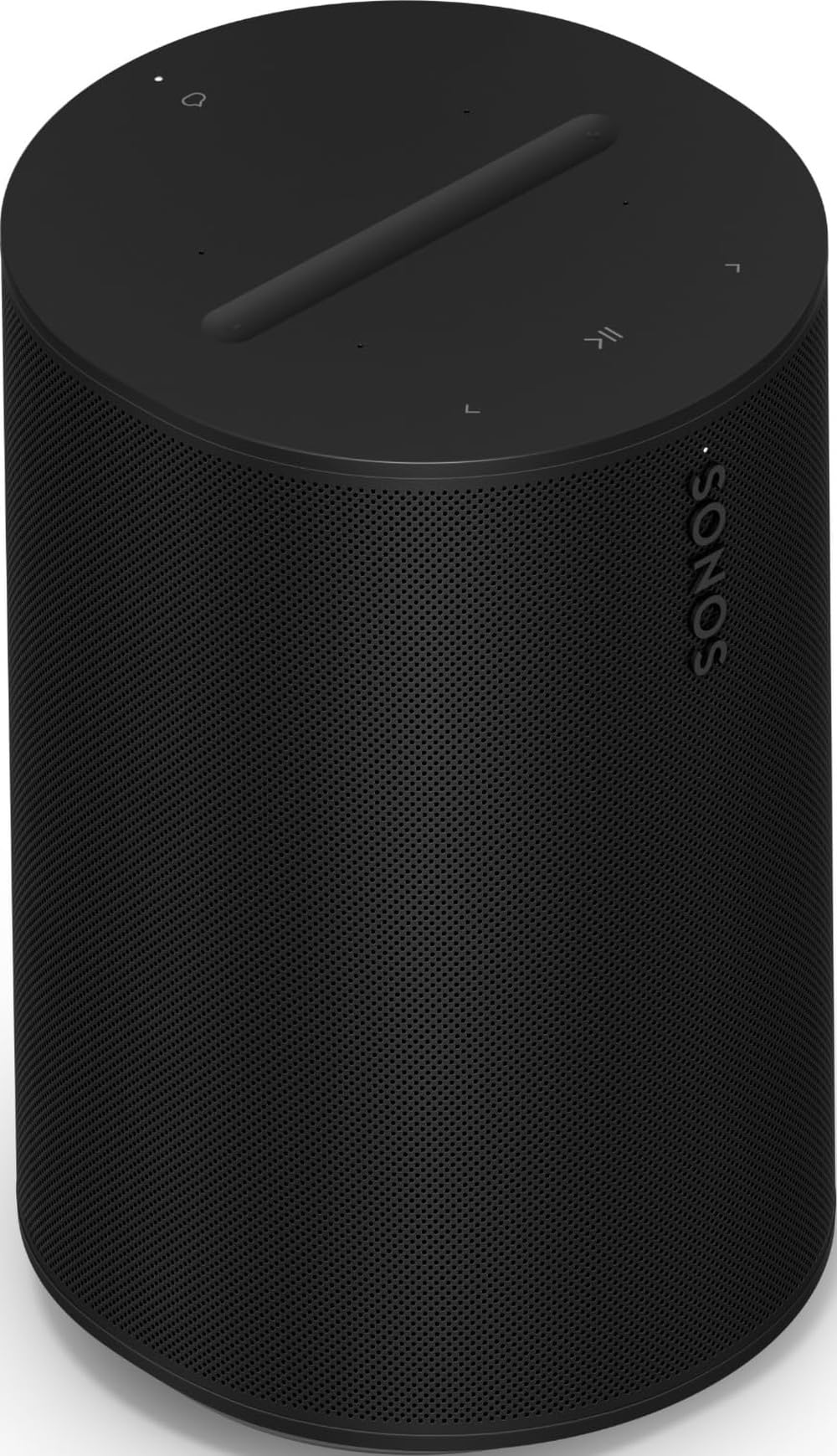
The Era 100 has a 3.5 mm line-in, which is not a connection you'll use every day and is exactly why we like it: the turntable in the corner can feed the same speaker that streams Spotify, so a house with records in it gets a modern speaker instead of a second system. That's the character of the whole product. It's a music speaker with Alexa inside, not an assistant that happens to play songs.

The hardware backs that up. A dual-tweeter array gives it real stereo separation rather than a single point of sound, a 25% larger midwoofer adds bass depth, and a 47% faster processor keeps it all moving. The feature we rate highest, though, is Trueplay: run it from the Sonos app and the speaker measures the room and adjusts its EQ, which is the difference between sounding good in a shop and sounding right against bare walls and a hard floor. At 7 by 5.1 by 7.2 inches and about 4.5 pounds, it sits on a bookshelf or a counter and stays where you put it.

Two practical notes before you commit. It's a single speaker at a premium, and the stereo separation is at its best with a second Era 100 — a bigger commitment than the first purchase suggests. And like the rest of this group it runs off a wall outlet, so the shelf you have in mind wants a socket nearby and a way to hide the cable. Get those two things right and nothing here sounds better.

Bottom line: We reach for the Era 100 when music is the point: it's the best-sounding speaker in this group, and the one worth pairing with a second.

3

Amazon Echo Dot Max

Amazon Echo Dot Max

Living room sound

Our Score 8.6/10
Check Price

Worth Noting

  • Wi-Fi and device pairing trip up some networks
  • A modest upgrade over the standard Dot for the money
Bass
Nearly 3x Echo Dot (2022)
Smart Home Hub
Built in
Wi-Fi Extender
eero, up to 1,000 sq. ft.
Voice Assistant
Alexa
Read the full review

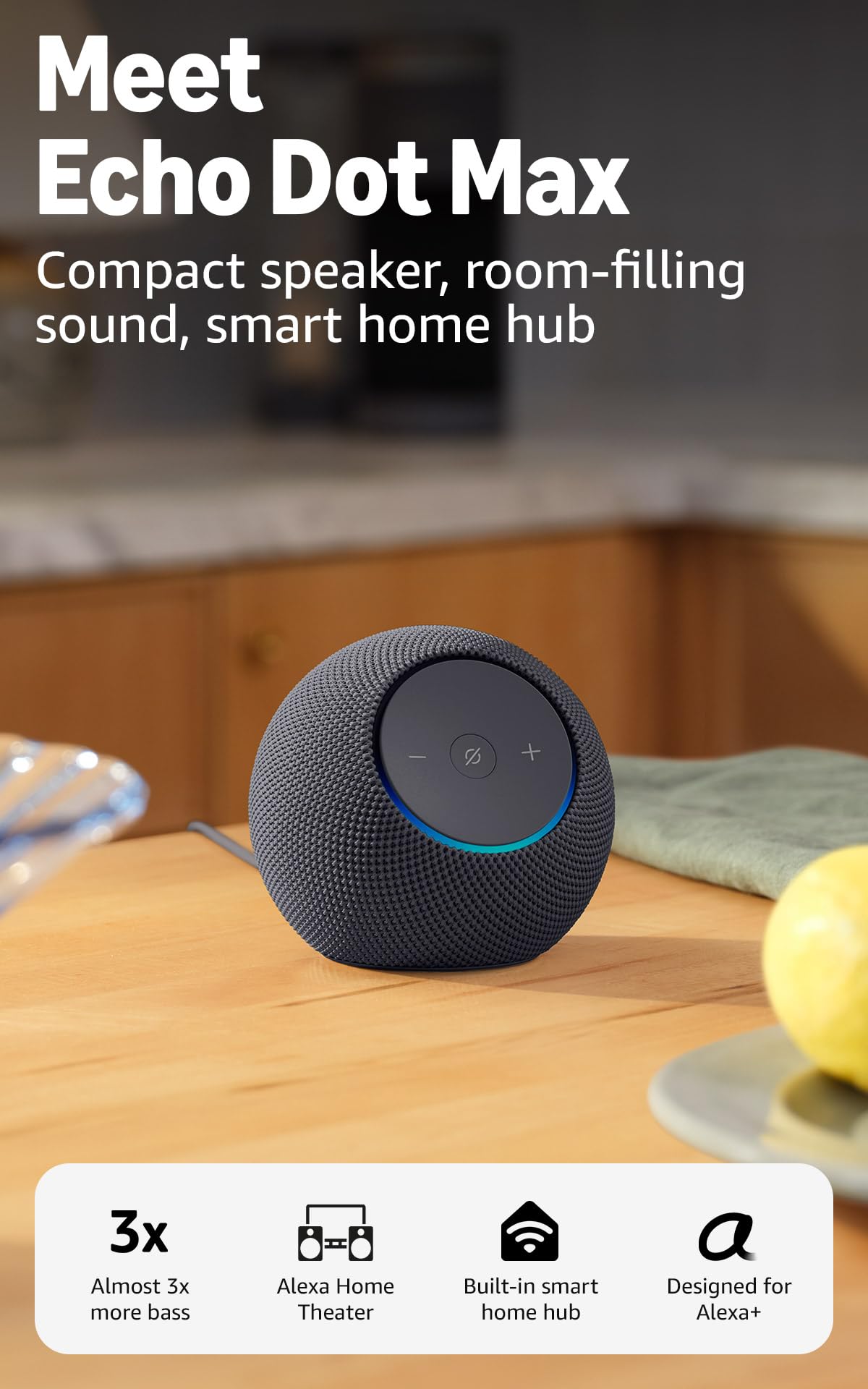
The Dot Max is the better-looking of the two Echo speakers here: a rounded graphite shell that reads as a piece of decor rather than a component that ended up in the room. On a living-room shelf that counts for more than a spec line, and the shape is compact enough to sit beside a plant or a stack of books instead of demanding its own table.

Then there's the part you hear. Amazon rates it at nearly three times the bass of the 2022 Dot, and the tuning adapts to the space it's sitting in, so a medium living room gets sound with some weight behind it rather than the thin, polite output of a bedside speaker. A smart home hub is built in too — the detail we appreciated most, because lights and locks that work with Alexa can connect without a separate bridge. A second Dot Max pairs with the first for a wider image.

Our take: the Max earns its keep in the room where you listen and is more speaker than the job needs anywhere else. As a bedside box for weather and alarms, the standard Dot does the same work for less. As the speaker that carries a living room — music while you cook, a podcast over dinner, an album you actually sit down for — the extra bass and room sense are worth the step up.

Bottom line: The step up we recommend for a living room: nearly three times the bass of the standard Dot, a built-in hub, and a look that earns its shelf space.

How We Tested Smart Speakers in Real Rooms

We started with the models that turn up again and again in reviews and on the shelf at big-box stores, then narrowed by price, footprint, and what each speaker can do without a subscription attached. Twelve made the cut, from pocket-sized units to bookshelf models, and each one spent six months in a real home rather than on a bench. We assigned them to rooms the way you would: one on the kitchen counter, one on a nightstand, one on a desk, and two paired in a living room.

Setup was timed from the moment the box opened to the moment the first song played. We counted the steps, noted whether an account was required before anything would play, and logged every time a speaker dropped off the Wi-Fi or needed to be re-paired. Voice recognition got tested at the worst moments: from the next room, with the faucet running, with the TV on, and with music already playing at kitchen volume.

For sound, we played the same handful of tracks at the volume you'd actually use on a weekday morning and listened for bass that turned to mush and vocals that got buried. Podcasts and audiobooks got the same treatment. We measured footprints with a tape measure against a standard 12-inch counter, wiped fingerprints off every finish, and asked whether each one looked like something we'd leave out. To test upgrades, we added a second unit for stereo and moved speakers between rooms to see how much work that took. Value came down to what shipped in the box versus what cost extra.

Everything is still running, and we'll update this list as firmware updates and new models change the picture.

How to Choose Smart Speakers

Start with the room, not the spec list

Sound scales with cabinet size and price, and the mismatch that disappoints people most is a small speaker in a big open room. A Dot is genuinely good on a nightstand or a kitchen counter; put the same speaker in a vaulted living room and it thins out fast.

Our rule of thumb: if the speaker sits within a few feet of where you sit, the small one is fine. If the sound has to cross a room, pay for the bigger cabinet and the bass that comes with it. Bedrooms and kitchens rarely need more than a Dot; living rooms usually do.

Decide whether music or the assistant comes first

Two of these speakers are built around Alexa and one is built around sound. If your day is timers, weather, shopping lists, and lamp control, the assistant is the product and the speaker is the accessory — buy on price and reliability and don't overthink it.

If you want to sit down and listen, the calculus flips. Stereo separation, a larger midwoofer, and room tuning like Sonos's Trueplay do more for a record than any voice feature does. We put more money into the room where we listen and less into the rooms where we mostly ask questions.

Multi-room only works inside one family

Every speaker here can play across several rooms, but only with its own kind. Echo devices group with Echo devices and Sonos groups with Sonos, and no app ties the two brands into one system. There's no stereo-pairing a Dot with an Era 100.

That makes the first purchase a bigger decision than it looks, because you're really choosing the family you'll add to. Four cheap speakers in four rooms is an Echo-shaped answer; two speakers doing proper stereo in one room is a Sonos-shaped one.

Plan for an outlet and a surface

None of these runs on a battery, so the socket decides placement as much as the decor does. A nightstand with a free plug behind it, a counter near an outlet, a shelf where you can hide a cable — those are the real shortlist, and it's worth sorting them before you fall for a finish.

The surface matters too: a solid shelf under a speaker gives bass something to work with, and a shared room or a guest bedroom is a good reason to check how the microphone gets switched off before you commit.

Frequently Asked Questions

Final Verdict

Buy the Echo Dot. It's the least expensive speaker here, it handles the everyday work of an assistant without drama, and its motion and temperature sensors mean it earns a place beyond music. For most homes, one in the kitchen and one in a bedroom is the whole purchase.

Move up to the Dot Max if the speaker will live in the room where you listen, and to the Sonos Era 100 if music is the reason you're buying at all — that's the one for a turntable, a stereo pair, and a room that deserves better than background.