Smart Home

Best Smart Garage Door Openers of 2026

There's a specific pang that hits about three blocks from home: did I actually close the garage door? A smart opener fixes that in an afternoon—live status on your phone, a log of every open and close, an alert when the door's been up too long. What it doesn't fix is a clumsy install, a controller that talks to your opener's brand but not your Wi-Fi, a chime that carries through the bedroom ceiling at 6 a.m., or a price that buys nothing your opener's free app doesn't already do.

Here's what nobody tells a first-time buyer: most of these don't replace your opener at all. They're a small unit wired into the one you already own, which makes brand matching the whole ballgame—and that's before HomeKit enters the picture. I had 10 of them running in my garage and a neighbor's over six months, and the gap between one that works and one that pings 'offline' every week is enormous. The picks below are grouped by what they do best—quiet operation, fast install, deep compatibility—so start there.

1

eKyro Smart Garage Door Opener

Top Pick
eKyro Smart Garage Door Opener

Existing openers

Our Score 9.0/10
Check Price

Worth Noting

  • Adapter may be needed for older openers
  • One controller needed per door
Control
App, voice, smartwatch
Voice Control
Alexa, Google Assistant, Siri
Subscription Fees
None
Opener Compatibility
Most openers; adapter may be required
Read the full review

The eKyro is a small box that wires into the same two terminals your wall button already uses, then puts the garage door on your phone. That's the whole idea, and it's why this is the first thing we recommend to anyone who hasn't killed their opener yet: nothing overhead gets replaced, and nothing gets thrown away.

It also covers the widest spread of households. Alexa, Google Assistant, and Siri all work, so a mixed-phone family isn't forced to choose sides, and nothing is held back behind a monthly fee — scheduling, auto-close, and voice are part of the hardware. On the two things that decide whether a controller is worth owning, it lands near the top of this set: setup and instructions are well covered, and its Wi-Fi link is the more dependable of the two budget controllers here.

Plan for the pairing rather than the wiring. The radio is 2.4GHz only, and the job goes quickest when your phone is on that band instead of a 5GHz network. The door sensor mounts with small screws, so take a minute to line it up squarely — that's the reading the app depends on.

Bottom line: We recommend this one first: it makes the opener you already own smart, works with Alexa, Google, and Siri, and charges nothing monthly.

2

Chamberlain Wall Mount myQ RJO101MC

Chamberlain Wall Mount myQ RJO101MC

Low-headroom doors

Our Score 9.0/10
Check Price

Worth Noting

  • Premium price
  • Printed instructions are thin on detail
Mount
Wall mount
Lighting
Remote LED
Dimensions
28 x 11.94 x 10 in
Battery Backup
Yes
Read the full review

The ceiling is the most useful storage space in a garage, and a rail-mounted opener is what ruins it. This one mounts on the wall beside the door and drives the torsion shaft, so the rails, the motor, and the hanging hardware are all gone — a two-car garage gets its overhead span back.

That's the reason to pay for it, and the price is a real one. This is a premium unit, and we think it's the right answer only in a particular garage: a torsion-bar door with a high-lift track, a low ceiling, or a layout where a rail simply won't fit. In that house, nothing else here solves the same problem. In a standard garage with a working opener, it's a lot of money to fix a storage issue you may not have.

The unit itself is compact against the wall — 28 by 12 by 10 inches and 33.9 pounds — and it still carries an integrated battery backup and a remote LED light that covers the whole bay. What it needs from you is an installation: the shaft coupling, the door lock, and the travel limits all have to be set correctly, and that work happens next to a torsion spring. Book a technician unless you already know your way around one.

Bottom line: A premium pick for a specific garage: it clears the ceiling entirely and fits high-lift or low-headroom doors a rail opener can't.

3

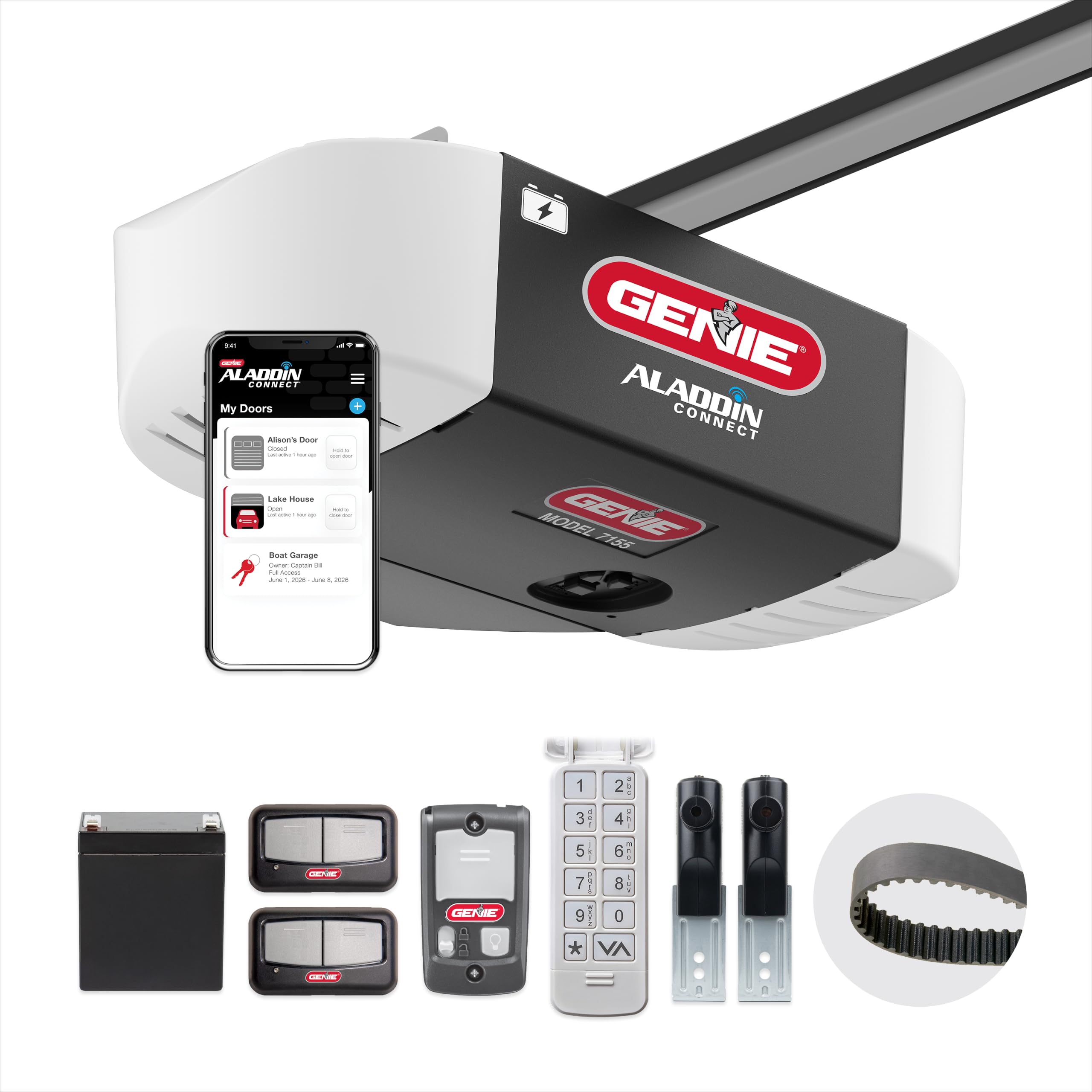
Genie StealthDrive Connect 7155-TKV

Genie StealthDrive Connect 7155-TKV

Attached garages

Our Score 8.8/10
Check Price

Worth Noting

  • Premium price for a full replacement
  • Wi-Fi pairing can take a few tries
Drive
1.25 HPc belt
Warranty
Lifetime motor, 5-year parts
Voice Control
Alexa, Google Assistant
Battery Backup
Yes
Read the full review

Noise decides this purchase when there's a bedroom over the garage, and the StealthDrive Connect is built around that. A 1.25 HPc DC motor drives a steel-reinforced belt rather than a chain, and quiet operation is the thing it does best — it's why this is our choice for a garage tucked under or beside living space. The door's own rollers make more noise than the motor does.

It's also the most complete package here. Battery backup keeps the door moving when the power drops, which stops mattering right up until it doesn't. Two pre-programmed remotes, a wireless keypad, and a multi-function wall console come in the box, so a second driver and a dog-walker are covered on day one rather than after another order. Aladdin Connect handles the app and works with Alexa and Google Assistant; opening by voice asks for a spoken PIN, which is the assistant's rule, not the opener's.

Installation is an afternoon, not a swap. The rail comes in five sections, the head unit is light enough for two people on ladders, and most of the work happens overhead. If your current opener still lifts quietly, this is money you don't need to spend — but a loud, undersized, or failing one is exactly what it replaces, and five-year parts with a limited lifetime motor warranty back it up.

Bottom line: If the garage sits under a bedroom and the opener is due for replacement, this is the one we point to: quiet, battery-backed, and complete in the box.

4

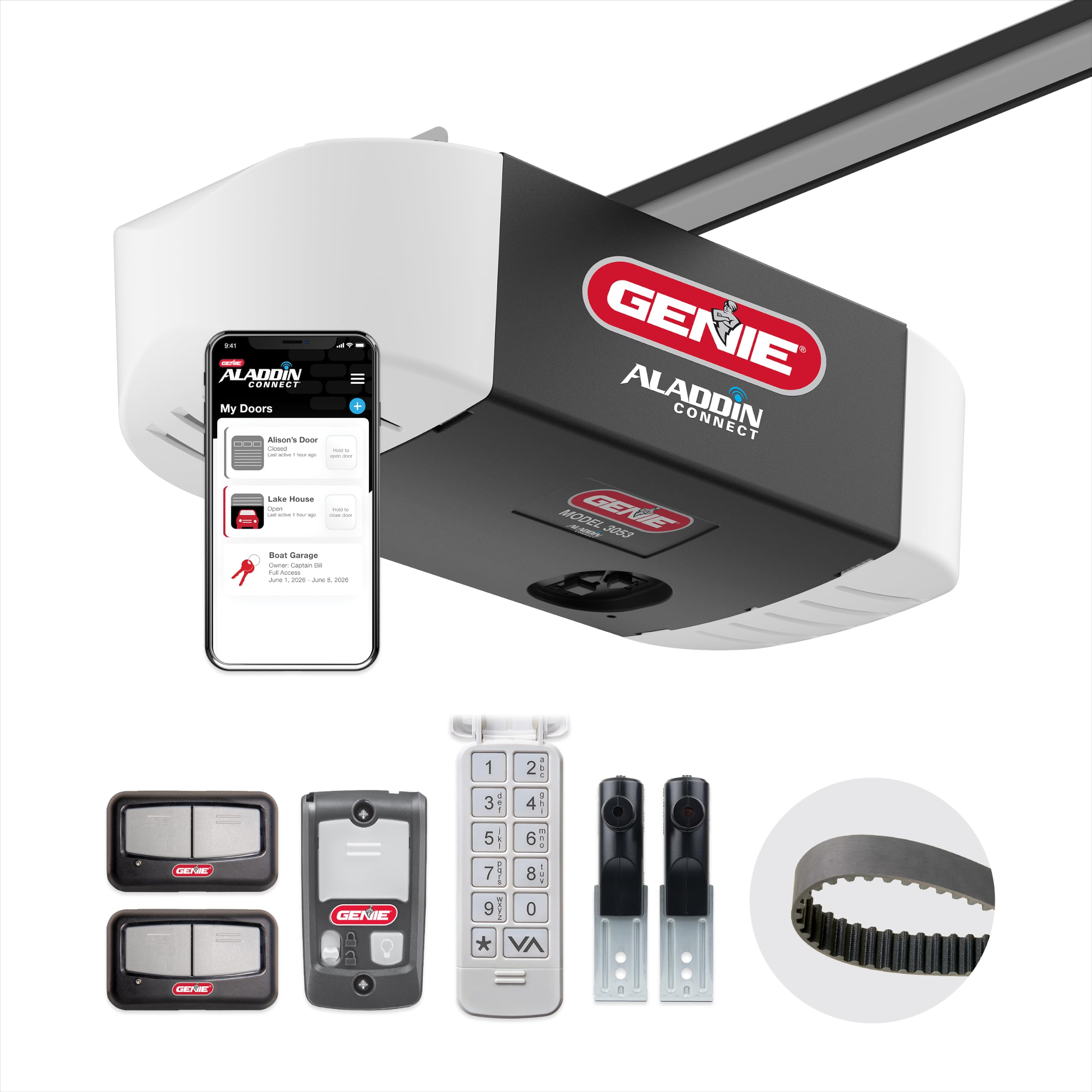
Genie QuietLift Connect 3053-TKV

Genie QuietLift Connect 3053-TKV

Standard doors

Our Score 8.8/10
Check Price

Worth Noting

  • Extension kit required for 8-foot doors
  • Wi-Fi setup can be fussy
Drive
¾ HPC belt
In The Box
2 remotes, keypad, wall console
Door Capacity
Up to 7 ft, 500 lb
Voice Control
Alexa, Google Assistant
Read the full review

The QuietLift Connect is the smaller of the two Genies: same belt-drive quiet, same Aladdin Connect app, but a ¾ HPC motor in place of the StealthDrive's 1.25. What that changes is lift. Genie rates it for sectional doors up to 7 feet tall and 500 pounds, which covers a standard double door; an 8-foot door needs the extension kit, sold separately.

What comes in the box is generous for the money. Two pre-programmed remotes, a wireless keypad, and a wall console with a light button and vacation lock are all included, and the five-piece rail snaps together instead of bolting. Belt drives are the reason a garage under a bedroom stays livable, and quiet operation is what this opener does best.

So the choice between the two Genies comes down to your door and your outages. The StealthDrive's extra money buys more lift and a battery backup; on a standard 7-foot door in a house with reliable power, neither changes your week. What stays here is the quiet belt, the app, and a keypad for whoever keeps losing remotes. On a standard door that's the whole job, and it's why this is the Genie we recommend to most people.

Bottom line: Our value pick among full openers — the quiet belt and app most garages need, with the lift to match a standard seven-foot door.

5

meross MSG100HK HomeKit Controller

meross MSG100HK HomeKit Controller

Apple Home homes

Our Score 8.8/10
Check Price

Worth Noting

  • Costs more than the non-HomeKit version
Warranty
2 year
Smart Home
Apple HomeKit, Alexa, Google, SmartThings
Door Sensor
Wired
Opener Compatibility
200 brands, 1,600+ models
Read the full review

If the house runs on Apple Home, this is the only pick here built for it. The MSG100HK appears as a native HomeKit accessory — a tile in the Home app, Siri control, and the same automations and geofences your lights already use. Everything else in this guide asks you to open a second app to check the door; this one doesn't.

The hardware is the same family as the plain MSG100, with a couple of differences worth naming. It covers 200 brands and more than 1,600 opener models, including the Security+ 1.0 and 2.0 units that trip up cheaper controllers, and it uses a wired sensor on the door rather than a battery-powered one, which is the more accurate way to know whether the door is actually shut. No hub, no subscription, and a two-year warranty.

In an Apple household we think it's the obvious choice, and in any other household it's the wrong one. If nobody carries an iPhone, HomeKit buys you nothing — the plain MSG100 covers Alexa, Google Assistant, and SmartThings, and the eKyro adds Siri voice on top of a strong installation record. What you're paying for here is the tile, the automations, and never explaining a second app to the people you live with.

Bottom line: The pick for an Apple household — native HomeKit, Siri, and Home automations, with a wired sensor that keeps the door status honest.

6

meross MSG100 Smart Controller

meross MSG100 Smart Controller

Alexa and Google

Our Score 8.6/10
Check Price

Worth Noting

  • 2.4GHz Wi-Fi only
  • No Apple HomeKit support
Alerts
Open, overtime, overnight
Smart Home
Alexa, Google Assistant, SmartThings
Subscription Fees
None
Opener Compatibility
200 brands, 1,600+ models
Read the full review

The best thing about the MSG100 isn't the app — it's the nagging. It pushes open and close notifications, flags a door left open past a set time, and sends an overnight reminder, which is exactly the kind of thing we want a controller to pester us about. This is the budget pick of the group, and for an Alexa or Google household with a standard opener it covers the essentials without a subscription.

Wi-Fi is where it asks for patience. The radio is 2.4GHz only, and the unit needs a genuinely good signal where it's mounted; on the far side of a detached garage it can drop off and sit there until it's power-cycled. Put a mesh node or an extender within range before installation rather than after. The rest of the setup is ordinary: two wires to the opener, one sensor on the door, and a phone on the 2.4GHz band while it pairs.

Against the eKyro, the trade is ecosystem and connection. This one covers Alexa, Google Assistant, and SmartThings and leaves Apple out entirely; the eKyro adds Siri and holds its Wi-Fi link more reliably. Pick the meross if the house is Google or Alexa and the signal reaches the garage, and pick the eKyro if Siri is in the house or the router sits at the far end of it.

Bottom line: Our budget route into app and voice control: it covers Alexa, Google, and SmartThings, and its left-open alerts are the reason to pick it.

How We Picked and Tested the Best Smart Garage Door Openers

We started with a long list of every smart controller and Wi-Fi-connected opener still on sale, then trimmed it by checking each one's published compatibility list against the opener brands in my garage, my neighbors' garages, and a handful of my colleagues' homes. Price, wiring requirements, and whether the unit needed a separate hub cut more than 30 contenders down to 10.

Installation came first. I timed each one solo, from slicing the box open to the first successful open from my phone, counting trips back to the instruction booklet and noting exactly where I needed a second person on the ladder. Then I killed the garage light and closed the door at 10 p.m. with a decibel meter on the bedroom floor above, because a chime or a gear whine that carries through a ceiling is what people actually complain about at midnight. Ease of use went to my wife and a neighbor's teenager, who added themselves as users and set up an open-door alert with no coaching from me.

For six months I opened and closed those doors from the end of the block, from the kitchen, and from an airport 700 miles away, logging every 'offline' banner, every status that failed to refresh, and every time the app and the actual door disagreed. HomeKit compatibility I verified the only way that counts—by adding each unit to Apple Home and running a scene. And I ran the math on what each one gives you that your opener manufacturer's free app doesn't, since in this category that difference is where the value actually lives.

How to Choose Smart Garage Door Openers

Replace the Opener or Retrofit the One You Have

Most garages don't need new hardware overhead — they need a new button. A retrofit controller wires into the same two terminals your wall switch uses and adds app and voice control for a fraction of the cost of an opener. Budget for a complete unit when the existing one is loud, undersized, or near the end of its life, or when you want a belt drive, battery backup, and a motor warranty. If your door still lifts smoothly, start with a controller and keep the difference.

Choose the Ecosystem Before the Feature List

Alexa, Google Assistant, Apple Home, and SmartThings don't talk to each other, so the phones and speakers already in the house decide more than any spec panel. A native Apple Home accessory is a different thing from Siri support through a third-party app: one gives you a tile and automations alongside your lights, the other gives you a voice command.

Check the features you actually want — schedules, auto-close, open-door alerts — and confirm they're included rather than sold as a subscription. The retrofit controllers here state no fees; not every brand in this category can say the same.

Wi-Fi Is the Whole Product

Almost every complaint in this category traces back to the radio. Most controllers run 2.4GHz only, so pair with the phone on that band, and expect a router change to mean re-pairing. A detached garage with a metal door is a genuinely hard spot for signal; a mesh node within range fixes more installations than any support line will. Keep the unit out of a metal cabinet, too — it's a radio, and it needs to be treated like one.

Match the Drive to Your Door and Ceiling

Three-quarter horsepower suits a standard seven-foot sectional door up to 500 pounds; step up to 1.25 HPc for tall, heavy, or custom doors. Belt drives are the quiet choice over a living space, while chain drives cost less and clatter more. If the ceiling has to stay clear, or the door runs a high-lift track or sits in low headroom, a wall-mount unit is the shape that fits — and it needs a torsion-bar door and a technician.

Plan the Installation, Not Just the Purchase

A retrofit controller is an afternoon with a ladder, two wires, and a sensor to mount square on the door. A full opener is a half-day job for two people, most of it overhead. Wall-mount units belong to whoever services your springs. Whichever route you take, the photo-eye sensors stay connected, aligned, and working — they're the reason a closing door reverses, and going smart changes nothing about that.

Frequently Asked Questions

Final Verdict

Our pick is the eKyro, and it's the one to buy first. It turns the opener you already own into something your phone and your voice can run, it works with all three major assistants, and it doesn't charge a monthly fee to do it — which is most of what anyone wants from this category.

Spend more only for a reason you can name. The Genie StealthDrive earns it when the opener itself is tired or the garage shares a wall with a bedroom. The Chamberlain wall mount earns it when the ceiling has to stay clear. The meross MSG100HK earns it in a house that runs on Apple Home. Everyone else should start with the retrofit.