Rugs

Best Doormats of 2026

A doormat has one job, and most fail at it in a predictable way: coir scrubs mud off boots beautifully and then sheds fibers across the hall, while rubber scrapes grit loose but leaves a puddle for bare feet. I've lived with both kinds, and I wanted to know which ones keep the dirt outside without making the entry look like the mat aisle at a hardware store. A good one scrapes shoes clean, stays exactly where you put it, and feels fine in socks — a bad one curls at the corner and becomes a trip hazard you learn to step over.

The fix isn't complicated, just specific. Over eight months, my team and I kept 14 mats in rotation at front doors, back doors, and one heavily trafficked hallway, and the differences showed up within a week. Here's what first-time buyers tend not to know: most homes need two mats, a stiff scraper outside and something plusher inside to catch what's left — a single mat is doing half a job. The picks below handle their half well.

1

Calloway Mills Gatsby

Top Pick
Calloway Mills Gatsby

Exposed porches

Our Score 9.6/10
Check Price

Worth Noting

  • No absorbency; wet boots need a mat inside
  • Gets hot under direct sun
Use
Outdoor
Care
Hose clean
Size
24 x 36 in
Material
100% rubber
Read the full review

Solid rubber is a different tool from a fabric mat, and the Gatsby is the most convincing version of it in this set. At 24 by 36 inches it's oversized for a doormat, it's heavy enough that a gust won't move it, and it's built to be hosed down where it lies rather than washed. For a front door with nothing over it — a stoop, a walk-up porch, a coastal entry — this is the one we take.

There's no pile to clog, so it scrapes instead of absorbing: mud and grit come off on the molded surface and rinse away, and the rubber is meant to go through a freeze without cracking or buckling. It also stays flat, which matters more than it sounds on a porch, where a curled corner is the thing that catches a heel.

What it isn't is absorbent. Wet boots still need a second mat inside, so plan the entry as a two-mat setup if your weather is wet. And because it's solid rubber, it holds heat — on a sun-baked stoop it runs hot under bare feet and hotter under a dog's paws, which matters in a shoes-off house.

Bottom line: For a door with no roof over it, this is the one: solid rubber, 24 by 36 inches, heavy enough to ignore wind, cleaned with a hose.

2

Muddy Mat Chenille

Muddy Mat Chenille

Wet paws

Our Score 9.4/10
Check Price

Worth Noting

  • Backing can tear after repeated washing
  • Indoor use only
Care
Machine wash
Size
19 x 30 in
Surface
Chenille
Thickness
1 in
Read the full review

An inch of chenille is a lot of mat. That depth is the entire idea: the pile holds water instead of passing it through to the floor, and the absorbency claim is five times the mat's own weight, which is why this is the one people buy for a dog that comes in from the yard with wet legs.

Underfoot it feels like a bath mat — soft, slightly springy, deep enough that you notice it through socks. That's also why it ends up in bathrooms, garages, and beside a shower as often as at a front door. The TPE backing holds it on tile and hardwood, and it's machine washable, which for a mat this absorbent is the feature that keeps it from becoming a soggy problem.

We rate it the best moisture mat of the ones here, and the one to choose when wet paws are the reason you're shopping. It's an indoor mat, so an uncovered porch leaves it soaked and doing nothing, and because it holds water rather than shedding it, it wants a wash-and-dry cycle now and then rather than a shake. At 19 by 30 inches it's a standard single-door footprint — fine at a back door, tight at a wide front one.

Bottom line: When wet paws are the problem, this is the mat we point to: an inch of chenille that holds water and goes straight into the washer.

3

AMARU Coir Bird Mat

AMARU Coir Bird Mat

Covered front doors

Our Score 9.4/10
Check Price

Worth Noting

  • Must stay dry; rain stains coir
  • Scrapes but does not absorb water
Care
Shake clean; keep dry
Size
17 x 29 in
Surface
Coir
Thickness
0.6 in
Read the full review

Coir is the oldest doormat material there is, and the AMARU is the reminder of why it survives: stiff natural bristles that stand up and scrape mud off a sole instead of smearing it around. The bird print is what turns it into a decor purchase — the colors are as vivid as the photos, and the 17 by 29 inch mat has enough border to look deliberate rather than folksy at a front door.

We think it's the best-looking mat here, and the one that suits a covered porch best: it takes a scraper's job seriously and still reads as decoration. The catch is water. Coir soaks, stains, and stays damp, and the care instructions ask for a shaded, dry spot — which makes this right for a roofed porch or a mudroom and wrong for an exposed walk. It's a scraper, not an absorber, so wet weather still wants something else.

Bottom line: Coir does the scraping and the bird print does the decorating, which makes this the mat to beat on a covered front porch.

4

SEEKSEE Buffalo Plaid Rug

SEEKSEE Buffalo Plaid Rug

Layered porch decor

Our Score 9.4/10
Check Price

Worth Noting

  • No pile or bristles to trap dirt
  • Cotton holds damp and marks in mud
Care
Machine wash
Size
27.5 x 43 in
Material
Cotton
Thickness
0.16 in
Read the full review

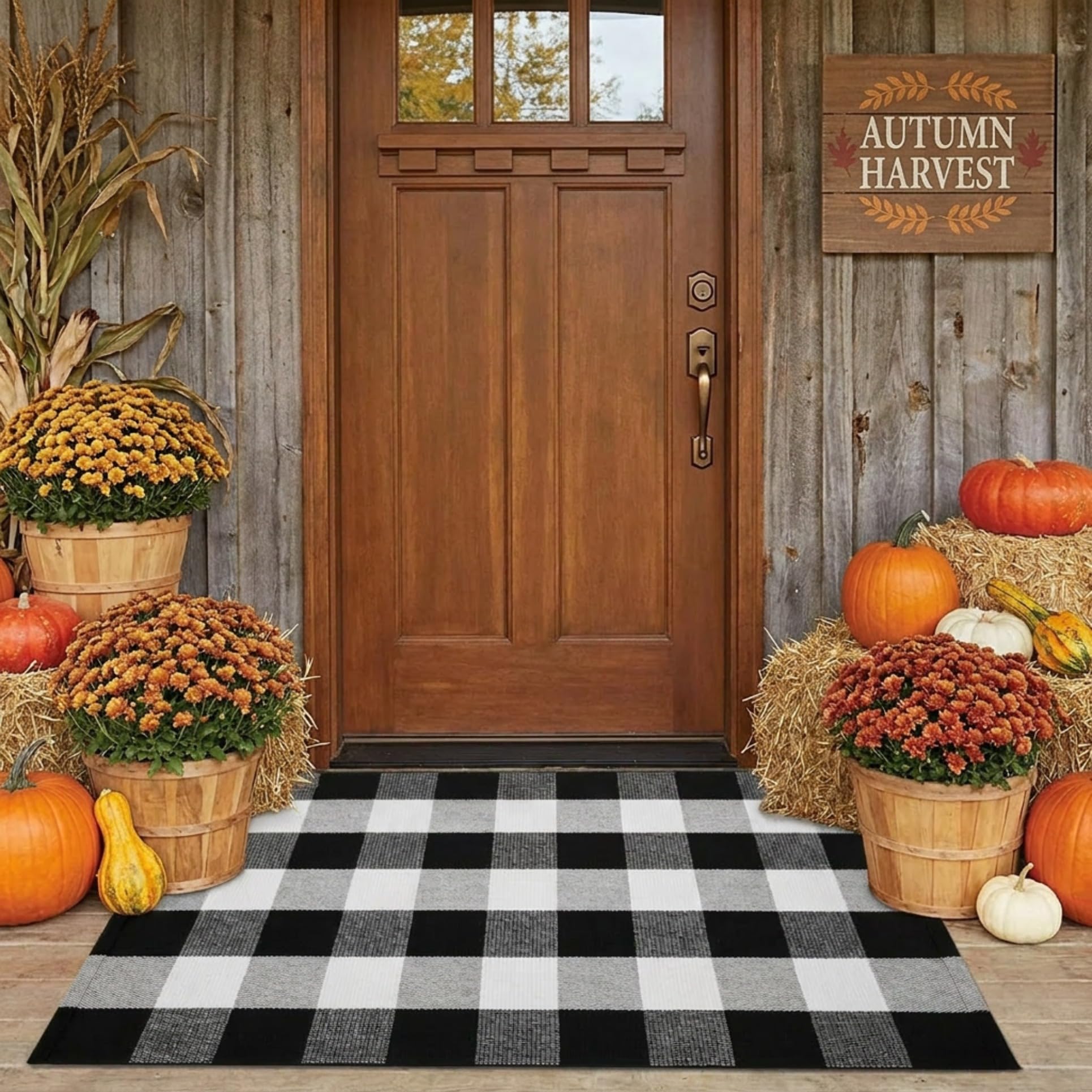
This is a porch rug, not a mat, and reading it that way is the whole trick. The SEEKSEE is a flat-woven cotton piece, 27.5 by 43 inches and a sixth of an inch thick, designed to sit under a coir or rubber mat and give the entrance some width. Buy it for how the doorway looks.

The black and white buffalo plaid is the whole pitch, and it's a good one: the plaid is woven flat rather than tufted, the colors are as vivid as the photos, and the rug is big enough to read as a deliberate layer rather than a mat that missed. It folds, it reverses, and it goes in the washing machine on a gentle cycle — which for a porch textile is the difference between a seasonal refresh and a permanent stain.

Practical notes: it's happiest on a covered porch or in a mudroom, and the 43 inch length is longer than a doormat's, so check the depth of your landing — a rug that overhangs the step will curl at the nose.

As a layer, we like it a lot: it turns a mat on a bare porch into a front-door arrangement, and the plaid carries from fall into winter without looking like a seasonal flag. It's the one product here that's decoration first, and it does that job better than anything else in the set.

Bottom line: Buy it for the look, not the mud: a washable cotton plaid that turns a bare porch into an arrangement.

5

BEQHAUSE Dirt Trapper

BEQHAUSE Dirt Trapper

Indoor entryways

Our Score 9.2/10
Check Price

Worth Noting

  • Indoor use only
Care
Machine wash cold
Size
20 x 32 in
Backing
TPR
Thickness
0.4 in
Read the full review

It arrives folded into a square, and for the first day or two the creases are visible enough that you wonder whether you've made a mistake. You haven't. The fold lines relax within a few days of ordinary foot traffic, and the mat underneath them is a dense, low-pile polypropylene that looks a good deal more expensive than it is.

This is the mat we put inside the front door. The pile is tight enough to pull water and grit off a wet shoe without feeling like something you have to tiptoe across, the TPR backing stays put on hardwood and tile, and at 0.4 inches it doesn't foul the door. It's also the easiest mat here to live with: machine wash cold, tumble low, back down before the next muddy day.

The boundaries matter. It's an indoor mat, so an open porch in a wet climate is the wrong home for it — the backing wants a dry floor and the fiber wants to dry out between soakings. The beige is also more forgiving than the photos suggest, which is exactly what you want at a door that sees a dog, three pairs of boots, and a school run twice a day.

Bottom line: The best indoor mat in this set, with dense fiber that pulls water off shoes, a backing that stays on hardwood, and a low profile that clears a tight door.

6

HIYARD Front Door Mat

HIYARD Front Door Mat

Tight budgets

Our Score 9.2/10
Check Price

Worth Noting

  • Runs small against a wide doorway
  • Plain next to the coir and plaid picks
Size
29 x 17 in
Backing
Rubber
Surface
Polyester
Thickness
0.3 in
Read the full review

You can spend twice as much on a doormat, and for most front doors you're paying for looks rather than function. The HIYARD is a 29 by 17 inch mat with a low, grooved polyester face, a rubber backing, and a waterproof surface — the plain, competent specification that does the actual job.

The grooves and the flow pattern do real work: grit settles into them, the rubber border helps keep water on the mat rather than under it, and the 0.3 inch profile means the door swings over it without a shove. It's machine washable, though on most days a vacuum or a shake is enough. It comes in a handful of colors, and the neutral ones disappear against a pale porch.

We rate it near the top of this set on value and grip, and middling on looks — it's a plain mat, and at a door that's on show the coir or the plaid does more for the entry. If the door is a utility one, a side entrance, a garage, or a back door near the garden, that trade is entirely in your favor.

Bottom line: If the door is a utility entrance, this is the sensible buy — low profile, waterproof, rubber-backed, and the least expensive full-size mat here.

7

Yimobra Welcome Mat

Yimobra Welcome Mat

Scraping muddy boots

Our Score 9.2/10
Check Price

Worth Noting

  • Light enough to shift in strong wind
  • Little absorbency for wet shoes
Size
29.5 x 17 in
Backing
Natural rubber
Surface
Artificial grass
Thickness
0.3 in
Read the full review

The top of this mat is artificial grass — short, stiff blades packed densely enough to stand up under a shoe. It's a scraper by design, and the difference shows on the dirt that defeats a fabric mat: clumped mud, wet leaves, grass clippings.

The backing is natural rubber, and it holds the mat flat on concrete rather than letting the edges lift. The gray version sits quietly against pavers and bluestone, and the welcome lettering is decorative without shouting.

Size is the thing to watch. At 29.5 by 17 inches it's a standard single-door mat, and it reads smaller on a wide stoop than the numbers suggest — measure the doorway, not the door. It's also a good-looking utility mat rather than a statement piece, which is the right call for a porch that gets rained on.

Where it lands: near the top of this set on scraping, middling on absorbency. Pair it with an absorber just inside the door and your entry handles a wet November; use it alone on an exposed step and the water comes in with you.

Bottom line: Grass blades instead of pile make this the scraper in the group, the mat for clumped mud and wet leaves on a covered porch.

8

Gorilla Grip WeatherMAX

Gorilla Grip WeatherMAX

Indoor or outdoor

Our Score 8.8/10
Check Price

Worth Noting

  • Spot clean only, no machine wash
  • Single-door size, 17 by 29 inches
Care
Spot clean only
Size
29 x 17 in
Surface
Woven polypropylene
Thickness
0.3 in
Read the full review

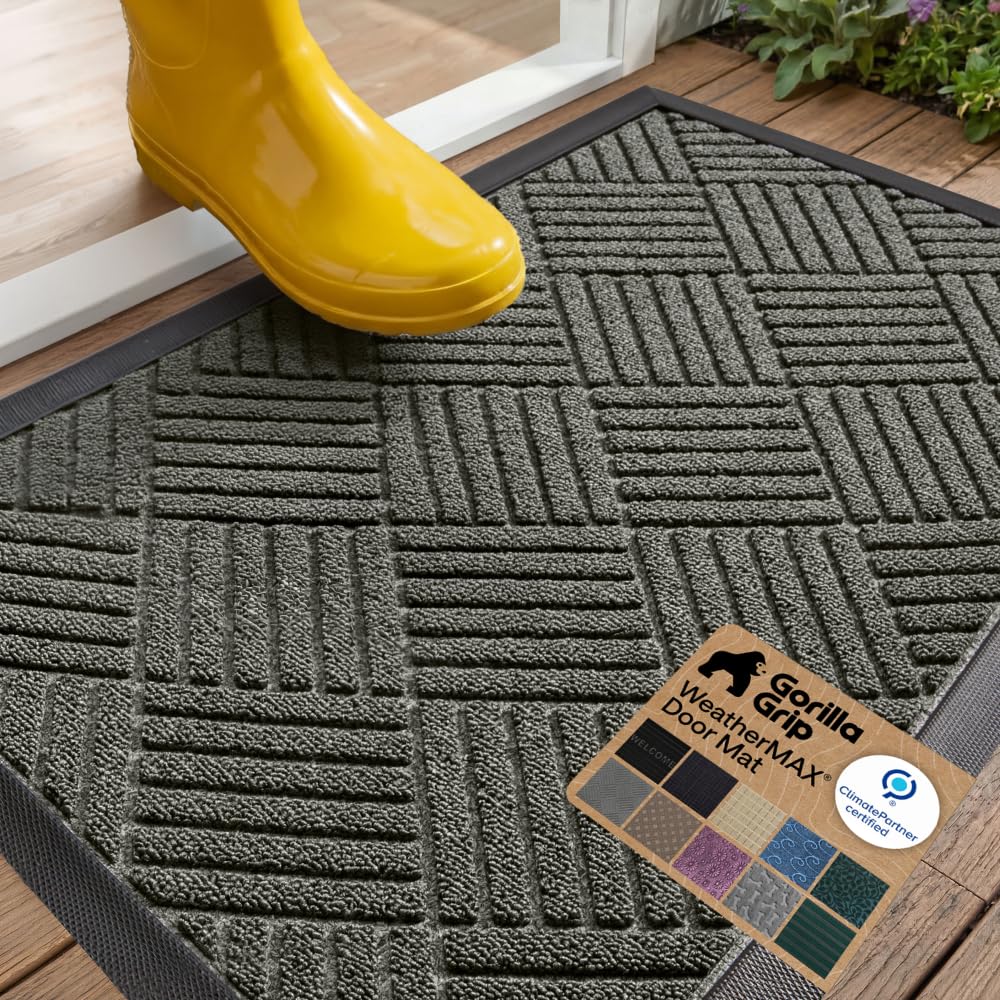
A doormat usually lives one of two lives: under a roof, or out in the weather. The WeatherMAX is the mat in this set we point to when we don't know which it will get, because it handles both. The face is a woven polypropylene with deep grooves and a beveled edge, the back is natural rubber, and at 0.3 inches it slides under doors that would catch a plush mat. That combination is why it comes first here.

The grooves are what you're paying for. Grit and mud drop into them instead of riding into the hall on your soles, and the rubber backing holds the whole thing flat on concrete, tile, or a wood porch. We also appreciate that the surface is fade and stain resistant, so a gray diamond mat that spends the summer in sun still looks like a gray diamond mat in October.

Cleaning is the trade-off, and it's worth going in with your eyes open. This is a spot-clean mat rather than a machine-wash one: hose it down, vacuum it, scrub a stain with a brush. In a wet mud season that means a rinse every couple of weeks instead of a load of laundry, which we found less bother than it sounds — but if you want to throw a filthy mat in the washer, the chenille picks are the ones to look at.

Two last details. The 17 by 29 inch size is a single-door mat, so a double door or a wide stoop wants two of them. And it grips best on a clean, dry surface; on a dusty garage slab it can skate, so sweep before you lay it down. Neither is a reason to walk away from our top pick.

Bottom line: We recommend it first because it handles a covered porch and an indoor hall equally well, clears the door at 0.3 inches, and hoses clean.

How We Tested 14 Doormats Over Eight Months of Real Foot Traffic

We started by gathering every mat we could find in the four materials that make up most of the category — coir, rubber, microfiber, and recycled indoor/outdoor — then cut anything without a non-slip backing or available in only one size. That left 14 mats, which we laid down in late summer and kept down through the following spring: one at a covered front porch, one at a back door that lets the dog out four times a day, and one in an apartment hallway where boots come off. We crossed them in work boots, sneakers, socks, and bare feet, and during one soaking week, in genuinely wet shoes.

For dirt containment, we spread a measured cup of potting soil and sand across each mat, walked over it in muddy boots, then checked a light-colored tile just inside the door to see what made it past. We vacuumed each mat afterward to see how much it gave back to the house. To judge whether a mat stays in place, we taped the corners to tile and hardwood and watched for creeping over a week of ordinary traffic, including a few hurried entrances.

Softness was judged barefoot, mostly on the plusher indoor styles — some felt great underfoot and trapped every grain of sand. Appearance either held or it didn't: we noted fading in sun, fibers shedding onto the floor, and edges curling away from the door. Durability ran across all eight months, checking for crushed pile, cracked backing, and frayed borders after vacuuming and washing per each maker's instructions. Value came last, weighing what each mat delivered against what it cost.

How to Choose Doormats

Match the mat to the weather it will see

Start with the roof, not the rug. A covered porch or an interior hall gives you the whole menu: coir, chenille, cotton, polypropylene. A door with nothing over it narrows things fast — you want rubber or a rubber-backed flat weave, something that drains and hoses clean, and enough weight that wind can't take it. That is why the Calloway Mills rubber mat and the Gorilla Grip WeatherMAX sit near the top of this set: both are built for weather and neither needs a washing machine. If your door bakes in afternoon sun, skip anything with a printed face, because fade is the first thing to go.

Decide between a scraper and an absorber

A doormat does one of two jobs. Scrapers — coir, artificial grass, molded rubber — stand up and knock clumped mud off a sole. Absorbers — chenille, dense polypropylene — pull water out of the tread and hold it. Very few do both well, which is why the best entries use two mats: a scraper outside, an absorber inside. Buying only one? Buy for the mess you actually have. Wet paws and rainy pavements want absorbency; gravel, leaves, and heavy mud want scraping.

Measure the door, then the doorway

Thickness is where good mats get returned. Half an inch clears most doors; a full inch of chenille does not, unless there is a real gap under the door. Anything around 0.3 to 0.4 inches is the safe default for a door that has to swing over it, which is why the low-profile mats here cover more entries than the plush ones.

Width catches people out just as often. 17 by 29 inches is a single door, and on a 36-inch opening it leaves bare floor at both ends. For a double door or a wide stoop, go up to 24 by 36 or plan on two mats.

The backing decides whether it stays

Rubber, TPR, and PVC backings all work on the same principle: they need a clean, dry surface to grip. On swept concrete or dry hardwood, a rubber-backed mat barely moves. On a dusty slab, or over a puddle, any of them will slide — that is the mat telling you the floor is the problem, not the mat.

Weight is the other half of the answer outdoors. A heavy mat resists wind in a way a light one simply cannot, and a mat that lifts at the corner is a trip hazard as well as an annoyance.

Be honest about the cleaning

Every mat here asks for something different. Chenille and dense polypropylene go in the washing machine; rubber gets hosed; coir gets shaken and kept dry; the plaid cotton rug washes on gentle and air-dries. Match the care to your climate and your patience. Where mud season runs three months, a spot-clean mat becomes a chore and a washable one earns its keep. Where the entry is covered and dry, the low-maintenance rubber options cost you nothing.

Frequently Asked Questions

Final Verdict

The Gorilla Grip WeatherMAX is the mat we recommend for most doors: it survives weather, clears a threshold, holds its place on concrete, and needs nothing more than a hose. If your door has no roof at all, the Calloway Mills Gatsby is the tougher, heavier answer, and if the mat never leaves the hallway, the BEQHAUSE is the cleaner indoor choice.

Pick by the roof over your door before you pick a color, and you'll get this right on the first order.