Kitchen

Best Dish Drying Racks of 2026

The sink is full, the counter is wet, and the dish rack is somehow the least useful thing in the kitchen. A good one gives wet plates a place to lean, sends drips into the sink, and looks decent enough to leave out. I’ve lived with enough wobbly wire racks to know this isn’t a one-size-fits-all purchase: the right pick depends on how much you cook and how much counter space you can spare.

Over six months, my team and I tested 12 racks side by side, from compact two-tier models to full-family versions. We loaded them with dinner plates, bowls, mugs, and the occasional stockpot, then watched where the water went. Size and fit mattered as much as capacity: a rack that swallows a sink’s worth of dishes but crowds out your cutting board is a bad trade. We also tracked appearance, build quality, and rust at the joints, because a rack that looks grimy by August isn’t a bargain. The picks below earned their counter space and kept it.

1

simplehuman Steel Frame Dishrack

Top Pick
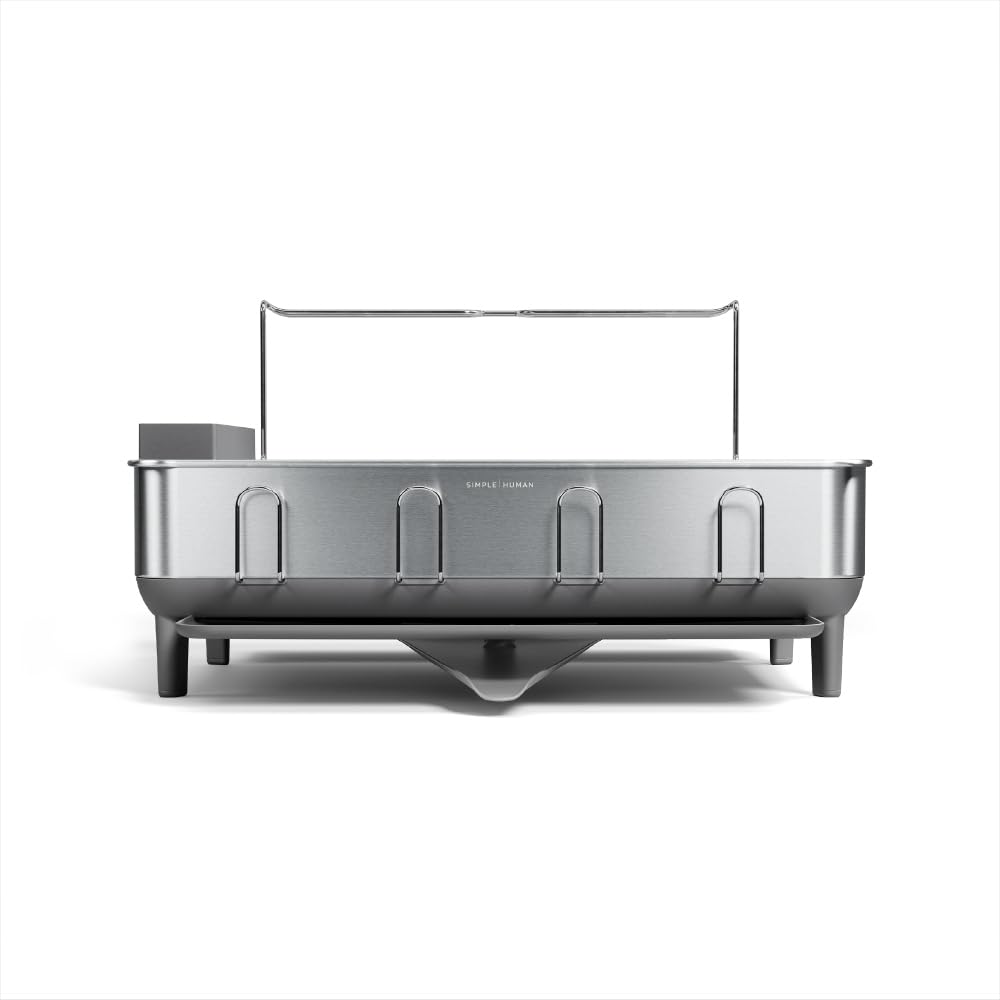
simplehuman Steel Frame Dishrack

Daily hand-washing

Our Score 9.4/10
Check Price

Worth Noting

  • Premium price against every other rack here
Weight
7 lb
Warranty
5 years
Stemware Holder
4 Bordeaux glasses
Counter Footprint
20.2 x 22.3 x 11.5 in
Read the full review

What you get for the money is mostly tray engineering. The surface is hydrophilic, which means it spreads water into a film thin enough to evaporate instead of beading into a puddle, and the anti-residue coating is aimed at the chalky mineral film hard water leaves behind. Around that sit silicone-capped prongs, a rail for chopping boards, and a holder that hangs four Bordeaux-sized wine glasses above the plates.

We think it justifies the splurge for a household that hand-washes every single day. The spout swivels a full 360 degrees to whichever side faces the sink and lifts out for cleaning, the frame is brushed stainless rather than coated wire, and a five-year warranty is not something a manufacturer offers on a rack it expects to rust. It swallows a sink full of pots and pans without spreading across the counter.

It is also 20.2 by 22.3 inches and 11.5 inches tall, seven pounds before a single dish goes on it. That is a dedicated corner of counter rather than something you tuck away, and on a short stretch of worktop it will be the only thing that fits. Kitchens with the room get the calmest drying here; everyone else should look at the compact racks.

Bottom line: For a household that hand-washes daily, we think this is the one worth paying for: silicone-tipped prongs, a tray that resists mineral film, and a five-year warranty on a rack that lives wet.

2

MOUKABAL Dish Drying Rack

MOUKABAL Dish Drying Rack

Most kitchens

Our Score 9.2/10
Check Price

Worth Noting

  • Drainboard plastic is the lightest-built part
Drainage
Four-channel tray, rotating spout
Material
Coated stainless steel
Stated Capacity
12 plates, 4 bowls, 6 cups
Counter Footprint
13 x 17 x 6 in
Read the full review

Water that lands back in the sink is the only real test of a drainboard, and this is the rack we hand people who are tired of wiping the counter after every wash. The tray is molded with four shallow channels that run toward a spout you can swivel to point at the basin, and the frame stands on short feet so the spout clears a sink with a raised lip. It is a small piece of design work, and it decides whether you still like the thing in month six.

Capacity is the other half of the argument. The stated load is 12 plates, four bowls and six cups, which covers a family dinner with room across the back for a couple of pans. The cutlery basket lifts out, has slots that keep knives apart, and the whole rack measures 13 by 17 inches — big enough to be useful, small enough to leave out on the counter.

Setup took us a few minutes and no tools. The tray slides out for rinsing and the caddy lifts off, so the weekly clean is a rinse rather than a scrubbing session. Coated stainless over a steel frame keeps the weight at three pounds, light enough to shift with one hand when you want the counter back for pastry.

The one thing to check before you order is reach. The spout is only a few inches long, so the rack has to sit beside the basin; park it at the far end of the counter and the water has nowhere to go. If your only free surface is well away from the sink, an over-sink mat is the better answer.

Bottom line: We recommend it as the default for most kitchens: a drainboard that actually returns water to the basin, room for a family dinner, and a footprint that leaves you somewhere to chop.

3

MECHEER Roll-Up Sink Rack

MECHEER Roll-Up Sink Rack

Tiny kitchens

Our Score 9.2/10
Check Price

Worth Noting

  • Plates lie flat rather than standing upright
Sink Span
17.5 x 11.8 in
Thickness
0.39 in
Heat Limit
400°F
Load Rating
33 lb
Read the full review

Seventeen and a half inches of stainless rod set in a silicone frame, 0.39 inch thick, rated to 33 pounds and safe to 400°F — this is less a dish rack than a landing pad that happens to roll up. Unroll it over the basin and a stockpot straight off the burner can sit on it; roll it back and it disappears into a drawer. We keep coming back to it for pans and produce: a colander of just-rinsed greens drains straight into the sink and there is nothing to wipe afterward.

It needs a rim to bridge, since the mat rests on the counter edges either side of the basin — fine on a sink set into an open counter, awkward under a deep overhang. The exposed steel at the ends is where a mat like this ages first, while the silicone body stays looking new. Buy it as the second drying surface in a small kitchen, or the only one if you cook more than you plate.

Bottom line: If the sink is your only free surface, we point you here: it rolls out for a hot pan, rolls up into a drawer, and it is the cheapest thing on this list.

4

Neat-O Small Dish Drainer

Neat-O Small Dish Drainer

Small sinks

Our Score 9.2/10
Check Price

Worth Noting

  • Plated steel can rust at the joints
  • Cutlery cup clips on loosely
Weight
1.3 lb
Material
Chrome-plated steel
Dimensions
14.25 x 12.75 x 5.25 in
Dish Slots
8 or more
Read the full review

It drops into the sink. That is the whole idea here: 14.25 by 12.75 inches, five and a quarter tall, with rounded corners that let it settle into a basin instead of straddling it. At 1.3 pounds you lift it out with one hand, and the coated wire base is there to keep plates and the sink itself from getting scratched.

Eight dishes sit in the slots, more if you lay smaller things across the top, and the plastic cutlery cup clips on the side and comes off when you want it out of the way. On the counter it reads as a piece of chrome kitchen equipment rather than a plastic tub, which is more than most racks at this end of the range manage.

For a one- or two-person kitchen this is the pick we come back to. It fits a small sink, it holds a day's dishes, and it leaves the worktop clear for actual cooking. The wire slots are spaced for ordinary dinner plates, and the coating on the base means a chip in the finish does not immediately become a rust mark on your porcelain.

There is no drain mat in the box, which the photos do not make obvious. On the counter, set it on a folded towel or a silicone mat you already own; in the sink it hardly matters, and the sink is where this one is happiest.

Bottom line: In a small sink this is the rack we trust to hold a day's dishes without taking the counter — light enough to lift out one-handed and tidy enough to leave out.

5

JASIWAY In-Sink Dish Rack

JASIWAY In-Sink Dish Rack

Awkward sinks

Our Score 9.2/10
Check Price

Worth Noting

  • Extension bars can slip on a smooth rim
  • Utensil holder holds a handful, not a drawer's worth
Material
Stainless steel
Sink Span
15.5 to 23.2 in
Dimensions
15.5 x 11 x 4.8 in
Load Rating
70 lb
Read the full review

Some sinks defeat every rack — a single bowl with no divider, a shallow basin, a faucet dropped in the middle. This one answers that with two support bars that slide out from 15.5 to 23.2 inches, so the rack bridges the opening rather than sitting down inside it, and the grid stays above the water line.

The open grid is the other good decision we noticed. Water falls straight through to the drain, so there is no tray to rinse and no puddle to wipe, and the stainless frame carries a stated 70-pound limit, which is more headroom than a rack this size needs. It arrives assembled, and the cup and utensil holder hang on the frame where you can reach them.

What makes it worth a place here is that it buys drying space without spending counter space. The trade is the sink itself: while dishes are on it the basin is out of action, so it suits a kitchen with a second bowl, or someone who washes up once and clears the rack before cooking again.

Bottom line: Our pick when the sink is an awkward shape: bars that bridge the opening, water that drops straight through, and no tray to rinse at the end of it.

6

Sakugi 2-Tier Over-Sink Rack

Sakugi 2-Tier Over-Sink Rack

No counter space

Our Score 9.0/10
Check Price

Worth Noting

  • Baskets will not take a stockpot or sheet pan
Depth
11 in
Height
21.5 in
Baskets
3
Sink Span
30 to 33.9 in
Read the full review

Twenty-one and a half inches tall is the number to reckon with. This rack stands over the sink on two legs like a small shelving unit, and it will sit in front of a window, a tap or a tiled splashback you would rather see. In exchange it holds dishes in the air above the basin and leaves every inch of counter free — which, in a kitchen where the counter is also the prep space, is the entire point.

Two baskets and a top shelf take plates, bowls, cups and cutlery, with a slot for a cutting board, a knife holder and five hooks for utensils and sponges. The frame is 304 stainless and adjusts from 30 to 33.9 inches to sit over the sink opening, and the baskets lift out so you can carry a load to the cupboard rather than reaching over your head.

It arrives flat, and assembly is an evening job rather than a five-minute one — worth knowing before it lands on the kitchen floor in pieces. Once up it is steadier than it looks: the legs rest on the counter either side of the sink and the weight runs down through them instead of onto the crockery.

So it earns a place as a specialist rather than a default: a galley kitchen, a studio flat, a sink under a window you never open. There the trade is worth making — you give up the view and get a drying area that costs no counter. In an ordinary kitchen with a few feet of worktop beside the sink, a countertop rack is simpler in every way.

Bottom line: Our specialist for a kitchen with no counter at all: everything dries above the sink, and you accept a tall frame and small baskets to get there.

7

Kitsure Compact Dish Rack

Kitsure Compact Dish Rack

Small counters

Our Score 8.8/10
Check Price

Worth Noting

  • One meal at a time in a family kitchen
Tiers
1
Cutlery
Detachable two-section caddy
Drainage
Removable tray, rotatable spout
Counter Footprint
15.5 x 12 x 5 in
Read the full review

If the counter is one narrow strip between the stove and the sink, width is the only number that matters, and this rack is twelve inches of it. Length runs 15.5 inches and height is five, so it tucks under a wall cabinet and still leaves room to chop. At a little over two and a half pounds it moves with one hand when you want the space back.

Do not mistake small for token. There is a real drainboard under the wire, a spout that swivels to either side, and a two-section caddy that lifts out in one piece, which is the detail we appreciate most on a busy evening. For one or two people this is the countertop rack we point to first: a full meal's dishes fit, and nothing about it takes over the kitchen.

The tray wants a level counter — prop a shim under one corner if yours slopes, or the water sits at the low end instead of finding the spout. And if you routinely wash for four, the 17-inch rack in this guide is the better fit; the extra inches are the whole difference.

Bottom line: For a one-person kitchen we reach for this one: twelve inches of counter, a real drainboard, and a caddy that lifts out with the cutlery still in it.

8

Kitsure Extendable Dish Rack

Kitsure Extendable Dish Rack

Big washes

Our Score 8.8/10
Check Price

Worth Noting

  • Plastic cup holder and end caps feel flimsy
  • Cup holder takes small glasses, not pints
Width
12.9 in
Height
7.2 in
Drainage
Removable tray, drain spout
Length Range
19.2 to 26.7 in
Read the full review

The fixed 17-inch rack is the right answer for a normal day. This one is for the wash that does not fit: a half-sheet pan, a stockpot, the roasting tin from Sunday. It slides from 19.2 to 26.7 inches, and at full stretch it takes the things a standard rack leaves sitting in the sink.

Closed, it measures 12.9 inches deep and 7.2 tall, with a drain spout, a lift-out cutlery caddy, cup holders on the side and a knife slot at the back. The tray extends with the frame, so the extra width is usable surface rather than an overhang you cannot load.

In daily use it behaves like the compact Kitsure with a longer reach: the spout points where you need it, the caddy lifts out in one piece, and the feet keep the tray off a wet counter. What you notice at full extension is how much of the load is cantilevered, so put the heavy pans over the fixed end and let the plates ride on the sliding side.

Retracted, it still asks for about 19 inches of counter, more than the fixed rack next to it in this guide. The number that decides it is the longest thing you regularly wash: a half-sheet pan runs 18 inches, and if that does not fit your current rack, a shorter one will not fit either.

Bottom line: We keep it in mind for anyone whose wash regularly outgrows a standard rack — it stretches to take a sheet pan, and the flimsy plastic is the price of that reach.

How We Tested 12 Dish Drying Racks

We started with more than 60 dish racks from established and smaller brands, then narrowed the field by counter footprint, claimed capacity, materials, drainage design, and the way each one was meant to sit beside a sink. From that shortlist, we tested 12 models over six months, rotating them through the same kitchen routine: weeknight dinners for two, weekend meal prep with sheet pans and stockpots, and the slow pileup of mugs and water glasses. We measured each rack’s footprint and checked whether dinner plates, bowls, and stemware sat securely without touching or tipping.

Rust resistance and durability got the most abuse. We left water sitting in trays, splashed the frames during sink duty, and checked joints, welds, and coated wires every few weeks for orange speckles, flaking, or wobble. We loaded each rack to its claimed capacity and then some—counting how many place settings it held before plates started nesting—and unloaded it one-handed the way you do when you’re in a hurry. Appearance was judged in daylight, not under kitchen LEDs, and we noted whether water spots, fingerprints, or dulled finishes made a rack look tired by the end of the month.

Fit and value were the final filters. A rack had to leave room for a cutting board or coffee maker, and we paid attention to whether its drain spout actually reached the sink or dribbled onto the counter. At the end of six months, we compared what each rack still looked and worked like against its cost and the counter space it occupied. The racks that survived without rust, wobble, or a puddle habit are the ones recommended below.

How to Choose Dish Drying Racks

Start with where it sits

Countertop racks with a drainboard hold the most and are the easiest to live with, but they want 15 to 20 inches of clear counter beside the sink and a tray you rinse out weekly. In-sink and over-sink racks buy drying space without spending counter, and take the basin out of action while they are loaded. Measure two things before you read another listing: the free strip of counter beside the sink, and the width of the sink opening. A rack marketed as compact is describing its counter footprint, not your sink.

Follow the water

Drainage is where inexpensive racks fail quietly. Look for a board angled toward a spout that overhangs the basin by an inch or more, and for feet that lift the frame over a raised sink lip — a spout level with the rim just recirculates water under the tray. Over-sink mats sidestep the problem by dripping straight through, at the cost of holding plates flat. If your sink sits flush with the counter and the faucet is behind it, a swivelling spout gives you the most places to put the rack.

Capacity is about slots, not inches

A rack's length tells you less than its plate spacing and its cutlery caddy. A twelve-plate claim is only real if your plates are the standard 10 to 11 inches; wide-rimmed china and pasta bowls need more room than the numbers suggest. Caddies range from a handful of cutlery to a drawer's worth, and the ones that lift out with the cutlery still in them are the ones you will keep using. Count what actually piles up in your sink after dinner — if it includes a stockpot or a sheet pan, buy for that rather than for the plate count.

Materials decide year three

Coated and chrome-plated steel is the value choice, and it is also where rust appears first, usually at welds, cut ends and joints that never fully dry. Stainless costs more and holds up better to constant wet use; silicone mats do not rust at all, though the steel rods inside them can. Whatever you choose, a rinse and a wipe of the frame every few weeks is the difference between a rack that still looks new and one that leaves marks on the counter.

Frequently Asked Questions

Final Verdict

If you want one rack and no deliberation, the MOUKABAL is the one to order. The channelled tray and swivelling spout are what earn it: water ends up in the sink instead of under the rack, and 13 by 17 inches holds a family dinner without claiming the whole counter. It is the balance most kitchens are looking for.

Two situations change the answer. If you hand-wash daily and have a wide counter to spare, the simplehuman dries better and is built to outlast the rest of this group, with a five-year warranty behind that. If the sink is the only free surface in the kitchen, start with the MECHEER and add a countertop rack later if you find you need one.