Home Decor

Best Terrariums of 2026

A terrarium is a closed loop: moisture lifts off the soil, beads on the glass, and slides back down to the plants. Get it right and you have a living centerpiece that goes weeks without a drop from you; get it wrong and you have a foggy jar of rotting leaves. What separates the two is rarely the shape of the glass — it's the seal, the false bottom, and an opening wide enough to get your hand inside.

I've killed my share of grocery-store succulents, so I came to this skeptical. Over four months my team and I set up 14 terrariums, from bare glass bowls to full kits with charcoal, gravel, and tiny scissors, and the pattern held: the prettiest jars and the ones that actually thrive are rarely the same. A terrarium is also one of the few gifts that arrives as an activity instead of an object, which is worth remembering if you're shopping for a kid or a plant-obsessed friend. The right pick below comes down to your light and your patience.

1

National Geographic Dinosaur Terrarium

Top Pick
National Geographic Dinosaur Terrarium

Kids 6 and up

Our Score 9.4/10
Check Price

Worth Noting

  • Smaller in person than the box photos suggest
Base
Water-tight
Light
USB-powered lid light
Included
Seeds, gemstones, two dinosaur figures, backdrop
Age Range
6 years and up
Read the full review

Grass that appears in a couple of days is the whole trick with a child's terrarium, and this kit is built around it. The chia and ryegrass come up fast — the first green shows before a six-year-old loses interest — and then keep going until the blades push at the lid.

We rate this as the best kit here for children, and the reasons are physical rather than educational. The mouth is wide, so small hands can reach the bottom without tipping the whole thing. The lid light runs off a USB cable, so there is no battery drawer to raid and no dead night light three days in. And the box carries genuine blue calcite, rose quartz, and aventurine alongside two dinosaur figures and a reversible backdrop — more real material than most kits at this size bother with.

Two practical notes. The light needs a cable, so the shelf has to be within reach of a powered USB port; check that before a child adopts it as a bedside night light. And we found it reads smaller in person than the box photos suggest. It is a countertop garden rather than a centerpiece — which is the right scale for a bedroom shelf, and the grass reaching the lid is the point.

Bottom line: If the terrarium is a gift for a child, this is the one we hand over: fast sprouts, a wide mouth sized for small hands, and a lid light that keeps working after bedtime.
2

NCYP Glass House Terrarium

NCYP Glass House Terrarium

Tabletop display

Our Score 9.2/10
Check Price

Worth Noting

  • Top hinge is the first thing to wear
  • Small plants only
Opening
Swing door on top
Included
Terrarium only
Footprint
9.84 x 5.31 x 7.87 in
Watertight
No — mist only
Read the full review

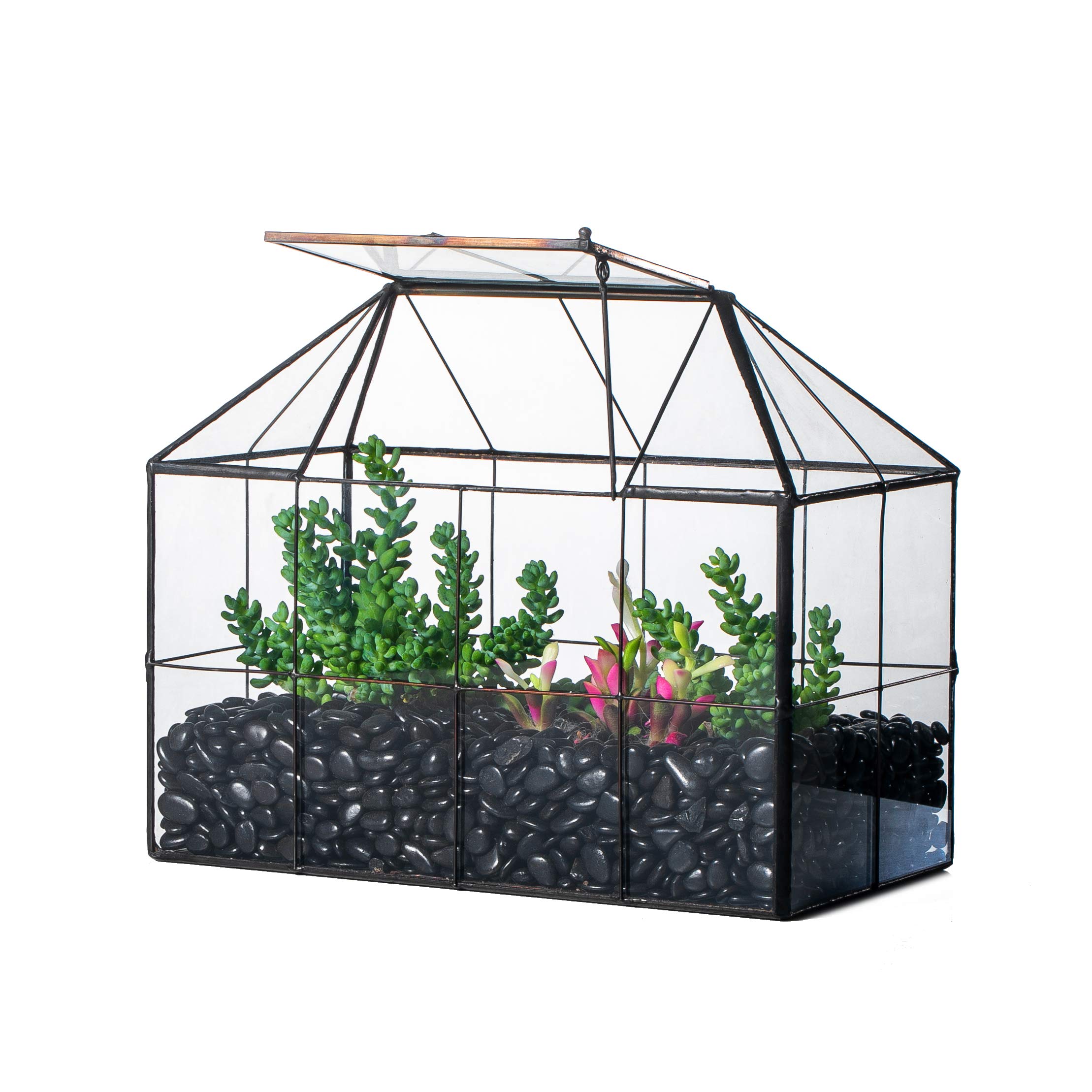
The NCYP house is the one we keep on the shelf even with nothing planted in it. Nearly ten inches long and under six inches deep, it lines up along a bookcase the way a model building would, and the black grid frame and copper-foil seams make it look chosen rather than bought from a craft aisle. It has real weight to it, which is the practical reason it stays put when you reach past it with a mister.

What it wants is a miniature landscape: succulents, a mossy corner, a couple of small ferns, a path of gravel. That is the scope it is designed for, and it is the right one — this is a display case, not a planter for anything with ambitions to sprawl. The swing door on top holds humidity in, which is what moss and ferns need from a glass box.

Water is where you change your habits. The panels are soldered rather than gasketed, so the body is not built to hold standing water. Put a gravel layer under the soil, water with a mister, and the seams never become an issue; pour from a can and you will be wiping the shelf.

Our reservation is the door itself. It is small, so planting means a spoon and a pair of tweezers, and it is the hinge that shows wear first when the house has been opened twice a week for a year. For a piece you plant once and then mostly look at, that is a fair trade — and looking at it is what this one is for.

Bottom line: We recommend the NCYP house to anyone who wants small plants on display and a terrarium that earns its shelf space on looks alone.

3

AREPK Desktop Terrarium with Grow Light

AREPK Desktop Terrarium with Grow Light

Low-light desks

Our Score 9.2/10
Check Price

Worth Noting

  • 10W will not carry a sun-loving plant
  • The most expensive pick here by a clear step
Vent
Rotating humidity ring
Light
10W LED with timer
Material
Borosilicate glass
Footprint
5.9 in diameter x 9.8 in tall
Read the full review

Most terrariums here assume you have a bright sill to spare; the AREPK brings its own light. A 9.8-inch borosilicate cylinder sits under a 10W LED ring with a timer, and a rotating inner ring opens or closes the top to raise or lower humidity. It is a plant case with a lamp built in, and the lamp is the whole reason to look at it.

The timer is the part that earns its keep in a real room. Set it once and the light runs its cycle whether or not anyone is at the desk on Saturday, which is more than a clip-on lamp on a plug timer manages with any grace. The glass is clean and undistorted, and the adjustable vent is a genuinely useful control — close it down for moss, crack it for ferns and anything that resents still air.

We come down in favor of it for low-light spots, with two limits in view. A 10W ring over a six-inch circle keeps moss, small ferns, and mini tropicals going; it will not carry a plant that wants full sun, and expecting it to is the usual way this purchase disappoints. The other is that the electronics live in the lid you will be handling — register the year of coverage on the light and keep the adapter away from the mister.

Bottom line: Our pick if your best plant spot has no daylight: the built-in timer light and adjustable vent make a desk or north-facing shelf genuinely usable.

4

Mkono 3-Pack Geometric Terrariums

Mkono 3-Pack Geometric Terrariums

Air plants

Our Score 9.2/10
Check Price

Worth Noting

  • Not watertight
  • Smaller in person than the pictures imply
Shapes
Globe, teardrop, bowl
Set Size
Three vessels
Watertight
No — seamed glass panels
Vessel Size
4 to 5 in
Read the full review

Three vessels, three silhouettes, four to five inches of glass apiece — the Mkono set is less a terrarium than a way to put plants in three places at once. A globe with a 2.5-inch opening, a teardrop, and a bowl, each in black-framed glass.

The panes are set into a metal frame rather than sealed, so the seams can gap and none of the three will hold water. For air plants and dry succulents that costs you nothing; for anything that wants wet soil it is simply the wrong vessel, and a gravel layer only partly rescues it. Mist, do not pour.

Size is worth being clear-eyed about. The teardrop is the tightest of the three and the one we found surprising — a single small plant and a couple of stones is the entire arrangement. The globe's opening is 2.5 inches across, fine for tweezers and hopeless for a hand.

We keep the globe empty on purpose. It looks better as glass geometry on a shelf than it does with something stuffed into it, and the teardrop is the one that earns its keep with a single air plant. Three shapes rather than one is the real appeal: you try a look on one shelf and a different one on another instead of committing to a single silhouette.

Bottom line: Three small vessels beat one big one when the plants are air plants, and that is the case we make for the Mkono set.

5

Creativity for Kids Grow 'N Glow

Creativity for Kids Grow 'N Glow

First kids' kit

Our Score 9.2/10
Check Price

Worth Noting

  • Plastic jar, not glass
  • Wheat and chia seeds only
Included
Seeds, soil, sand, stones, stickers, mister, two figures
Jar Size
5 x 3.25 in
Age Range
6 years and up
Plantings
Two per kit
Read the full review

A five-inch plastic jar, potting mix, sand, river stones, wheat and chia seeds, two resin figures, and 45 glow-in-the-dark stickers: the Grow 'N Glow is the least expensive way into terrariums, and it makes no attempt to be anything else.

The glow stickers are the smart part. The planting itself is an afternoon's work at most; the stars and constellations stuck to the jar are what bring a six-year-old back to it after dark. The kit is also portioned for two plantings if you use half the seeds and half the mix the first time, which is the most useful thing to know before you open the box.

Where it gets unpredictable is germination. Wheat and chia come up fast when they take, and some jars simply sit there — a hard thing to explain to a child who has been misting for a week. Planting half the seeds now and holding the rest turns a failure into a retry. We also like that the jar is small: it lives on a dresser without a negotiation about shelf space.

Bottom line: A first terrarium for a child who wants to do the whole thing alone: that is what we keep the Grow 'N Glow around for.

6

PYEF Crafts 1-Gallon Terrarium Kit

PYEF Crafts 1-Gallon Terrarium Kit

Adult planting project

Our Score 8.8/10
Check Price

Worth Noting

  • No plants included
Plants
Not included
Capacity
1 gallon
Included
Cork lid, coir soil, stones, moss, charcoal, four tools
Footprint
8.07 x 7.28 x 11.81 in
Read the full review

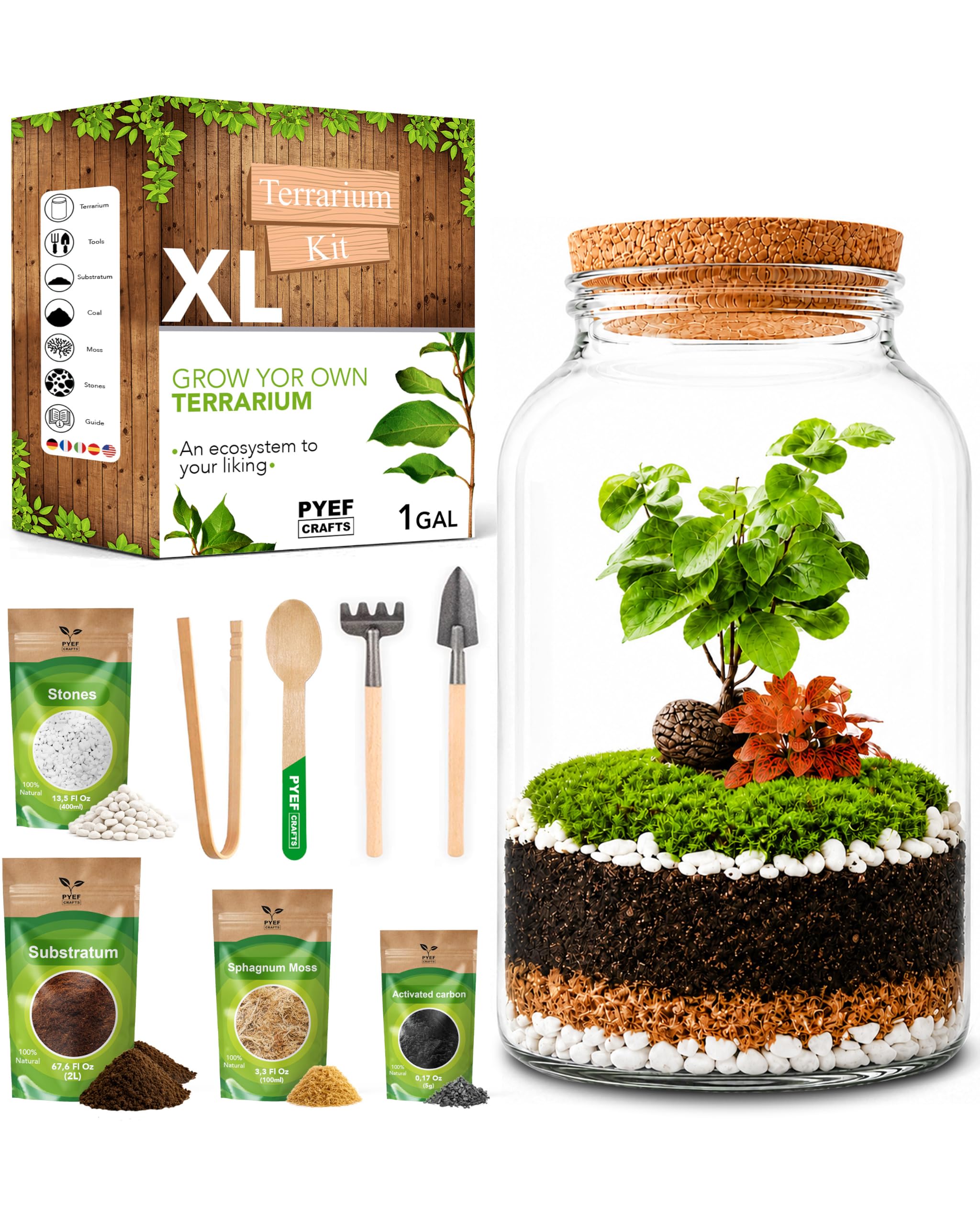
There are no seeds in the PYEF box, and no plants either. What you get is the one-gallon jar, a cork lid, coir soil, activated charcoal, sphagnum moss, decorative stone, and four tools — tweezers, a spoon, a rake, a trowel — that exist because you are planting down through the mouth of a jar rather than lifting a roof off.

We like that bargain. A kit with seeds is an afternoon that ends; a kit that supplies the hardscape and then gets out of the way is a project where you choose the planting — a fittonia, a small fern, a bit of moss — and seal it. The charcoal layer and the cork lid are what make the closed-jar idea plausible: once it settles, condensation on the glass does most of the watering.

The part worth the most thought is plants. Nothing in the box tells you which ones tolerate a sealed jar, and a fern that sulks in humidity will undo a good build. Ask the nursery for humidity-tolerant, low-light varieties, plant densely, and give it two weeks before you judge it.

Bottom line: For adults who want to plant rather than assemble, we point to this kit: a one-gallon jar, the hardscape, the tools, and a sealed result you can leave alone.

7

YIMORENCE Large Glass Terrarium

YIMORENCE Large Glass Terrarium

Wide-access planting

Our Score 8.8/10
Check Price

Worth Noting

  • Roof sits loose, with no latch or hinge
  • Glued joints need care when moving it
Base
Drains — not waterproof
Opening
Removable glass roof
Included
Terrarium only
Footprint
8.65 x 6.3 x 7.1 in
Read the full review

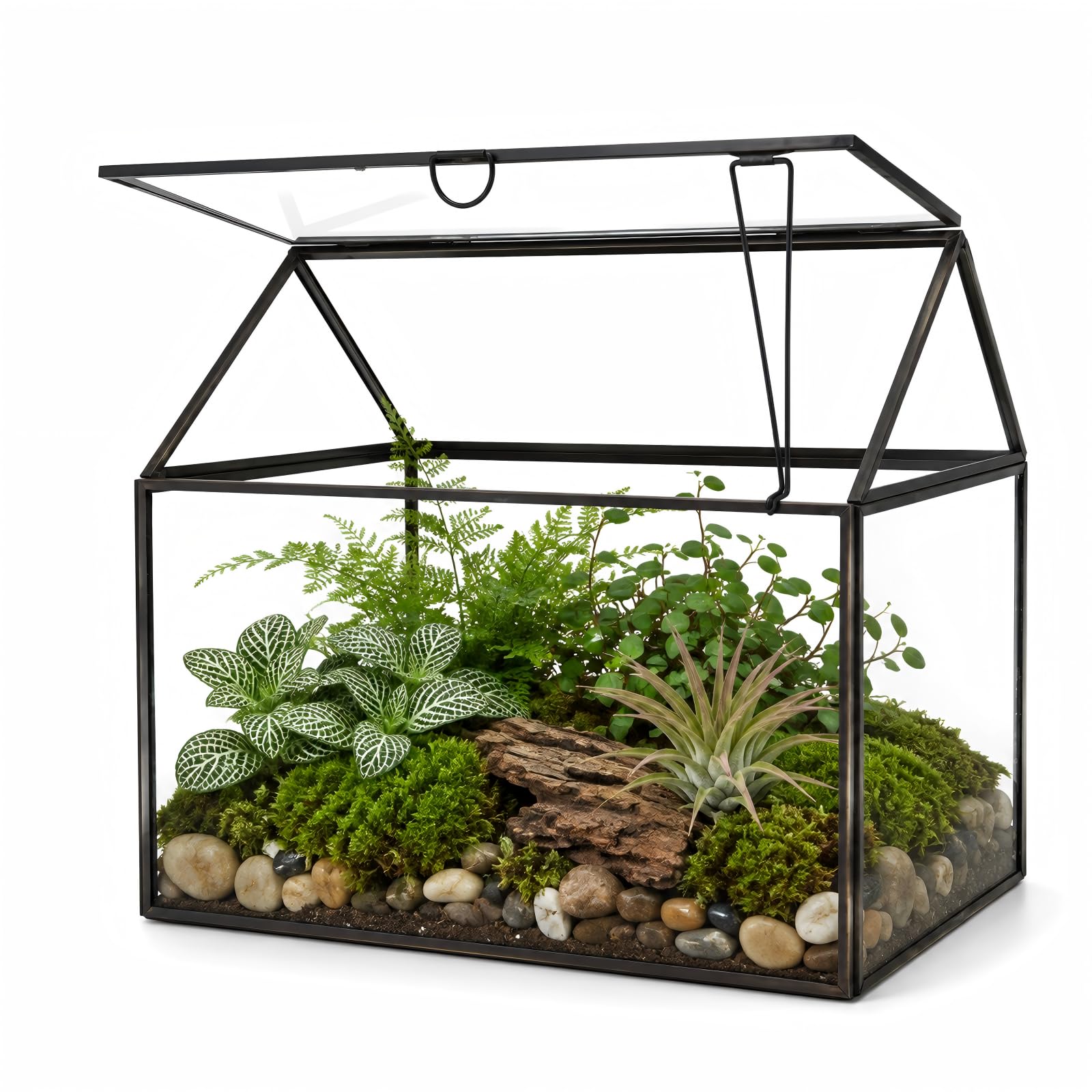
Planting through a small swing door is fiddly work, and the YIMORENCE solves it by taking the whole roof off. We put it in this roundup for that single difference: set the base on the table, build the hardscape with both hands, place the plants where you actually want them, then lift the glass house back on.

It is a good-looking object on its own terms — 8.65 by 6.3 by 7.1 inches, black frame, glass on all four sides, with a wide swing lid and a vent. The base is deliberately not waterproof, so excess water drains away instead of sitting against the roots. For succulents and cacti that is exactly right, and it is why this one works on a windowsill where a sealed jar would hold too much humidity.

The trade-off is that same base: it lets water out, which is right for a desert planting and wrong for anything that wants bog conditions, and it means a wooden shelf wants a mat or a saucer underneath. None of that is a flaw — it is the difference between a greenhouse and a jar.

Bottom line: The YIMORENCE is the one we choose when planting access matters more than a seal: the roof comes off, the base drains, and succulents do well in it.

How We Tested the Best Terrariums

We started with a list of about 40 terrariums from big-box retailers, garden centers, and small glass studios, then cut anything we couldn't confirm shipped with a false bottom or that arrived only as a photo we couldn't verify. Glass thickness, seal type, opening size, and what actually comes in the box — some kits include charcoal, gravel, and plants; some are an empty bowl — narrowed that to 14.

Each one was assembled at my kitchen table using only the instructions in the box, with a timer running to see how long it took one person to go from flat-packed to planted. We filled each to its recommended water line, set it on a paper towel overnight, and checked the next morning for seepage and damp rings underneath — the fastest way to catch a lid that doesn't seat or a base that sweats. Then we planted them and lived with them for four months, on a bright windowsill and in a dimmer corner of the living room, noting how quickly the glass fogged, whether the fog cleared by afternoon, and how the plants actually grew.

Durability was tested the unglamorous way: carrying each terrarium between rooms, running a thumbnail along every rim and seam, and seeing which ones chipped. For the gift question, we judged whether one could be handed over as-is or needed re-wrapping, and whether a beginner or a kid could follow the instructions without help — the kits that explain the charcoal layer and the water cycle earn their keep. Last, we priced out what each box contained against buying the glass, gravel, charcoal, and plants separately.

How to Choose Terrariums

Start With What Is in the Box

Three quite different products get sold as terrariums. The first is a vessel: glass and a frame, nothing else, and you supply the soil, the drainage layer, and the plants. The second is a starter kit, which adds substrate, hardscape, and tools but still leaves the greenery to you. The third is a grow kit, usually aimed at children, which arrives with seeds and is meant to be planted the day it is opened.

Read the included-components list before you buy and you avoid the most common letdown: a beautiful glass house that turns up empty. If you want to plant this weekend, buy the kit and pick up plants on the same trip. Our pick for adults here is a one-gallon jar kit that supplies everything except the plants themselves.

Watertight, Draining, or Dry-Only

Glass terrariums sit on a spectrum. A sealed jar with a cork or glass lid holds its own humidity, so condensation does most of the watering and you open it to trim. A vessel with a soldered or framed body usually is not watertight, and it wants a gravel layer under the soil plus a mister instead of a watering can. A house with a deliberately open base drains freely, which suits succulents and ruins anything that wants bog conditions.

Match the vessel to the plant before you fall for the shape. If a listing says it will not hold standing water, that is a design, not a defect — plan the false bottom and buy a mister.

Measure the Shelf and the Opening

Two measurements decide whether a terrarium is a pleasure or an irritation: the footprint and the opening. Depth matters more than height on a bookshelf, so a vessel that is ten inches wide and five deep will sit happily where a round bowl will not. Then look at how your hand gets in. A wide mouth or a lift-off roof means you can plant with both hands; a small top door means tweezers, a spoon, and patience.

For a child, the opening is the whole thing. A mouth wide enough for small hands is worth more than any feature list, because the planting is the activity.

Decide Where the Light Comes From

Terrariums fail slowly in bad light, and the plants sulk for weeks before they die. A bright sill out of direct summer sun is the easy answer. If the spot you actually have is a desk or a north-facing shelf, an integrated grow light in the lid is tidier than a clip-on lamp and far easier to put on a timer, and it makes a genuinely dim corner usable.

Be honest about wattage. A small ring light keeps moss and mini tropicals going; it is not a substitute for sun on a plant that wants full sun, and buying one expecting that is the usual disappointment.

Who Is Doing the Planting

A terrarium built by an adult and one built by a seven-year-old are different purchases. For children, weigh the opening, the germination speed, and whether the body is glass or plastic — a plastic jar that gets knocked off a dresser is a disappointment rather than an injury. For adults, the questions are access, drainage, and how the piece will look in a year, when the novelty has worn off and only the planting is left.

Buy the plastic kit for the child and the glass house for the shelf. They are not competing for the same corner of the house.

Frequently Asked Questions

Final Verdict

Start with the NCYP glass house if you want a terrarium that looks like a piece of furniture: it is the best-looking vessel here, long enough for a real miniature landscape, and it takes a gravel layer without fuss.

If a child will be doing the planting, the National Geographic dinosaur kit is the better buy — the sprouts arrive in days, which is the only deadline that matters at six. And if your best spot gets no daylight at all, the AREPK's timer-driven lid light changes what is possible there.