Home Decor

Best Terracotta Decor of 2026

Terracotta is supposed to feel like a sun-warmed wall in Oaxaca — earthy, a little dusty, warm without shouting. What shows up instead is often traffic-cone orange, or a vase so thin you can see light through the rim. I've had a planter sweat a rust ring onto a windowsill and a "terracotta" pillow cover turn salmon the moment it met daylight. Get it right and you have the cheapest way to warm a room that's gone gray: honest color, real weight in the hand, a finish that shrugs off a watering can.

Over the past six months, my team and I have kept 14 pieces in rotation — vases, planters, candleholders, and terracotta-toned pillow covers and throws — on mantels, bookshelves, and a covered porch. Here's what nobody tells a first-time buyer: terracotta color shifts with light, so a photo shot at golden hour can read like brick in your north-facing living room. The pieces below are the ones that held their color, their shape, and their zippers.

1

Quoowiit Polka Dot Bird Figurine

Top Pick
Quoowiit Polka Dot Bird Figurine

Shelf and mantel

Our Score 9.6/10
Check Price

Worth Noting

  • Strong dotted texture clashes with busy shelves
Color
Orange
Finish
Raised polka dots
Material
Resin
Dimensions
7.87"L x 3.15"W x 6.3"H
Read the full review

Resin, not ceramic, is the first thing to know about this bird, and it is the reason we recommend it for a shelf at hip height where things get knocked. A ceramic figurine this size is a small heartbreak waiting to happen; resin takes a bump and stays whole. At 7.87 inches long and 6.3 tall it holds a corner of a bookshelf without needing company.

The finish is the interesting part. The feathers are raised polka dots in a real 3D texture, which sounds gimmicky on a listing page and reads much better on a shelf — the dots catch light and give the orange a surface that a smooth ceramic bird doesn't have. It sits flat and does not wobble, which matters more than it should on a floating shelf.

Where it does not work: a shelf that is already busy. The dots are a strong graphic, and beside a patterned vase or a row of lettered book spines they start to shout. It is happiest alone with one other object, or as the single orange note in a run of white and wood. Ours has stayed out since we unboxed it, which is more than most small decor manages.

Bottom line: A resin bird that takes a knock and holds a corner: the terracotta accent for anyone who does not trust themselves with ceramic.

2

Keketoarrange Gauze Table Runner

Keketoarrange Gauze Table Runner

Holiday dining table

Our Score 9.4/10
Check Price

Worth Noting

  • Sheer gauze; a decorative layer, not a work surface
Size
35"W x 120"L
Color
Terracotta
Includes
1 jute rope, 40 inches
Material
Cotton gauze
Read the full review

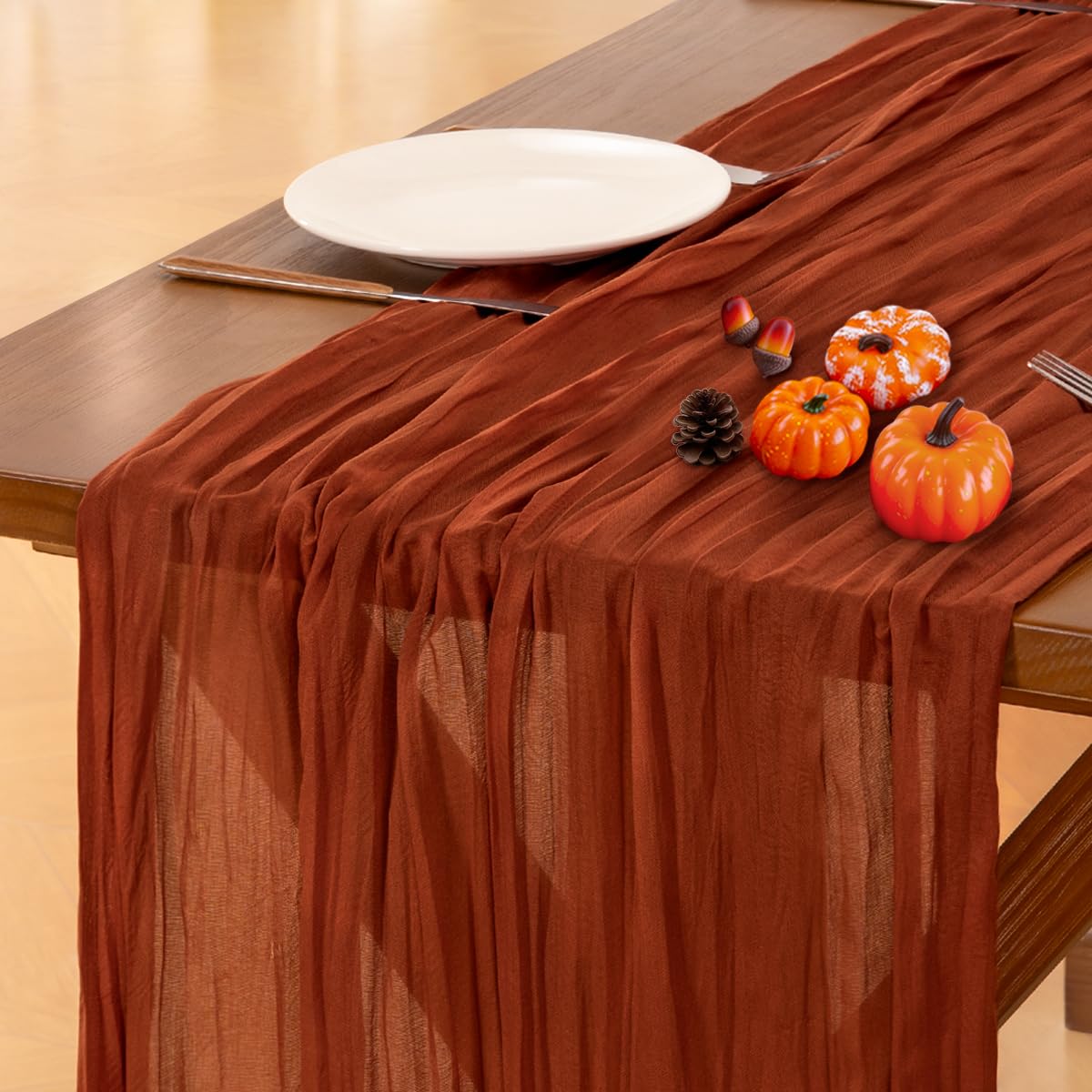
Thirty-five inches of width is what separates this runner from the narrower gauze ones here. Laid down the middle of a long table, the extra fabric pushes out toward the edges instead of running as a thin stripe, and 120 inches is enough to pool over both ends — the draped, generous look people are chasing when they save a photo of a Thanksgiving table.

The material is hand-dyed cotton gauze with a soft, almost scarf-like hand, and it holds a crumple, which is the point. Gather it around a centerpiece, run it diagonally, or bunch it along one edge; a 40-inch jute rope comes in the bag for tying it off or wrapping a chair back. It is machine washable, and it looks better slightly rumpled than pressed flat.

We keep this one for the table that gets photographed — Thanksgiving, a shower, a long birthday dinner — because it is a sheer layer rather than a workhorse. Cutlery and hot dishes want a mat under them, and the loose weave means a sharp corner can catch. For a Tuesday night, the narrower Socomi is the easier choice.

Bottom line: Buy it for the long holiday table: 35 inches of gauze that pools over both ends, ties off with jute, and washes clean.

3

Socomi Cheesecloth Table Runner

Socomi Cheesecloth Table Runner

Weeknight table

Our Score 9.4/10
Check Price

Worth Noting

  • Narrow 29-inch width leaves more table bare
Care
Machine wash
Size
120"L x 29"W
Color
Terracotta
Material
Cotton cheesecloth
Read the full review

At 29 inches wide, this is the narrower of the two runners here, and that is a styling decision rather than a defect. Less fabric across the table means more bare wood at each edge — which flatters a farmhouse top with a good grain and looks skimpy on a wide, plain one. The 120-inch length is generous enough to pool at both ends of a long table.

The material is hand-dyed cotton cheesecloth with a soft, crinkled hand and stitched edges that keep it from fraying in the wash. It comes out of the machine looking better than it went in: the creases settle, it does not want an iron, and it layers over a plain cloth without bulk. That is why it lives on our table on ordinary weeknights and not just holidays.

It earns its place as the everyday runner — soft enough to leave down, long enough to drape, and the sort of piece you buy in a second color once you see how much it changes a table. Order both at once if you want a pair, though. Hand-dyed batches shift, and two bought weeks apart can arrive slightly different in tone and weight.

Bottom line: For a table in daily use, this is the runner: soft cheesecloth, stitched edges, and no ironing after a wash.

4

Meplait Wood Bead Garland

Meplait Wood Bead Garland

Tray and shelf

Our Score 9.4/10
Check Price

Worth Noting

  • Small 16 mm beads on a short 39-inch strand
  • Orange is brighter than a clay terracotta
Color
Orange
Length
39 inches
Material
Wood and jute
Bead Diameter
16 mm
Read the full review

Thirty-nine inches is shorter than it sounds. Looped over a hook or laid through a tray, this garland covers about the width of a mantel shelf and then stops, and the 16 mm beads are small — closer to a pea than a marble — so the effect is a delicate line of orange rather than a chunky strand. That is the right scale for a tiered tray or a stack of books, and the wrong one for a doorway or a big mirror.

What keeps it in rotation is that it does not try to be a centerpiece. The beads are natural wood on a jute cord with visible gaps between them, so it drapes and holds a curve instead of standing stiff, and the tone sits well against terracotta pottery and warm wood. Loop it through a pitcher handle or around a candle holder and it does the work of a much larger object in a fraction of the space.

One caution: the gaps that make it drapeable also let it slide, so give it a surface with some friction or tie the ends off. And because the strand is handmade from natural wood, the spacing varies along its length — treat it as an accent with variation rather than a matched piece.

Bottom line: A small, well-made way to get terracotta onto a tray or a hook — just do not expect it to span a mantel.

5

Fancy Homi Corduroy Pillow Covers

Fancy Homi Corduroy Pillow Covers

Sofa color accent

Our Score 9.2/10
Check Price

Worth Noting

  • Covers only; pillow inserts not included
Pack
2 covers
Size
18"L x 18"W
Color
Rust
Material
Corduroy, patchwork front
Read the full review

Terracotta is a color that lies on a screen. The same word covers pale clay, deep rust, burnt orange, and a peach that photographs like pumpkin, and the difference between two of those on a sofa is the difference between a room that looks designed and one that looks like a near-miss. The Rust corduroy covers from Fancy Homi handle that problem better than anything else here, because the fabric does half the work: a cut-pile corduroy catches light at different angles, so the color moves through the day instead of sitting flat the way printed cotton does.

That is why these are our top pick. Each cover has a patchwork front and a solid back, so one pair gives you two distinct looks — textured side out for a layered, boho sofa, plain side out when the room is already busy. The 18-inch square is the size most throw pillows already are, the hidden zipper is color-matched rather than an obvious stripe of black, and the covers go through a machine wash.

Two things we noticed once they were on the couch. The rust is deep and saturated, so it reads as the accent in a pale room rather than a neutral that disappears into beige — we like that, but it means one pair goes a long way and a second pair in the same corner would tip into too much. And the patchwork front is genuinely busy up close; beside a patterned rug or a printed sofa, the plain back is the side you will want showing.

Bottom line: If you want one purchase that makes a room read terracotta, we point you here: two corduroy covers, two looks each, and a rust that holds up in daylight.

6

Topfinel Terracotta Pillow Covers, Set of 4

Topfinel Terracotta Pillow Covers, Set of 4

Full sofa refresh

Our Score 9.2/10
Check Price

Worth Noting

  • Fiddly zippers on all four covers
Care
Machine wash, tumble dry low
Pack
Set of 4
Size
18"L x 18"W
Color
Terracotta
Read the full review

Four covers in one box is the entire argument for this set. Topfinel packs four 18-inch corduroy covers in a matched run of warm shades, and that solves the problem most people hit when they decorate in a single color: three pillows that almost match look like an accident, while four that step through a palette look like a decision. If the whole sofa is changing at once, we recommend starting here.

The fabric is a soft, thick corduroy with a woven stripe that shows up in raking light and disappears in flat light — texture without a print, which is what keeps these from dating the way a leaf motif does. The backs are plain, the hidden zippers are color-matched, and they take a cold machine wash and a low tumble dry. It also works out as the best value per cover in this group, which matters when you are buying four at a time.

What you give up is choice. The four shades come as a set, so you can't swap one out for a different color the way you can with a two-pack. In practice that bothered us less than expected: the odd shade out migrates to a bedroom chair or a bench, which spreads the palette through the house rather than trapping it in one room.

Bottom line: We recommend this set when the whole sofa needs to change at once: four covers, four warm shades, one decision.

7

MIULEE Chenille Pillow Covers

MIULEE Chenille Pillow Covers

Solid color accent

Our Score 9.0/10
Check Price

Worth Noting

  • Color runs brighter than the listing photos
Pack
2 covers
Size
18"L x 18"W
Color
Burnt orange
Material
Chenille (polyester)
Read the full review

Where the corduroy covers here bring pattern and direction, these are flat by design. The chenille pile is short and even, so the burnt orange goes down uniformly — no stripe catching the light, no patchwork competing with a rug, a curtain, or a gallery wall. In a layered room, that restraint is worth more than texture.

The hand is velvety rather than plush, closer to a short velvet than a fleece, and it keeps that feel through washing, which is not a given with pile fabrics. Two 18-inch covers per pack, color-matched hidden zipper, machine washable, and the kind of smooth surface that brushes clean instead of holding lint.

The pile is the part to keep an eye on. It flattens where heads and elbows land, so rotate the pair if one end of the sofa gets all the traffic — a quick shake and a brush with your hand brings most of it back, but a spot worn flat by a favorite seat stays flatter than the rest.

We recommend these for the room where terracotta should read as a block of color and nothing else: behind a neutral sofa, under a plain wool throw. If you want texture you can see from the doorway, the corduroy picks do that better; if you want the color alone, this is the pair.

Bottom line: Our pick when you want the color without the pattern: chenille that goes down flat, stays quiet, and lets burnt orange do the talking.

8

Lussena Rust Fleece Throw

Lussena Rust Fleece Throw

Draped color layer

Our Score 9.0/10
Check Price

Worth Noting

  • Thin pile; a layer rather than a warm blanket
  • Sheds, especially when new
Size
50"W x 60"L
Color
Rust
Weight
1.52 lb
Material
Polyester fleece
Read the full review

This is the least expensive way in this group to put a large block of rust into a room. A 50 by 60 inch throw covers the arm of a sofa or the foot of a bed, and at that size it reads as color from across the room rather than as a textile detail — which is the whole reason to buy terracotta in the first place.

The fleece is soft and light, at 0.69 kg closer to a layer than a blanket, so it is the piece we pull over our knees on a cool evening rather than a cold one. It goes through a machine wash and a low tumble, and it is the one thing here that gets used daily instead of looked at.

The texture is where expectations split. There is a subtle brushed pattern in the pile that gives the surface some interest in raking light, but the fabric is thin, and thin fleece loses richness when it is heaped on a chair. Folded neatly it looks plush and deliberate; crumpled on the sofa it looks like something you slept under. If you want a throw with weight, this is not it.

So we treat it as decor that happens to be warm. Buy it for the color, keep it folded where the rust can work against a grey or cream sofa, and don't expect it to be the blanket anyone reaches for in January.

Bottom line: A color layer rather than a warm blanket — worth it if you want rust draped over a chair, not if you want weight.

How We Tested Terracotta Decor in Real Rooms

We started with about 60 pieces — vases, planters, pots, candleholders, and terracotta-toned pillow covers and throws — from ceramic studios and home brands we'd bought from before. Anything with vague dimensions, a saucer sold separately with no matching size, or photos that looked color-edited got cut. That left 14 pieces, all bought at retail like anyone else's.

For six months they lived in real rooms: mantels, bookshelves, dining tables, a bathroom windowsill, and a covered porch. Every planter held a real plant and got watered weekly, so we could see which bases wept onto the shelf. Vases moved between direct sun and a dim corner to watch the finish age. Covers went onto the same 20-inch inserts, were stuffed and restuffed, and washed on cold twice a month; softness was judged by hand after the first wash and the fifth. Throws went home with three editors for the couch and the porch.

We weighed each piece, felt the clay wall between thumb and forefinger, and ran a nail along the seam and foot ring for rough or unfired edges. Covers were zipped and unzipped 20 times in a row to see whether the pull snagged or the tape puckered, and we checked the tape measure against the listed size rather than trusting the insert. Shedding got the navy-shirt test plus a lint roller after a week of use. Color was judged in morning light, evening light, and under a lamp, and value came down to what the money bought — a denser clay body, a hand-finished rim, a metal zipper pull.

How to Choose the Right Terracotta Decor

Decide which terracotta you actually mean

Clay, rust, burnt orange, and pumpkin all get sold as terracotta, and the gap between them is wide enough to wreck a scheme. The practical move is to stop hunting one exact match and pick two tones that sit close together: a deep rust cover beside a lighter clay runner reads intentional, while two near-misses read as a color mistake.

Fabric shifts the shade as much as dye does. Cut-pile corduroy and chenille look darker and richer than the same tone on flat cotton, and gauze goes lighter because light passes through it. Don't try to match a paint chip or a pottery glaze from a photo — order the piece, live with it in your own light for a day, and keep the packaging until you are sure.

Match the piece to the surface it sits on

A table runner takes spills and goes through the wash; a pillow cover takes elbows nightly; a figurine or a garland only has to survive dusting. That difference decides material more than taste does. For a table you eat at, a tighter cheesecloth with stitched edges beats a loose decorative weave. For a sofa, a corduroy or chenille with a real hidden zipper will outlast a thin decorative cover.

For a shelf, weight and material matter more than finish: resin survives the knock that ceramic will not, and a piece that sits flat and does not wobble is worth more than one with a prettier paint.

Get the coverage right before anything else

Width is the number most people skip. A 29-inch runner leaves visible wood at the edges of a wide table, which flatters a good tabletop and looks skimpy on a plain one; a 35-inch runner nearly fills the center and gives the layered, draped look. Neither is wrong, but you are choosing a look, not a size.

Length is easier: 120 inches pools over both ends of a long table, while anything near 72 inches stops at the edge. Measure the table before you fall for a photo.

Check the closure and the edge

The zipper is where inexpensive decor fails first. Hidden closures look better and are harder to work, so open one the whole way, push the insert in corner-first, and zip before you fluff. If a cover's zip feels stiff and gritty out of the bag, it will not loosen with age.

On runners, look for stitched or sewn edges rather than raw-cut ones, which fray after a wash. On a wooden garland, gaps between beads are a feature — they let the strand curve instead of standing stiff.

Plan for the wash and the season

Anything on a family table or sofa will be washed, so treat the care label as a buying criterion: machine washable beats a marginally better shade that needs hand washing.

Expect fleece to shed for the first wash or two, chenille pile to flatten where it is leaned on, and gauze to come out creased rather than pressed — none of that is a fault. If you want the piece out after November, buy texture rather than motif, and skip anything shaped like a pumpkin.

Frequently Asked Questions

Final Verdict

The Fancy Homi covers are the recommendation we stand behind. Two corduroy covers, two looks each, and a rust that behaves itself in daylight is more than most terracotta accents manage, and at the low end of this group's pricing it is also the easiest one to try.

If the whole sofa is changing, the Topfinel four-pack does that in one order; if you want the color with no pattern at all, the MIULEE chenille pair is the quiet version of the same idea. Buy the covers first, then add a runner when the table starts to look bare.