Home Decor

Best Fake Plants of 2026

The corner of my living room gets about twenty minutes of indirect light a day — enough for a fern, a fig, or, as it turns out, nothing else I've tried. A good fake plant fixes that in an afternoon: the spot reads styled instead of sad, and nothing drops on the floor. Its only job is to pass — not fool a botanist, just survive a glance from across the room with the lamp on.

I've bought a few of these on impulse and regretted most of them. Over the past six months, my team and I have lived with 14 fake plants — ficus trees, trailing pothos, an olive branch that fooled a houseguest — in entryways, a windowless bathroom, and on top of the kitchen cabinets. Price, I learned, mostly buys leaf material; the cheap ones shine under a bulb like gift wrap. The other surprise is assembly: nearly everything arrives compressed, and the hour you spend bending stems back into place is the difference between a plant and a pile of plastic. The picks below earned their spot.

1

Velener Artificial Agave 2-Pack

Top Pick
Velener Artificial Agave 2-Pack

Porches and patios

Our Score 9.6/10
Check Price

Worth Noting

  • No planters in the box
  • Rigid leaves need clearance on a path
Height
22 in
Spread
28 in
Set Size
2 plants
UV Resistant
Yes
Read the full review

Most of the faux greenery here will live indoors, where it never meets direct sun. These agaves are built for the other side of the door: UV-resistant, 22 inches tall with a 28-inch spread, and sold as a pair so they can go straight into whatever containers are already on your porch.

We planted ours in heavy pots flanking a door, and the difference from the indoor picks is scale. A 28-inch spread gives the plant the wide, low silhouette a real agave has; most artificial succulents stand up in a tight bundle and end up looking like a pineapple. The green is matte rather than glossy, with enough variation across the rosette that the plastic does not announce itself.

They have held their color through a summer in full sun, which is where cheap artificial plants fail first, and rain has not spotted them. Two things to plan for: there is no planter in the box, so the real cost includes a container, and a light one tips in wind unless you set the base in gravel or sand. Rigid leaf tips are worth keeping clear of a busy path.

Bottom line: The outdoor pick: UV-resistant agaves that keep their color through a summer of direct sun and fill a doorway planter with real presence.

2

Der Rose Mini Fake Plants 3-Pack

Der Rose Mini Fake Plants 3-Pack

Shelves and counters

Our Score 9.4/10
Check Price

Worth Noting

  • Only 7.5 inches tall
Height
7.5 in
Set Size
3 plants
Pot Diameter
3 in
Pot Material
Paper pulp
Read the full review

Three pots, three different greenery shapes, and a finish that does not announce itself as plastic: that combination is why this Der Rose set is the one we point most people to first. The leaves are frosted gray-green rather than glossy, and that is the single detail separating convincing faux eucalyptus from the shiny kind you can spot from across a room. We put one on a windowless bathroom shelf and it took a week before anyone asked how it was surviving without light.

The three designs differ enough that spreading them across three rooms does not look like a matching set, and grouping them reads as one arrangement rather than three separate purchases. The pots are paper pulp — matte, muted, slightly textured, very much in the farmhouse register. Set them beside glossy ceramic or brass and they look plain, which is worth knowing before you build a shelf around them.

Handle these by the pot, not the stems. They are delicate, and a leaf or two can work loose coming out of the box; a dot of craft glue puts it back in seconds. Once arranged, the color holds without fading or collecting dust badly, and the muted sage sits well with wood, white, and terracotta. For a first order of fake greenery, this is where we start.

Bottom line: Three matte, sage-toned plants that make a shelf look styled without asking you to keep anything alive — this is the set we recommend first.

3

ASTIDY 5FT Dracaena Tree

ASTIDY 5FT Dracaena Tree

Living room corners

Our Score 9.4/10
Check Price

Worth Noting

  • Priciest plant in this guide
Height
60 in
Planter
Included
Pot Width
9 in
Plant Type
Dracaena
Read the full review

The box is the size of a small suitcase: 11 pounds of dracaena, a tall black planter, a bag of moss, and branches folded up for shipping. Setup is a five-minute job — the branches pull down and separate without tools or a second pair of hands — and that counts for a lot when you have bought a five-foot plant online and half expect a fight.

Proportion is what sells it. Sixty inches tall on a 9-inch pot means slender and upright rather than wide and bushy, the shape that fits beside a sofa or in the corner of a small dining room where a full-width tree would eat the light. The moss covers the base convincingly and the planter is heavy enough that it stays where you put it.

At the top of the price range here, it earns the money if you want one floor plant rather than five small ones. Leaf tones vary enough that it does not read as artificial from across a room, and the whole thing looks planted rather than propped. It is also the easiest floor plant in this set to assemble and the one we reach for in a rental where nothing can go on the walls. Measure your ceiling line first: five feet plus a planter is taller than most people picture against a bare wall.

Bottom line: If you want one floor plant and no fuss, this is it: five feet of dracaena that stands up in minutes and looks planted, not propped.

4

Velener Small Eucalyptus 2-Pack

Velener Small Eucalyptus 2-Pack

Tight spaces

Our Score 9.2/10
Check Price

Worth Noting

  • Bright green leans artificial in formal rooms
Height
8.4 in
Planter
Included
Set Size
2 plants
Plant Type
Eucalyptus
Read the full review

Two potted eucalyptus plants, 8.4 inches tall, with stems flexible enough to bend out into a shape you choose. That flexibility matters more than it sounds. Plenty of small faux plants arrive crushed into a tight bundle and stay that way forever; shake these out, separate the stems, and they go from a green stick to something that reads as a plant.

For a narrow windowsill, a bathroom counter, or the sliver of space behind a coffee station, this pair is the easiest buy in the group: it undercuts our top pick and stands nearly an inch taller. The trade-off is color. This green runs brighter and more saturated than the muted sage of the Der Rose set — fine against white tile, wood, and other plants, slightly loud in a formal room.

Keep the scale in mind. At 8.4 inches with a 3-inch pot, these are shelf plants, and they will look undersized beside a big lamp or a tall vase. We use ours to fill gaps rather than to anchor a corner, and filling gaps is exactly what they are good at.

Bottom line: We send budget shoppers here: two tall eucalyptus pots that undercut our top pick, with stems you can bend into shape.

5

Nearly Natural 35in Snake Plant

Nearly Natural 35in Snake Plant

Narrow corners

Our Score 9.2/10
Check Price

Worth Noting

  • Planter looks undersized for the height
Height
35 in
Leaves
28
Planter
Included, black
Pot Width
6.75 in
Read the full review

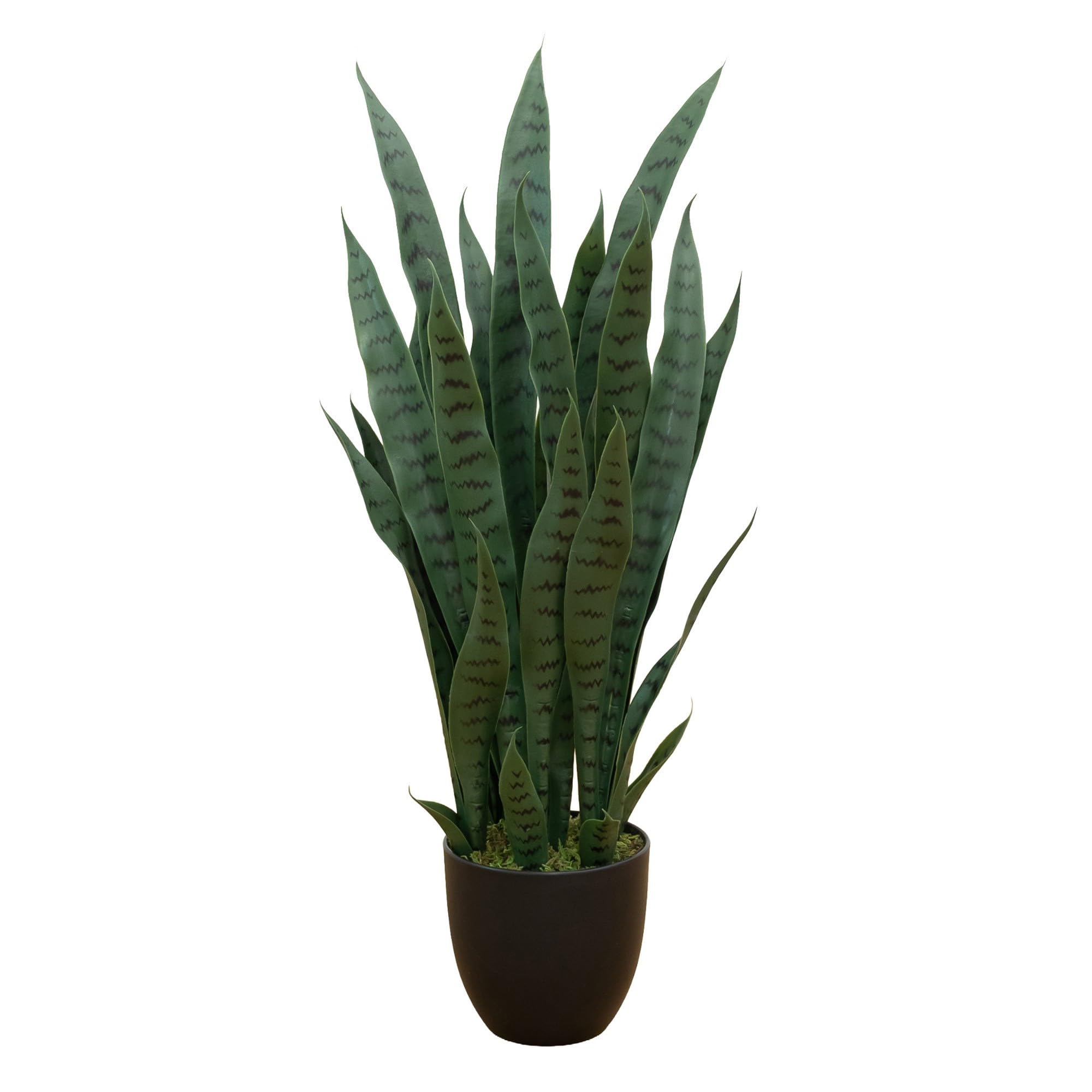
Snake plants are the easiest houseplant to fake and the hardest to fake well. Real sansevieria leaves are thick, upright, and slightly irregular, with a matte surface and faint banding that flat green plastic never has. This one stands 35 inches tall on a 7-inch footprint — narrow enough for the strip of floor between a sofa and a wall, or the dead corner beside a fireplace where a wider plant will not go.

Twenty-eight leaves give it enough density to look established rather than newly bought, and they bend gently, so you can open the plant up and give it the slight lean a real one develops. The square black planter is plain and modern: it disappears against dark furniture and looks deliberate against a pale wall.

Two things to know before it goes in a bedroom. Some of these arrive with a musty smell that takes days to clear, so air it on a porch or in a garage first. And up close, some leaves show molding seams along the edges — invisible from standing height, obvious while you are dusting.

Neither changes our view that this is the best tall-and-narrow option in the group. At 35 inches it fills vertical space without eating floor area, which is the entire reason to own a snake plant indoors, and the matte finish holds up in a hallway you walk past every day. For a low-light corner where a real sansevieria would sulk, this is the plant we put there.

Bottom line: A tall, narrow snake plant for the awkward strip of floor a wider tree cannot use, provided you can air it out first.

6

Der Rose Succulents 6-Pack

Der Rose Succulents 6-Pack

Desks and niches

Our Score 9.0/10
Check Price

Worth Noting

  • Just over three inches tall
  • Green is flat next to real succulents
Height
3.14 in
Set Size
6 plants
Pot Diameter
2.3 in
Pot Material
Plastic
Read the full review

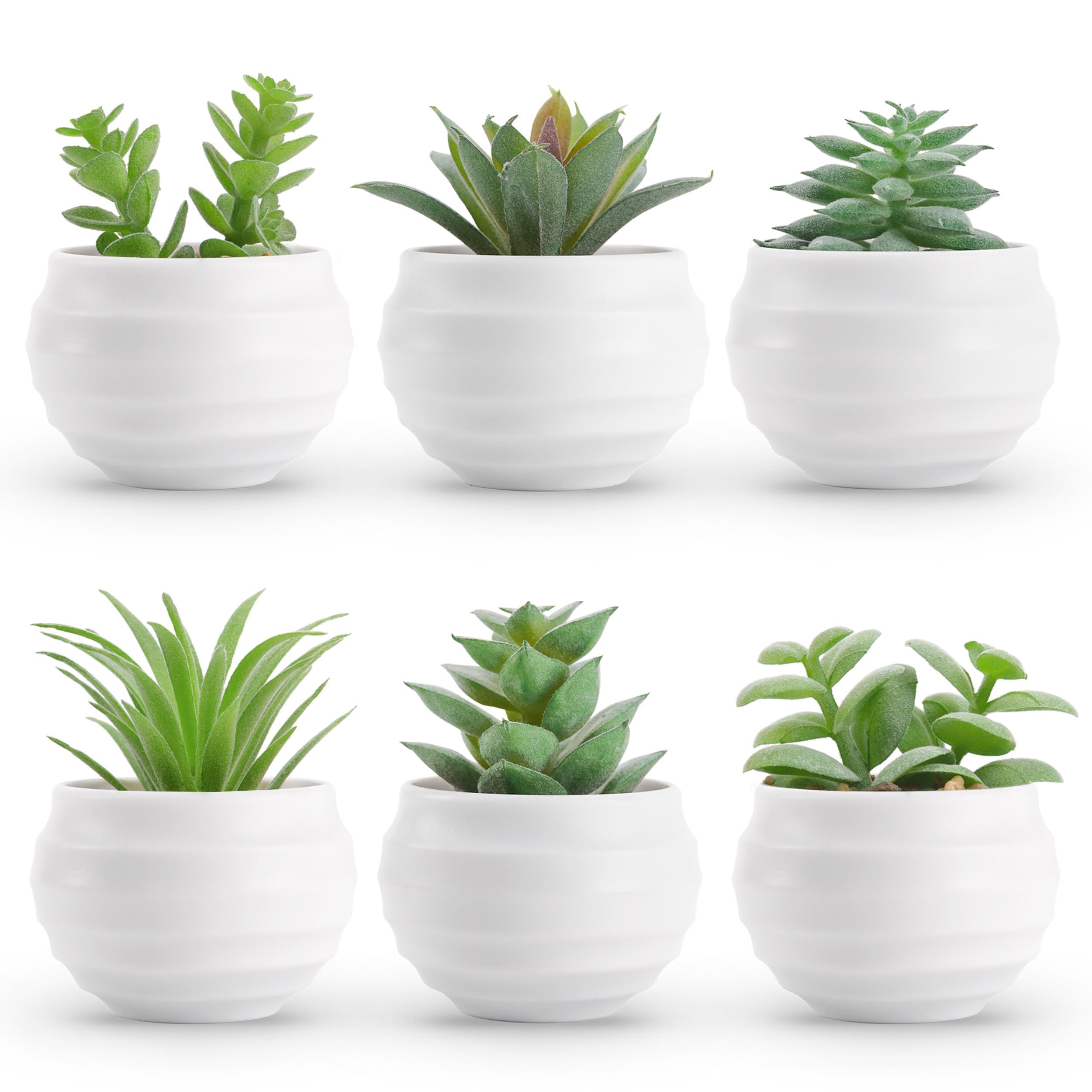
Not every space wants a centerpiece. This box is for the desk, the windowsill, the bathroom counter, the nightstand: six matched succulents in white pots with pebbles on top, each about three inches tall, ready to set down without repotting anything.

We found they work best scattered. Three in different rooms costs nothing in impact, and the white pots and pebbles keep the look clean and modern in a way that six crowded onto one shelf does not. The pots are plastic with a seam you can see from a few inches away; from standing height they read as ceramic.

Realism is decent rather than remarkable. The leaves are fatter and softer than the thin, shiny ones on cheaper succulents, but the green is flat and a little gray where a real plant would show variation. The pebbles are secured in each pot — a small kindness, since loose stones in packaging are a mess — though a few settle in transit and press back down easily.

Bottom line: Six tiny succulents that turn a scattering of bare spots into one coordinated set — just expect three-inch plants, not shelf centerpieces.

7

VIVATREES 5FT Olive Tree

VIVATREES 5FT Olive Tree

Entryways

Our Score 9.0/10
Check Price

Worth Noting

  • Looks thinner than the photos
Height
60 in
Planter
Included, white
Plant Type
Olive
Planter Width
9.45 in
Read the full review

Real olive trees have thin, woody, slightly crooked trunks, and a plastic trunk with painted bark convinces nobody. This one comes closer than most, with a natural wood trunk, narrow silvery-green leaves, and a scattering of olives that reads as detail rather than decoration. From across a room it is the most convincing tree in this guide.

It also arrives with a 9.45-inch white planter, which is the practical argument over the other trees here: no second purchase, no guessing at proportion, no repotting. Assembly is three branches and a few minutes of separating leaves.

Balance is where it needs attention. The pot is small for a 60-inch tree, so shaping the branches — which you do with the tree standing — is exactly when it wants to tip. Work against a wall with a hand on the rim and the problem disappears; once placed, ours has stood without wandering. Slender, tall, and light enough to carry alone, it is the best of these for an entryway that needs height without width.

Bottom line: An olive tree with the planter already included, for an entryway that needs height without width.

8

BLEUM CADE Faux Pothos Vines

BLEUM CADE Faux Pothos Vines

Hanging displays

Our Score 8.8/10
Check Price

Worth Noting

  • No baskets or hooks in the box
  • Plastic smell when new
Material
PVC
Set Size
2 vines
Vine Length
43.3 in
UV Resistant
Yes
Read the full review

Hanging greenery is the hardest thing to fake, because the illusion depends on how the vine falls. Wire-stemmed versions stick out at angles and read as plastic ivy; these are soft-stemmed, 43 inches each, and they drape in a relaxed arc that looks like a pothos hunting for something to climb.

The leaves slide along the stem, which is more useful than it sounds. You can close a gap where a vine looks bare, thin out a section that is too uniform, or shorten a strand to fit a shelf edge without cutting anything. We spent ten minutes sliding leaves around on ours and the arrangement stopped looking like a garland.

Where they struggle is the bottom of each vine, which thins out faster than the top, and in bright light, where the plastic sheen shows. They are at their best above eye level — over a kitchen cabinet, along a curtain rod, on a balcony rail — where you see the overall drape instead of individual leaves.

They are also the cheapest way here to green a wall, and the only pick that solves a problem the potted plants cannot: a spot with no surface to put anything on. Waterproof and UV-resistant means a covered balcony is fair game. Give them an afternoon outside before they go up and the new-vine smell fades.

Bottom line: The cheapest way here to green a wall, best over a cabinet or on a balcony where nothing potted will fit.

How We Tested Fake Plants in Rooms Where Nothing Grows

We started with roughly 60 listings — brands we already knew, plus a handful that kept surfacing in customer reviews — and cut anything with only one photo or a listed height that didn't square with the pot size, since those are the two fastest routes to a plant that arrives smaller and sparser than it looked online. Fourteen made the cut.

Each one then spent six months in a spot where a real plant had already failed: an entryway console, a windowless bathroom shelf, the top of the kitchen cabinets, a home-office desk. Before styling anything, we measured actual height and spread against the listing and counted stems and leaf sprays against the product photos — some pots were nearly full, others were three sprays and a lot of air.

Realism got the blunt test. A friend who doesn't shop for fake plants stood six feet back and named the ones that read as real, and we looked at all of them again at night with the overhead light on, which is where printed, glossy leaves give themselves away. We sniffed each plant on unboxing and again a week later, nudged and bumped the tables they sat on to see which pots rocked or tipped, and wiped the leaves with a damp cloth. One spent the entire six months beside a sunny window to see whether it faded. We also timed assembly from box to styled, noted which plants needed extra moss or a fluffed center to look full from the sofa, and weighed what each one actually delivered against what it cost.

How to Choose Fake Plants

Scale first, plant second

Listing photos are shot close, so a three-inch succulent can look like a centerpiece and a five-foot tree can look like a shrub. Measure the surface and the height above it before anything else. A shelf, desk, or nightstand wants something 6 to 10 inches tall; a bathroom counter or windowsill, 7 to 12. Floor plants start around 4 feet, and they need roughly 2 feet of clearance from the wall so the branches have somewhere to go. Filling several small spots? A six-pack covers more ground than one larger plant, provided you actually have six spots.

The finish is what gives it away

Walk past a fake plant in raking light and you will see the tell: a hard white highlight on a glossy leaf. Matte and frosted finishes, with color that varies from leaf to leaf, read as real from across a room. Succulents and agave want a slightly dusty surface; ficus and olive want matte leaves with visible veining. We check two things before anything else: whether the green is uniform across the whole plant, because one flat green reads as plastic, and whether the leaf edges are cut cleanly or stamped.

What the pot adds, and what it asks of you

A planter in the box saves a second purchase, but check the proportion before you commit. A 60-inch tree in a 9-inch pot looks top-heavy and can tip when someone brushes past; as a rough rule, a floor plant's pot should be about a third of its height in width. If the plant arrives bare, weight the base with gravel or sand instead of trusting the stem, and choose a container wide enough that the pot it shipped in still sits inside.

Match the material to the room

UV-resistant plastic is the only thing worth putting on an uncovered porch; everything else fades within a season. In a bathroom, PVC and polyester shrug off steam, but paper-pulp pots and unsealed finishes stain and soften in constant spray, so keep them out of the splash zone. Indoors, matte finishes hide dust better than gloss, though nothing here is dust-proof, so plan on a rinse or a cool blow-dry twice a year.

Frequently Asked Questions

Final Verdict

Most people should start with the Der Rose three-pack. Three matte, sage-toned plants style a shelf, a counter, and a nightstand for less than the price of one floor tree, and the finish holds up under a close look better than anything else at that size here.

If your bare spot is outdoors, the Velener agaves are the only pick built for sun and rain, and worth the planters you will have to buy for them. If you want one plant doing a corner's worth of work, the ASTIDY dracaena assembles in minutes and looks planted rather than propped from the moment it is up.