Furniture

Best Sideboards of 2026

A sideboard looks like the easy part of a dining room: four legs, a couple of doors, a stretch of top. Then it arrives, the doors hang a quarter inch off, the finish smells like a hardware store for a week, and the whole thing shifts every time you pull a drawer open one-handed. The right one does the opposite — it swallows the serving platters, the board games, and the tangle of chargers you'd rather not display, and it looks like furniture you chose on purpose.

Over the past six months we assembled, loaded, and lived with 10 of them, from budget flat-pack to solid wood, and the differences almost always came down to details the product photos never show. One thing I'd tell any first-time buyer: measure the depth of your dinner plates before you fall for a shallow mid-century silhouette. Hinges matter more than the finish, too — good hardware is what keeps a door sitting square years down the line. The picks below are the sideboards that still looked and worked like new, and still felt worth the money, after all of that.

1

Bme Georgina Sideboard

Top Pick
Bme Georgina Sideboard

Dining room centerpiece

Our Score 9.6/10
Check Price

Worth Noting

  • The priciest cabinet in this set
Width
61 inches
Height
29.21 inches
Storage
2 doors, 3 drawers
Assembly
Legs only
Read the full review

Four legs. That is the entire assembly. The Georgina arrives with the carcass already built, so the job is bolting on four legs through pre-drilled holes, and ours was standing in the dining room before the kettle boiled. After a run of flat-pack cabinets, that felt almost indecent.

The money goes on material rather than hardware. The top and frame are solid acacia, the door fronts carry a carved geometric pattern that reads mid-century rather than reproduction, and behind those doors sit two cabinets with an adjustable shelf in each, plus three drawers. The doors close on soft-close hinges with magnetic catches instead of banging shut, and at 98.1 pounds the cabinet sits flat and heavy on the floor rather than skittering when you lean on it. The back panel and some interior panels are MDF, which is normal at this level and worth knowing if you are matching a set.

The height is the detail we keep coming back to. At 29.21 inches the top is level with a dining table, which makes the piece look built for the room rather than parked in it. It is also roughly four inches lower than the 34- and 36-inch cabinets here, so it is the wrong choice if you want a surface to serve from or a coffee station you use standing up.

Solid wood moves with the seasons, too. Cracks in the acacia are the one recurring problem with this model, so unbox it in the first week, run a hand along the top and the door edges, and raise anything you find while a return is still straightforward. Do that and the premium buys you a cabinet that feels like furniture.

Bottom line: We recommend the Georgina to anyone who wants real wood without a flat-pack weekend: it is the best-built cabinet in this set, and it earns the price difference.

2

Smuxee 31.5-Inch Sideboard

Smuxee 31.5-Inch Sideboard

Small entryways

Our Score 9.2/10
Check Price

Worth Noting

  • No drawers, doors and shelves only
Depth
14.9 inches
Width
31.5 inches
Height
30.6 inches
Storage
2 doors, 2 shelves
Read the full review

Most small sideboards look like an apology, a little box marooned on a big wall. This one does not. At 31.5 inches wide and 30.6 inches tall it is a proper cabinet, with line-grooved doors, gold pulls and a walnut tone that reads warm rather than orange, and we think it is the best answer here for an entryway or the dead end of a hallway.

The walnut is a stain over engineered wood rather than solid timber, applied evenly — no pale patches at the corners, which is where cheap finishes give themselves away. Inside, a shelf adjusts to three heights, so it takes a stack of bowls or a row of boots. At 43.2 pounds one person can shift it, which matters in an entry you are still rearranging, and the 14.9-inch depth leaves room to walk past. If the wall runs longer than 31 inches, buy two and set them a few feet apart.

Bottom line: The best small sideboard here — an entryway cabinet that looks deliberate at 31 inches, and one person can carry it in.

3

Tribesigns 2-Piece Sideboard

Tribesigns 2-Piece Sideboard

Narrow hallways

Our Score 9.2/10
Check Price

Worth Noting

  • Doors need patient alignment after assembly
Depth
13.78 inches
Doors
4 across two cabinets
Height
31.49 inches
Set Width
59.05 inches
Read the full review

At 13.78 inches deep, this is the shallowest cabinet here, and in a hallway that is the whole argument. A 14-inch cabinet leaves a walkway where a 15.75-inch one scrapes knuckles, and the difference never shows up in a photograph.

It is two cabinets rather than one, which we like more than we expected: split them around a doorway, put one under a television and one in the hall, or push them together for a 59-inch run. There are no handles — the doors are push-to-open on rebound catches — which keeps the front flat and makes the pair look built in.

Adjustable feet help on an old floor, an anti-tip strap comes in the box, and the set weighs 83.8 pounds, so one person can move half at a time. The compartments are wide and unobstructed, which means serving platters and folded linens both work.

Bottom line: Choose the pair if your hallway is the constraint: at under 14 inches deep it leaves a walkway, and the two halves can be split.

4

ONBRILL 55-Inch Buffet Cabinet

ONBRILL 55-Inch Buffet Cabinet

Budget dining room

Our Score 9.0/10
Check Price

Worth Noting

  • Top surface scratches and marks easily
Width
54.72 inches
Height
34.65 inches
Storage
3 doors, 2 drawers
Capacity
180 lb
Read the full review

Fifty-five inches is the width that solves the awkward wall — the one between a doorway and a window, or under a run of stairs — and the ONBRILL uses every inch: three doors, two drawers, and a top long enough for a lamp, a bowl and a stack of plates without crowding. We think it is the best value in this group, and it does not feel like the least expensive thing you can buy.

At 87.5 pounds it is heavier than most engineered-wood cabinets at this width, and that shows up when you slide it into place: the panels do not flex and the carcass lands square. The knife-edge trim on the door fronts gives the black paint a shadow line, which is why it photographs better than it has any right to. Behind the doors there is an adjustable shelf, and the two drawers run on smooth rails.

The drawers are shallow, sized for cutlery, napkins and small linens rather than serving pieces, so plan on the cupboards for platters and the drawers for the small stuff. Ours went together square, with doors that close flush without any hinge fiddling, which is what most often goes wrong with flat-pack furniture. Two people make the build easier, though one patient person can finish it in an evening.

Bottom line: We point budget-minded shoppers here first: 55 inches of solid-feeling cabinet with two usable drawers, for a fraction of what the top pick asks.

5

T4TREAM 60-Inch Fluted Sideboard

T4TREAM 60-Inch Fluted Sideboard

Modern entryways

Our Score 9.0/10
Check Price

Worth Noting

  • Four-hour build, with door balancing at the end
Top
Faux marble veneer
Width
60 inches
Height
34 inches
Storage
4 doors, 3 drawers
Read the full review

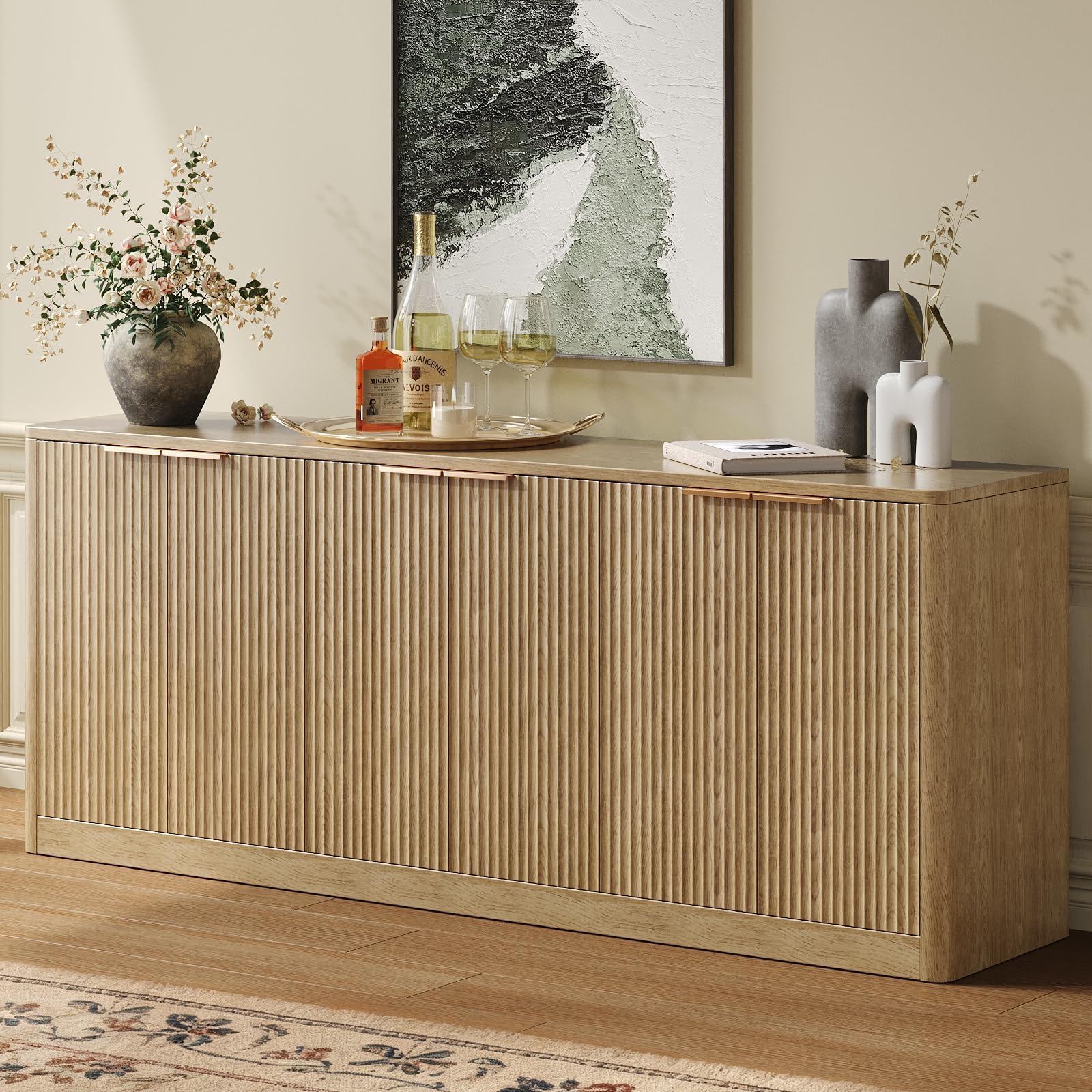
The fluted front is what stops people in the doorway. Vertical grooves catch the light along the whole 60 inches, and the natural oak finish under a pale, marble-look top makes this look like the most expensive cabinet here — which it is not.

Look closely and the flutes are molded rather than carved: the panel is formed, not routed from solid timber, and the top is a melamine veneer printed to look like stone. That is an explanation of cost rather than a complaint, and at arm's length the effect holds. Inside there are three drawers, four doors and six compartments with adjustable shelves, and the drawers run on metal slides.

Where it wins is the room. If the sideboard sits somewhere guests actually look — an entry, the end of a living room, the wall opposite the table — we think it is the best-looking cabinet of the eight, and the printed top means a vase of flowers does not need a coaster under it. Build quality is a step behind the solid acacia cabinet; so is the money.

Fifteen point six inches of depth is mid-pack: deep enough for a stack of dinner plates and a serving dish, not for a platter laid flat, so those go upright behind a door. The width matches the HOSTACK exactly, which means the choice between them comes down to height — 36 inches there, 34 here.

Bottom line: We pick it when the sideboard will be looked at: the fluted front and marble-look top do the work of a much dearer piece.

6

HOSTACK 60-Inch Sideboard

HOSTACK 60-Inch Sideboard

Kitchen and dining

Our Score 8.8/10
Check Price

Worth Noting

  • Doors often need hinge adjustment to sit flush
Width
60 inches
Height
36.02 inches
Storage
4 doors, 4 drawers
Capacity
450 lb
Read the full review

Thirty-six inches is counter height, and that single number explains this cabinet. Stand at the HOSTACK and your hands sit where they do at a kitchen counter, which is exactly right for a buffet you serve from or a coffee station you use standing up.

The layout is four drawers across the top and four cupboards underneath, with gold pulls against white and a plinth base that closes off the gap at the floor. The cupboards are divided by fixed shelves rather than adjustable ones, which is the one place the cabinet asks you to adapt: stand platters upright behind the doors, because a tall stockpot will not sit on the lower shelf.

Assembly is a full evening rather than the hour the box suggests. Numbered parts and clear diagrams help, but four drawers and four doors each hang on their own hardware, and the last stretch is adjusting all of it.

For a dining room, this is the one we reach for first: counter height, four drawers for cutlery and linens, and a top deep enough for a stack of plates and a carafe. Fill the lower cupboards with the heavy stoneware and the upper drawers with the light things, and it behaves exactly like the built-in it is standing in for.

Bottom line: Buy it if you want to serve from it: no other cabinet here puts the top at counter height with four drawers underneath.

7

BOTLOG 71-Inch Sideboard

BOTLOG 71-Inch Sideboard

Long empty walls

Our Score 8.8/10
Check Price

Worth Noting

  • Only two drawers across 71 inches
Depth
15.7 inches
Width
70.9 inches
Height
34.3 inches
Storage
6 doors, 2 drawers
Read the full review

Seventy-one inches is a lot of sideboard. This is not the piece you squeeze into a gap; it is the piece you build a wall around, and with six barn doors, two drawers and eight compartments it swallows the good china, the board games and the box of chargers nobody knows where to put. At 15.7 inches deep it takes a stack of plates and a serving dish, though a large platter goes in on edge.

For a long, empty wall it is the best answer here. The frame is engineered wood, but at 131 pounds it is the heaviest cabinet in this group, and that mass does what mass does: it stays put. The top is steady enough to run a stand mixer on without the whole thing walking across the floor, which is more than we can say for most cabinets this wide.

The six doors are soft-close and hold shut on magnetic catches, so nothing swings open when the house settles. Set it on a flat floor and check the carcass is square before you hang a single door — the pre-drilled holes line up only once the frame is true, and 71 inches of cabinet is unforgiving of a wonky start.

Bottom line: For a long wall that needs filling, this is the one we send people to: 71 inches, eight compartments, and enough weight to stay where you put it.

8

Evermagin 67-Inch Fluted Sideboard

Evermagin 67-Inch Fluted Sideboard

Living room storage

Our Score 8.6/10
Check Price

Worth Noting

  • Two people, most of an afternoon, to build
Depth
15.74 inches
Width
66.92 inches
Height
31.5 inches
Storage
6 compartments, no drawers
Read the full review

Six doors and not a single drawer — the Evermagin makes its choice and sticks to it. Across 67 inches you get six compartments behind soft-close doors, each with an adjustable shelf, a layout built for dishes, glassware, board games and media rather than for cutlery.

That is a spec to check against your own kitchen rather than a flaw. If you want somewhere to drop napkins and batteries, the T4TREAM and the BOTLOG both have drawers; if you want long, uninterrupted shelves for serving pieces, this is the better shape. The fluted fronts and adjustable hinges deliver the same designer trick as the other fluted cabinet here, for less money, and the listing states a one-year warranty worth registering on arrival.

Every door hangs on two adjustable hinges, and getting six of them to sit flush is the fiddliest part of the build. Do it last, with the cabinet level and the shelves in, and the gaps even out; rush it and you will be back with a screwdriver a week later.

For a living room or a media wall, this is the pick: 67 inches of closed storage with nothing showing but fluted panels, and a top long enough for a lamp at each end. Just do not buy it for the drawers.

Bottom line: We like it as a media wall or living room run of closed storage, provided you can live without a single drawer.

How We Tested (and Lived With) 10 Sideboards

We started by pulling every sideboard we could find from the major furniture retailers and narrowing the field by dimensions, material, price, and the complaints that kept surfacing in customer reviews. From that shortlist we bought 10, a mix of budget flat-pack, mid-priced veneer, and solid wood, ranging from a narrow hallway piece to a full dining-room buffet.

Each one was assembled by one person with a stopwatch running and the instruction booklet followed to the letter before we allowed ourselves any shortcuts. We noted where the diagrams stopped making sense, where hardware arrived unlabeled, when a second pair of hands was genuinely necessary, and how long it really took to get from box to standing.

Then we filled them: a full dinnerware set, serving platters, board games, table linens, and the usual dining-room clutter. Usable storage varied more than the spec sheets suggest — shallow cabinets took bowls but not platters, and adjustable shelves made the difference. We opened and closed every door dozens of times a day for six months, watching for sag, checking the gaps at top and bottom with a straightedge, and noting which hinges let a door drift out of alignment and which held.

Durability got tested the unglamorous way: a wet glass set down without a coaster, a key dragged across the top, one piece moved between rooms twice. We also smelled each sideboard straight out of the box and again a week later, since a chemical odor that lingers is hard to forgive in a room where you eat. At the end of six months we asked whether the price still felt fair given the finish, the hardware, and how the piece was holding up.

How to Choose Sideboards

Height decides how you will use it

Two heights dominate this group, and they do different jobs. Between roughly 29 and 31 inches, the top lines up with a dining table, so the cabinet reads as part of the table setting and suits lamps, bowls and a drinks tray. At 34 to 36 inches it hits counter height, which is what you want if you plan to stand at it to serve, pour coffee or butter toast.

Pick the habit first. A low cabinet behind a buffet line means leaning over hot dishes all evening, and a counter-height one next to a dining table can look like a kitchen cabinet that wandered into the wrong room.

Depth, and the hallway trap

Sideboards here run from 13.78 to 15.75 inches deep, which sounds like nothing until the piece is in a corridor. The trap is the word compact: in a listing it usually describes how the box ships, not whether the cabinet leaves you a walkway. Measure the floor, not just the wall, and leave about three feet for a person to pass.

The shallow Tribesigns pair buys a usable hall where a deeper cabinet turns it into an obstacle course. In a dining room the opposite is true: more depth means platters and serving dishes sit comfortably instead of standing on edge.

Drawers, doors and the shape of what you own

Count your platters before you count doors. Wide, unobstructed shelves suit serving dishes, glassware and board games, while drawers swallow cutlery, napkins, batteries and the chargers that turn a shelf into a mess. One cabinet here has six doors and no drawers; another has three drawers and two cupboards. Neither is wrong, but only one of them matches your kitchen.

Adjustable shelves are worth insisting on. A fixed shelf is usually the reason a tall stockpot ends up on the floor beside the cabinet instead of inside it.

Solid wood, engineered wood, and what you are paying for

Solid acacia costs more and feels different in the hand: heavier, cooler, with grain that carries around an edge. Engineered wood with a good veneer or paint can look just as convincing for far less, but it chips at corners and marks more easily, and it does not enjoy being moved twice.

Neither is automatically the better buy. Solid timber moves with humidity, so cracks are the failure to watch for; engineered panels fail at the joints and the finish. Buy the material that matches how long you intend to keep the thing.

Assembly, alignment and a second pair of hands

Assembly ranges from four legs to most of an afternoon, and that gap is worth paying for if your patience is short. Whatever you choose, build it on a flat floor, get the carcass square and level before a single door goes on, and hang the doors last.

Alignment trouble almost always traces back to that order. A door hung on a twisted frame never sits right, however long you fiddle with the hinges. Finish by anchoring the cabinet to the wall; the strap is usually in the box.

Frequently Asked Questions

Final Verdict

The Bme Georgina is the one we point people to. It is the only solid acacia cabinet here, it is standing ten minutes after the box opens, and it reads as furniture rather than flat-pack — provided a 29-inch top suits the room and you inspect it for cracks in the first week.

Want the same footprint for much less money? The ONBRILL. Serving from it standing up? The HOSTACK at counter height.