Furniture

Best Recliners of 2026

A recliner has to do two opposite things at once: support you like a proper chair and let you melt into it by the end of the night. The wrong one shows up as a backache, a footrest that stops halfway, or a chair that swallows your living room. I look for cushioning that supports instead of bottoms out, a smooth recline, fabric that still looks good after a month, and a footprint that fits the room. A good one fixes all of that—and doesn't leave you overheated after a long movie.

My team and I spent nine months with seven recliners, from compact manual models to plush power ones, assembling each in a normal living room. We used them for movie nights, Sunday naps, and reading with a knee up, noting how the cushions felt after an hour, whether the frame stayed steady getting in and out, and if the fabric still looked good. The best balanced size, support, and price; the rest became coat racks. The picks below earned their floor space.

1

Harkawon Swivel Rocker

Top Pick
Harkawon Swivel Rocker

Small living rooms

Our Score 9.0/10
Check Price

Worth Noting

  • Only three recline positions
Seat Height
19.3 inches
Recline Type
Manual lever
Swivel Motion
360-degree swivel and rock
Weight Capacity
350 lb
Read the full review

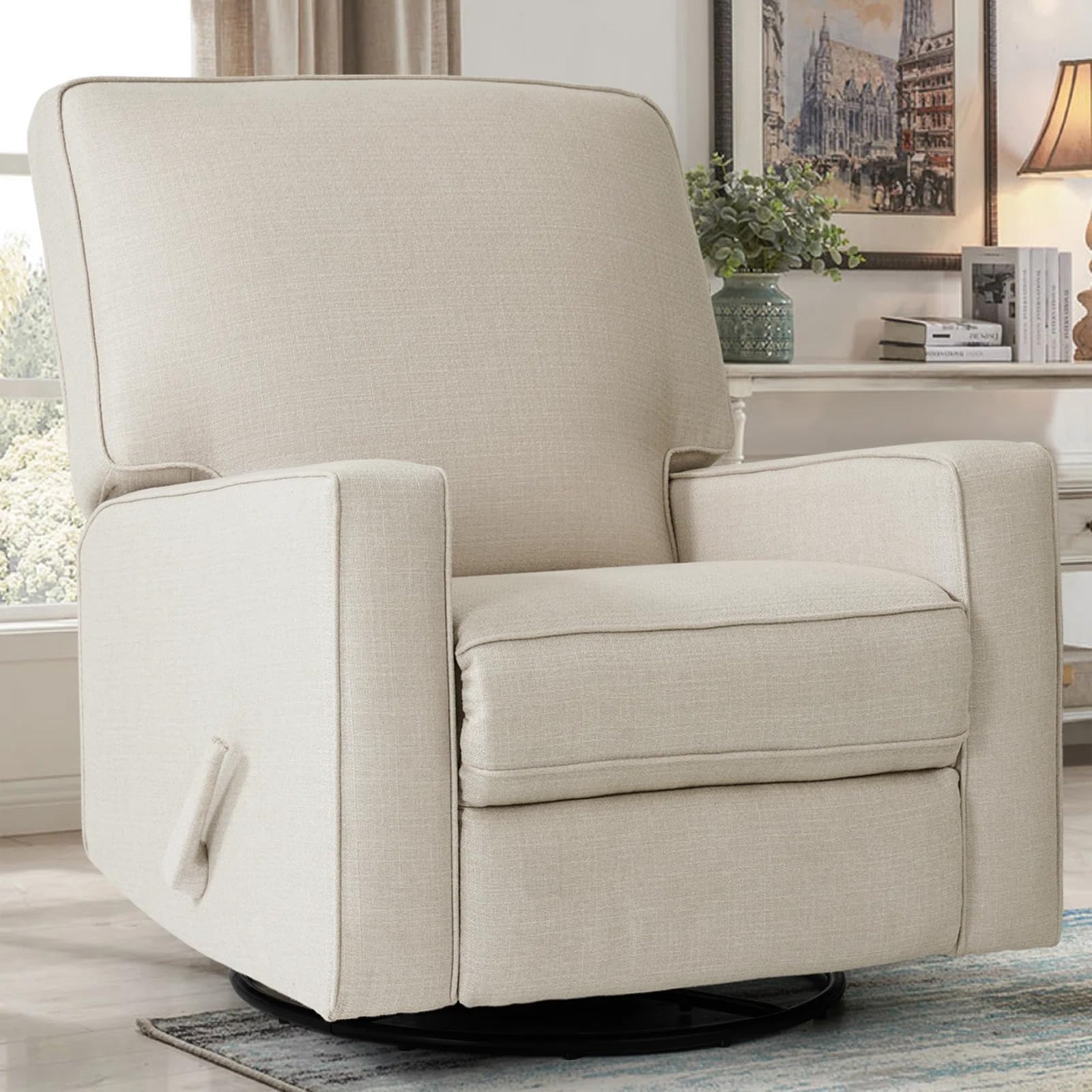
What makes the Harkawon our top pick is the combination of a wall-hugging base, 360-degree swivel, and a manual lever that does not depend on a nearby outlet. In a living room, the swivel matters more than a long list of gadgets: you can turn toward the TV or the person beside you without dragging the chair. The high back and 19.3-inch seat height give it a more upright, supportive feel than the low-slung recliners that swallow you.

The fabric is a practical choice for a room that gets everyday use. It feels soft, spot cleaning is straightforward, and the beige finish is easier to decorate around than another black leather box. We also like the wall-hugger design for apartments and small dens, because the chair does not need the deep clearance of a conventional recliner. The trade-off is that this is not a plush, overstuffed lounger.

The 350-pound weight capacity and 30.32-inch back height give it room for a range of adults, though the 32.67-inch width means it is not a compact chair in the way the budget models are. We kept it at the top because it is the one here that feels like a complete living-room chair rather than a compromise for a spare room. If you want a chair that disappears into a corner, look at the Homall; if you want one that anchors the room, this is it.

Bottom line: The Harkawon is the recliner we recommend first for a small living room: it swivels, rocks, reclines, and hugs the wall without looking like a theater seat.

2

MCombo 7287 Lift Recliner

MCombo 7287 Lift Recliner

Mobility support

Our Score 9.0/10
Check Price

Worth Noting

  • Firm seat may not suit everyone
  • Medium size is tight for tall users
Recline Angle
140 degrees
Lift Mechanism
Power lift
Weight Capacity
350 lb
Footrest Extension
4.7 inches
Read the full review

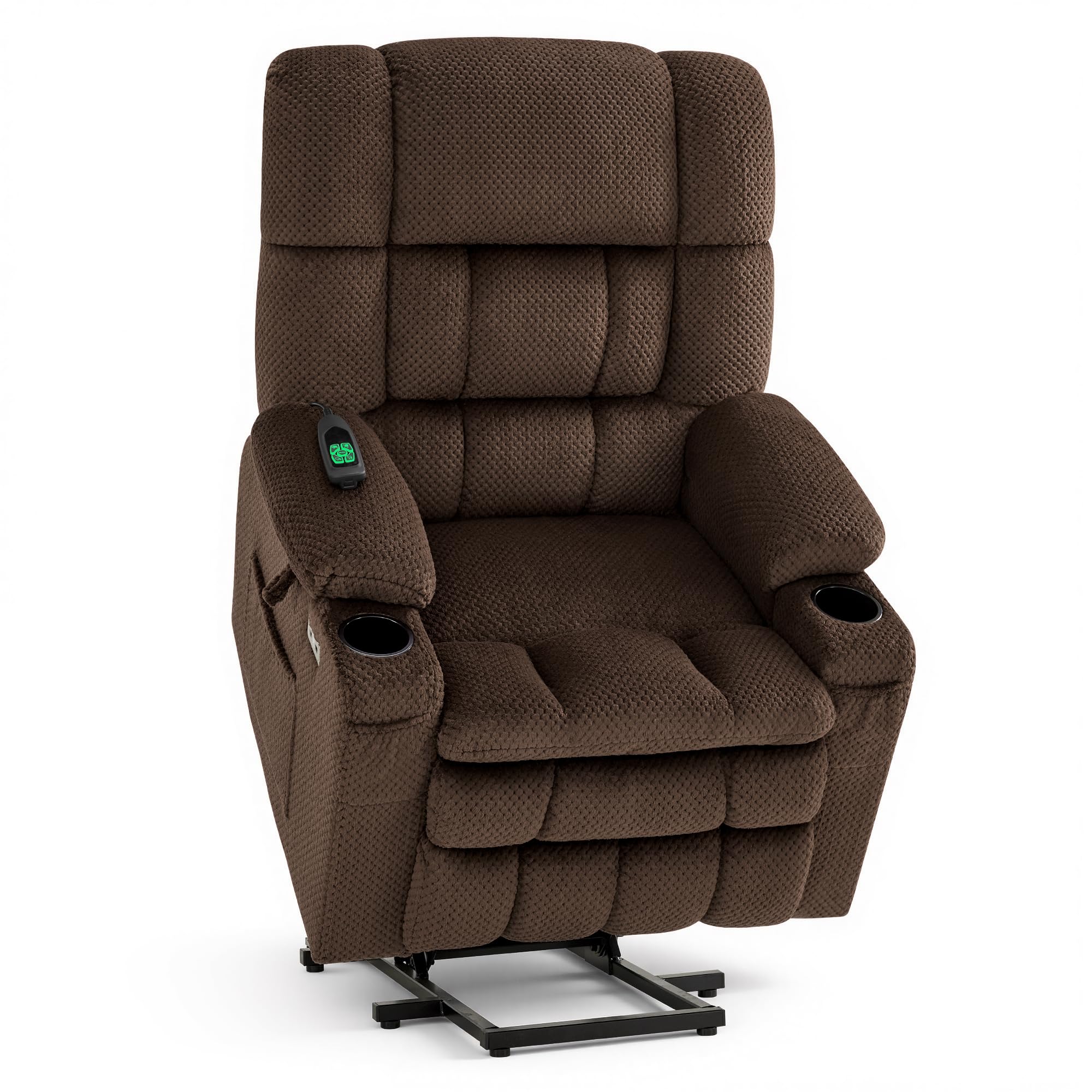
The MCombo 7287 begins with the lift, and that is the right place to begin. The counter-balanced mechanism raises the whole chair to help someone stand, while the 140-degree recline and 4.7-inch extended footrest let the same chair serve for reading, naps, and recovery. The controls are simple, and the cup holder, USB and Type-C ports, and side pockets keep everyday items within reach.

Setup is straightforward, though the 115-pound shipping weight means you will want a second person to move the box. The fabric is a better living-room choice than shiny faux leather, and the lack of massage and heat is deliberate: fewer powered extras means fewer things to break. The controls are simple enough for someone who does not want to learn a remote with twenty buttons.

That makes it our lift-chair pick for a parent or partner who needs help standing but does not want a medical-looking chair. The 350-pound capacity and 2-year warranty add useful reassurance. Against the dual-motor MCombo below, this one gives up independent back and footrest control, but it also gives up complexity. That is the right trade for a household that wants one reliable motion rather than a chair full of features.

Bottom line: The MCombo 7287 is our lift-chair pick for everyday mobility: the power lift, longer footrest, and simple controls make standing easier without making the room feel clinical.

3

Homall Recliner Chair

Homall Recliner Chair

Tight spaces

Our Score 8.6/10
Check Price

Worth Noting

  • Recline may not hold its position
Upholstery
PU leather
Recline Range
90 to 160 degrees
Seat Dimensions
18.8 x 20.2 inches
Weight Capacity
265 lb
Read the full review

The Homall gets your attention with its footprint: 24.4 inches wide, a 160-degree recline, and a seat that sits 17.9 inches off the floor. In a small apartment or a den where a full-size recliner blocks a walkway, that is a useful shape. The PU leather is the wipe-clean kind, which makes it easy to live with if snacks and pets are part of the routine.

That combination makes it our budget pick. We are willing to accept a chair built to a price when the layout benefit is this clear, and the Homall's easy assembly and 265-pound capacity cover the basics for a spare room or a secondary seat. It is not the chair for a tall or heavy sitter, and the PU leather will not fool anyone into thinking it is full-grain hide.

Against the Harkawon, the Homall gives up the swivel, the high back, and the fabric feel, but it saves a lot of floor space. For a first recliner in a rental or a teenager's room, that trade makes sense. Just do not expect it to be the last recliner you ever buy.

Bottom line: The Homall is our budget pick for tight rooms and shorter sitters; it reclines deeply, wipes clean, and asks little of the floor plan, though the recline hardware is the part to watch.

4

CANMOV Power Recliner

CANMOV Power Recliner

Movie rooms

Our Score 8.6/10
Check Price

Worth Noting

  • Does not recline fully flat
  • Modest lumbar support
USB Ports
Two
Cup Holders
Two
Recline Control
Power
Weight Capacity
350 lb
Read the full review

The CANMOV power recliner is the one we point to when the chair is going into a movie room. Two cup holders, two USB ports, and storage inside both arms mean drinks, remotes, and cables have a place that is not the floor. The 36-inch width and 350-pound capacity give it a broader, more substantial stance than the budget chairs here.

The power recline moves smoothly and adjusts with a button rather than a lever. We like that the USB charging lives inside the arm storage, so you can plug in a phone without a cable draped over the side. The seat is 23 inches wide and 23 inches deep, which gives adults room to settle in without the chair feeling like a loveseat.

It earns a runner-up spot because it delivers the home-theater conveniences without the lift-chair complexity. The caveat is stability at full extension; the chair can feel less planted when the footrest is all the way out, so it is better for a carpeted movie room than a hard floor where it might slide. If you want a chair that disappears into a corner, the Harkawon is the easier fit.

Bottom line: The CANMOV is our power pick for movie nights: cup holders, USB charging, and arm storage make it useful, though it stops short of a flat recline and feels less planted at full extension.

5

Yaheetech Recliner Chair

Yaheetech Recliner Chair

Compact corners

Our Score 8.4/10
Check Price

Worth Noting

  • Recline may not hold its position
  • Build sturdiness is uneven
Upholstery
Faux leather
Seat Height
17.5 inches
Weight Capacity
265 lb
Reclining Positions
3
Read the full review

The Yaheetech is the chair we point to when the tape measure, not the decor budget, is the deciding factor. At 24.5 inches wide and 33.5 inches deep, it tucks into a corner that a full-size recliner can overwhelm. The faux leather wipes clean, and the three-position backrest covers sitting, lounging, and a near-flat nap.

That makes it a useful compact pick, though it is a smaller chair in every sense. The 265-pound capacity and 17.5-inch seat height set expectations: this is a small chair, not an oversized lounger. It suits a guest room, a reading corner, or a first apartment where space is the real constraint.

As an occasional chair, the Yaheetech makes sense: it is light enough to move, simple to assemble, and the wipe-clean cover is forgiving. It is not the chair for the only seat in a TV room used every night. The Homall has the same small-room brief with a deeper recline, while the Yaheetech's advantage is a slightly lower seat height and a footprint that fits almost anywhere.

Bottom line: The Yaheetech is our compact pick for a spare room or tight corner; it wipes clean and takes up little floor space, though its recline and build are not the most reassuring here.

6

MCombo 7890 Lift Recliner

MCombo 7890 Lift Recliner

Independent positioning

Our Score 8.4/10
Check Price

Worth Noting

  • Heat and massage are mild
  • Premium price for extra complexity
Motor Type
Dual motor
Weight Capacity
350 lb
Recline Positions
Infinite
Footrest Extension
4.7 inches
Read the full review

The MCombo 7890 is our pick for independent positioning, because its dual motors let the back and footrest move separately. You can raise the legs without pushing the back down, or settle into an almost flat lay-flat position for a nap. The 4.7-inch footrest extension and 350-pound capacity put it in the same practical territory as the simpler 7287.

The independent positioning is the reason to choose it: for a frail user who needs the legs raised without a full recline, that control is worth more than heat or massage. The rest of the chair is familiar MCombo territory, with a cup holder, USB ports, and a fabric cover that is easy to spot clean.

The chair is heavy at 121.3 pounds, so moving it into place is a two-person job. It also has a little wobble as it reclines; test that on your floor while returns are easy. For everyone who does not need independent back and footrest control, the 7287 is the cleaner, simpler buy.

Bottom line: The MCombo 7890 is our pick for independent back and footrest control; the dual motors are genuinely useful, though the heat and massage are mild for the premium.

How We Chose and Tested the Best Recliners

We started by narrowing the field to recliners with clear dimensions, multiple size or fabric options, and enough owner feedback to reveal recurring problems. We ordered seven models across manual and power recline, compact and full-size, and a range of upholstery finishes. Each chair was assembled at home with the tools in the box; we timed how long one person needed and noted whether the instructions matched the hardware.

Over nine months, those chairs lived in a living room and were used daily: movie nights, afternoon naps, reading with the footrest up, and the awkward work of getting in and out with a coffee mug in hand. We sat in each for at least an hour and noted where pressure built up—whether the seat felt too hard after 20 minutes or too soft to climb out of—and how the back and footrest moved through the full recline without a jolt. We checked sturdiness by rocking side to side, pushing up from the arms, and watching for wobble at the joints after weeks of use.

Size and fit got measured, not guessed: we taped the footprint on the floor, checked clearance behind the chair as it reclined, and had people from 5-foot-2 to 6-foot-1 sit in each one. Appearance was judged in daylight and lamplight, including how the fabric wore at the arms after a few months. Heat came up more than expected—we noted whether the seat and back felt warm after an hour, especially on models with tight upholstery. Finally, we weighed each chair's cost against its build, comfort, and fit for the room; a recliner only earns a recommendation if it feels worth the space it takes up.

How to Choose Recliners

Pick the recline mechanism before the upholstery

We rank the mechanism first because it changes who can use the chair independently. A manual lever or pushback is simple and has fewer powered parts, which is why it suits a main living-room chair such as the Harkawon. Power recline is easier on the hands and shoulders, but it needs an outlet and adds a motor to the repair list. A lift chair goes further, raising the seat to help someone stand; the MCombo 7287 is the straightforward version, while dual-motor models add independent back and footrest control.

Measure the floor plan and the wall gap

Recliners take more room than their upright dimensions suggest. Measure the footprint, then add the space the back needs to lean into; a wall-hugger reduces that gap but does not make the chair invisible. Check the turn into the room and the width of the path, too. The Harkawon's wall-hugging base is the reason it suits a small living room, while the wider CANMOV power chair needs a more generous movie-room layout.

Fit the seat to the person

Seat height and depth decide whether a recliner feels supportive or perching. A low seat can be hard to stand from; a deep seat can leave shorter users with their feet dangling. Check the back height too, especially if the sitter is tall. The MCombo 7287 and Homall are both medium-to-small chairs with different missions, so compare the seat dimensions to the person rather than assuming a recliner is one-size.

Choose the covering for the life you live

Faux leather wipes clean, which is why it dominates budget recliners, but it can feel sticky and is not automatically more durable than fabric. Fabric is softer and more breathable, though it usually needs spot cleaning. If the chair is near heavy snack traffic or pets, the wipe-clean cover matters more than the showroom sheen. Our top pick's fabric is a living-room choice; the Homall and Yaheetech are the easy-wipe options.

Decide which extras earn their space

Swivel, rock, cup holders, USB ports, heat, and massage all change how a chair gets used, but each adds something to clean, power, or repair. We value a swivel or wall-hugging base in a shared room because it solves a daily problem. We are more skeptical of heat and massage in a lift chair: they can be pleasant, but the lift and recline are the jobs that matter. Buy extras because they fit your routine, not because the listing makes them sound premium.

Frequently Asked Questions

Final Verdict

The Harkawon is the recliner we recommend first because it solves the everyday living-room problem: it swivels, rocks, reclines, and tucks close to the wall without turning the room into a theater. If someone needs help standing, choose the MCombo 7287; its lift and longer footrest are worth the extra complexity. For a tight budget or a small spare room, the Homall is the practical compromise. Start with the person who will sit in it most, then let the room and the mechanism decide the rest.