Furniture

Best Nursery Dressers of 2026

A nursery dresser has to do more than hold tiny clothes. It doubles as a changing station, a late-night storage wall, and the one piece of furniture you yank open one-handed while half asleep. The right one gives you steady drawers, a footprint that fits the room, and a finish that survives a middle-of-the-night wipe-down; the wrong one wobbles, arrives with a confusing hardware bag, or has drawer bottoms that sag under a stack of blankets. Over the past eight months, we’ve lived with seven nursery dressers in real nurseries and a toddler’s room, assembling them, filling them, and judging how they hold up.

What I’d tell a first-time buyer: ignore the styled photos for a second and look at the drawer boxes, the anti-tip hardware, and the assembled footprint. A dresser that looks charming online can feel flimsy the first time a toddler pulls on an open drawer. Our picks were chosen for build quality, straightforward assembly, and real-world value, not just appearance—and the testing notes below show how we separated the steady from the shaky.

1

BOLUO Changing Table Dresser

Top Pick
BOLUO Changing Table Dresser

Small rooms

Our Score 9.4/10
Check Price

Worth Noting

  • Changing pad sold separately
Drawers
6 fabric
Item Weight
40.3 lb
Changing Top
Removable
Assembled Size
16.9 x 32.7 x 37.2 inches
Read the full review

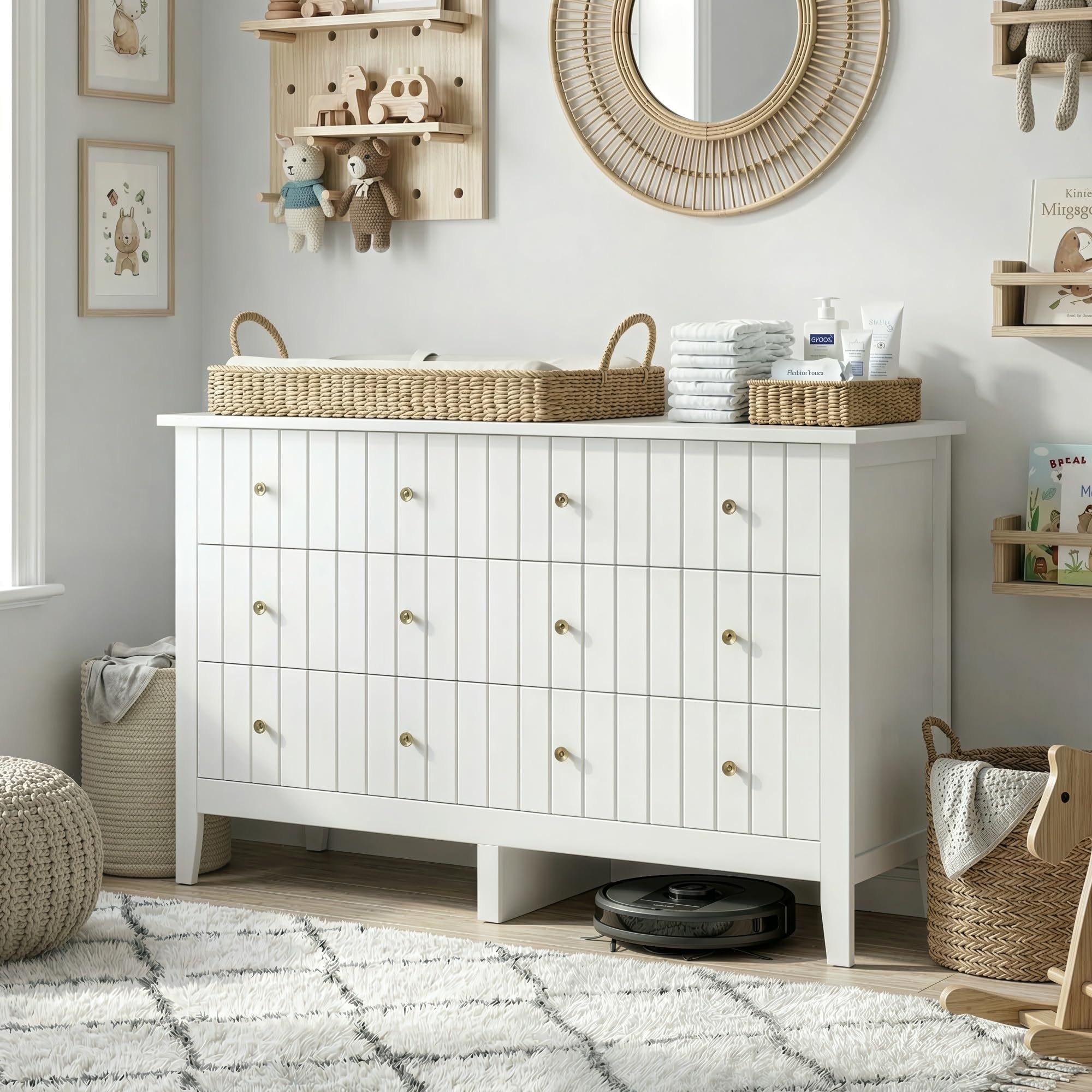
32.7 inches wide and 40.3 pounds is a different category of nursery furniture from the double dressers here, and in a small room that's the entire point. The BOLUO slides into the gap between a crib and a closet that nothing else on this list will fit, and one person can carry it upstairs without taking the door off its hinges.

The six drawers are fabric, 12 inches wide by 16.9 deep by 9 tall, which makes them noticeably taller than the wood drawers on the Delta and far lighter to pull. One drawer takes a full box of diapers with wipes beside it, and the four adjustable feet keep it level on an old, sloping nursery floor. BOLUO says the build takes under half an hour, and nothing about the design argues with that: a metal-and-engineered-wood frame, few parts, and no drawer-track alignment to chase.

What we keep coming back to is the top. It's a removable changing platform that lifts off when the baby outgrows it, leaving a plain six-drawer dresser — more than the wood picks here offer without buying a topper. We think it's the smartest first-two-years buy in this group. The fabric boxes are the trade, and they're why it's a first-two-years piece rather than a hand-me-down: light and crack-resistant, but not a wood box a four-year-old can climb.

Bottom line: For a small nursery or a tight budget, we point people to the BOLUO: a 33-inch footprint, 40 pounds, and drawers that swallow a box of diapers.
2

Delta Children Universal 6 Drawer

Delta Children Universal 6 Drawer

Most nurseries

Our Score 9.2/10
Check Price

Worth Noting

  • Assembly takes an evening and a helper
Drawers
6
Air Quality
GREENGUARD Gold
Assembled Size
47.25"W x 20.75"D x 34.75"H
Drawer Interior
18.75"W x 13.5"D x 4.75"H
Read the full review

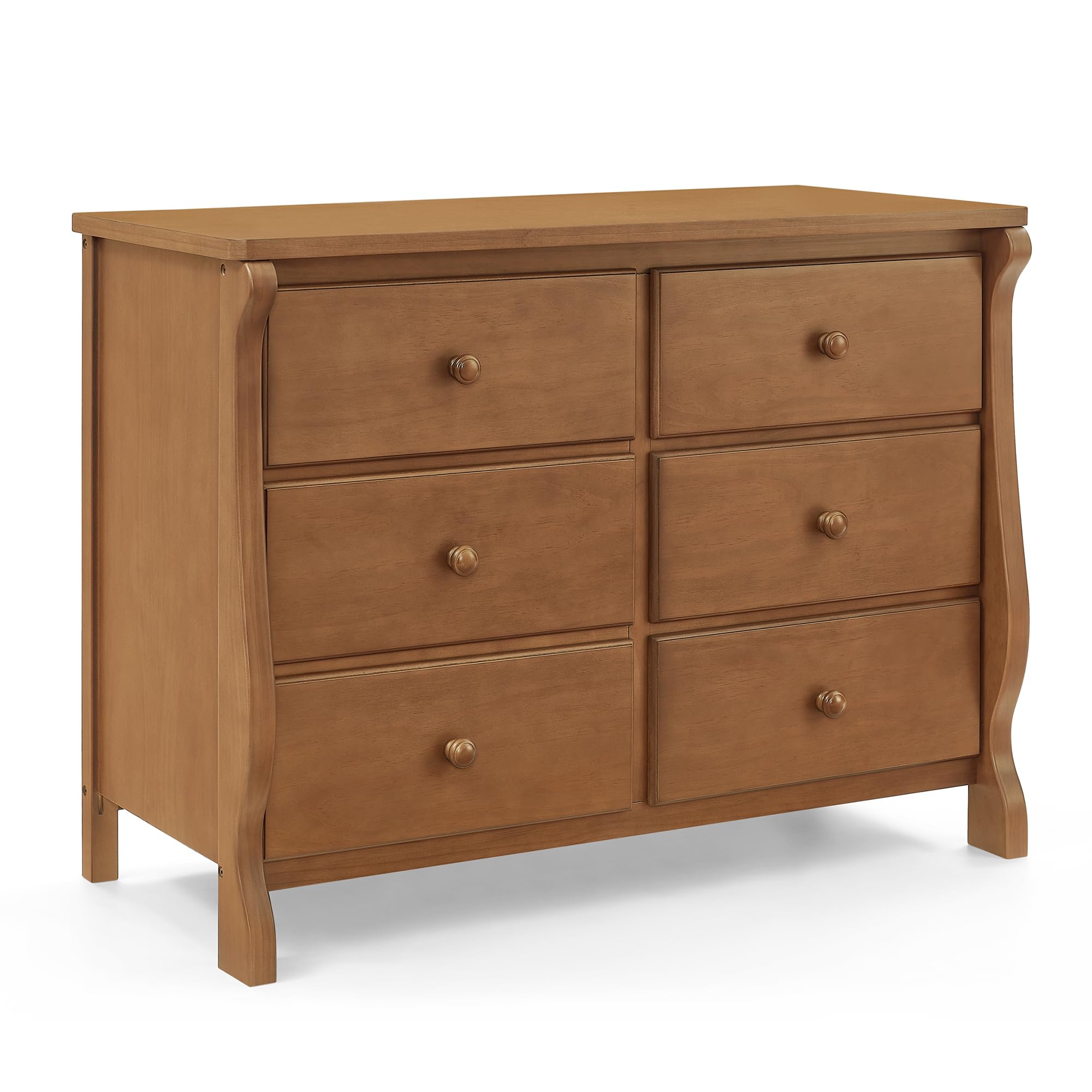
Two things settle a nursery dresser for us: whether the drawers still run when the baby is three, and what the finish is putting into a room where a baby sleeps eight hours a night. The Delta Universal is the pick here that answers both on the listing — GREENGUARD Gold for emissions, ASTM F2057 for tip-over safety, an interlocking system that keeps a climbing toddler from hauling two loaded drawers out at once, and a wall anchor in the box. That combination, rather than any single flourish, is why it's our default.

At 47.25 inches wide and 20.75 inches deep, it has the deepest body of anything here, and its drawers measure 18.75 by 13.5 by 4.75 inches inside. Treat that last figure as the real specification: onesies and bodysuits fold two rows deep in a drawer this shallow, but a winter quilt takes one whole drawer to itself. The top is broad enough for a changing pad with wipes and a lamp beside it, and Delta lists a matching changing top for the Universal collection if you want a proper station rather than a pad on a flat surface.

Two details show up in the first week of ownership. The paint can smell for a day or two, which clears if you leave the drawers open overnight before the dresser goes into the nursery. And the underside of the top panel is where damage appears, so lay the panels out on the floor and check them before you start building, then lift the frame rather than the top when you shuffle it into place. Give it a wall with 21 inches of depth to spare and there's very little to argue with.

Bottom line: We recommend the Universal for most nurseries: certified low emissions, interlocking drawers and a wood build in a footprint that fits a normal wall.

3

DaVinci Charlie 6-Drawer

DaVinci Charlie 6-Drawer

Wood frame

Our Score 9.0/10
Check Price

Worth Noting

  • Changing tray sold separately
  • White paint shows everyday scratches
Frame
Solid New Zealand pinewood
Drawers
6
Air Quality
GREENGUARD Certified
Changing Tray
M0619, sold separately
Read the full review

The changing tray isn't in the box. DaVinci sells it separately as the M0619, and that's the first practical fact about the Charlie: the top is a flat, unrailed surface, so a changing station means buying the tray as well. Factor that in before you decide this one is the better deal on paper.

What the dresser itself gives you is a solid New Zealand pine frame with engineered wood panels, GREENGUARD certification, metal pulls instead of wood knobs, and a built-in stop mechanism with a safety strap. We think it's the best-looking of the pine dressers here — the painted finish and the metal hardware give it a slightly more grown-up face than the Delta, which counts if the nursery doubles as a guest room or a corner of your bedroom.

The white finish is the part to be realistic about: scratches show, and they show more on white than they would on a chestnut or a walnut tone, so keep it away from the toy box corner where things get dragged. Assembly is the variable — the pre-tracked drawers help, but the Allen key has very little room in the slots and a second pair of hands makes it quicker. It's a dresser you buy for the frame and the hardware, and it rewards that focus.

Bottom line: Our pick for a wood-framed dresser with metal hardware: certified, sturdy, and it needs the sold-separately tray to become a changing station.

4

Storkcraft Avalon 6 Drawer

Storkcraft Avalon 6 Drawer

Taller parents

Our Score 8.8/10
Check Price

Worth Noting

  • Shallow 17.5-inch body limits drawer depth
  • Multi-hour build with weak instructions
Drawers
6
Air Quality
GREENGUARD Gold
Item Weight
114 lb
Assembled Size
17.5"D x 50"W x 40.5"H
Read the full review

Forty and a half inches is the tallest dresser top in this group, and that number deserves more attention than it usually gets. A changing surface at that height means you change a diaper standing up rather than bending to a 34-inch top a dozen times a day. For a taller parent, or anyone whose back is already complaining, that's the whole argument.

We think the height is the Avalon's real case, and it's backed by GREENGUARD Gold certification, the same interlocking drawer system and tip-over restraint the Delta uses, and pre-installed drawer tracks that take the worst of the assembly out. The trade is depth: a 17.5-inch body against the Delta's 20.75, so each drawer holds less even though the dresser runs 50 inches across the wall.

Set aside an evening and a second person for the build — this is a 114-pound double dresser with a lot of parts, and the instructions are the weakest thing in the box. Before any of that, unbox on the floor and lay every panel out: chipped edges and scuffed fronts turn up in transit, and a replacement is far easier to arrange before assembly than after. Get a clean set and it's a handsome tall white dresser that will see out the diapers and the toddler years after them.

Bottom line: We think the Avalon earns its place for taller parents: GREENGUARD Gold air quality and the tallest changing surface here, in a 50-inch footprint.

5

FOTOSOK 6 Drawer Dresser

FOTOSOK 6 Drawer Dresser

Growing kids' rooms

Our Score 8.6/10
Check Price

Worth Noting

  • Low 31.4-inch top is below changing height
  • No low-emission certification listed
Drawers
6
Material
E1 MDF with paulownia
Assembled Size
17.7"D x 52.4"W x 31.4"H
Read the full review

Fifty-two inches of dresser for less than the nursery brands ask, and it doesn't look like nursery furniture at all. That's the trade the FOTOSOK offers, and it's a good one for a room that will grow into a kid's bedroom: matte white, bronzed handles, tapered wood legs. Nothing about it says baby, which is a quality more nursery pieces should have.

What you get for the money is width — 52.4 inches across a wall, six drawers, and an extra support plate under the base that keeps a wide, shallow carcass from sagging in the middle. The drawers are on the small side, fine for onesies and socks and tighter once you're folding for a three-year-old, because the body is only 17.7 inches deep. This is a dresser for someone who wants the wall filled and the nursery looking finished, not for maximum storage per drawer.

It's E1 MDF with paulownia framing rather than the pine of the Delta or the DaVinci, and no low-emission certification is listed. What surprised us is how little it reads as a baby dresser in a room with a crib in it — it looks like the piece you'll still be using in ten years, and that's a longer working life than most nursery furniture gets.

Bottom line: We like the FOTOSOK for a nursery that will grow up: 52 inches wide, six drawers and a grown-up finish, as long as you don't need a certification.

How We Tested Seven Nursery Dressers Over Eight Months

We started by researching dressers marketed for nurseries, then narrowed the field by dimensions, drawer layout, material, anti-tip hardware, price tier, and the assembly and durability complaints that show up repeatedly in reviews. Seven made the final cut, and we tested each for eight months in two nurseries and a toddler’s room. We assembled every unit ourselves—timing a solo build, checking whether the hardware matched the instructions, and noting whether pieces arrived damaged or poorly packed. We also paid attention to the purchase experience: how clearly the delivery window was communicated and whether the box was easy to move before opening.

Once built, each dresser went into the room it was meant for, with a changing pad, baskets, and actual clothes. We checked size by taping the footprint on the floor and walking around it with a laundry basket, then looked at the finish in daylight and under a dim nursery lamp. We loaded drawers with sleepers, sheets, and heavier blankets, opened and closed them one-handed at 3 a.m., and watched for catching, wobble, and drawer fronts that drifted out of alignment. To judge drawer thickness, we pressed on the bottoms and side panels to see if they flexed under a normal load.

Sturdiness got the toddler test: we pulled open a loaded drawer, leaned on it while dressing a child, and checked whether the dresser shifted or the anti-tip strap felt like an afterthought. After eight months, we rechecked corners, glides, and finish for wear, and compared what came in the box—hardware, anti-tip kit, drawer liners—against the going rate for similar size and material. The dressers that held up were the ones that felt solid before the first load and stayed that way after hundreds of openings.

How to Choose Nursery Dressers

Measure the wall before you compare drawers

Width is where nursery dressers differ most, and the wall doesn't move. The picks here run from 32.7 inches to 52.4, which is the difference between squeezing into the gap between a crib and a closet and owning the whole wall. Measure that gap, then subtract the room you need to stand beside an open drawer; a 52-inch dresser that blocks a door swing is worse than a 47-inch one that doesn't.

Depth costs floor space in a small room: 17 to 21 inches across these picks, and every extra inch is floor a toddler crawls on. Tape the footprint on the wall and floor before you order anything.

Drawer boxes matter more than drawer count

Six drawers is the standard at this width, but the boxes behind the fronts aren't equal: the Delta's interiors are 4.75 inches tall, the BOLUO's fabric drawers are 9. Baby clothes fold small, so shallow drawers feel generous for the first year — then toddler clothes arrive and every drawer is suddenly full.

If you want one dresser to last past preschool, favor interior height and a solid drawer box over an extra drawer. Check whether the drawers run on metal slides or simply on the frame, because that's the part that fails first.

The safety features are the ones to check twice

Every dresser here ships with a tip-over restraint, and it only does its job once it's fixed to a stud or to a wall anchor rated for the load. The anchor, not the dresser, is what stops a climbing toddler bringing 100-odd pounds down on themselves — so treat anchoring as part of the purchase, not an optional weekend job.

The interlock that lets only one drawer open at a time is the same protection done twice over, which is why we don't count it as a fault. Look for ASTM F2057 on the listing; the Delta and Storkcraft picks here both state it.

Air quality earns its premium in a small room

A nursery is a small room that stays closed, so what a new finish emits matters more there than in a living room. GREENGUARD Gold is the certification to look for, and two picks here carry it; others stop at a lower tier or list nothing at all.

That's not a reason to panic about an uncertified dresser, but it is a reason to air one out. Leave the drawers open in a garage or a well-ventilated room for a day or two before it goes into the nursery, and the new-paint smell usually leaves with it.

Budget an evening for assembly, not twenty minutes

None of these arrives built, and the honest range is about an hour and a half at the good end and most of a day at the bad one. Pre-installed drawer tracks, which the Storkcraft and DaVinci picks use, cut out the fiddliest stage.

Have a drill/driver, a stud finder and a second pair of hands lined up for the final flip upright. Plan an evening rather than an hour, and start earlier than you think you need to.

Frequently Asked Questions

Final Verdict

The Delta Children Universal is the nursery dresser we tell most people to buy. It's the pick that pairs GREENGUARD Gold certification and ASTM F2057 compliance with a pine-and-engineered-wood build, six roomy drawers and a 47-inch width that fits a normal nursery wall — the fewest compromises of anything in this group.

If the room is tight, the BOLUO does the job in 33 inches and 40 pounds for the first two years. If you're tall, or changing on the floor is already hurting your back, the Storkcraft Avalon's 40.5-inch top is worth the extra depth you give up.