Furniture

Best Cane Furniture of 2026

Cane is rattan bark sliced into thin strips and woven over a frame, and that weave does more structural work than it ever gets credit for. Pulled tight over solid wood, it holds for decades; stretched loose over particleboard, it sags through one humid summer and never tightens back up. I learned that the hard way with a secondhand sideboard whose doors stopped meeting flush a month after I moved it. What a good cane piece actually fixes is the tradeoff between light, airy texture and real storage — you get the woven look without a heavy wooden box swallowing the room.

My team and I spent the past eight months assembling, loading, and living with 12 cane pieces — chairs, sideboards, nightstands, a bar cart — across living rooms, a dining nook, and one very narrow entryway. Assembly sorted them quickly: screw holes that lined up on the first try, doors that closed flush without shimming. Past that, we watched whether the weave stayed tight, whether cushions kept their firmness through a long dinner, and whether the storage was genuinely usable. The pieces below earned their floor space.

1

Zesthouse Rattan Dining Chairs

Top Pick
Zesthouse Rattan Dining Chairs

Dining rooms

Our Score 9.6/10
Check Price

Worth Noting

  • Firm pad; not a chair for lingering
  • Cane edge and frame paint can wear
Back
Hand-woven natural rattan
Frame
Chrome steel cantilever
Seat Height
19.1 in
Weight Capacity
320 lb
Read the full review

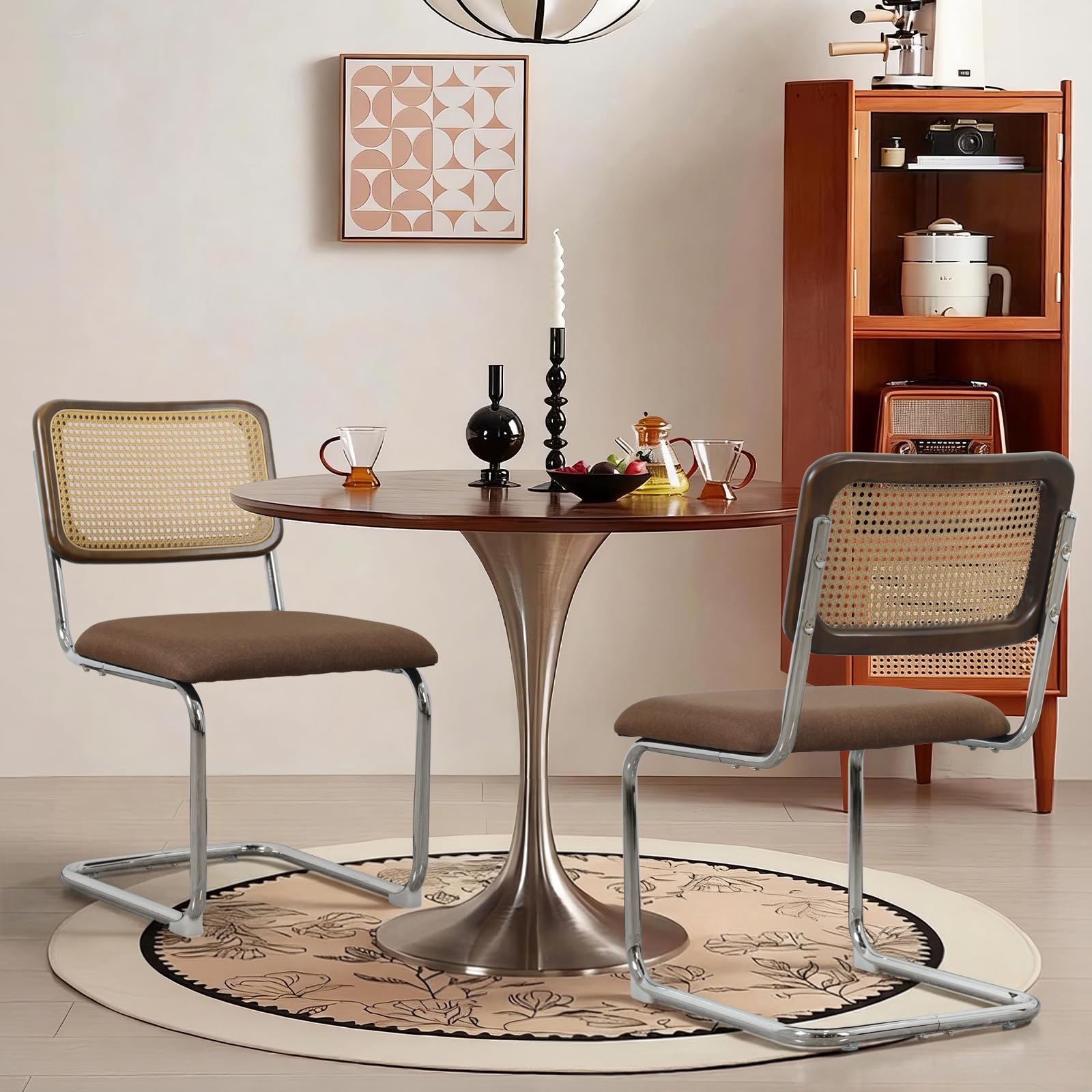
The bent steel tube, the cane back, the cushion floating on it — this is the rare chair where the design does the persuading on its own. It's a Cesca derivative, but a well-proportioned one: the cantilever curves under the seat rather than meeting it at a right angle, and the weave is tight enough to read as a panel rather than a net. Two of them land in a dining room and the room stops looking like a room with chairs in it. That's why it's our top pick — the most recognizable cane silhouette here, with the least risk attached.

Comfort is the trade-off to think through. The pad is 50D foam under PU leather and, to us, it's firmly on the upright side — a chair that keeps you at the table rather than one you sink into. Plenty of people want exactly that after a plate of pasta; if you host three-hour dinners, add a thin seat cushion. The PU surface is the practical half of the bargain, because a spill wipes off with a damp cloth instead of soaking into a weave, which is why these hold up in a kitchen with children in it.

Underneath, the chrome cantilever carries a 320-pound rating, and the gauge is heavy enough that you notice the weight when you lift a chair to sweep under it. Two things to check when they arrive: run a hand along the woven edge of the back for splinters, and watch the paint where the tube meets the floor, since a cantilever takes its whole load at those two points and that's where finish wear shows first. Assembly is back, legs and hardware, and the 19.1-inch seat height sits comfortably under a standard 29- to 30-inch table.

Bottom line: Our default pick for a first cane purchase: a hand-woven back, a steel frame rated to 320 pounds, and a pair that makes a small dining room look finished.

2

GrandNoor Rattan Bar Stools

GrandNoor Rattan Bar Stools

Kitchen counters

Our Score 9.6/10
Check Price

Worth Noting

  • Built for 36-inch counters only
Set
2 stools
Frame
Chrome steel
Seat Height
24.8 in
Weight Capacity
350 lb
Read the full review

Bar stools live or die on one measurement. A 24.8-inch seat height is built for a 36-inch counter, leaving roughly 11 inches between seat and worktop — enough room to cross your legs, not so much that you're perched. Put these at a standard 30-inch dining table and you're eating with your chin near the plate.

At the right counter, the rest of the design earns that number. A woven cane back, an upholstered seat and a chrome cantilever base use the same vocabulary as the Cesca chairs, so the cane story carries from the dining table to the kitchen without a seam. The frame is rated to 350 pounds, the highest rating in this group, and bolted assembly is straightforward with the included parts.

The seat is padded rather than woven, which is what makes a long breakfast comfortable, and the open back keeps air moving in a small kitchen that heats up when the oven is on. Care is the same as any cane piece: wipe the chrome with a dry cloth and never soak the weave. The wide 17-inch seat also means a cushion stays where you put it.

This is the narrowest use case in the roundup, and we're comfortable saying so: right for a 36-inch island, wrong for anything shorter. If your kitchen counter is the standard height and you want the cane look to continue past the dining room, these are the pair that does it — and the height matches the dining chairs closely enough that the two read as a set.

Bottom line: Buy these for a 36-inch island where you want the cane story to keep going — proper counter height, a 350-pound frame and a padded seat.

3

SICOTAS Rattan Sideboard

SICOTAS Rattan Sideboard

Coffee bars

Our Score 9.4/10
Check Price

Worth Noting

  • Heavy box; plan a two-person build
Width
51.6 in
Shelves
Adjustable
Storage
3 drawers, 2 cabinets
Material
FSC-certified engineered wood
Read the full review

Three drawers is the reason this cabinet exists. Most cane sideboards give you doors and a shelf; the SICOTAS adds a row of shallow drawers across the top, which is precisely what a coffee station or a bar needs — pods, filters, a bottle opener, the small things that otherwise live in a bowl on the counter and never get put away.

At 51.6 inches wide, 14 deep and 35.4 high, the top lands at counter height, so it reads as an extension of a kitchen run rather than a separate piece of furniture parked against a wall. The two side cabinets have adjustable shelves for taller items; the drawers take cutlery, utensils and the drawer-dwelling clutter of a dining room.

The body is FSC-certified engineered wood and the gold hardware is the single decorative flourish — restrained enough that the cane does the talking. Everything lined up for us: drill holes, doors and drawers, which is not a given with flat-pack furniture at this width. The soft-close hinges mean the doors settle rather than bang when someone closes them with a hip.

It is also heavy. Heavy enough that the box wants two people and a clear route to the room, and heavy enough that you want to build it where it will stand — moving it afterwards means emptying it and lifting from the base rather than the top. Give yourself an evening and a second pair of hands and it goes together without drama.

If storage is the point — a dining room that needs the serving dishes out of sight, a kitchen corner that needs a coffee bar — this is the piece we recommend first in this group. It holds more than the budget cabinets, costs less than the Kova, and the counter-height top is the detail that makes it useful rather than merely handsome.

Bottom line: The pick when cane has to earn its square footage: three drawers, two adjustable cabinets, and a counter-height top that turns into a coffee bar.

4

VICBARLEY Rattan Dining Chairs

VICBARLEY Rattan Dining Chairs

Small dining rooms

Our Score 9.4/10
Check Price

Worth Noting

  • Only one colourway offered
Seat
Linen over foam
Frame
Steel base
Seat Width
19.09 in
Seat Height
18.89 in
Read the full review

The obvious question with a cane dining chair is whether the cheap pair is a false economy. Here the answer is mostly no. You get a natural woven rattan back, a linen seat over high-resilience foam and a steel base, and the seat is a generous 19 inches wide — which matters when teenagers are eating at your table twice a day.

For a first apartment, a rental, or a table that genuinely gets three meals a day, this is the pair we point to. The linen cushions are softer underfoot than the firm PU seats on the pricier chairs, the cane back breathes in a warm kitchen, and the whole thing goes together with the included hardware and no drama. The seat height of 18.89 inches is a fraction lower than the Cesca-style pair at the top of this list, so check it against a tall dining table.

Then follow the assembly note the listing gives you, because it isn't marketing filler: run every screw in to about 80 percent, stand the chair on a level floor, then tighten everything down. Skip that and the frame settles crooked, which is where most of the wobble in flat-pack seating comes from. The chairs are light enough to move around the room when extra places are needed, which is the other job dining chairs quietly do.

Bottom line: A first-apartment dining chair that doesn't look like a compromise: woven cane back, linen seat, and a pair that costs less than one of the big-name chairs.

5

Nathan James Kova Sideboard

Nathan James Kova Sideboard

Entryway storage

Our Score 9.2/10
Check Price

Worth Noting

  • Doors often need aligning out of the box
  • Cane panel can bubble over time
Depth
16 in
Width
31 in
Shelves
2 adjustable
Warranty
Lifetime
Read the full review

The lifetime warranty is what stopped us. Furniture coverage usually runs a year at most, and Nathan James backs the Kova for as long as you own it, with a hundred days to send it back. On a cabinet that lives by the front door and takes a shoulder bag to the hinges every morning, that's the most useful line on the whole spec sheet.

It also happens to be the most modern-looking piece in this group. Black oak against natural cane is a cooler, sharper pairing than the honey-toned boho cabinets that dominate the category, and at 31 inches wide with 16 inches of depth it slips into a hallway or beside a sofa without eating the room. Inside there are two adjustable shelves, enough for a record player on top and vinyl standing upright below. We also like the magnetic catches more than the roller fittings most flat-pack doors use — nothing rattles when the door shuts.

Where the money goes is worth being clear about: it buys the finish, the hardware and the warranty, not more storage. The budget cabinets here hold as much or more for less. What the Kova gives you instead is a piece that looks like it came from a showroom rather than a warehouse, and one you can call someone about in year four if a hinge gives up. For an entryway that has to look good for a decade, that's the trade we take.

Bottom line: Buy it for an entryway that takes daily punishment: a slim cane-front cabinet with adjustable shelves and a lifetime warranty that outlasts the trend.

6

Best Choice Rattan Cabinet

Best Choice Rattan Cabinet

Narrow hallways

Our Score 9.2/10
Check Price

Worth Noting

  • Doors often need realigning
  • Sixty-day warranty is short for furniture
Depth
15 in
Width
31.5 in
Top Capacity
165 lb
Leg Clearance
8.25 in
Read the full review

Fifteen inches of depth is the number to run past your hallway. This cabinet is 31.5 inches wide and 32.5 high but only 15 deep, so it tucks into a passage, the end of a kitchen run, or the gap beside a sofa that a 16- or 18-inch sideboard simply won't take. In a narrow entryway that difference is the whole decision.

Two details make it better than the price suggests, and they're why it holds a place here over bigger cabinets. The doors are soft-close on overlay hinges, so they settle instead of slamming when someone comes in with an armful of shopping. And the body sits on raised legs with 8.25 inches of clearance underneath — enough for a robot vacuum to pass under and enough visual air that the piece doesn't read as a solid block in a tight space. Adjustable foot caps take up the lean on an old floor.

The top is rated to 165 pounds, more than most people will ever stack on a sideboard, and the interior shelf splits the cabinet into two compartments for baskets, board games or the good plates. The one thing to do promptly is inspect it: sixty days of coverage is short for furniture, so check the doors, the finish and the hardware the day it comes out of the box, while the window is still open.

Bottom line: A 15-inch-deep cabinet for hallways and tight walls, with soft-close doors and a top that holds far more than its footprint suggests.

7

Yechen Rattan Sideboard Set

Yechen Rattan Sideboard Set

Long walls

Our Score 9.2/10
Check Price

Worth Noting

  • Doors can arrive noticeably out of line
  • Printed finish scratches easily
Set
2 cabinets, 4 doors
Legs
Powder-coated metal
Capacity
100 lb
Total Width
63 in
Read the full review

A single 31-inch cabinet leaves gaps on a long wall, and buying two of anything decent usually doubles the bill. This set solves that problem directly: two cabinets, 63 inches of width when they sit side by side, four doors and four enclosed shelves between them.

Each half has a wide top, two shelves inside its doors, magnetic closures and matte black knobs that disappear against the cane. The detail that makes the pair work is the adjustable leveling feet — you can wind one cabinet up a turn so the two tops read as a single continuous run instead of a step, which is exactly what a long living-room wall needs.

Construction is thick engineered wood on slim powder-coated metal legs, with a 100-pound capacity across each unit. Spread the heavy things — records, a row of hardbacks, a lamp — rather than loading one end, and the pair stays honest. Assembly is straightforward, with illustrated instructions and hardware in the box.

Keep the finish in mind. The wood grain is printed on engineered board, so it scratches if you drag something ceramic across the top, and a felt pad under a vase is cheap insurance. The knobs and hardware are the other weak point at the margins; check both boxes before you break down the packaging.

Two cabinets for roughly what the single premium cabinets here cost is the argument, and it survives scrutiny: this is the most storage width in this group for the money, and the 31.5-inch height lines up with the Kova, so the two can share a room without one looking taller than the other. If your wall is long and your budget isn't, start here.

Bottom line: Two cane cabinets that read as one long sideboard, and the widest run of storage in this group for what it costs.

8

Bme Oliver Rattan Nightstand

Bme Oliver Rattan Nightstand

Small bedrooms

Our Score 9.0/10
Check Price

Worth Noting

  • Cane front is molded synthetic rattan
  • Drawer boxes are unfinished board
Width
19.7 in
Drawers
2
Assembly
Legs only
Material
Solid acacia
Read the full review

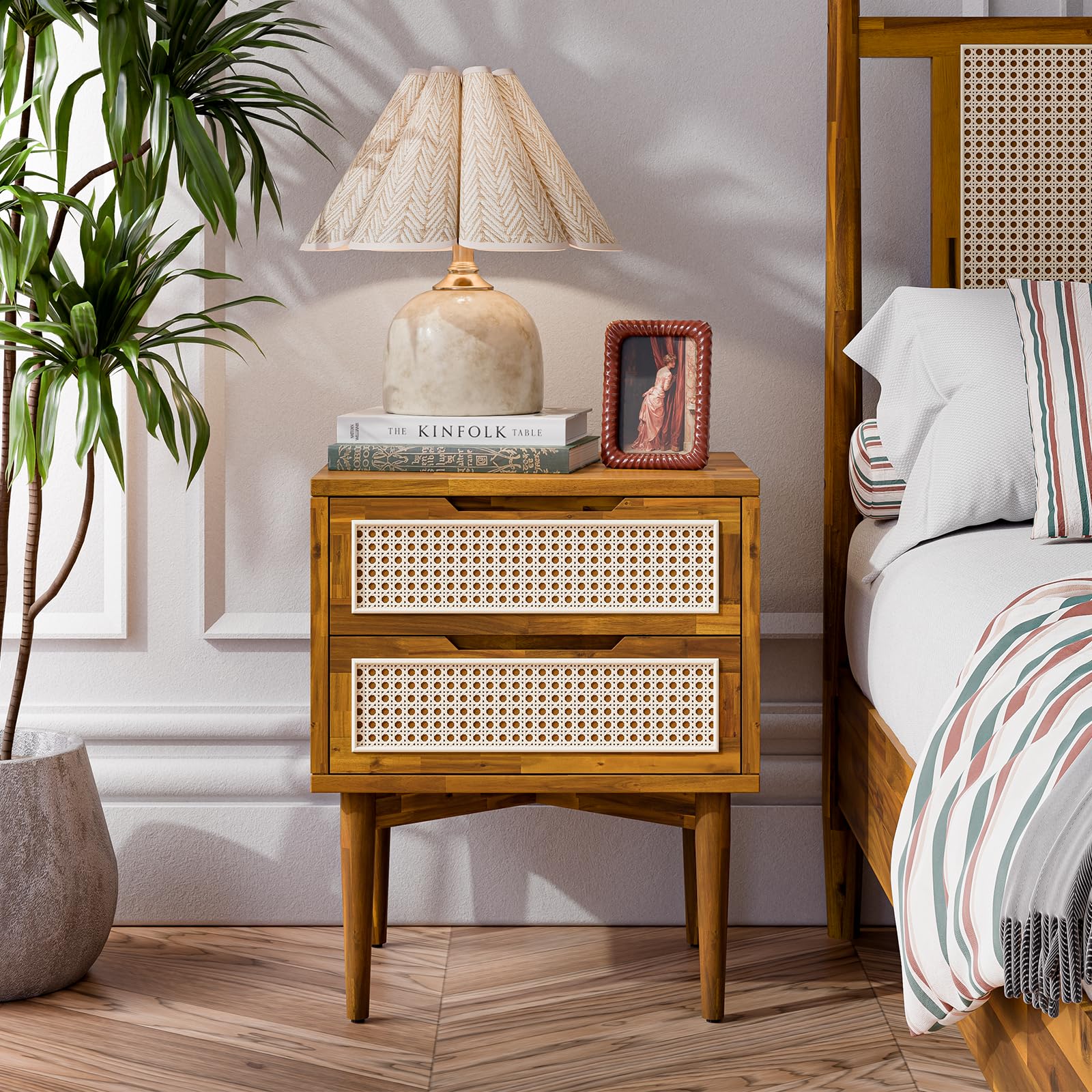
Ninety-five percent built is the detail that makes this nightstand worth its price. The Oliver arrives assembled apart from the legs, which take minutes with the hardware in the box — no cam locks, no bag of screws, no evening lost to a hex key. If you've recently put together a flat-pack dresser, you'll understand why that alone is the argument.

What the money buys underneath is solid acacia, 35 pounds of it, rated to 79.5 pounds on top, with two drawers, adjustable levelers on the legs and a one-year warranty. The drawers work, though they want a straight pull rather than a shove. The height is the other useful thing: at 24.2 inches it sits closer to a low platform bed than most nightstands, which is the gap a lot of people are trying to fill.

One thing the specification admits and the photographs don't: the cane on the front is synthetic rattan, formed and finished rather than woven. From a doorway it reads exactly right; up close you get a uniform texture where real cane has variation and the odd loose strand. The caramel finish also runs warm — toward honey under a lamp, toward yellow in daylight — so hold a sample of your floor colour next to the photo before you commit, and know that the drawer boxes inside are plain unfinished board.

Bottom line: For anyone tired of flat-pack: solid acacia, real drawers, and legs that go on in minutes — the cane-look front is molded, not woven.

9

SUPERJARE Rattan TV Stand

SUPERJARE Rattan TV Stand

Media consoles

Our Score 8.6/10
Check Price

Worth Noting

  • Low 19-inch height; check your sightline
  • Particleboard chips and dislikes moving
Storage
2 cabinets, adjustable shelf
TV Size
Up to 65 in
Cord Holes
4
Top Surface
53.9 x 13.7 in
Read the full review

It's built around a 65-inch television, and that's the number to start with. The top measures 53.9 by 13.7 inches, so a big screen's feet sit inside the edges with room to spare, and the two cane-doored cabinets underneath swallow the console, the remotes and the cable tangle you'd rather not look at.

The practical details are where this one earns its keep: an adjustable middle shelf that can be raised for a soundbar or a stack of consoles, four cord holes so the cables disappear down the back instead of looping around the side, and six solid wood feet with two adjustable ones to take up the wobble on an uneven floor. We noted the adjustable feet in particular — a media unit that rocks is a media unit you resent.

For the money, this is the least expensive way here to put cane under a television, and it looks more considered than the particleboard it's made from. That's also the caveat: particleboard chips at the edges and doesn't enjoy being moved, so build it where it will live, keep a touch-up pen nearby, and don't plan on disassembling it for the next move. At 19 inches tall it sits low, so check the sightline from your sofa before the box goes out with the recycling.

Bottom line: The one to buy if a television lives in the room: cane doors, four cord holes, and room for a 65-inch screen at the lowest price here.

10

Lerliuo Rattan Nightstand

Lerliuo Rattan Nightstand

Tight guest rooms

Our Score 8.6/10
Check Price

Worth Noting

  • Screws can bind and sit proud
Depth
11.81 in
Width
15.94 in
Storage
1 drawer, open shelf
Top Capacity
100 lb
Read the full review

Eleven and three-quarter inches of depth is what this nightstand actually is, and that number is the whole story. It's shallower than most bedside tables — narrow enough to sit in the gap beside a low platform bed, or between two twin beds in a guest room where nothing else fits — and it's the reason to buy it or walk away, depending on the room you have.

The front carries the look with a woven cane drawer panel and a small drawer above an open shelf. The top is rated to 100 pounds, which you'll never test once a lamp, a glass of water and a phone are on it. At about seven pounds the whole thing lifts with one hand, so vacuuming behind it stops being a reason to leave the dust there.

The frame is beech with a pale natural finish, and the sides and back are plain board — the cane story is the drawer front and nothing else. That's not a criticism so much as a styling note: slide it into a corner where the plain sides are hidden and it photographs like a far more expensive piece, which is the trick these small pieces are for.

For a dorm, a guest room or a rental where a full-size nightstand would crowd the bed, this is the least expensive way into the look here and the proportions suit it. It isn't heirloom furniture and doesn't pretend to be. What we like is that it does the one job — a place for a lamp and a book in a room with no floor space to spare — without looking like a plastic crate doing it.

Bottom line: The right nightstand for a small room and a small budget: under twelve inches deep, seven pounds light, and unmistakably cane from the front.

How We Tested 12 Pieces of Cane Furniture

We started with roughly 40 cane chairs, cabinets, nightstands, and carts from brands we had bought from before plus a handful of newer names, then cut anything with a particleboard frame, a resin weave passed off as cane, or dimensions that wouldn't clear a standard doorway. That left 12 pieces, which we assembled and used for eight months.

Assembly happened on living room floors on weekend afternoons, one person with the included tool and a timer running. We noted whether screw holes lined up on the first pass or needed the frame loosened and re-tightened, how long each build took solo, and whether doors and drawers sat flush on build day and again a week later, after being opened and closed a few dozen times.

Then we lived with them. Sideboards were loaded with records, linens, and glassware until the shelves were full, and we checked weekly for bowing and doors that had drifted out of alignment. Chairs got sat in through full dinners and long work-from-home afternoons, which is where cushion firmness shows itself, and we ran a palm over every weave looking for loose strands, splinters, and spots where the cane had stretched. We compared each finish in daylight against the product photos, since cane photographs warmer than it reads in a room, and we checked the weave once more at the end of summer to see whether humidity had loosened anything. Finally, we set what each piece cost against how it had actually held up.

How to Choose the Right Cane Furniture

Woven cane, molded rattan, printed panels

The word cane covers three quite different fronts. Hand-woven natural cane is split stem threaded through a frame, so it has variation, a little give and visible joints where strands cross. Molded or synthetic rattan is formed in a sheet and looks uniform — the Bme nightstand uses it, and from a doorway most people won't tell. A printed panel is a photograph of cane on flat board, and that is the one to skip if texture is what you're buying.

Read the material line before the adjectives. If a listing says hand-woven, expect the weave to move slightly under a thumb; if it says rattan-decorated, ask yourself whether you're paying for a surface or a weave.

Measure depth before you measure width

Walls are long; the floor in front of them isn't. Cabinets here run 14 to 16 inches deep and nightstands 11.8 to 15.7, and that inch or two decides whether a hallway stays walkable. The trap is the word compact, which usually describes the shipping box rather than the assembled piece — a cabinet that arrives flat can still stand 32 inches tall and three feet wide.

Measure the wall, the walkway you want to keep, and the height of your baseboard. A cabinet on 8-inch legs will not sit flush against a skirting board, and a nightstand deeper than 13 inches crowds the gap beside a low bed.

The frame decides what it holds

The cane is the look; the frame is the furniture. The steel cantilever chairs here are rated to 320 and 350 pounds, the engineered-wood cabinets from 90 to 165, and a solid acacia nightstand to just under 80. Those figures describe the frame, not the weave, so treat them as a ceiling for the whole piece rather than a measure of how much the shelf will take.

For a television, check the rated load on the top rather than the screen size alone. A 65-inch set spreads its weight through two feet in the middle, but a stack of consoles and a soundbar add up faster than most people expect.

Budget for the assembly, not just the delivery

Nearly everything here ships flat, and the recurring snag isn't the box — it's the doors. Overlay hinges have adjustment screws, and a door hanging a few millimetres low out of the carton usually straightens with a quarter turn and a second pair of hands. Build wide cabinets where they'll stand, and keep the packaging until both halves are upright.

Treat the warranty as part of what you're buying. One cabinet here carries a lifetime guarantee and a hundred-day trial; another covers sixty days, which is short enough that you want to inspect hinges and finish the day it arrives.

Frequently Asked Questions

Final Verdict

The Cesca-style pair from Zesthouse is where we point most people. It's the purest version of the look on this page, it sits on a steel frame rated to 320 pounds, and two chairs change a room faster than any single cabinet.

If your walls need storage instead, the SICOTAS sideboard gives you drawers, adjustable shelves and counter height in one piece. And the Nathan James Kova is worth the step up when you want a lifetime warranty and a darker, more modern finish in an entryway that takes daily punishment.