Furniture

Best Bar Cabinets of 2026

The best five minutes of a party are the ones before anyone arrives: ice in the bucket, playlist on, bottles lined up along the kitchen counter. Then the doorbell rings, someone asks for a wine glass, and the counter turns into a graveyard of corks, half-empty seltzer cans, and a shaker with no home. A bar cabinet solves that specific problem — it gives the bottles, the stemware, and the tools one place to live, and it all disappears behind a door when the night is over.

I've built a bar on a bookshelf in a studio apartment and on a proper sideboard once I had the wall space for one, and the difference between a cabinet that earns its footprint and one that just looks good in photos comes down to unglamorous things: whether a shelf sags under a full bottle of bourbon, whether the doors still sit flush after a month of daily use, and whether the holes drilled for the hinges, pulls, and shelf pins were done with any care at all. One thing nobody tells a first-time buyer — most cabinets are shallower inside than they look, and a standard bottle stands roughly 12 inches tall, so measure your tallest bottle before you fall for a silhouette. My team and I have spent the past eight months living with nine of these, and the standouts share more than a nice finish.

1

BON AUGURE Small Bar Cabinet

Top Pick
BON AUGURE Small Bar Cabinet

Tight, narrow spaces

Our Score 9.6/10
Check Price

Worth Noting

  • No wine or stemware racks
Shelves
3, adjustable
Dimensions
29.53W x 13.39D x 36H in
Top Capacity
300 lb
Shelf Capacity
100 lb each
Read the full review

Three hundred pounds is the number that matters here. That is the rated load on the top of this 30-inch cabinet, and it changes what the piece is: not just bottle storage, but a surface that takes a coffee machine, an ice bucket and a tray of glasses without you thinking about it.

The rest of the design is quietly sensible. It is 13.4 inches deep, so it hugs a hallway wall where a 20-inch sideboard would block the way; at 36 inches tall it lands at counter height for pouring; the three shelves adjust, and each is rated for 100 pounds; the feet level on a floor that is not true; and an anti-tip strap comes in the box for the day a child tries to climb it. Labeled hardware and a short parts list keep the build to a single sitting.

What keeps it in the guide is how little it asks of a room. A short wall between two doorways, the end of a kitchen run, the alcove beside a fridge: this is the cabinet that fits when a proper bar does not, and it does not look like a compromise doing it. The top is engineered wood, so a spilled syrup wants a cloth rather than a night to soak in.

Bottom line: Our pick where the wall is short: 30 inches wide and only 13.4 deep, with a 300-pound top, adjustable shelves and leveling feet.

2

JKsmart Corner Bar Cabinet

JKsmart Corner Bar Cabinet

Corner bar setups

Our Score 9.4/10
Check Price

Worth Noting

  • Lower compartment is short for tall bottles
  • Needs a genuine 90-degree corner
Height
50.8 in
Storage
Wine racks and glass holder
Lighting
16-color LED, 4 modes
Footprint
18.7 x 18.7 in
Read the full review

A corner is the one spot in a dining room where nothing useful fits, which is why a cabinet built for it earns its keep before you even look at the finish. This one is 18.7 inches square and 50.8 inches tall, so it slides into dead space beside a table and turns two unused walls into a bar: two open counters behind a metal guardrail up top, wine racks and a glass holder, and two doors closing over the rest.

What earns it the top spot is how much it holds without looking crowded. Tall bourbon bottles stand upright on the open counters, where a shallow, flat-back sideboard forces them to lean or stick out, and the glass holder keeps stems off the shelf below. The X-frame and four legs give it a steadier feel than most flat-pack furniture at this size, and it is the least painful build of the corner units we assembled.

The LED is the part to calibrate your expectations on. Sixteen colors, four modes and adjustable brightness make it party lighting rather than task lighting, and the glow lands best on the glassware and bottle labels on the open levels. Nobody is finding the vermouth by it.

Two of the four levels stay open, which is the whole point of a bar cabinet: bottles and stems where guests can see them, closed storage below for the backup stock and the ice bucket. That split is also why it belongs in a dining room, den or finished basement rather than a hallway you pass through in a coat.

Bottom line: If you have an empty corner, this is the bar cabinet we recommend first: it holds tall bottles and glassware, goes together cleanly, and looks more expensive than it is.

3

X-cosrack Wine Bar Cabinet

X-cosrack Wine Bar Cabinet

First apartments

Our Score 9.4/10
Check Price

Worth Noting

  • Rack holds five wine bottles at most
Door
Mesh, magnetic latch
Wine Rack
5 bottles, detachable
Dimensions
23.6W x 13.4D x 31.1H in
Load Capacity
330 lb
Read the full review

The least expensive closed cabinet in this group is also one of the cleverest. The five-bottle rack and the stemware holder both lift out, so the same 24-inch box can be a wine bar this month and a coffee station the next, while the mesh door keeps everything visible and the magnetic latch keeps it shut. At 23.6 inches wide and 31.1 tall it is the piece for a first apartment, a den, or the end of a kitchen run that has nothing else to offer.

Capacity is the surprise: 330 pounds across the frame, with a lower cupboard for the backup bottles, the opener and the napkins. The metal frame and wood-grain shelves read industrial rather than cheap, and the adjustable feet mean an old, sloping floor does not turn into a wobble. Where it runs out of room is headroom, since the cupboard below the rack is shallow, so the rack and the top do the display work and the cupboard takes what is left.

Bottom line: The cheapest closed cabinet here, and worth it: a lift-out rack and stemware holder in a 24-inch box that fits a first apartment.

4

JOINICE 70-Inch Corner Bar Cabinet

JOINICE 70-Inch Corner Bar Cabinet

Tall corner display

Our Score 9.4/10
Check Price

Worth Noting

  • One door means reaching in one side at a time
  • Build runs to a few hours
Finish
Walnut, fluted door
Shelves
Glass
Lighting
Built-in
Dimensions
22.2W x 15.7D x 70.1H in
Read the full review

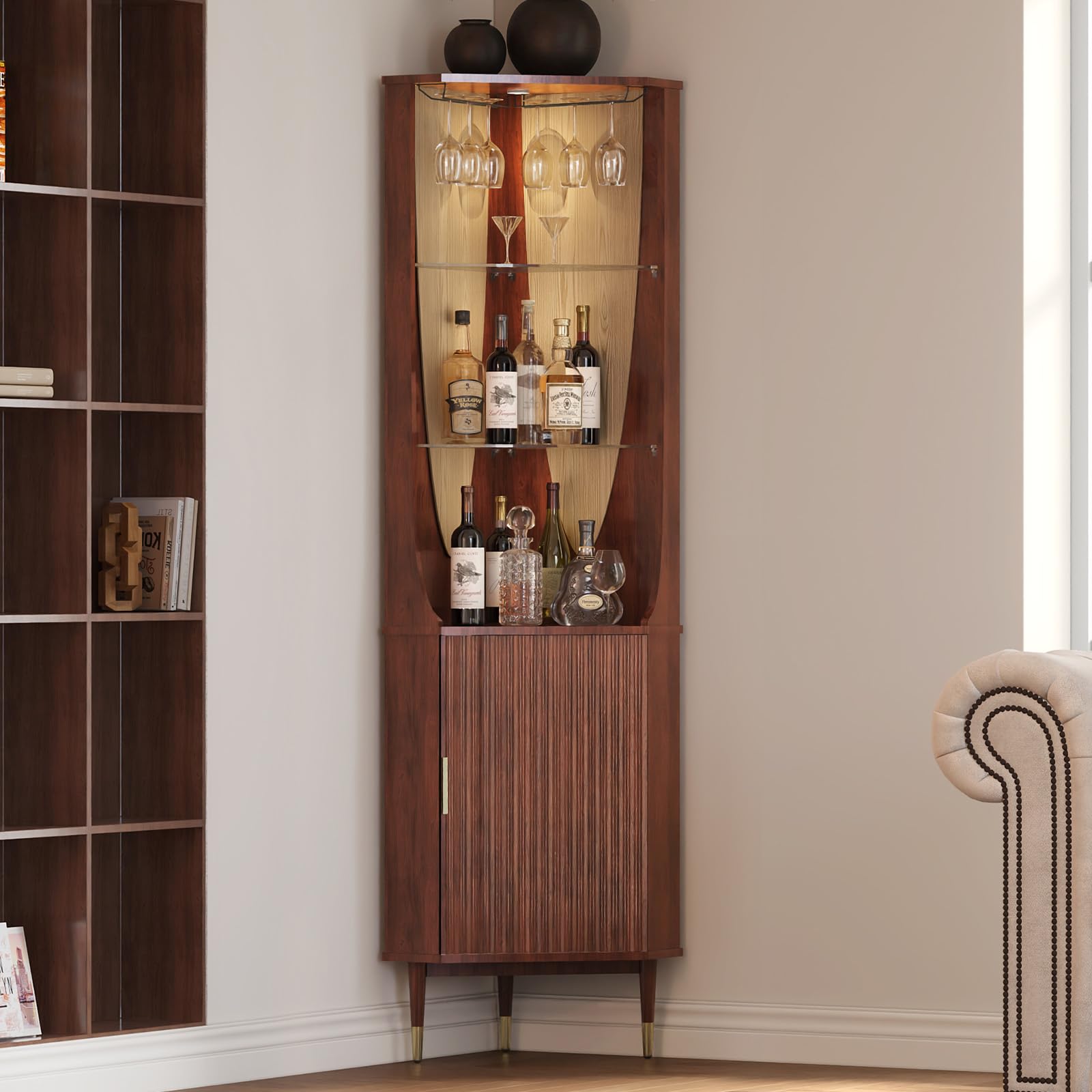
Seventy inches tall and barely 22 inches wide, this is the corner cabinet for someone who wants the bar to disappear into the furniture. The walnut finish, the fluted door front and the glass shelves read mid-century rather than industrial, closer to a display hutch than to a liquor store.

The built-in light is what makes glass shelves worth having. It picks out stems and bottles against a dark interior, and in a dining room that is most of the show. Below and behind the door, the closed section handles what you do not want on display, and the wood is FSC-certified, which matters to some buyers and not at all to others.

Capacity is more generous than the footprint suggests. A bourbon collection stands upright with room for the odds and ends, and the same interior works stocked with a coffee machine and mugs if the bar lives somewhere else in the house.

For a small dining room where the corner is the only free space and the look matters as much as the storage, this is our pick. The finish is the reason: at this size an industrial rack would dominate the room, and this reads like a piece you bought on purpose.

Bottom line: For a small dining corner that deserves real furniture: 70 inches of walnut, glass shelves and a built-in light in a 22-inch footprint.

5

ONBRILL 55-Inch Fluted Bar Cabinet

ONBRILL 55-Inch Fluted Bar Cabinet

Long wall sideboards

Our Score 9.2/10
Check Price

Worth Noting

  • Finish reads darker than the listing photos
Width
55.1 in
Lighting
RGB LED with remote
Stemware
9 glasses, 3 tiers
Wine Storage
12-bottle grid
Read the full review

Fifty-five inches is a lot of sideboard, and this ONBRILL puts all of it to work: a twelve-bottle grid laid on its side, a nine-stem rack across three tiers, an open middle section that lets the glasses catch the light, and sliding doors over the closed storage. We recommend it for the wall where the bar is supposed to look like furniture rather than equipment.

Sliding doors are the detail that makes it practical in a dining room. A pair of hinged doors on a cabinet this wide needs a couple of feet of clear floor every time you open them; these track sideways and leave the walkway alone. Behind them, adjustable shelves take the bottles that do not fit the grid, and the charging ports mean a cocktail appliance or a speaker can live on the same run of furniture without a cable snaking to the wall.

The fluted fronts and warm wood top are what sell the sideboard illusion, and the walnut holds up close. The surface is where it asks for care: engineered wood with a woodgrain finish marks where glasses and keys land, so keep a tray and a few coasters within reach.

Bottom line: For a long empty wall, this is our pick: 55 inches of walnut with a twelve-bottle grid, a nine-stem rack and sliding doors that need no swing room.

6

GDLF Fridge-Space Bar Cabinet

GDLF Fridge-Space Bar Cabinet

Mini fridge stations

Our Score 9.2/10
Check Price

Worth Noting

  • Bay suits compact mini fridges only
  • Ships in two boxes; build wants two people
Counter
53.2 x 20.9 in
Drawers
2
Outlets
2 AC, 1 USB, 1 USB-C
Fridge Bay
19.7W x 19.9D x 34.7H in
Read the full review

The point of this cabinet is a hole. A bay in the middle takes a compact mini fridge, the sort of 3.2-cubic-foot model most home bars run, and ours slid in with room to spare, so the drinks fridge stops being a box on the floor and becomes part of the furniture. If a fridge is in your plans, nothing else in this guide does this job.

Around the bay it is the largest piece here: a 53.2 by 20.9-inch counter that takes a full cocktail setup, two drawers for the small stuff, cabinets on both sides and a stemware rack overhead. The fluted doors on a black body with a warm wood top are what stop it reading like office furniture.

Power is built in, with two AC outlets, a USB and a USB-C, which is the difference between a coffee station that works and one that needs an extension cord across the floor. The outlets live in the cabinet, though, so the cabinet still needs a wall socket within reach of its own cord. Plan the wall before you plan the drinks.

It is the priciest cabinet in this group and the only one that replaces two pieces of furniture: a fridge stand and a sideboard in a single footprint. Where the budget stretches and the fridge is non-negotiable, this is the one.

Bottom line: Buy this when a mini fridge is part of the plan: the bay swallows a compact model and the counter is the biggest in this group.

7

ARTPOWER Green Bar Cabinet

ARTPOWER Green Bar Cabinet

Style-first rooms

Our Score 9.2/10
Check Price

Worth Noting

  • Part-heavy assembly takes an evening
Doors
Tempered glass
Glassware
3 stemware racks
Dimensions
37W x 14.96D x 31.49H in
Wine Storage
Pull-out bottle drawer
Read the full review

Green with gold hardware is a commitment, and it is the reason to buy this one. In a room of beige and wood tones the ARTPOWER reads as a deliberate piece: tempered glass doors with gold pulls, four slim metal legs, a matching drawer and three stemware racks inside so the glasses hang rather than stack. Under 16 inches deep, it slips into places a sideboard cannot go, like the wall under a window or the gap beside a sofa.

We recommend it for the room where the bar is on show and the collection is modest. The pull-out bottle drawer lays bottles down and out of sight, which is the tidiest wine storage in this group and the easiest to load without unstacking anything. One caution from our time with it: no shelf load rating is published, so heavy bottles stay on the bottom and the top is for glasses, a decanter and the ice bucket.

Bottom line: We chose it for rooms where the bar has to look like furniture: green, gold and glass in a 37-inch footprint an apartment can take.

8

Auromie Glass-Door Bar Cabinet

Auromie Glass-Door Bar Cabinet

Glass-front display

Our Score 9.2/10
Check Price

Worth Noting

  • Assembly is an evening's work
  • Panels can arrive damaged, so inspect first
Doors
Tempered glass
Drawers
2, soft close
Lighting
App-controlled LED
Dimensions
47.24W x 15.75D x 45.28H in
Read the full review

The tape measure tells you what the photos do not: 47.2 inches wide, 15.75 deep and 45.3 tall. Those are sideboard proportions rather than hutch, which is why it works under a mirror, between two doorways or at the end of a kitchen, and why it will not fill a big alcove you were picturing.

Inside, two glass doors open onto a lit interior with a wine rack and glass holders, and two soft-close drawers swallow corkscrews, coasters and napkins, which is what separates a bar from a shelf. The top is broad enough for a coffee machine or a microwave, the other life these cabinets tend to have, and the LED strip runs from an app, so the color can change with the evening without anyone hunting for a remote.

We recommend it for a first dining room or a rental where the bar doubles as the sideboard: no other cabinet here pairs glass doors with drawers at this price, and the light does the rest. Go in knowing it is a midrange cabinet dressed up well, with engineered panels and glass doing the visual work rather than joinery.

Bottom line: We recommend it for a first dining room: glass doors, soft-close drawers and app-controlled light at a midrange price, in a sideboard-sized cabinet.

How We Tested the Best Bar Cabinets

We started with a long list of bar cabinets from major furniture retailers, then cut it down using specs that actually affect daily use: interior shelf clearance for standing bottles, exterior footprint for real rooms, materials and finishes, and price relative to what you get. Cabinets whose interior height couldn't clear a standard liquor bottle, or whose depth left the doors unable to open fully in a normal dining space, came off the list early. That left us with nine to build, load, and live with over eight months.

Every cabinet was assembled by one or two people in a living room with standard hand tools, and we timed each build and noted where the instructions stopped matching the hardware. Hole quality got its own scrutiny: we checked whether pre-drilled holes for hinges, handles, and shelf pins lined up without forcing, whether the pilot holes were clean or splintered the veneer, and whether shelf pins sat level enough that a shelf didn't rock. Then we loaded each one the way a real bar gets loaded — bottles on the bottom, stemware overhead, a shaker and jigger in a drawer — and counted exactly how many wine glasses and bottles each could hold before it felt crowded.

Living with them was the longer test. We opened and closed the doors daily, yanked both at once to see whether the frame racked, and nudged the corners to check for wobble under weight. Over the months we watched for fingerprints on dark finishes, scratches on veneers, and rings where a spilled drink sat too long, and we judged value at the end, once assembly headaches and hidden flaws had time to surface. The picks below are the ones that still looked and closed like new.

How to Choose Bar Cabinets

Start with the footprint, not the finish

Corner units earn their place by using floor space nothing else can. An 18.7-inch-square corner cabinet or a 22-inch-wide tall unit turns a dead angle into a bar, but it needs a genuine 90-degree corner with both walls clear; an open-plan angle with one short return will not hold it. Flat-wall sideboards give you more counter and more storage, and depth is the number people forget: 13 inches hugs a hallway, 20 inches stands proud into the walkway.

Tape the footprint on the floor, then add the door swing or the drawer pull. That extra strip is what decides whether the cabinet crowds the chair beside it, and it is the single most common reason a bar cabinet gets returned.

Match the interior to what you actually drink

A wine rack lays bottles on their side and a stemware rack hangs glasses from the shelf above, and both eat the upright clearance you need for tall rye, vermouth and liqueur bottles. If your bar is mostly spirits, adjustable shelves serve you better than a twelve-bottle grid.

Measure your tallest bottle from base to cap and compare it with the gap between shelves; the lower compartment is usually the tight one. Then count what you keep out of sight, because mixers, backup bottles and an ice bucket take more room than the display does.

Solid, glass or mesh doors change the room

Every bar cabinet is a display decision. Solid doors hide a mismatched collection and keep dust off the glassware; mesh keeps bottles visible but enclosed; glass doors put everything on show, which is wonderful with a curated shelf and unforgiving with twenty half-empty bottles. Open shelving is the most sociable and the dustiest.

If you are somewhere in between, look for closed storage below and one open, lit section above. That split is exactly why the corner cabinets here work in a dining room: the good bottles are visible, the backup stock is not.

Pay for the outlet, not the glow

Built-in outlets are the feature that changes daily use: a coffee machine or a cocktail appliance plugged into the cabinet instead of an extension cord stretched across the floor. Remember that the cabinet's own sockets still need a wall socket within reach of its cord, so placement becomes an electrical decision as much as a decorative one.

LED strips are ambiance. Sixteen colors will not help you find the vermouth, and the light strip is best treated as a bonus rather than a feature worth paying extra for.

Budget for the build, not just the cabinet

Flat-pack is the norm, and assembly is where these cabinets divide. Small units go together in a sitting with labeled hardware; the 53-inch pieces arrive in two boxes, weigh well over a hundred pounds and want two people and an afternoon. The instructions are the weak link on the largest pieces.

Sort and label the hardware first, build close to where the cabinet will stand, and anchor anything taller than waist height to the wall. Keep the heaviest bottles on the bottom shelf, where they also make the cabinet harder to tip.

Frequently Asked Questions

Final Verdict

If you have an empty corner, buy the JKsmart. It holds tall bottles upright, keeps the stems off the shelf, and turns floor space you were not using into the bar, which is why it takes the top spot.

If the corner does not exist, the decision becomes a wall: the ONBRILL is the best-looking way to fill a long one, and the BON AUGURE is what fits when the run is short and the room is small. Settle the footprint first and the finish follows.