Bedding

Best Eco-Friendly Comforters of 2026

Eco-friendly comforters have a reputation problem: the greener the label, the more likely it feels like a paper bag or sleeps like a brick. That's the tradeoff nobody mentions — you go looking for something kinder to the planet and end up with a stiff, crunchy blanket that runs hot. A good one does the whole job: soft against bare skin, heavy enough to feel settling, and good-looking enough that you stop bothering with a duvet cover.

I've slept under a rotating stack of these for nine months, and my team has put a dozen through real nights, real washes, and real fitted-sheet fights. One thing I've learned: the badge on the box tells you less than the shell fabric and how the fill is held in place — loose quilting clumps by month two no matter what's printed on the tag. The picks below run from budget to investment, and each earned its spot for a different reason: loft, softness, fit on a deep mattress, or looks.

1

Bedsure Oeko-TEX Comforter

Top Pick
Bedsure Oeko-TEX Comforter

Guest rooms

Our Score 9.4/10
Check Price

Worth Noting

  • Less loft than the photos suggest
  • Polyester shell and fill
Size
Queen, 88 x 88 in
Thickness
1.18 in
Certification
Oeko-TEX
Shell And Fill
100% polyester
Read the full review

This is the cheapest comforter in the group, and it still carries an Oeko-TEX certification — worth understanding, because that's a different promise from GOTS. Oeko-TEX tests the finished article for harmful substances; it says nothing about whether the fiber is organic or plant-based. If your eco priority is what sits against your skin for eight hours a night, this passes. If it's the fiber itself, it doesn't, and the organic cotton pick is the one to look at.

What it does well is the everyday stuff. The fill is light enough for summer with just a sheet and layers comfortably in winter, and the box quilting keeps it from turning into a lumpy mess after a few trips through the machine. It's soft the way microfiber is soft — smooth, a little slippery, quiet — and the size range is the widest here, running from twin through oversized king, which matters when you're outfitting a guest room or a dorm rather than one bed.

Here's the honest trade: this is a light all-season layer, not a cloud. Anyone hoping for hotel-bed puffiness will be disappointed by how little loft there is in person compared with the photos. For a spare room, a first apartment, or a bed that gets washed constantly, we think that's the right trade — the certification is real, and it's the one we suggest for anyone who wants to find out whether they even like a down-alternative comforter before spending more on one.

Bottom line: Budget-first shoppers still get a certified comforter here: Oeko-TEX tested, soft, light enough for year-round use, and the one we suggest for guest rooms and dorms.

2

WENERSI Organic Cotton Down Comforter

WENERSI Organic Cotton Down Comforter

Certified organic bedding

Our Score 9.0/10
Check Price

Worth Noting

  • Animal-derived down fill, not for vegan homes
Fill
Goose feather and down, 750+ fill power
Size
Queen, 90 x 90 in
Shell
100% GOTS-certified organic cotton
Fill Weight
65 oz
Read the full review

The certification is what sold us. This WENERSI's shell is GOTS-certified organic cotton, which covers how the cotton was grown, dyed and finished rather than just how the listing describes it, and the fill underneath is a goose feather and down blend rated at 750+ fill power. Queen sizing runs 90 by 90 inches with 65 ounces of fill, so it drapes over the mattress edge instead of stopping at it.

What that buys you is warmth without weight. Down traps air more efficiently than a solid synthetic batt, so this one holds a cool bedroom overnight without the pressed-down feeling of a heavy polyester comforter, and we were struck by how little of it you seem to need. The box stitching does the unglamorous work: the fill stays where it's put instead of sliding to the foot of the bed by morning, which is the first thing that goes wrong on a cheaper down insert. It does have the light crunch a down comforter is supposed to have — pleasant if you like that, noticeable if you don't.

Expect the usual down routine out of the box: it arrives vacuum packed, so fluff it and give it a few hours, or tumble it on low for fifteen minutes, before you judge the loft. Ours came back to full height after a cold wash. The one practical catch is the shell — a light, unprotected cotton on a pale insert — so plan on a duvet cover, which the 90-inch square dimensions make easy to shop for.

Bottom line: Certified organic cotton wrapped around warm, lightweight down: this is the comforter we hand people who want a real eco credential and a bed that sleeps comfortably.

3

HOMBYS Bamboo Viscose Comforter

HOMBYS Bamboo Viscose Comforter

Hot sleepers

Our Score 9.0/10
Check Price

Worth Noting

  • Polyester microfiber fill, not bamboo
  • Thin, with minimal loft for winter
Fill
Hollow microfiber
Size
King, 106 x 90 in
Shell
100% viscose derived from bamboo
Weight
5.91 lb
Read the full review

If you kick the covers off at three in the morning and pull them back on at five, start here. HOMBYS makes the shell from 100% viscose derived from bamboo, which gives it a cool, faintly silky hand and lets it move air rather than trap it. At 2.68 kg for the king it's a summer-weight layer, closer to a good hotel blanket than to a duvet, and in a warm bedroom that's the entire point.

What we appreciate is that it stays cool without turning clammy. The bamboo shell is moisture-absorbing and dries quickly, and the hollow fill is light enough that the whole thing never becomes a heat trap. It's quiet, too — no rustle when you turn over, which is not something every fill in this group manages at two in the morning.

The eco story stops at the shell, though. That bamboo viscose is the outer layer; the fill is hollow polyester microfiber, described as seven-hole fibers — so if you came for an all-bamboo comforter, this isn't one. Sizing is the other thing to check: the king measures 106 by 90 inches, which is a real 15 inches of drop on each side of a king mattress, but some arrive smaller than the label suggests, so open it early enough to exchange. Treat it as a warm-weather comforter or a summer duvet insert rather than a winter-only layer.

Bottom line: We recommend it for anyone who wakes up overheated: a cool bamboo viscose shell over light microfiber fill, in a king that actually covers the bed.

4

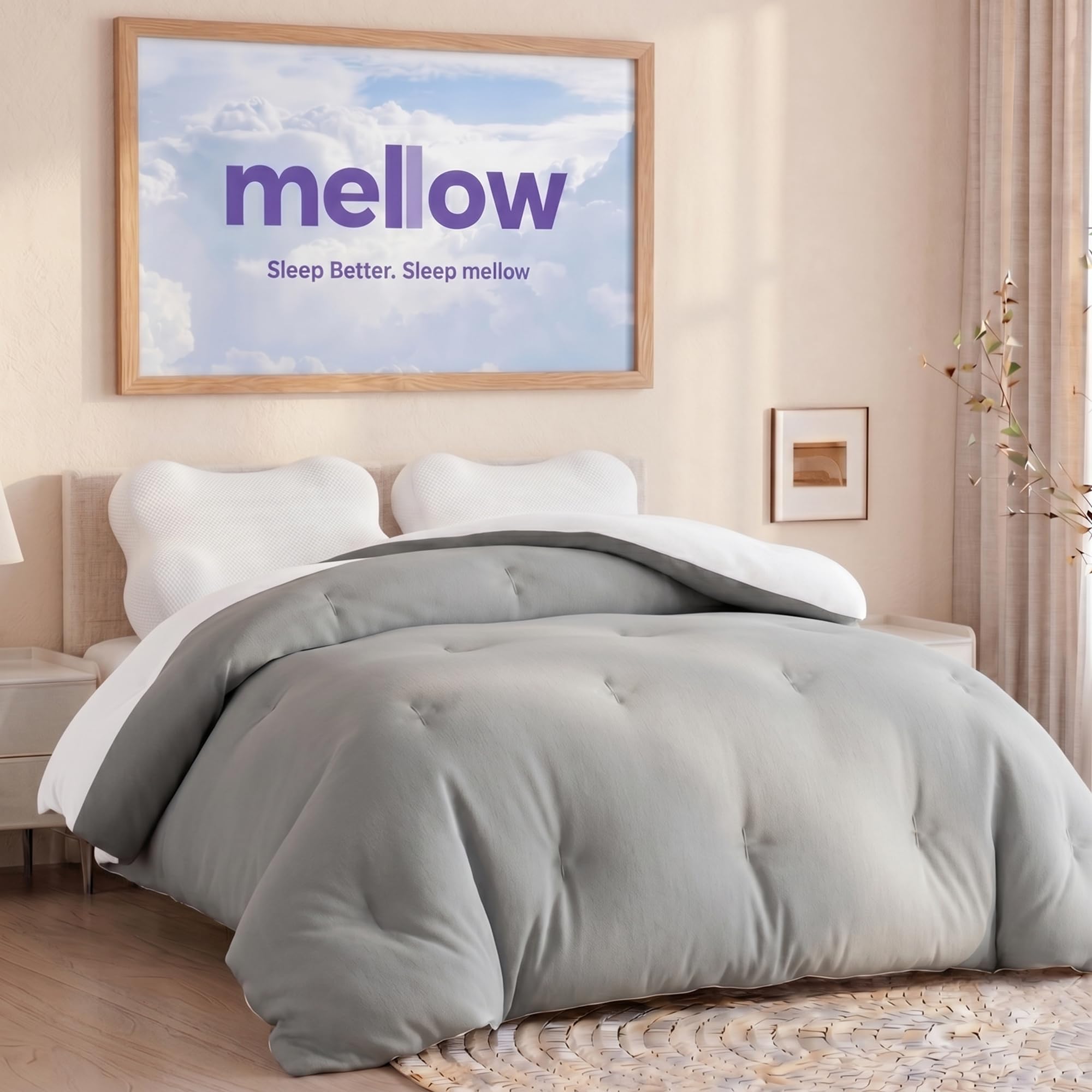
Mellow Marshmallow Comforter

Mellow Marshmallow Comforter

Sensitive skin

Our Score 8.8/10
Check Price

Worth Noting

  • Line-dry only, no tumble drying
Fill
Down alternative, double-stuffed
Size
Full/Queen, 90 x 68 in
Shell
Microfiber
Certification
OEKO-TEX Class I
Read the full review

Double-stuffed usually means the brand added more polyester. In the Marshmallow it's also the thing you notice first: this is the loftiest comforter in the group, the one that makes a bed look finished the moment you pull it up. The shell carries OEKO-TEX Class I certification, the class intended for articles that may come into contact with a baby's skin and the strictest of the Oeko-TEX levels — the most specific skin-safety credential on this page.

We rate it the softest of the four, and it's the one we point to when a comforter is headed for a child's bed or a household that cares about what's been used to finish the fabric. It's warmer than its cloud-like looks suggest, too: the warmth is described as heavyweight and the doubled fill holds heat, so it suits a cool bedroom better than a stuffy one.

One thing to check before you order is the width. The full/queen is 90 by 68 inches, which is 4 inches of overhang on each side of a standard 60-inch queen mattress, against the 15 inches a 90-inch-square insert gives you. On a full bed that's generous; on a queen it's a coverlet look, and plenty of buyers want more fabric at the sides. The other is drying: it's line-dry only. In a small apartment in February, that's the difference between washing it and putting it off.

Bottom line: We rate this the softest comforter here, and the one with the most specific skin-safety certification: OEKO-TEX Class I fabric over a genuinely lofty double-stuffed fill.

How We Chose and Tested Eco-Friendly Comforters

We started with roughly 40 comforters marketed as eco-friendly — plant-based fills, recycled shells, organic cotton, or some combination of the three — and cut anything with vague claims, anything that wouldn't name its fill material, and anything sold in only one size. That left 12, which we ordered in full/queen wherever possible so the fit comparisons were fair.

Testing ran nine months, straight through air-conditioned summer nights and a genuinely cold winter, on beds belonging to people who sleep at different temperatures. Every comforter went onto the same 14-inch mattress first, so I could see whether the corners stayed put or crept toward the middle by morning, and whether the listed dimensions matched a real queen bed once it was out of the bag. We noted how each felt in the first ten minutes — whether the shell was smooth or had that faintly scratchy hand recycled fabrics often start with — and again after a month, because softness that doesn't survive a few washes isn't softness. Weight turned out to be the most personal variable: some testers wanted that settling, sandbag feeling, others kicked it off by 2 a.m.

Each one went through at least three machine washes on the care label's settings. After every cycle we measured it flat against its original dimensions, pressed along the quilting lines for clumps or bare patches, and re-fluffed it to see how quickly the loft returned — a few came out visibly flatter, and one had shifted its fill into the bottom third. Thickness got judged by how the comforter draped over the edge of the bed rather than by a number, and appearance by whether it still looked crisp after a month without steaming. Value came down to price against fill weight and how it held up, since a cheap one that goes lumpy in a season costs more than it saves.

How to Choose Eco-Friendly Comforters

Read the certification, not the adjective

Two names do most of the work in this category. GOTS covers organic cotton from the field through dyeing and finishing, so it's the certification to look for when the fiber itself is the reason you're shopping. Oeko-TEX tests the finished article for harmful substances and says nothing about the fiber — a polyester comforter and an organic cotton one can both carry it.

Match the label to the worry: GOTS for what the comforter is made of, Oeko-TEX for what's been left in it, and Oeko-TEX Class I when the bedding is headed for a child's bed. Bamboo viscose sits outside both. It's plant-derived but chemically regenerated, so treat bamboo as a temperature and feel story rather than an automatic credential.

Shell and fill are separate decisions

Most listings blur these together, but they do different jobs. The shell sets how the comforter feels at first touch and how it handles moisture: cotton is dry and breathable, bamboo viscose runs cool and silky, microfiber is smooth and can sleep warm.

The fill sets warmth-to-weight. Down gives the most loft for the least weight, but it's animal-derived and wants a duvet cover. Down-alternative and microfiber fills are washable, vegan and cheaper, and they need more bulk to hold the same heat — which is why a down-alternative comforter often feels heavier for the same warmth. A hot sleeper wants the cool shell with the light fill; a cold bedroom rewards the down.

Measure against the mattress, not the label

Comforter sizing isn't standardized, and width is where it shows. A queen mattress is 60 inches wide, so a 90-inch-square comforter hangs 15 inches down each side, while a 68-inch-wide full/queen gives you 4. Neither is wrong — one is a made bed with a skirt of fabric, the other sits inside the mattress edges — but they're different looks, and only one of them is what you pictured. Decide which you want, then check the number. Putting a king insert on a queen bed is a legitimate way to get a deeper drape.

Decide how you'll dry it before you buy

Washing is rarely what kills a comforter; drying is. Some shells tumble on low and come back to full loft, which makes a mid-week wash realistic. Others are line-dry only, and in a small apartment in winter that means two days of a comforter draped over a door — and bedding that's annoying to dry gets washed less often than it should. Read that single care line before you commit, because it matters more day to day than thread count.

Frequently Asked Questions

Final Verdict

We recommend the WENERSI first because the certification and the fill both hold up: GOTS-certified organic cotton on the outside, a 750+ fill power down blend inside, light enough for three seasons and warm enough for a cold bedroom.

If you avoid animal products, the HOMBYS and its bamboo viscose shell is the better answer, particularly for a warm sleeper. And if the comforter is for a spare room rather than the bed you sleep in, the Bedsure's Oeko-TEX certification is the cheapest route to a credential that means something.